The sharper edge to traveling in Asia

WoWasis pioneers the use of travel-site GPS coordinates

Written By: herbrunbridge - Nov• 29•10

Like most non-Western nations, the countries of Southeast Asia have loads of street addresses that don’t mean much to non-residents. It’s common for numbering schemes to stop as a street name changes, then start up again a few blocks away. Often, addresses on one side of the street have nothing in relation to those on the other. Street names can change arbitrarily. From the back streets of Saigon to the country lanes of Hanoi, finding addresses can be a horror.

But not any more. WoWais makes it easy for you by giving you GPS (Global Positioning System) coordinates for many hard-to-find spots. By utilizing a hand-held GPS device, you can walk, ride, or xiclo to any of a number of fascinating spots you might ordinarily miss, including historical temples and buildings, and difficult-to-find touring and trekking sites, like Wat Phu Champasak in Laos.

 We suggest you buy your GPS device in your own country, get familiar with it, and bring it to Southeast Asian countries like Vietnam, Thailand, Malaysia, Indonesia, Singapore, Cambodia. We cover just about all of them. 

When you visit many of the pages on our main WoWasis travel site, you’ll see that many of the venues we discuss will have coordinates listed in red at the bottom of the article. On the WoWasis blog, they’re listed in black.

GPS technology makes travel to out of the way spots in Asia a whole lot easier!


WoWasis book review: Joseph Smith’s ‘Portrait of a Cold Warrior’

Written By: herbrunbridge - Nov• 27•10

Perhaps the most telling element of Joseph Burkholder Smith’s compelling and controversial exposé of his life as a CIA agent, Portrait of a Cold Warrior: Second Thoughts of a Top CIA Agent (1976  ISBN 0-345-29839-X) is what amounts to something of an apology, although, as he states several pages later, he’s not exactly apologizing. He does say: 

“We sometimes reported only the intelligence that supported our case for actions we thought should be taken, as we did in Indonesia in 1957 and 1958. We lied to ambassadors who tried to thwart our plans and even maneuvered their reassignment when they persisted in opposing us. Living lies and inventing self-serving excuses for failures, and, worse still, believing them, eroded the character of CIA officers from the lowest to the highest.” (p. 422) 

And for sure, he has a lot to address. This career CIA officer, like many of the rest, came into the Agency with great intentions and a notion of integrity. It got waylaid in petty politics and beaurocracy, and, as Smith admits sometimes resulted in the U.S. taking the side of the least democratic of two positions (e,g. Chile). The book is fascinating in virtually every page, as we learn about the CIA’s almost unbelievable reliance on David Maurer’s classic book The Big Con, a history of confidence games, as a textbook. In terms of Southeast Asia, some of Smith’s best stories relate to the attempt to overthrow Indonesia’s Sukarno, noting his sexual peccadilloes (a CIA specialty), and the Agency’s development of a faked porno film, starring an alleged lookalike, in an ill-fated and misplaced effort at propaganda. 

Smith’s description of rigging the political system in the Philippines is terrific, too, a must-read for anyone wishing to delve into the twisted political history of that nation. Although written in 1976, the book has tremendous value in describing the myriad of inner workings involved in clandestine operations, and the pitfalls of re-engineering political systems to suit the perceived, and ever-changing needs of world powers. Buy it now from the WoWasis Spycraft eStore.

Bachelor in Bangkok: Khun Lee on gals both good and whacko

Written By: herbrunbridge - Nov• 21•10

It was my first trip to Thailand. Actually, it was my first trip to Southeast Asia. I was 37 years old, had been to Latin America, North America and Western Europe but had yet to venture into the Far East.  I can still recall that after 37 years of American women, I had pretty much written off women as a whole and was really looking forward to traveling around Thailand, partying and taking in the sights. Frankly, I had little or no interest in meeting any gals, and was starting to feel that I just didn’t like them very much anymore.  Well, I still liked sex, but wasn’t interested in all the pain, frustration and humiliation that had to be endured in order to obtain it!  

One of the biggest shocks of my life (which to this day I still haven’t recovered from I must add) came when I changed planes in Tokyo for the Tokyo to Bangkok leg of the flight and first laid my eyes on all those perfect looking Thai hostesses. I had never seen such exquisite beauty and literally was tongue-tied for the first 15 minutes. The prettiest of the attendants approached me and inquired as to whether or not I would like something to drink.  She was so angelic, demure and really the epitome of what a woman she be.  I believe my response was “urgh maybe me uhhh errr” or something like that.  Then I turned to the guy sitting next to me (I was flying first class) and said “what are these?”  He replied that they were Thai flight attendants.  I said “you mean these are women?”  He chuckled and added that they were Thai women.  My very first thought was that I am suddenly afraid of death.  I finally have something to live for! 

I had one of those special moments this week that could only happen in Thailand.  I was in the lobby of the Nana Hotel, chatting with a few friends about various unimportant nonsense when my old mate Seth came lurking around the corner. Seth is a jovial old fellow of approximately (he won’t tell anyone his real age) 85 years and in spite of his years has quite a fondness for the female natives.  I often see him with 2 or 3 gals stumbling back to his apartment which is spitting distance from Nana. On this particular day he was beaming from ear to ear (even more than usual-which is considerable) and looked like he had a secret to tell me. I inquired “Seth, what the heck are you up to you old coot?” With a grin reminiscent of the infamous cat that swallowed the canary he blurted out “In my entire lifetime I never thought it would be possible.  There is actually TOO MUCH pussy!” 

Don’t let anybody tell you that it’s only the bar gals who can act completely irrational.  I had 2 incidents in the past month where “normal” office gals acted like they were completely bonkers.  The first incident concerned a young lady I met at an office party.  She is 23, went to a good university and works at a small Thai company.  We exchanged email addresses and phone numbers and after chatting online a few times we decided to hook up for lunch.  The day before the date I sent an SMS message to her mobile reminding her of the correct time and place to meet.  She sent back a scathing SMS about how I had ruined her life!  We chatted the next day online and she said that her Thai boyfriend had intercepted the message and they had a HUGE fight over it.  Better yet, in her opinion it was all my fault!  Well, she never told me she had a boyfriend and that we had to meet secretly.  She even went as far as to change the title of her MSN homepage to “It’s all your fault” in reference to me.  

The second incident involved a Thai nurse that I have been dating for only a few weeks.  I brought her back to my apartment for the first time and the following conversation ensued:

Me: How do you like my apartment?
Gal: You live here alone?
Me: Yes, I live alone.
Gal: You must have a different lady in your room every night.
Me: Why do you say that?
Gal: If a Thai man doesn’t have a lady live with him then he has sex with a different gal every night.
Me: I am not a Thai man.
Gal: Every man is the same like this.
Me: But if I had a lady live with me, then you couldn’t date me!
Gal: Yes.
Me: And if I live alone then I must be a playboy and you shouldn’t date me.
Gal: Yes, exactly.
Me: So if I have a lady here then you cannot date me, and if I don’t then I am a playboy and you don’t want to date me?
Gal: Yes, now you understand! 

Thankfully we had sex anyway otherwise it would have been a totally frustrating evening.

So what do we conclude from all this nonsense?  Gals will be gals and a certain percentage are totally whacko regardless of whether or not they are Thai or Western, Bar gal or Office gal.  So keep your guards up out there.

Read Khun Lee’s other WoWasis columns for more advice on navigating the adult dating scene through the backstreets of Bangkok

WoWasis book review: Jonathan Kwitny’s ‘Crimes of Patriots’

Written By: herbrunbridge - Nov• 20•10

Here’s a book about one of the great bank swindles of the 20th century, that touched countries as disparate as the U.S., Australia, Hong Kong, Taiwan, Singapore, Thailand, Malaysia, the Philippines, Brunei, and Indonesia. And it touched them all in a big way. The bank was called Nugan Hand, named after its co-founders, lawyer Frank Nugan and ex-Green Beret Bill Hand. Nugan eventually committed suicide, but Hand disappeared, was never found, and is presumably still alive somewhere living off his money. 

As detailed in Jonathan Kwitny’s extremely detailed The Crimes of Patriots: a Tale of Dope, Dirty Money, and the CIA (1987, ISBN 0-671-66637-1), the bank was launched in 1973, took in billions of dollars from investors that were promised exorbitant rates of return, and went insolvent in 1980. It served as a laundering facility for southeast Asian drug money, CIA slush funds, what have you, and subsequent investigations of the total scope of the fraud went nowhere, allegedly because the CIA sealed various documents that might have blown the conspiracy wide open. And Iran –Contragate is a player here, as well. 

The Nugan Hand Bank was an expert in the “advanced brokerage fee” con game, in which people are told they’ll receive a loan, but must pay a brokerage fee in advance, only to never receive the loan, nor ever see their fees again, just one of many con games spelled out in the book. 

So why read it? If you’re a traveler to Southeast Asia with any notion of history, you’ll occasionally run into situations (e.g. Golden Triangle dope) that are referred to in the book, which makes for fascinating reading. And if you’re thinking of investing in Asian businesses, read here too. We here at WoWasis love to report on scams, and this book is one big cautionary tale about how personal greed got the best of some very well-meaning — but later broke — investors. The book’s flaw is also its drawing point: author Kwitny includes so much material that 400 or so pages can really grind down the reader at times. We’d use the word “exhaustive” to describe this project, but we’re glad Kwitny put in the time and research to write it. It’s a good adventure and a great reference book, and to Kwitny’s credit, he makes a valiant attempt to tell the story from everyone’s perspective, black hats and white. Buy it now at the WoWasis estore, powered by Amazon.

The Good Manner: Thai girl asks ‘What’s in the Western Man’s Heart?’

Written By: herbrunbridge - Nov• 10•10

The Good Manner: Advice on Thailand from WoWasis’ Pa Farang
This week’s dilemma: Thai girl asks ‘What’s in the Western Man’s Heart?’
 

Dear Pa Farang, 

I am Thai lady 23 years old, from good family, have good heart.  Last year, I met farang [Western] man who travel Thailand many time each year, and we begin relationship.  When he in his country he call me every day, so know he care about me. Last month we go Ko Samui for holiday. I want the good relationship, and want to know everything about his life. He handsome man, old OK, and think maybe he have another girl, but never see. When he go to swimming, I look at pictures in his camera, and find the photo of another lady.  He tell me photo old, but he keep it in camera anyway.  But he very angry me for looking at pictures. When I not ask him first. He say I don’t trust him and he have no lady, only me.  Maybe is true, because he with me all the time.  Now he tell me I damage his pleasure. I tell him must know if he have other lady, and begin cry.  Holiday not go so good then, and now he do not call me. 

Now, we not same before, and I sao jai every day, because he not call again. Pa Farang, what is in the heart of farang man?  Why he angry me for looking him camera?  What you think I do now? 

–  Only Sao Jai 

Dear Sao Jai Girl, 

It’s very difficult for many Thais to understand the western concept of privacy.  In many Thai villages, houses are built without interior walls, and children grow up with the philosophy that within a room, everything is shared.  Westerners like to have personal privacy, where they prefer others keep out.  This includes the pockets of their clothes, men’s wallets, ladies’ handbags, and backpackers’ backpacks.  The contents of a farang’s camera are something he shows when he chooses, but you will find other farang will have the same reaction as your friend, not good.  I recommend you show the Good Manner by not looking through cameras, wallets, or pockets of any farang man.  In return, he should show you the same courtesy.  Jealousy damages everyone’s pleasure, and, unless you see something with your own eyes, my recommendation is that you trust the person.  

You communicate well in English, so I suggest you write a letter to him, and apologize for looking through the camera.  Tell him you will not do it again, and ask him to call you.  If that does not work, consider going to a wat and asking a nun to write you a letter to him, on your behalf, telling him how sad you are.  This can melt the hardest of farang stony cold hearts.  If this does not work, I’m sure the nun will tell you that it was not meant to be.  I wish you well. 

Marayat dee, 

– Pa Farang

Read Pa Farang’s other columns for more advice on relationships and cultural matters  in Southeast Asia

Bachelor in Bangkok: Khun Lee’s 5 favorite simple pleasures of life in Bangkok

Written By: herbrunbridge - Oct• 30•10

For some reason I was extremely nostalgic this week and began pondering the simple pleasures of living in Bangkok. We all know about the hot babes, delicious food, tropical climate and friendly people. However, if I just wanted good food and hot babes I don’t think I would have ever relocated here permanently. After all, I was making a very good salary back in the States and could have continued working and traveling the world at my leisure with a pocket full of money.  There are so many simple pleasures that make living here a constant adventure and mystery.  Below I have listed some of my favorite “simple pleasures” of living in Bangkok: 

1) Getting off at any train station in Bangkok and wandering around aimlessly with no goal or destination in mind.  This is such an exciting city and the streets are just full of mystery, special moments and energy.  Strolling along you glimpse a guy fixing bicycle tires, a coconut juice salesman with a weird straw hat, an old lady selling smoked peanuts and corn, more lovely ladies than you could possibly count, and oops, I just about got run over by a guy on a strange three wheeled vehicle who couldn’t possibly see me because his merchandise is piled two feet high right in front of his face!  It is so easy to get stuck in a pattern and go to the same places using the same routes and seeing the same things.  Just get on the Sky train or MRT and stop at any station that you don’t normally frequent.  You will be rewarded handsomely if you just wander the streets with an open mind and heart. 

2) Sitting at a beer bar at the entrance to Nana Plaza, in front of a Soi Cowboy gogo bar or at an outside beer bar or restaurant on Patpong 2.  You can just sit for hours sipping a beer or diet coke and watching the carnival unfold.  Thousands of bar gals coming and going, lady boys strutting like roosters, elephants, people who are unidentifiable as to gender, nationality or gene pool, midgets, soi dogs, food vendors, customers who look like they just saw a ghost, and there is never a dull moment.  Seeing the farang ladies with their husbands will remind you of what brought you here in the first place. As for the 3rd gender, trust me when I say there is nothing uglier than a lady boy arriving to work in the rain, two hours worth of makeup running down her face!  

3) Being treated like royalty when you are spending a minimal amount of money.  I pay $270 U.S. per month for my apartment, but they treat me like a King.  When I go out of town, they send someone to my room to water my plants.  They fired a security guard once because he allowed someone to come up and see me without my permission.  If I buy something for the room that requires installation such as a ceiling fan, the maintenance guy comes in after finishing work and installs it for pennies.  I have a swimming pool that could be at a four star resort. 

4) The easy going positive attitude of the Thai people.  In Thailand, life is to be enjoyed.  No reason to get upset if traffic is terrible, the waiter is slow or the weather too hot.  Just relax, enjoy yourself.  The easiest way to obtain a horrible reputation here is to get angry over little things.  When I return to the U.S. and see how stressed out and full of anger and rage people are, it makes me miss Thailand right away.  It a constant source of amazement for me that the average Thai is MUCH happier than the average American, and on 1/20th the amount of money.  It makes me shake my head in total bewilderment to watch my old friends in the U.S.  killing themselves working 60 hours a week and thinking the extra income is going to bring them happiness.  Sad indeed. 

5) Having friends from so many different countries, in different lines of work and all different ages.  Living here I have made friends who are ages 18 to 90.  From so many different countries that I don’t think I could calculate the number.  Some are entrepreneurs, writers, actors, computer salesmen, teachers, pirates, vagabonds and Princes.  Yet we all get along and find something interesting in each other.  I met an English Muay Thai boxer this week as well as a Malaysian Orthopedic surgeon.  This place is amazing. 

I am sure our faithful readers have their own “simple pleasures” and we would love to hear about them.  Until we meet again be happy, healthy and never forget to view the world as if through the eyes of a child. I leave you with the quote of the week, which comes from my mate Alejandro.  “I didn’t think I liked women any more until I discovered Thailand.”

Read Khun Lee’s other WoWasis columns for more advice on navigating the adult dating scene through the backstreets of Bangkok

WoWasis film review: Cambodia’s ‘Enemies of the People’

Written By: herbrunbridge - Oct• 23•10

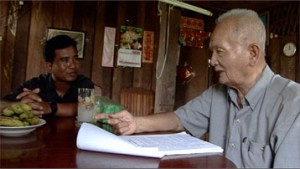
Thet Sambath interviews Nuon Chea

It is estimated that between 2 and 3 million people were killed by the Khmer Rouge before North Vietnamese troops put an end to the carnage and the regime in 1979. Unlike several other films that deal with mass atrocities (Bill Guttentag and Dan Sturman’s Nanking of 2007 being one of them), Rob Lemkin and Thet Sambath’s 2010 documentary Enemies of the People makes an attempt to answer “why?” 

The film details a multi-year journey by Phnom Penh Post writer Thet Sambath to conduct interviews with Khmer Rouge cadres and leaders, with the objective of recording on film their reminiscences of killing. Sambath’s own family was killed by the Khmer Rouge, a fact he refuses to disclose to #2 Khmer Rouge official Nuon Chea until their final interviews. As Sambath notes several times in this documentary, his aim is not to seek revenge, but to gain a better understanding of how this genocide could have occurred in the first place. Readers of books such as David Chandler’s Brother Number One: a Political Biography of Pol Pot already know many of the gruesome details, such as the fact that much of the killing was done by teenagers taking orders under threat of being killed themselves. Sambath here interviews some of these former killers, now in their 50s and 60s, who express remorse and lead him to their superiors. 

Sambath’s interviews were successful, in part, because of his respectful socializing, referring to these older individuals as “uncle,” and painstakingly gaining their trust. Eventually, after years of visiting Nuon Chea’s house in the town of Pailin, Chea begins to disclose the political reasons for killing. It was to save the country from its enemies, he states, and no individual was more important than solidifying the country. He expresses no remorse, other than feeling sorry that Sambath’s family was killed. 

The film works well on the premise of being one man’s journey to understand the truth, and leaves the grisly footage of Tuol Sleng and the killing fields to the end. Many of today’s travelers to Cambodia wish to understand more of why this cataclysmic event occurred. Enemies of the People is an important document in the written and cinematic literature, an essential one to understanding how Cambodians today deal with a war upon its own people that has had an effect on every family in Cambodia.

Of his film, Sambeth says: “Some may say no good can come from talking to killers and dwelling on past horror, but I say these people have sacrificed a lot to tell the truth. In daring to confess they have done good, perhaps the only good thing left. They and all the killers like them must be part of the process of reconciliation if my country is to move forward.”

The Good Manner: Was mummy a prostitute?

Written By: herbrunbridge - Oct• 22•10

The Good Manner: Advice on Thailand from WoWasis’ Pa Farang
This week’s dilemma: Was mummy a prostitute? 

Dear Pa Farang, 

Dad and mom were killed last year in an auto accident outside of Needles, California. He was a sergeant in the Vietnam war, and met her at a restaurant while on leave at a beach town in Thailand. They married and lived in the US, where they had me and my brother.  Mom spent most of her life taking care of dad, whose back injury kept getting worse.  She was a Buddhist, and kept a small shrine at home, but never made it back to Thailand to visit her family, although she always wanted to.  She always sent money to relatives in  a town called Bung Kan, so this year we went to Thailand to look them up. 

My new Thai family was wonderful to us, and lots of tears were shed.  We wanted to find out what mom was like as a little girl, but no one could remember much about her adolescence.  One night, we all got pretty blasted on Mekhong whiskey, and mom’s sis told us mom had worked in a bar when she met dad.  Tom (my brother) and I were horrified.  We asked everyone if this were true, but people clammed up and started arguing with my aunt, who left the party angry.  The next day, no one would say anything, including my aunt.  We’re really hurting, and need some closure on this.  I can’t believe mom would have done this (might she have been a prostitute?), and if she had, I think she would have told us, as our family communicated well.  I need our Thai relatives to open up.  What can I do to get them to talk? 

–   An American Girl in Thailand

Dear AG, 

Your mother led a tough life before meeting your dad, and he was the ray of sunshine that allowed her to drop the past.  Your aunt obviously had her own reasons for letting it slip, maybe guilt, maybe revenge.  Nevertheless, she was chastised by the family and made to lose face, which means your family served her justice on a silver platter.  Thousands of sweet, wonderful girls like your mom seek opportunity away from small villages, as did she.  They are not criminals, but are unfortunately regarded as such in your own country of the United States.  You absolutely must revise your concept of your mother’s previous occupation if you expect to gain the “closure” you so desperately seek.  You have made a good attempt to know your relatives.  Show The Good Manner by immediately stopping any attempt to get them to discuss this aspect of your mother’s life.  They lose face by discussing this, and want to remember her in a special way, as do you.  Moving forward, recognize that you have been gifted with having been born in a privileged country, and try not to judge the actions of others, in other countries, by the social standards of the United States. All countries are different. 

There is a way to get closure, and I want you to consider it.  Go to a wat, and tell the monk about your mother, her family, her life, and death.  Ask him how she, as a Buddhist, would want her untimely death resolved, according to her philosophy.  Follow the advice of the monk, who may ask you to perform certain Buddhist tasks involving making merit.  This will allow her soul to rest, a last request your mother was unable to make.  Your relatives will have already done this, and you may have already participated.  Nevertheless, you and your brother should do this alone, which will provide you with the peace you seek.  Whether you know it or not, this trip has allowed you to know your mother better.  Try to learn from her teaching, which you’re only beginning to understand, but which you will assimilate in time. 

Marayat dee, 

– Pa Farang

Read Pa Farang’s other columns for more advice on relationships and cultural matters  in Southeast Asia

Top 6 sights in Myanmar: WoWasis visits Burma, a short travelguide

Written By: herbrunbridge - Oct• 18•10
 

Welcome to Myanmar Burma!

Burma (or Myanmar, its official government name) has few equals as an exotic travel location, with hundreds of significant temples, and a lack of commercialism that most travelers find refreshing.  Getting around in Burma is not as easy as in other Southeast Asian countries, but the visitor is rewarded with fewer crowds in historical sites. If you’re not sure whether to visit or boycott Burma, read WoWasis’ short essay on the subject, then make up your own mind.    

Our top 6 favorite spots include:

1) Tthe capital of Rangoon (today’s Yangon), with its amazing golden Shwedagon Temple. Tour Yangon now!

2)  Mandalay is a fascinating city, and the jumping off point to the historical sites of Mingun Paya, Bagan, and Myauk U. Tour Mandalay now!

3) The grand and historic temple of  Mingun Paya is not to be missed. Tour Mingun Paya now!

4) For us, the historic archaeological district of Bagan is the most compelling reason to visit Myanmar. Tour Bagan now!

5) Inle Lake is marvelous, with traditional fishing craft and a relaxing atmosphere. Tour Inle Lake now! 

6) Historical Myauk U, is reached by traveling through the traditional port town of Sittwe

In addition to the WoWasis Top 6, fascinating tribal village treks can be made from the hill city of Kyaing Tong (Keng Tung) in the north.

There are three caveats important to recognize when traveling in Burma: 

1) Credit cards and travelers checks are not honored in Burma.  You must bring cash (U.S. dollars are preferable), which can easily be exchanged into kyiat at any bank, or through numerous street and market money changers.  Remember to bring more money than you think you need, as there is no easy recourse when your money runs out.

2) Many countries have restrictions on importing souvenirs from Burma.  Be sure to check your own country’s regulations to ensure your goods are not confiscated upon return.  Burma does not allow Buddha images or antiquities to be exported.

3) Burma is under military rule.  Residents and visitors alike are monitored by plainclothes police, and although Burma is a safe country, you could be questioned if you’re overheard discussing national politics.  This could also be uncomfortable for any Burmese person who discusses politics or the military with you.  If you are a reporter or writer, you will probably be denied entrance into Burma, so keep that in mind as you fill out the “occupation” field in your visa application. 

Burma is also a land of engaging, friendly people who are eager to talk with visitors.  By western standards, they are economically very poor, and even a one dollar tip is welcomed.  If you receive good service from a cyclo driver, boat pilot, or informal guide, please consider giving a small tip.  We’d encourage you to bring enough one dollar bills to spread around a bit. 

We’ve found Burma to be a great destination, extremely rewarding to those who wish to break away from timeworn itineraries.  Travel can be slow, but you’ll travel in ancient carriages, buses, and boats, and you’ll meet a great many interesting people.  Travel infrastructure does exist, you’ll find good hotels, and terrific Resort/hotel spas everywhere. 

There are a number of interesting Fiction and Non-Fiction books on Burma, which we encourage you to read prior to your arrival. 

Visas are readily obtainable from any Myanmar embassy, for two passport-sized photos and a fee, currently $20 USD.  In the Myanmar embassy in Bangkok, you fill out your paperwork, use the handy gluepot to affix your photo to the documents, pay $20, then return the next day at the pre-arranged time to pick up your visa.  Tourist visas are good for 28 days, and you must have at least six months time remaining on your passport, from the date of entry, to be allowed into the country.  You are no longer required to exchange $200 for FECs (Foreign Exchange Certificates) at the airport, upon entering Burma. 

You may also get quick on-the-spot day visas at most overland border posts.  You will be expected to leave your passport at the border crossing, and reclaim in later in the day on your return.

Air transportation 

  • International air departures
    You must confirm your outbound flight the day you intend to leave, best done at the city desk of your airline.  If not, you may find that you’ve been bumped.  You’ll be dunned a $10 exit fee before exiting Customs.  Air travelers may only depart Burma from the airport at Rangoon.
     
  • Burma’s internal airlines
    Generally, if you can catch a flight, do it, rather than taking surface transportation, which is slow in a country with poor roads and meandering waterways.  There are 20 airports in Burma that will accept jets, and approximately 40 more than have an airstrip suitable for propeller craft.  You will encounter three airlines in Burma, Yangon Airways, Air Mandalay, and Myanma Airways

Yangon Airways is the best, with a newer fleet of planes, a friendly, well-trained staff, and is generally on time.  It seems to boast a business model similar to the exceptional boutique airline of Thailand, Bangkok Airways.  Their cute smiling white elephant logo is a welcome sight for the tired traveler, who can’t wait to get to the next stop.  Yangon Airways is chartered to fly only within Burmese airspace. www.yangonair.com  

Air Mandalay isn’t much of a step down from Yangon Airways, and flies the same routes, usually on alternate days.  Air Mandalay ground staff has proven to be particularly attentive to the traveler at Mandalay Airport, even going to the trouble of contacting Yangon Airways to help a visitor get to a destination on a day Air Mandalay wasn’t flying there. Air Mandalay flies inbound from Chiang Mai to both Mandalay and Rangoon, and outbound from Rangoon to Bangkok and Chiang Mai.  www.air-mandalay.com 

Myanma Airways is run by the Burmese government.  Older aircraft and dodgy commitments to schedule tend to keep veteran travelers away, especially considering the well-run Yangon Airways and Air Mandalay fleets. 

Land transportation

  • By bus
    Buses are ubiquitous in Burma, but local buses are slow, and Burmese roads aren’t always the best.  Fast air-con buses (without toilets) run from Rangoon to Mandalay, Mawlamyaing, Meiktila, Pathein, Pyay, and Taunggyi (Inle Lake).  On these routes, the bus is faster than the train.  
  • By train
    Private train lines are faster than the government-owned Myanma Railways, but cost considerably more, and there are over 500 rail stations in Burma.  Veteran train travelers insist on the yellow-painted express trains, and eschew the slower, blue trains. 
  • By car
    Car and driver combinations are offered in all cities and most towns, and are an effective way to get to outlying destinations.  Price is negotiable, generally $20-25 per day.
    Rental cars are increasingly more available, at a rate of approximately $50 per day.  Since many roads and areas are off-limits to foreigners, be sure to ask your rental agency to draw no-go areas on your map. 
  • By boat 
    Boats go everywhere there’s a waterway to be navigated, but do take a fast boat when you can, particularly if you’re going upcurrent.  Cheaper watercraft will generally have no seats, but will give you an assigned number that corresponds to a deck space, for you and your belongings.  If you have the time to spare, Burma’s boats are wonders from the past, living history that’s still doing its job. 
  • In town
    Trishaws, or pedicabs, are the most common form of city and town transport.  Taxis are common in cities like Rangoon and Mandalay, almost always in a real state of disrepair, rusty, and commonly with broken windows.  Cities and many towns also have buses, and pick-up truck jitneys that run in-town and out-of-town routes.  Consult your hotel for stops and routes.  Horse-drawn carriages are common in country towns, and in archaeological zones, such as Bagan and Myauk U.

WoWasis visits Day, Resort, and Hotel Spas in Burma

Written By: herbrunbridge - Oct• 18•10

Burma’s spa business is growing slowly, but there are several spots, particularly in the Resort/Hotel variety, with good choices.  Day spas are beginning to appear, and we’ll keep you posted as new spas develop.  We expect the situation to evolve, and will continue to list great spas as they appear.

Day Spas

Day spas commonly offer treatments such as aromatherapy, hydrotherapy, therapeutic body  massage, body scrub, body wrap, iridology, and overall wellness programs, on a walk-in basis.  Full-service day spas are not yet common in Burma, and many visitors prefer to visit the easier-to-find Resort/hotel spas.

Day Spas in Rangoon

Eros Health and Beauty Spa
SR 22/1, Next to the Pearl Shopping Centre, Kaba Aye Pagoda Road, Bahan Township, Rangoon
+ 95-1-544297, 549527
Offering hydrotherapy, body scrub, and other services

Resort/hotel Spas in Burma

Note: for all medical procedures, remember to consult your own doctor.  WoWasis does not recommend participating in any medical procedure without first discussing the situation with a professional.  The data on this page is for informational purposes only, and does not constitute a recommendation.

Resort/Hotel spas offer professional spa services within a hotel or resort environment.  Here, you’ll typically be offered spa cuisine choices and a number of services and packages, from daily to multi-day regimens. Burma’s Resort/hotel spa business is growing, and while not as extensive as the offerings of neighboring Thailand, they do offer the amenities you’re used to, in a uniquely Burmese setting. Today, best Resort/hotel venues are located in Bagan, Mandalay, and Rangoon.

Resort/hotel spas in Bagan

Thiripyitsaya Spa
Bagan Thiripyitsaya Sakura Hotel
Bagan Archeological Zone, Old Bagan
+ 95 61 60048
www.thiripyitsaya-spa.com
This spa offers wraps, scrubs, and massage in a beautiful setting

Resort/hotel spas in Mandalay
SedonaHotel Mandalay
No. 1 Junction of 26th and 66th Street
Chanayetharzan Township, Mandalay
+ 95 2 36488
www.sedonahotels.com.sg
This small spa offers body beauty and massage treatments

Resort/hotel spas in Rangoon

Hotel Nikko Royal Lake Yangon
40, Natmauk Road, Tamwe Township, Rangoon
+95-1 544 500
www.nikkoyangon.net
Offering massage and body therapy, other spa services.

Sedona Hotel Yangon
No. 1 Kaba Aye Pagoda Road
Yankin Township, Rangoon
+ 95 1 666900
This small spa offers Thai massage, foot reflexology, and sauna
www.sedonahotels.com.sg

We will continue to update this list as we hear about new Day and Resort/hotel spas.  If you are a spa owner and wish to be listed, please contact us, and please include your website.