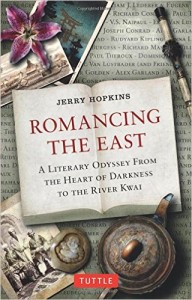
 We’re old fashioned, those of us here at WoWasis. We like books that have left room to include a few blank pages at the end. Author Jerry Hopkins, one of the more prolific writers of the last few years, has written a compelling book that lacks those blank pages. It’s called Romancing the East: A Literary Odyssey from The Heart of Darkness to The River Kwai (2013, ISBN 9787-0-8048-4320-1). If you enjoy literature on the subject of Asia, this book belongs on your bookshelf as a reference, but also will quickly go to the top of your reading stack, we’d guess
It’s a profile of 33 western authors that have made Asia their beat for a short time or a lifetime, and you’ve heard of most of them. In a total of 285 pages, Hopkins can’t say a lot about each, word-count wise. But in a very few pages, he cuts to the chase, telling wonderful, interesting short tales of some rather interesting elements of these people’s lives. Much of it centers on why they felt driven to write about Asia.
That’s where those missing blank pages come in.
Gosh, how many of us of a certain age cut our eye teeth on Sax Rohmer’s Fu Manchu stories (we still get up close and personal to the “yellow peril” each time we set foot into a bar in Bangkok’s Nana Plaza). We’d forgotten about Rohmer, whose real name, Hopkins reminds us, was Arthur Henry Ward. Somewhere way in the back of our mind, we’d forgotten how the terms “Shangri-La” and “Suzie Wong” got into the lexicon, until Hopkins reminds us of James Hilton and Richard Mason. They sit here in Hopkins’ book, close to Maugham and Orwell, Conrad and Kipling, Michener and Clavell.
What were we saying about those missing blank pages?
Oh yes. That’s for the stuff we didn’t know, that we want to dig into further, that’s forcing us to consider and read books — and authors — we’d skipped or not known about. Read a book like Hopkins’ and you’ll find references to books that you’ll want to investigate when you’re done reading this one. You have a pencil handy so you can write them down in those blank pages, because when the book’s done, you’ll refer to your notes, head down to the bookstore, and go on a buying spree. And those notes will stay in the back of the book as long as you own it, making it your own personal reference.
Armed with those notes, you’ll soon be launched into the likes of Richard Condon’s Manchurian Candidate (p. 224), now all of a sudden made tantalizing through Hopkins’ short and powerful discussion. And Trevanian/Rod Whitaker’s Shibumi (267), Barry Eisler’s Rain (269), Michel Houellebecq’s Elementary Particles (274), and V.S. Naipaul’s biography by Patrick French (279). Since you don’t have those blank pages, you have to sneak all that stuff into a tiny patch of white on page 287, along with a few extra remarks about Steve Rosse (didn’t know Hopkins knew him) and Paul Theroux (gotta watch Saint Jack again).
That’s what makes a great book, we think. The reader loves it so much that he or she is constantly taking notes regarding future actions that will occur as a result of reading the book. And with this book, it seems to occur with irritating but satisfying regularity. And it’s only irritating because those damn blank pages are missing. Thanks go to Hopkins for writing this thought-provoking and entertaining title and to Tuttle for publishing it. Also, perhaps a swift kick to the rear of the latter for not including those Few Blank Pages…
 Keith Nolan’s a hard guy to miss if you’re around the Bangkok music and writing scene. He’s at the sound board every Sunday afternoon for the jazz jam session at
 Here at WoWasis, we’ve found that most murder stories in the Thai press have real gems buried deeply inside. But even we were shocked when unnamed Thai officials invoked their interpretation of Theravada Buddhism while making a helpful suggestion to the parents of noted crime victim Hannah Witheridge. According to the
 In an event that many thought would never happen, former Tourism Authority of Thailand governor Juthamas Siriwan will be indicted for allegedly accepting Bt60 million in bribes, as reported by
 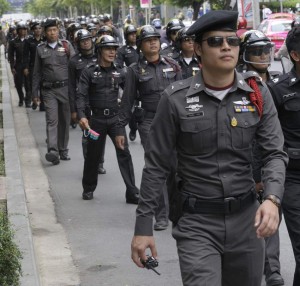 People who thought things would be easier for members of Thailand’s domestic and foreign press after the coup of May, 2014 may be re-evaluating their positions. The NCPO (National Council for Peace and Order), who now runs the government, cancelled a discussion that was to be held at Bangkok’s Foreign Correspondents’ Club (FCCT) on June 17. The topic was to be “Article 112: Its role in Thai society – A Panel Discussion about Article 112 and its role in Thai Society” (see the FCCT’s press release below).