
The sharper edge to traveling in Asia

WoWasis visits Kyaingtong (Keng Tung) Burma

Written By: herbrunbridge - Oct• 18•10

Akha woman near Kyaing Tong, Burma

Welcome to Kyaingtong (Keng Tung), a rambling hillside city in the Shan State, close to numerous tribal villages.

 It’s the center of the Khün tribal culture, filled with nice examples of colonial architecture, and has only been open to tourism since 1993.  The Khün people, whose traditional dress consists of horizontally-striped longhis and jackets with cross-ties on the side, are believed to have arrived from Thailand’s Chiang Mai area in the 13th century ACE.  Although relatively few Westerners reach Kyaingtong, many Thais from Chiang Mai visit to see remnants of the original Lanna culture, which  many feel the Khün represent. 

In Kyaingtong, you’ll want to take one or multi-day treks to outlying Akha, Ann, Lahu, Palau, Shan, and Wa villages.   Accompanied by a guide who speaks the language and knows the people, you’ll meet tribal elders, drink a glass of their local brew mixed with honey, and get to see first hand how the people live today.  Your guide will also ask you to pay for candies for children, and medicines that he’ll give to the headman (your cost for this will be under $10). 

You may also want to visit the site of Dr. Columbo’s Leper Colony, still active more than 50 years after its founding in the early 1950s. View the spectacular 1959 film The Happy City for moreon this fascinating colony. 

Kyaingtong loses its power during most of the day, a cold beer is hard to find, and nightlife is pretty much restricted to reading in bed until the lights go off. Getting to the city usually requires flying in, as the roads leading to it are often closed due to military action.  Kyaingtong is not inundated with tourists, and you’ll be rewarded by a personal travel experience that your friends lying by the pool in Rangoon will not believe. 

Highlights           

  • Treks to hillside villages are easy to arrange at your hotel, and can be done in one day, or multi-day trips, the latter of which can involve staying in a village overnight if you choose to do so.  This is the best way to see traditional village life, and in a single day’s walk you’ll end up seeing villages of several different tribal groups.  On these walks, you could see Akha, Ann, Lahu, Palau, Shan, and Wa villages, all in the same day.  Typically, each guide will carry several itineraries, and you may choose the one you prefer.  Price is generally $20 per day, and includes a jeep ride to the point at which you begin your hill walk.   

Treks are, as a rule, not arduous, and a steady pair of hiking shoes, should allow you to walk in comfort.  Your guide will tell you what to bring, and he’ll ask you to make a small donation so he can bring some medicines for the village headmen, and candy for the children.  Your guide will have established friendships with these people, your visit will be welcomed; the villagers are polite and will ask nothing of you.  

Our recommendation?  Take several one-days treks so you can return to your hotel for a beer and a shower each night.  On the other hand, veteran trekkers will want to stay in the villages for one or more nights, to sample village cuisine and hospitality.  We further recommendation is that you synch up with a guide as soon as you check in at your hotel, to help ensure that they’re not all booked for the following day.  All-in-all, tribal trekking in Burma is one of its greatest travel experiences. 

  • There are several interesting wats (temples) in Kyaingtong, including Wat Jong Kham, with its gilded spire.  In the center of town, Wat Pha Jao Lung, Wat Ho Kong, and Wat Pha Kaew, virtually across the street from each other.
               
  • In Kyaingtong you can also have the experience of seeing mountain medicine first-hand, by traveling ten kilometers out of town to the village of Naung Kan, to the Hansen’s Disease (leprosy) colony established by Father Cesare Columbo in the early 1950s.  Villagers come from hundreds of miles around to be treated here, and the hospital is designed so family members of the patients live on the grounds as well, in separate quarters. After release, patients and their families typically move to Kyaingtong. The buildings built by Columbo still stand, although the upper story of the original hospital has been condemned. Columbo’s original operating room, seen in Bill Deneen’s early 1950s film The Touch of His Hand, sits undisturbed as a testimony to his memory. 

To get there, visit the Roman Catholic Mission and Cathedral off the western road leading out of town.  Here, over 100 orphaned boys are cared for.  Explain that you’d like to visit the colony outside of town, and a visit will be arranged.  Depending on his availability, your guide may be Vicar Mario Matu, who will explain the daily life of the  patients.  When we visited, the patient population was 395, most of whom were elderly.  The youngest patient was 12 (the disease is curable if the patient is treated early enough).  

By agreement with the Burmese government, Western religion is not taught in the colony.  Since the colony operates on a shoestring, your small donation will be welcome. 

Hotels 

We found the Princess Hotel to be a friendly, accommodating place, and the desk staff recommended a great trekking guide.  The Princess offers 10 days worth of tours to various spots, and you can select your favorite(s).  Lodging price is roughly $30 per night.

Princess Hotel
No. 21, Zaydankalay Road
Tel: +(95) 84-21319
Fax: +(95) 84-21159 

Getting to Kyaingtong is best done by air, and both Yangon Airways and Air Mandalay fly there from Rangoon, for a fare of roughly $140. They also fly from Mandalay, by way of Heho (Inle Lake).   The airport closes every now and then depending on the military situation in the area, so if you intend on traveling to Kyaingtong, we recommend you arrange your trip as soon as you arrive in Burma. 

Yes, there is a road that runs north from Thailand, beginning in Burma in the town of Tachileik.  It’s seven hours of testy dirt track and, if it’s open, will cost you $10-20, depending on the form of wheeled transportation available. 

The road from Taunggyi to Kyaintong periodically opens to non-Burmese travelers, but closes again just as fast.  When open, convoys are recommended due to the presence of armed dacoits (robbers).
WoWasis’ Burma Non-Fiction Bookshelf

Written By: herbrunbridge - Oct• 18•10

(see also WoWasis’ Burma Fiction bookshelf)

The exoticism of Burma has been well-documented in fact and fiction.  Well-known writers such as George Orwell have based their novels on Burmese political and cultural life, while a number of non-fiction writers have investigated Burmese topics ranging from the flora and fauna of the country to its complex and fascinating history.  Travelers contemplating a visit to Burma will find their visits enhanced by reading about the nation beforehand, and investigating its political history from WWII onward is de rigueur.

Due to the dearth of bookstores in Burma, readers are advised to buy and read their books before traveling.  While historical novels such as Orwell’s Burmese Days can be found in-country, they will generally be locally-made photocopies.

Warning: the carrying of any books or literature perceived to be critical of the present political régime may be grounds for expulsion from the country, and/or result in an uncomfortable interview with the authorities.

Non-Fiction books on Burma

It’s easy to be impressed by the richness of Burma’s arts and crafts traditions, and two books in particular stand out from both a scholarly and design perspective.  Any visitor contemplating buying old lacquerware could do worse than read both, as they provide keen examples of the best.

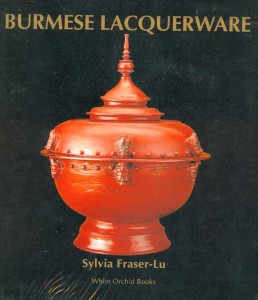
Lacquer expert Sylvia Fraser-Lu has been writing on the subject for two decades, and her Burmese Lacquerware (2000, ISBN 974-8304-82-5) has wonderful photos, a fine explanation as to how lacquerware is made, and tips on where to buy.  Her discussion of Bagan lacquerware shops is of particular interest.

Ralph Isaacs and T. Richard Blurton have written Visions from the Golden Land: Burma and the Art of Lacquer (2000, ISBN 1-878529-69-2), another wonderful book on lacquerware, with some particularly fine examples of hsun-ok (bowls to carry food alms to monks.

The Golden Triangle area of Burma, Thailand, and Laos is incredibly rich in Tribal culture, jewelry, crafts, and clothing.  Paul and Elaine Lewis’ Peoples of the Golden Triangle (1984, ISBN 974-8225-42-9) is a wonderfully written and photographed book, and photographically one of the most compelling we’ve yet seen.

Richard K. Diran’s large-format photo essay, The Vanishing Tribes of Burma (1997, ISBN 1-84188-032-9) has exceptionally beautiful photos of people from thirty-one of Burma’s tribal groups. 

Burmese marionette puppets can be seen throughout the country, in shows and shops.  Author Ma Thanegi has written an extremely informative book, The Illusion of Life (1994, ISBN 974-8299-61-9) on the history and culture of these figures. Thanegi describes the different characters, their construction, history, and profiles of famous Burmese puppeteers. 

Pamela Gutman provides a nice history of Burma’s old realms along the Bay of Bengal in Burma’s Lost Kingdoms: Splendours of Arakan (2001, ISBN 974-8304-98-1).  Included is a map of Myauk U, accompanied by Zaw Min Yu’s splendid photographs. 

Alan Rabinowitz’ struggle to establish a successful wildlife sanctuary in Burma is richly detailed in a fascinating first-person narrative Beyond the Last Village: a Journey of Discovery in Asia’s Forbidden Wilderness (2001, ISBN 1-55963-799-4).  The book amalgamates adventure, conservation theory, and political process, and is essential reading for anyone interested in flora and fauna conservation in developing nations.

To a large extent, the study of Burmese politics is a study of its military. Timothy Syrota’s sardonic Welcome to Burma (and Enjoy the Totalitarian Experience) (2001. ISBN 974-524-00807) discusses the relationship between the Burmese military and its citizens, and offers insights into day-to-day life in today’s Burma.  We found his explanation of the relationship between the Burmese Army, the Shan State Army, and the United Wa State Army to be informative.

For a more scholarly approach to Burma’s recent military history, Christina Fink’s Living Silence: Burma Under Military Rule (2001, ISBN 974-7534-68-1) is highly recommended.

Nearly 60 years after George Orwell’s Burma adventures, writer Emma Larkin retraced his steps in Secret Histories: Finding George Orwell in a Burmese Teashop (2004, ISBN 0-7195-5699-6).  This will be of interest mostly to Orwell enthusiasts, as Larkin’s observations on the modern Burmese social and political situation have been better covered in other books.

Mike Tucker is an author who patrolled with the Karen National Liberation Army. His The Long Patrol: with Karen Guerillas in Burma (2003, ISBN 974-8303-79-9) offers an insider’s view of the political perspectives of, and military skirmishes between the guerillas and the Burmese Army.

Inge Sargent, an Austrian who now lives in the U.S., was a Shan princess who, as Thusandi, Mahadevi of Hsipaw, was married to Sao Kya Seng, Prince of Hsipaw.  In Twilight Over Burma: My Life as a Shan Princess (1994, ISBN 974-7100-61-4) she details her life in Burma, the death of her husband, and her flight under duress.  Although the book meanders, it serves as a good introduction to the Shan way of life, as seen by Hsipaw’s last ruling family.

WoWasis’ Burma Bookshelf: Fiction

Written By: herbrunbridge - Oct• 18•10

(see also WoWasis’ Burma Non-Fiction bookshelf)

The exoticism of Burma has been well-documented in fact and fiction.  Well-known writers such as George Orwell have based their novels on Burmese political and cultural life, while a number of non-fiction writers have investigated Burmese topics ranging from the flora and fauna of the country to its complex and fascinating history.  Travelers contemplating a visit to Burma will find their visits enhanced by reading about the nation beforehand, and investigating its political history from WWII onward is de rigueur.

Due to the dearth of bookstores in Burma, readers are advised to buy and read their books before traveling.  While historical novels such as Orwell’s Burmese Days can be found in-country, they will generally be locally-made photocopies.

Warning: the carrying of any books or literature perceived to be critical of the present political régime may be grounds for expulsion from the country, and/or result in an uncomfortable interview with the authorities.

Fiction on Burma

The drug trade emanating from the Golden Triangle is one of the several fascinating sub-plots of Geoffrey Archer’s The Burma Legacy (2002, ISBN 0-7126-82961), which also describes events relating to the incursion of the Japanese in World War Two.  Set in modern times, Archer’s protagonists are British and Australian government agents attempting to thwart a revenge killing that threatens to economically destabilize an international agreement. 

George Orwell’s classic Burmese Days (1934, ISBN 014-0004-564) is set in the days of the British Empire, and weaves the tale of a Western timber merchant’s life amidst the corruption and intrigue of colonial Burma.  Orwell is a keen observer of the complexities in the juxtaposition of native and imperialist cultures.

Daniel Mason’s well-crafted The Piano Tuner (2002, ISBN 1-4000-3038-2) is set in British colonial times, and offers some interesting insight into Shan-Burmese relations.  The first 100 or so pages are tough-going, but the book eventually becomes a fascinating study of individual character and interpersonal relationships.

Alex O’Brien’s Midnight in Burma (2001, ISBN 974-8303-58-6) relates the story of an international lawyer’s plunge into the dangerous world of drugs and intrigue, driven by his fascination with a beautiful, intelligent stranger, and his investigation into her disappearance.

Primarily a writer of Bangkok Fiction, Christopher G. Moore has penned a novel based in Burma, Waiting for the Lady (2003, ISBN 974-90755-6-0), in which a “part-time art dealer and full-time rogue” finds himself in possession of a camera containing pictures of Aung San Suu Kyi, and develops a passion for finding the history of the camera’s owner.

British author Col Cotterill’s background includes stints with child protection agencies on Southeast Asia, which clearly shows through in Evil in the Land Without (2003, ISBN 974-8303-70-5).  With action taking place primarily in England and the Karen border area of Burma and Thailand, Cotterill details the workings of an international crime ring focusing on children.  The book is well-written, although we would have liked to have seen an ending perhaps a little less pat.

Bachelor in Bangkok: Khun Lee’s 10 rules for being a bar girl

Written By: herbrunbridge - Oct• 15•10

When I first started writing this column I explored the top ten rules for dealing with regular gals as well as a top ten for surviving with bar gals.  I received a lot of positive feedback from both readers and close mates of mine who have to be constantly bombarded by my rants and unsolicited opinions. Since I live in an area surrounded by bar gals who are plying their trade (much like Louis Armstrong and Vincent Van Gogh did) I am often privy to the way these gals think and act.  So if you were ever curious about how the other side thinks, here comes Khun Nana’s top ten rules for being a bar gal: 

1) The Golden Rule is to make the most money while doing the least amount of work.  Yes, I know that most of you are thinking that this is rule number one for anyone working any job. You would be right! The gals are no different. They all want money and most are generally very lazy (I can relate) so maximum income for minimum effort is the key.  Guys who send money from abroad are the Holy Grail. Huge money for virtually no effort. Ever wonder why they always ask what hotel you are staying at?  There are two reasons for this. First is to set the price, as punters staying in four or five star hotels will definitely be charged more. Just as important is that they want to know how far it is to your place. Guys staying two minutes away are much more desirable than guys staying across town. If you are willing to use the short time room that is 50 feet away you are a dream come true. 

2) Try to have fun. Thai gals are fun loving and easily bored, so it is very important for them to have at least some fun while making money. Many gals will quit a job that they consider no fun (“mai sanuk” in Thai) even if it is the 28th of the month and they have no money for next month’s rent!  This may seem insane to us responsible foreigners, but believe me when I tell you that the biggest insult you can receive in this country is to be labeled “mai sanuk.” Most gals have chosen the venue that they work in because they have at least one friend there. Often if the friend quits or moves to another bar, the gal in question will move on with her. What fun will it be to work in a bar with no friends?  

3) Never ever ever ever say you have a boyfriend! They all realize that they are not just selling their bodies, but are also selling a fantasy to the customer. I wish I had one baht for every gal I have heard say “I no have boyfriend. Thai man no good.” They may have a steady Thai boyfriend, several Thai lovers, four western guys sending money every month and dozens of customers, but they will absolutely tell you that they are unattached.  This also works in reverse. Many of the customers are married or have a girlfriend but very few ever talk about it when meeting new gals. 

4) Seize every opportunity to benefit financially from the time spent with a customer.  Receiving clothes, jewelry, mobile phones, etc. will all increase the bottom line. The customer really should be prepared for this one. If you go to a tailor shop to buy a shirt, he is going to attempt to sell you suits, shoes, etc. It’s his job. One of my favorite gals always says “my job to ask, your job to say no.” 

5) Collect phone numbers and email addresses from every customer even if he only bought you a cola. I don’t need to tell you the HUGE reward that comes from sending out 357 emails and 642 sms messages requesting money. Just a one or two percent response rate and bills are paid for the month. One gal joked with me “my Mom is sick and the buffalo died, or the buffalo is sick and my Mom died, can’t remember which one but it’s really bad!” 

6) Learn to put your mind away in a separate place. Whether the gal is bored, tired, listening to a punter drone on and on about his pathetic life, staring at the ceiling while a stranger has his way with her, or perhaps just not in the mood to work, it is essential to be able to separate the mind from the body.  I once asked a gal what she thought about when she was making love with a strange man. Her response was “I think about how I am just about to walk out of there with xxx baht in my hand. And what I am going to buy with that money.” 

7) Always say to the customer that the reason you are working in the bar is to help out your desperately poor family.  Some gals actually do send some money home.  Some give it away to their Thai boyfriends.  Many others just blow their money on the latest fashions and mobile phones. Regardless, everyone must learn to say the following: “I no have boyfriend. I no like Thai man. Thai man no good. I no like work in bar but need money to send to family.” No gal will be allowed to work in the bar until she memorizes that script. 

8) Learn to prey on the emotional weaknesses of Western men. You must learn how to make customers feel lust, guilt, responsibility, jealousy, and a myriad of other emotions. This isn’t that easy, as no Thai man would ever fall for the silly little games that come from this, but many (certainly not all) Western men are unequipped to handle these games. One of my best mates likes to say (when referring to Western customers dealing with Thai bar gals) that “the gals have the home field advantage and many of us don’t even know the rules to this game.” 

9) Don’t trust all the other gals in the bar. Yes friends, they lie, cheat and steal from each other as much (if not more so) than they do with customers. One more reason it is so important to have at least one true blue friend in the bar. There is no such word as “LOAN” in the bar gal dictionary. It was not a loan, it was a gift. 

10) Always accompany the customer to the airport. Guys are so emotional when they must leave Paradise that they are known to lavish gals with money and gifts while waiting for the plane to antisepticville. I was in G-Spot in Nana Plaza one night when a gal came in and started throwing bank notes around the bar and the whole place went nuts.  She later told me that her customer gave all of his local currency to her while he cried at the airport. It was over 76,000 baht. 

Until next time have fun and be happy!!!! 

Read Khun Lee’s other WoWasis columns for more advice on navigating the adult dating scene through the backstreets of Bangkok

The Good Manner: Lost Motorbike, or is my Thai girlfriend cheating me?

Written By: herbrunbridge - Oct• 09•10

The Good Manner: Advice on Thailand from WoWasis’ Pa Farang
This week’s dilemma: The Lost Motorbike: is my Thai girlfriend cheating me?

 Dear Pa Farang, 

I am a pensioner living in Krabi, enjoying a bit of the good life after many a cold winter in Manchester. Last year, a met a charming girl in her early twenties, a sweetheart who does the little things like caring for my laundry (I’m a semi-invalid). Several months ago, she asked if I’d buy her a motorcycle, so she could run the occasional errand for me. I thought this a splendid idea, and we bought a spanking new one. Recently, whilst she was away visiting her family in Surat Thani, her bike encountered motor problems, and she arrived back in Krabi by bus. She’s told me that her brother is a fine mechanic, but it’s been several weeks since it’s been at his place for repairs, and he hasn’t seemed to have gotten the hang of fixing the thing. 

Earlier this week, my girlfriend proposed that she take motorcar-driving lessons. We don’t have a car, but, after putting our heads together, thought that if we got her an inexpensive used vehicle, she’d be able to take me around down a bit better, and spirit me away for the occasional country holiday. My problem is that the blokes have been winding me up a bit about this, and have chided me about the gold necklace I bought her last year, which she unfortunately lost when it was nicked from her neck at a market whist she was out shopping for me one day.  Their feeling is that I spend too much money on the girl, and that the motorbike is gone for good. None of these gentlemen, I might add, has a steady girlfriend, and methinks, their opinions may be coloured by jealousy. Really now, this last idea about the motorcar does seem like a good one.  Any advice would be welcome. 

–  Driven to Question, but not yet to Drink

Dear DQ, 

I think you should listen to your girl, but only if you’re considering investing in a used vehicle business in Surat Thani.  Your motorcycle is being happily ridden by a member of her family, or her Surat boyfriend.  This individual has now ordered a car, and your girlfriend has provided you with the requisition form.  Don’t be surprised if, on second thought, she prefers a pickup truck, gently suggesting that it will be easier to place your wheelchair in its bed, rather than in the back seat of a car.  Country boys prefer pickups to cars.  

Your friends are providing you good counsel, and, in running the risk of offending a good friend, are showing you The Good Manner, better certainly than the gamblers who now own the necklace you bought for your girlfriend. I would find some excuses to spend more time with your friends, and ease her out of your life. This may not be easy, as you’re a proven meal ticket. Your friends can advise you on how to do this, and you’ll soon find another girl who will be better worth your time. Ultimately, if you do not break the bonds, the only wheels you’ll end up with are the ones on your wheelchair, unless, of course, your girlfriend has a younger brother at home building a go-cart for you to finance. 

Mariyat dee,
– Pa Farang

Read Pa Farang’s other columns for more advice on relationships and cultural matters  in Southeast Asia

Bachelor in Bangkok: Khun Lee on Bangkok nightlife today vs. 1995, Pt. II

Written By: herbrunbridge - Oct• 03•10

Greetings to our loyal readers and I hope you are enjoying this blessing we call life as much as I am. In my August, 2010 column, I compared 1995 Bangkok to present day and detailed the changes in the nightlife industry.  This month, I want to compare changes in cost, livability, transportation and relationships with “good gals.” Then I will throw in an entertaining story or two of every day life here in Paradise. 

Much like everywhere else in the world, costs are rising in Bangkok. Even more so for those who insist on only living, eating and partying in places set up to serve foreigners.  It is really quite simple. The average Thai makes about 7000 baht a month and the average foreigner around ten times that.  Many foreigners make (and somehow find a way to spend) twenty or thirty times that amount. We are therefore willing and able to pay much more for basic services. Apartments in lower Sukumvit (a popular area for foreigners to reside) average about 30,000 baht for a modest place, while a Thai would pay 2500 to 4000 for his place. Thai food on the street costs 30 baht, but 150 baht in a restaurant catering to foreigners. It probably won’t taste as good!  The lesson is simple. Try to branch out a little and enjoy the “real” Bangkok and you will spend far less and probably enjoy life a lot more. See some of my earlier archived columns for suggestions. In addition, the US dollar is very weak at the moment which has hurt purchasing power for many. It seems weak at 30 baht to the dollar, but when I came here in 1995 it was 25 baht to the dollar! Let’s hope it doesn’t get back to those “good old days!” 

Livability has improved ten fold.  I manage my entire financial life on the internet now.  Impossible in 1995.  The entire range of services from ATM machines, laundromats, maid service, great restaurants, bookstores, shopping malls etc. has improved so much that I feel like I am living in a different city.  Bangkok 1995 was a little like the Wild West!  Every little thing that needed to be done was a minor (or major) challenge.  I feel a little nostalgic when recalling those first few years as even the most simple errand often turned into a debacle!  I guess I don’t miss it that much! 

Transportation is excellent and VERY inexpensive. The most significant change is the rail system. The BTS and MRT are cheap, clean, air-conditioned, and go to many of the most important points in Bangkok.  The trains are also full of some of the best eye candy on the planet!  To demonstrate how the rail system has completely transformed the city I would like to offer the following example: in 1995 I stayed in Siam Square and met a friend who worked nearby.  She offered to meet me on her day off and gave me directions to her home in Ekamai, which is about 10 kilometers distance.  I boarded a taxi at NON-RUSH HOUR and it was a horrific 1 hour and 40 minute ride!  I thought I would fry in that taxi for sure.  Today, I reach Ekamai from Siam Square in 14 minutes on the BTS!  

One absolutely HUGE change from 1995 to present is the situation involving foreign men and the “good gals.” In 1995 I was obviously 13 years younger, quite a bit more handsome (or less homely depending on your view) and a lot more reckless in my spending habits to say the least.  However it was quite difficult to get dates with the local lasses as the perception at the time was that only “bad girls” would be seen with a lowly foreigner and the normal gals were very shy about being seen with us.  I must admit it was not just my own situation.  I very rarely saw Thai gals and foreigners together outside of the nightlife areas in those days.  Today the situation has improved dramatically.  Thai ladies from virtually every segment of society are open to meeting foreign men and some (a somewhat smaller percentage) actually prefer foreigners.  

Ooooohhhhh baby it’s so good to be a single guy in Bangkok today! 

Somewhere out there is a German gentleman who owes his life to the fact that I am one of the horniest cats on the planet!  Last week I was walking up Sukumvit soi 4 at 3AM  and there was the usual mob scene of night crawlers out and about.  By chance I happened to glance quickly to my right and this guy was drunk and falling from the sidewalk onto the street, right in the path of a speeding taxi! I swung around 270 degrees and just managed to grasp his wrist and pull him up from a certain death.  He was literally 1/10th of a second from being run over by this taxi.  It was so close that he was in shock and couldn’t speak for thirty seconds or so.  Then the horrified taxi driver pulled over and walked back to make sure all was OK and they both just stood there in shock staring at each other.  The driver then went about his business and this lucky gentleman with a very thick German accent hugged me five times and kept repeating “thank you, thank you, thank you, Oh my God thank you.”  The next day I returned to the scene and realized that if I tried that rescue 100 times I probably would have been successful in grasping his arm maybe five percent of the time.  It was truly luck.  Or was it??  At 3am I am nearly always in bed and if I am still out I would not have been SOBER enough to have pulled off that maneuver.  Why was I sober that night?  Oh yeah…..I ran into a HOT Thai gal I have had a crush on for years and spent three hours chatting her up instead of my usual beer drinking antics with my mates.  Make no mistake about it my fortunate German friend; you are alive today because I am one hopelessly horny individual!

Read Khun Lee’s other WoWasis columns for more advice on navigating the adult dating scene through the backstreets of Bangkok

WoWasis book review: ‘Yakuza: The Explosive Account of Japan’s Criminal Underworld’

Written By: herbrunbridge - Oct• 03•10

If you’re looking for a comprehensive book that provides great insight on Yakuaza business, history, culture, scams, players, this book is it, even though it was first published in 1986. Where it falls short is in the area of Yakuza and prostitution, where frankly, it has a lot of it wrong. We’ll explain why, but let’s talk about the good stuff first. 

David E. Kaplan and Alec Dubro’s Yakuza: The Explosive Account of Japan’s Criminal Underworld (1986, 0-356-14226-4) is best when it details the hidden world of this very disparate group of often loosely-aligned criminal organization. Fascinating cultural elements include the Yakuza’s relationship with police (they’ve positioned themselves as municipal peacekeepers), Yakuza internal magazines, and the Yakuza film genre (naturally, they control it). The chapters on scams were wonderful, and display a creativity on the part of Yakuza that’s amazing. Gift-giving, loan sharking, and disrupting shareholders meetings (or extorting corporate money to shut-up share-holding protestors) were our personal favorites. The Yakuza have all this down to an art form. 

Where we highly disagree with this book is mainly found in the chapter entitled ‘The Yakuza and Sexual Slavery.’ Here, the authors derive much of their information from Christian organizations, and the writing of Feminist author Kathleen Barry all of whom find “slavery” in virtually every venue in which money is exchanged for sex. Western Feminists and Christian groups are noted for their positions of moral colonialism when it come to sex in the East, and Kaplan and Dubro fail to offer any mention of the bias inherent in these groups. And it’s a poor position to take, as it infers that any man availing himself of women in sexual venues pro forma supports slavery. 

Here at WoWasis, we’ve known women who worked as entertainers at establishments run by Yakuza. Yes they had sex with men. Yes, they were paid. And yes, they walked away, and were complimentary of their hosts. One such ‘victim’ amassed a small fortune through this trade in Japan, then returned to her home country 15 years later, talking about her wonderful experiences in the country. The authors of the book, if they indeed did interview women who had worked in the business, certainly didn’t report the story. 

That’s an important caveat. The rest of the book, however, relays meaningful and interesting information about this fascinating yet little understood (in the West, that is) underworld group. Together with Martin Booth’s The Dragon Syndicates: The Global Phenomenon of the Triads, it serves as one-half of a nice couple of important library bookends to anyone desiring a greater knowledge of two of Asia’s most important and influential underworld organizations. Buy it now at the WoWasis estore, powered by Amazon.

The Good Manner: Should I pay a dowry for my Thai wife?

Written By: herbrunbridge - Sep• 23•10

The Good Manner: Advice on Thailand from WoWasis’ Pa Farang
This week’s dilemma: Should I pay a dowry for my Thai wife? 

Note from Pa Farang:  This week, I have received two letters that deal with two sides of the same coin.  They appear consecutively, as they are thematically intertwined. 

Dear Pa Farang, 

My lovely Thai girlfriend, who I want to marry, has just dropped a bomb on me.  Her upcountry daddy wants me to pay a dowry!  I’ve been told I’m supposed to pay up, but it will be returned, as it’s just a way to gain face.  I calculated it out, and the damn family wants $1000!  What gives here, I thought this stuff went out with the Middle Ages?  Please answer quickly, as there’s bad blood brewing.

–   Didn’t just fall off the apple cart 

Dear AC, 

In fact, the dowry, known as Sin Sot, has never gone out of fashion in Thailand.  Traditionally, the groom (or the groom’s family) pays a price for removing a wage earner or farm laborer (your girlfriend, in this case), from the home of her parents.  They will therefore be deprived of the fruits of her labor, and will expect to be compensated.  Yes, there is a face issue here.  If you pay nothing, you are “keeniow”, or cheap.  This reflects badly on the girl’s choice of a husband, and demeans the status of her family in the village. To keep harmony, and perhaps even to save the marriage, you should show The Good Manner and agree to pay something, and don’t expect to get this gift back.  The question is how much.  As a westerner, you should pay more than a simple Thai farmer, but you don’t want to give the impression that you’re a soft touch either.  I think if you pay somewhere between 5,000 and 10,000 baht ($150-$300 USD), you should be perceived as a good guy, making your future wife happy, and your future in-laws satisfied that you’re amenable to doing things the Thai way. Tell your girlfriend that this is what you’ll give.  Most Thais are fair, and will respect this amount.  If you’re met with resistance, don’t let her stories of the vast amounts other farang have allegedly paid sway you.  If you love the girl, stick to your guns.  This sets the stage for other discussions involving money, so this is your opportunity to gain the respect you’ll need to have as your marriage moves forward.  If the caterwauling continues, you’re looking through a telescope into your future, my friend: consider whether you’re being married for love or money.  It most assuredly won’t be both. 

Marayat dee, Pa Farang 

Dear Pa Farang, 

I’m considering how much to pay as Sin Sot to marry Sasitorn, my girlfriend.  Here’s the deal.  I’ve grown to love her family very much.  They’re dirt poor, work hard, and always make me feel welcome. They’ve treated their daughter with love and respect, and frankly, her family is a lot nicer than mine is. It would give me a great deal of joy to set them up for life.  Since I sold my business, I’ve had more than a couple of nickels to rub together.   I figure $31,000 US [1 million baht] would do the job nicely. They’d be able to build a modern house, and live comfortably for the rest of their lives. Now, my best Thai friend’s brother is a monk, and when I told him the idea, he cautioned against that amount, saying it would upset the balance in the village, and perhaps cause trouble for my in-laws.  I’m not sure I quite understand what he’s getting at, but I don’t want to do something stupid.  What’s your take on this? 

–   Daddy Angel 

Dear DA, 

The monk is giving you good council.  Without appearing so arrogant as to attempt to read his mind, I’m going to make a guess as to what’s going on.  After you read my response, ask the monk again for his reasoning, as I’ll bet I’m not too far off.  In the village, there’s a fellow we call “poo-yai baan”, or the village headman. This is an elected position, it commands respect, and this individual sees to the general welfare of the village. He makes requests to higher-ups regarding services the village needs, from roads to medicine. He also brings in the local vote for politicians further up the chain.

Your generous donation might conceivably make your relatives visibly the wealthiest people in the village. This puts them in a “poo-yai” status of their own.  People would come to them for money, and they’d be hard-put to turn anyone down. As a result, the status of the formally elected “poo-yai baan” would be diminished. He might get jealous, and cause some real trouble for your nice in-laws. Your generous relatives will conceivably not give an amount tantamount to what some individuals in the village might ask for. Such individuals might bear a grudge, and cause trouble, or worse, team up with a vindictive “poo-yai baan” to harass your girl’s people. In some such cases, a drug charge is trumped up against the girl’s brother, and local authorities will demand a large bribe to drop charges. The monk’s aware of this.  Westerners can be unaware that their generosity can breed more contempt than love, and you’re getting some good advice.  

Here’s what I’d do.  You’re the beneficiary of knowing a monk, so show The Good Manner by asking him what amount he’d consider wise.  Heed his advice.  If your amount is questioned (it probably won’t be, if your father in law is as nice as you say he is), mention that you consulted with the monk, and are giving the proper amount based on his guidance.  No Thai will disrespect the good counsel of a monk.  In doing this, you will have honored your Thai friend, and gained the respect of the girl and her family as one who recognizes the wisdom of ancient customs.  The ‘poo-yai baan’ will act favorably to the family, and others won’t be overtly envious.  Continue to support your new family, doing it a step at a time, and don’t forget to be a bit generous to the wat to which your friend’s brother belongs. 

Marayat dee, Pa Farang 

Read Pa Farang’s other columns for more advice on relationships and cultural matters  in Southeast Asia

WoWasis book review: Martin Booth’s ‘The Dragon Syndicates’

Written By: herbrunbridge - Sep• 23•10

If, like those of us here at WoWasis, you’re a veteran traveler in SE Asia, you’ve done business with the Triads, the underworld syndicates that have their hands in businesses ranging from noodle shops, to food carts, to politics. That goes for some Western cities too, including London, New York, and cities in the San Francisco Bay Area. Martin Booth has done a wonderful job of laying it all out in The Dragon Syndicates: The Global Phenomenon of the Triads (1999, ISBN 0-7867-0735-6).   

Here, he provides a history of the Triads from ancient times, and discusses their rituals and important figures, such as Big-eared Du and Pockmarked Huang. Noted political figures such as Sun Yat-sen and Chiang Kai-shek have been intimately involved with the Triads. The movement crosses continents, doing business in virtually every corner of the globe with a significant Chinese population, focusing on legitimate businesses as well as those proscribed by law. 

Some of the most fascinating elements of the book detail a plethora of business frauds perpetrated by the Triads, including phony luxury goods (and some not so phony, being made in the same factories as the “originals”) and substituting salt for sand in construction projects using concrete. 

This book is especially critical for Westerners doing business in Asia, as it explains the machinations behind the scenes that often control pricing and distribution elements, politics, and human business connections. In the West, it’s an old adage that “you can’t fight city hall.” To a very great extent, as Booth suggests, that would apply when dealing with the Triads as well. Buy it now from the WoWasis eStore.

Bachelor in Bangkok: Khun Lee’s tips on living modestly while the Thai baht rises in value

Written By: herbrunbridge - Sep• 18•10

The world economy seems to be slowing down and the U.S. is especially weak.  The U.S. dollar has recently weakened significantly against the Thai baht. This has had a major impact on many people including those of us living in Paradise. Most of my money is invested in the U.S., and many of my mates either have their money there, or are working at a job where they are being paid in dollars.  The British pound has also weakened against the baht recently.  Well, Khun Nana is here to tell you that some major sacrifices are taking place in light of these most sobering recent events.  

Chatting with an American friend over a cold brew at Lucky Luke’s beer bar in Nana Plaza last night reminded me of just how severely some locals are being impacted.  My mate Big Earl and I were relaxing, watching the parade of lovelies come and go from their nightly “duties” and enjoying the attention of the gals we had sitting on our respective laps. Earl began telling me of the many recent sacrifices he has had to make because of his weakened financial position.  Not only is he an American and therefore feeling very poor when cashing in his dollars for baht, but he also retired from a somewhat modest position and really is on a very meager budget to begin with.  I must say I was shocked and horrified by the extreme measures he has had to take in order to live on his recently reduced income.  

With a sober expression Earl said “mate, I have had to cut back from 4 full-time girlfriends down to only 3.”  I wasn’t really feeling a lot of sympathy.  After all, Earl is 57 and overweight, and all 4 of his ladies are under 25 and drop dead gorgeous.  He could be doing worse.  However, the tale turned even uglier. “It’s not just that.  I can survive on 3 ladies for a while since I also short-time a couple newbies a week out of the Plaza to break the monotony,  and also go to that massage place on Ratchada for a soapy and roll in the hay every week.  The worst part is that I have had to give up my daily 2 hour massage!”    

I gasped upon hearing this terrible news.  It’s alright to make certain sacrifices, but a daily massage is a birthright for heaven’s sake.  Earl continued on “well I didn’t really give up the massage.  I just used to pay double the cost of the massage in order for the gal to come to my room.  Now I have to get dressed and walk all the way around the corner from my apartment and receive my massage at the shop.”  This guy really is hurting.  I offered to buy him a cold beer to help soothe the pain.  “Mate, if things get any worse, I am going to have to make the ULTIMATE sacrifice.” I cringed upon thinking that he was referring to returning to America to work.  “Yes mate, if push comes to shove I may have to fire my maid and clean my own room!”  

Now I want to say to all my readers and friends across this great planet, no matter how tough life may seem at times, just remember the extreme hardship that my mate Big Earl is suffering through.  My deepest sympathies go out to my mate Big Earl.  Keep your chin up, things can only get better.

 I was watching the excellent film “Memoirs of a Geisha” the other day and there was one scene in particular that reminded me so much of the naughty nightlife in Bangkok.  A young girl of perhaps 7 years of age has been given to a Geisha house when her parents are just too poor to feed her.  This takes place in 1930’s Japan but the scene was just so much like one that must play out in Thailand hundreds of times a month, although I would say with somewhat older girls these days.  This girl has no idea why she is there or what she is there to do.  At the moment she is down on her hands and knees and scrubbing the floor and basically working her fingers to the bone like some sort of indentured slave.  She is chatting with a slightly older girl (perhaps 10 years of age) and the older gal says “if you are lucky, when you are older mama will train you to be a Geisha.”  She responds “what does a Geisha do?” without even looking up from her chores.  The older gal says “They drink sake and sleep till noon!”  The little 7 year old lass stops in her tracks and looks up with amazement.  It is such a precious moment.  Of course, in Bangkok bar gals drink whiskey and sleep till 5pm! 

QUOTE OF THE WEEK comes from my mate Len who lives in Bangkok but originally hails from Arizona.  “Never in my life have I seen so many guys fall for gals who are transparently predatory.”  Yes, some guys must enjoy the pain.  My mates and I enjoy the nice girls more, but to each his own. 

I have another great quote which I heard from a stranger while watching the parade of beauties file into Nana Plaza this week.  When he commented on one gal and I was forced to tell him it was a Katoey (lady boy) he said “any place in my country that guy would be the best looking gal in the room.” 

It’s getting hotter and hotter in Bangkok and you know what that means?  It means in a month or so high season will be over and all of us will suddenly become much, much handsomer!  I can’t wait!

Read Khun Lee’s other WoWasis columns for more advice on navigating the adult dating scene through the backstreets of Bangkok