The sharper edge to traveling in Asia

Did that Thai girl bewitch me with love magic?

Written By: herbrunbridge - Oct• 26•11

The Good Manner: Advice on Thailand from WoWasis’ Pa Farang
Today’s question: Did that Thai girl bewitch me with love magic?

Dear Pa Farang, 

A little over a year ago I entered into a relationship with a beautiful lady from Isaan, during a visit a few days before leaving to go back to Afghanistan she asked me to buy her a gold bracelet, it was a simple bracelet with a small gold heart and cost just a little under 5k baht, she also asked for a T-shirt of mine. As a few months past due to my work and my time away from Thailand, she found someone that was more suitable and more open to marriage than I was. They married, however she comes to visit me when I come to Thailand if we are there at the same time and sends emails to me on a consistent basis, I don’t try to contact her because she’s married, but why can’t I stop thinking of her, she told me that the bracelet would always make me come back to her, and it seems that it does…

–          Jon

Dear Jon,

Whether or not we in the West believe in love charms, many Thais do. Here’s what a good friend said when he told his Thai wife about your letter: “she calls these sorts of love charms a mild form of s’nae (short ‘s’ sound). Heavy duty s’nae happens when the lady foists a love charm that prevents her target from ever saying ‘no,’ e.g., when she asks for a gold necklace, etc.” That’s a pretty important — and potentially expensive —  “etc.,” so Jon, at 5K baht plus a T-shirt, the lady thinks you got off cheap!

Love and luck amulets abound in Thailand, as does belief in superstitions and ghosts (read about Krasue, she’s not a nice ghost, trust me on this one). But “love magic” isn’t just confined to the East. I remember reading a while back that traditional French women would sleep with an apple in one of their armpits overnight, then feed it to the object of their affections the next day, in hope of winning his love (I’d rather pay the 5K baht).

It sounds like you were good to her, and she’ll never forget you, hence any kind of magic she can acquire to keep you remembering, she will. You mentioned that “due to my work and my time away from Thailand, she found someone that was more suitable and more open to marriage than I was.” She realizes you have a good heart, weren’t BSing her, and if she’d had her druthers, she would have married you.  That’s why she still sees you whenever she can. You were probably “the guy that got away,” and regardless of how her marriage is going, she still more than occasionally wonders how it would have worked out with the two of you. 

You can’t forget her either. It’s human nature to dwell on wonderful romances of the past, as they never aged enough to go sour. So in essence, Jon, yes, she did work her love magic on you. And vice-versa too, it seems.

Marayat Dee,

– Pa Farang

Read Pa Farang’s other columns for more advice on relationships in Southeast Asia

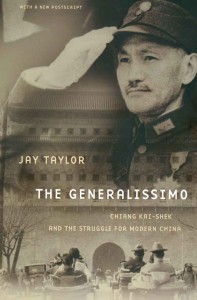
WoWasis book review: Jay Taylor’s ‘The Generalissimo: Chiang Kai-shek and the Struggle for Modern China’

Written By: herbrunbridge - Oct• 16•11

As we here at WoWasis found when we visited Taiwan, English books on Chiang Kai-shek are damned hard to find. Chiang isn’t a very popular figure in many Taiwanese circles, which is why, as a bookstore clerk explained to us, books on Chiang would be found in the “China,” rather than the “Taiwan” section of the store.

Nevertheless, as pointed out by Jay Taylor in his The Generalissimo: Chiang Kai-Shek and the Struggle for Modern China (2011, ISBN 978-0-674-06049-4), Chiang is an important figure historically, and a critical player in defining the Taiwan of today. This book, comprising 607 pages of text including a postscript for the paperback edition, is exhaustive, drawing on interview, documents, and Chiang’s diaries, now located at the Hoover Institution. Of particular interest was Chiang’s political affiliation with Zhou Enlai, who secretly disclosed discussions between mainland China and the Nixon administration to Chiang.  (Taylor has also written an exceptional book on Chiang Kai-shek’s son Ching-kuo, who presided over the political modernization of Taiwan, The Generalissimo’s Son: Chiang Ching-kuo and the Revolutions in China and Taiwan).

Chiang’s early history, conflicts with Mao Zedong’s People’s Liberation Army, his flight to Taiwan, and Cold War actions are all described, as is his relationship with Madame Chiang (Soong Mayling). The latter, from her emphasis on inculcating progressive hygienic measures to the masses, to her meetings with various officials in the U.S., is a fascinating character in herself discussed liberally by the author. It also provides insight into the growth of Chiang’s son Chiang Ching-Kuo, who followed in his father’s footsteps and is the subject of one of Taylor’s previous books.

The book is recommended for anyone wishing to understand the progression of Taiwan from a Japanese colonial entity to an Asian economic power, and from a military state to a democracy. Buy it now at the WoWasis eStore.

WoWasis book review: Judith Heimann’s The Airmen and the Headhunters (Borneo)

Written By: herbrunbridge - Oct• 12•11

Judith M. Heimann’s The Airmen and the Headhunters: A True Story of Lost Soldiers, Heroic Tribesmen, and the Unlikeliest Rescue of World War II (2007, ISBN 978-0-15-101434-7) is more than just an adventure story, encompassing many fascinating anthropological elements of the Dayak culture of Borneo. It starts off slowly, but becomes a real page-turner as the dynamic among the downed soldiers, Dayaks, and Japanese army unfolds. We here at WoWasis feel it’s an important component to the library of anyone interested in Borneo or the Pacific War.  The book is essentially the story of U.S. Army and Navy fliers crashing into the jungles of what is now Indonesian Borneo, and encountering the local Lun Dayeh tribe, as well as a number of other individuals. The area was occupied by Japanese Imperial forces, and the Japanese used draconian measures against indigenous peoples that attempted to assist allied personnel.

Heimann, a career diplomat, spent seven years in the general area, including two in Borneo, and speaks Malay/Indonesian. She utilized documents, oral transcriptions, and personal interviews to tell the story, and includes fascinating information on Dayak culture, including bathroom habits, greetings, food sources, and headhunting, all of which quickly became important to the fliers, who were in constant threat from the nearby Japanese. Headhunting becomes more common as the book unfolds, as British Major Tom Harrisson, commanding the Australian SEMUT I forces, encouraged the Dayaks to take Japanese heads, and even lined the bamboo airstrip at Belawit with them.

The book is well-documented, with a terrific glossary, index, and exceptional maps hand drawn by Helen Phillips, which show, in addition to Indonesian Borneo, adjacent areas in today’s Sarawak and Sabah Malaysian states, in which some of the action took place. She painstakingly tracked down all of the surviving fliers, documenting their post-war lives and deaths.

This is a compelling book, and highly recommended. Order it now at the WoWasis eStore.

What’s with my Thai broken toilet seat?

Written By: herbrunbridge - Oct• 01•11

The Good Manner: Advice on Thailand from WoWasis’ Pa Farang
This week’s dilemma: My new Thai broken toilet seat

Dear Pa Farang, 

Greetings from California.  I go to Thailand several times a year, and am proud to say that I’ve plumbed a Thai toilet hose into my bathroom here in the States.   Recently, at a home store in Bangkok, I bought a nifty toilet seat, made of sea shells and creatures embedded in sand, and encased in plastic resin.  I brought it back toCalifornia, installed it, and after 5 days, the damn thing broke, nearly flinging me into the bowl.  I paid 1000 baht for it, too!  I called the store from California and complained, but they refuse to take it back.  I don’t suppose I’ll get resolution on this, but would like you to warn others.   

–  Scammed Sandy 

Dear Sandy, 

Poor craftsmanship is endemic in every country.  Unfortunately, like used underwear and bathing suits, the store probably won’t take it back for hygienic reasons.  I suspect that these seats were not fully tested for weight (I would like to see the job description spec for the job!).  

I have also received reports of toilet hose nozzles going on the blink overseas as well.  Hydraulic experts here tell me that foreign countries may have increased water pressure, and that could be the cause. 

When we think of all the nice things Thailand exports, we think of fashion, crafts, and the occasional bottle of Mekhong Whiskey.  We do not think of plumbing items used for bathrooms.  I do not think you have been scammed, but instead, my opinion is that Thai manufacturers are not yet up to international standards in these matters.  That is the “bottom” line.

– Pa Farang 

Read Pa Farang’s other columns in WoWasis for more advice on relationships and cultural matters in Asia

WoWasis visits Taiwan’s Customs Museum in Taipei

Written By: herbrunbridge - Sep• 29•11

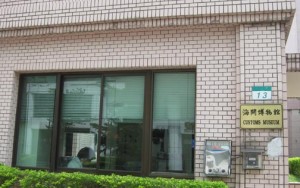
One of Taipei’s more curiously odd museums is the Customs Museum. It sits in the highly secure Customs Building, so like we did here at WoWasis, you’ll need to call for an appointment. You’ll be given a tour of the museum by a uniformed customs official, and ours clearly enjoyed leaving the desk and pointing out many of the exotic items. Smuggling is one of their focuses, and they have a large number of objects on display in which smuggled goods were ensconced. Our favorite was the intricately carved 3 meter ivory pagoda, which was found to carry drugs. All sorts of bizarre weapons were seized, and they’re on display, too.

Everything to do with customs, from stamps, to uniforms, to old adding machines, find their way here. And Customs runs Taiwan’s lighthouses, so there’s all matter of things relating to lighthouses, including lanterns. The museum isn’t for everyone, but provides a really nice one-hour break if you happen to be nearby.

An easy way to get there is to take the Y27 exit from City Mall below the streets of Taipei (under Civic Blvd.), then take a short taxi ride to the museum. If you’re walking, follow our GPS coordinates below.

Customs Museum
13 Tacheng Street, Taipei
Tel: 02-2550-5500 x2212
Open Monday-Friday 9 am – 5 pm, call for appointment
http://museum.customs.gov.tw/english/index.htm
GPS: N25°03.065’  E121°30.625’

WoWasis book review: ‘A New History of Taiwan’ by Hung Chien-Chau

Written By: herbrunbridge - Sep• 20•11

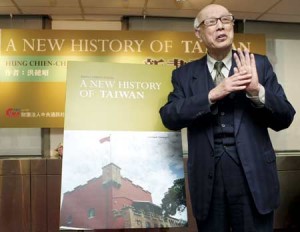
Joe Hung at his book launching (photo CNA)

Noted Taiwan newspaperman Hung Chien-Chau (also known by his English name, Joe Hung) has admirably faced up to the daunting task of writing a history of his country in A New History of Taiwan (2011, ISBN 978-986-86637-3-2), an updated edition of his 368 page book of 2000. Hung is a veteran journalist who serves as Chairman of Taiwan’s central News Agency, and has a Bachelor’s degree in English Literature and Ph.D. in history from Georgetown University in Washington, District of Columbia. This 483 page book reads well-enough to be a novel, and provides fascinating historical data on historical eras ranging from the advent of indigenous aboriginal groups through the national elections of 2008.

Some of his best writing concerns the Ming and Qing conflicts during the time of Koxinga, the Japanese era of 1895-1945, 20th century industrial and public works projects, and the post Chiang Kai-shek period. From our perspective here at WoWasis, the most fascinating part of the book delves with the election process and the various regimes that have held political sway over the island in the last two decades. We’ve seen the parliamentary fisticuffs on television, and Hung reveals the tensions that drive these passions, including some wonderful insight into the corruption and bribery scandals that rocked the nation.

With the exception of the map on the rear cover, there are no maps in the book, which would have been helpful for the Western reader. In particular, we would have benefitted from maps of various eras, showing place names, which changed along with history. The book itself is very nicely designed, with a lovely wraparound cover, stitched binding with integrated bookmark, and pages made of paper that enhance the reading experience.

Perhaps where Hung shows his writing and analytical chops best are the several pages in which he critiques the young people of Taiwan, in terms of their economic and social habits, including the influence of superstition on their lives:

“Still another task, which is a much harder nut to crack, is a sort of moral
rearmament to curb the hedonistic penchants of young adults. People in their
20s belong to what is popularly called the “strawberry generation.” They
look nice, red and shining, but are extremely fragile like strawberries. Unlike
their grandparents who experienced war, most of these young adults have
been pampered almost their entire lives and detest hard work. They would
do almost anything to get a quick buck. They are Machiavellian, convinced
the end justifies the means. One public opinion survey asked college students
whether they would cheat in examinations. Eight out of every 10 respondents
told their pollsters they would cheat just to get high grades, even though they
knew cheating was wrong. Honesty is no longer their best policy. And they
have role models to look up to: corrupt political leaders from President Chen
Shui-bian on down. The rapid proliferation of colleges and universities, one
lamentable outgrowth of the education reform recommended by Nobel laureate
Lee Yuan-tseh, has led to an increasingly high jobless rate among new college
graduates. Taiwan now has more than 180 degree-granting institutions of
higher learning, the highest density of university population in the world, which
has resulted in a coinciding fall in the quality of higher education. Quite a few
of these young college graduates who can find no jobs chose to end their lives
out of despair. They were true strawberries, not tough enough to survive the
harsh struggle for existence. But by far the greater majority of young people
believe life is for them to enjoy. Fun is easily available because banks are
more than willing and ready to give them credit to buy it. These banks, overly
eager to extend consumer credit to people who they know are unable to repay,
have issued credit, debit and cash cards almost indiscriminately, helping create
millions of “card slaves” in the last two years of the first decade of the 21st
century. They are slaves in every sense of that word, for they have to toil for
the rest of their lives to repay their card debt. Taiwan’s suicide rate has soared.

“Moreover, an increasingly large number of young people are turning
ever more superstitious. Geomancers and quack “religious” gurus are raking
in billions of dollars. Again, the young people have good examples to follow.
Frank Hsieh, for instance, knelt before a once-convicted quack to beg for divine
help to beat his Kuomintang rival Wu Den-yih in the Kaohsiung mayoral
election in 1998- Hsieh won. His guru. Sung Chi-li, was convicted of fraud for
claiming a magical ability to levitate and openly said he took Hsieh to the Eiffel
Tower in reincarnation, though they both did not leave Taiwan. And Hsieh did
not deny it. President Chen seemed intent on imposing the rule of magic, too.
He showed an amulet he never parted with and claimed it saved him from the
assassin’s bullet on March 19, 2004 and helped him survive what he called a
“soft” coup d’etat that followed. The term referred to a conspiracy of retired
top brass who tried to persuade their former colleagues in active duty to resign
en masse to topple him. He even had tens of thousands of replicas of the
amulet made and distributed them to his supporters, young and old, claiming
the look-alikes would help them fulfill whatever wishes they might have.
Many Cabinet ministers consulted geomancers as to how they should rearrange
their offices to insure they could keep their portfolios. At the suggestion of a
geomancer, these top government officials would spend millions of dollars to
have old trees removed, gates razed and new ones made, while a long tunnel
still under construction was opened to “traffic” a dozen times on auspicious
occasions. Matsu, the goddess of the seas, was paraded in New York to call
for divine support to facilitate Taiwan’s entry into the United Nations using
the name Taiwan. A recent poll shows seven out of every 10 college students
believe ghosts bring them bad luck. Nothing has been done to slow down this
superstition bandwagon.” 

Pretty tough societal analysis for what is ostensibly a history book, and it’s commentary such as this that makes the book so readable. This is an important book that is recommended to anyone wishing to sort out the dramatic events that continue to influence the politics and culture of Taiwan.

WoWasis explores Taiwan’s rich indigenous aboriginal culture

Written By: herbrunbridge - Sep• 19•11

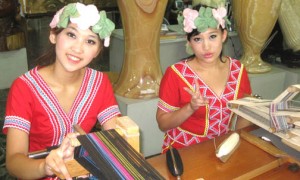
Atayal weavers

Taiwan’s presence in the high technology world has given it an aura of modernity that somewhat masks the fact that it has an extraordinary richness and diversity of aboriginal peoples. These diverse tribes are all part of the Austronesian language group, which spans an incredible distance, from Madagascar to Easter Island, and Taiwan to New Zealand, and comprises over 200 million people. Traditionally, many of Taiwan’s aboriginals were headhunters, and fought with Portuguese, Dutch, Chinese and Japanese invaders, among others, over centuries. They have lived in Taiwan for an estimated 4,000 years, and share cultural elements with indigenous groups in the Philippines, Malaysia, and Indonesia. Today, they are considered an important element of the Taiwanese population, with cultural villages in virtually every part of Taiwan. The Shung Ye Museum  in Taipei makes an ongoing effort to document and chronicle these groups, and the large format photography book Taiwan’s Aboriginal Peoples  discusses and documents some of the major groups.

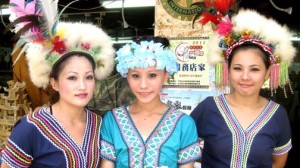
Pefformers in the Atayal Cultural Village in Wulai, Taiwan

Taiwan’s officially recognized aboriginal groups are: the Amis, Atayal, Bunun, Kavalan, Paiwan, Puyuma, Rukai, Saisiyat, Sakizaya, Sediq, Thao, Truku (Taroko), Tsou, and Yami (Tao) tribes. Linguists and anthropologists have identified a number of other Taiwanese groups sharing the same language family. They include the Basay, Ketagalan, Kulon, Taokas, Pazeh, Papora, Babuza, Hoanya, Siraya, and Makatao. These latter ten groups formerly occupied the northern and western plains until Japanese occupation (1895-1945), and are now known as the Pingpu.  

Aboriginal cultural villages can be easily visited in Taiwan, where you’ll generally see song and dance programs, be able to purchase aboriginal crafts, visit dwellings, and even stay overnight. One such village close to Taipei is the Atayal Cultural Village at Wulai, 40 minutes away.

WoWasis visits Taipei’s Baoan and Confucius Temples

Written By: herbrunbridge - Sep• 19•11

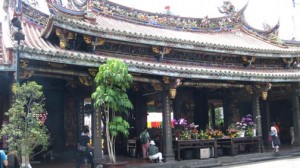
Taipei's Baoan Temple

Two of Taipei’s finest temples are adjacent to each other, and offer a nice contrast in architectural styles and bearing. Both the Baoan and Confucius temples are located a short cab ride from the Yuanshan MRT station.

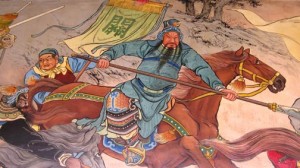
Baoan Temple fresco

The Baoan temple is the more ornate of the two, dedicated to Baosheng Dadi, the god of medicine. Ceramic figures adorn the roofline, and there are many elaborate carved statues with. Particularly worthy of note are the beautifully frescoed exterior walls. Outdoor festivals are commonly held outside the temple, replete with wonderfully-designed colored paper god images.

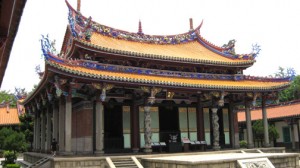
Counfucius Temple, Taipei

One block away is the Confucius Temple, with its elaborately structured roof beams and dragon columns, and a fine example of a stately hall. The temple is set in a beautiful garden with bamboo groves, ponds, and bridges.

Baoan Temple
61 Hami Street
Tel: 02-595-1676
Open daily
www.baoan.org.tw
GPS: N25°043.377’  E121°30.933’

Confucius Temple
275 Dalong Street
Tel: 02-592-3924
Open Tuesday through Sunday
www.baoan.org.tw
GPS: N25°043.343’  E121°30.945’

Apartment Asian Massage Parlors (AAMP) in North America: how masseuses create a home in a motel

Written By: herbrunbridge - Sep• 17•11

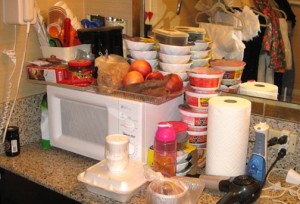
Full-service AAMP microwave kitchen

In earlier posts, WoWasis described the nuances of the AAMP (Apartment Asian Massage Parlor) scene in North America,  and defined a list of commonly used AAMP acronyms Although a number of these women live and work out of their own apartments, many do not. So how do they instantly create a homey environment in a motel room in which they’ll only stay a few days? 

Four of the most common elements employed to help recreate their homelands are food, music, clothing, and religious objects. Any motel room with a microwave oven becomes an instant kitchen, where all varieties of Asian food and snacks may be heated and eaten. Mama-sans will take them shopping to Asian stores, where they can load up on instant noodle dishes, ramen, candies, you name it. 

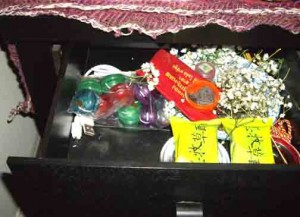
Drawer altar, with Buddhist amulet, flowers, incense, and a bag of yoyos

They bring music with them from their home countries on MP3 players, which they play through their ever-present laptop or netbook computers. In terms of Asian clothing, the cute animal slippers are ubiquitous. And many of these women create hidden altars in their rooms, reflecting Buddhist or other philosophies. A common practice is to put them in furniture drawers, where they can be kept open at all times except when customers arrive. 

Since typical lengths of stay range in any one city range from a few days to two weeks, keeping the continuity of a home is critical, and instant food, music, clothing, and religious objects can be easily packed into a rollaway suitcase to create an instant “home” at the next stop.

What can a girl do without her animal slippers?

WoWasis drives Taiwan’s East Coast National Scenic Area

Written By: herbrunbridge - Sep• 15•11

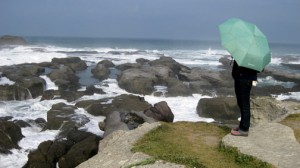
Fantastic sea views, like this one at Shihtiping, are common along Taiwan's East Coast National Scenic Area

We here at WoWasis feel this is one of the most remarkable drives in Taiwan. Beginning just 24 km south of Taroko Gorge National Park is the city of Hualien, the northern terminus of the 170 km long East Coast National Scenic Area, which reaches its southernmost point near the city of Taitung. Like the Northeast Coast National Scenic Area  120 km to the north, the East Coast National Scenic Area comprises spectacular ocean views and interesting things to see, with relatively little traffic. These two drives, combined with Hengchun Peninsula drive 100 km south of Taitung, comprise a spectacular trip that will allow you to see Taiwan’s most scenic coastal sights

Begin the East Coast National Scenic Area drive by stopping at the Hualien visitor Center, 10 km south of the city on Highway 11, where you can get a very good English-Chinese map. 4 km further south is the Henan Temple, where a statue of Guanyin, the goddess of mercy, overlooks the sea. 14 km south, stop at the Fanshuliao Bridge at the 29.5 km sign. Walk across the highway to the old bridge. Walk on the old bridge, and you’ll get a nice view of a gorge that runs down to the ocean.

Shihtiping

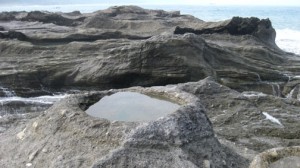
South of Fanshuliao, you’ll pass some scenic views at the Baci Recreation area of the Jici seashore below you. 25 km south of Jici, you’ll need to stop at Joki (click on the link for full description and pictures), the coffee bar and studio of Kan Hsin-Yi, who makes and sells decorative sculptural items and furniture using local material, unlike anything you’ll see in Asia. at Shihtiping, where a wooden walkways takes you to some of the most spectacular moonscape-like sea rocks you’ll see in Taiwan. The turn off is at GPS: N23°29.452’  E121°30.524’.

Just south of Joki, you’ll cross the Changhong (Rainbow) Bridge, which spans the Xiuguluan (Siougulyuan) River, where we encourage you to take a rafting trip down the river to the sea from the nearby town of Rueisuei   Just after you cross the Rainbow Bridge heading south, you’ll see a tall obelisk, which marks the Tropic of Cancer.

10 km south of the Rainbow Bridge are the Basian Caves, with a small visitors’ area displaying Paleolithic items found in the caves, and the caves themselves, now filled with Buddha images, which we found far too commercial for our tastes.

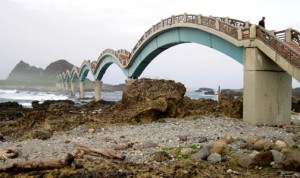
Sanxiantai Bridge

One of the most scenic spots in eastern Taiwan is the beautiful footbridge at Sansiantai (Sanxiantai), 24 km south of the Basian Caves, just off Highway 11 (look for the signs). The bridge resembles a dragon’s back, and takes you to the Platform of the Three Immortals, s small island. You’ll walk over wonderful small smooth speckled stones (called Haulien stones) that are particular to the East Coast National Scenic Area.

24km south is the  East Coast National Scenic Area Visitor Center in Chenggong, with a view of Green Island, and close to the nearby Ami Folk Center, an aboriginal venue featuring Ami cultural exhibits. Further south is the Donghe Bridge. Turn just before the bridge at the 140 km sign to a parking lot, where you’ll see magnificent views of the Mawuku  river. There are wonderful sea views att the way to the end of the Scenic Area at the city of Taitung, home of the National Museum of Prehistory.    After Taitung, proceed south for 100 km to the spectacular Kending National Park on the Hengchun Peninsula.