The sharper edge to traveling in Asia

Bangkok’s abandoned rails get new life for food cart transport

Written By: herbrunbridge - Jan• 26•12

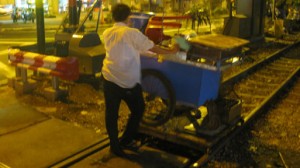
Food cart loaded atop the flat car, a vendor pushes his way home down Bangkok’s abandoned railway

Here at WoWasis, one of our most popular posts is about Cambodia’s bamboo train, which makes use of abandoned rails and cars made from army tank wheels. As we found out this week, Bangkok’s not far behind in determining new uses for abandoned railroad tracks.

It’s been years since any train rolled down the tracks that cross Sukhumvit at the intersection of Soi 1, and what used to be known as Soi Zero. Like any other area in Bangkok, thousands of vendors operating mobile food carts (rot kaen) ply their trade, either stationary, or constantly on the move. Recently, sitting on the abandoned tracks at Soi 1, we found a home-crafted flatcar that had its wheels spaced to meet the gauge of the railroad track. And on this flatcar, at the end of a working day, a rot kaen operator placed his cart, then rolled it north toward the direction of  Klong San Saep. We’ll bet he doesn’t own the flatcar either; it’s probably rented for each trip.

ThailandPromoBannerBangkok is truly a city in which one person’s trash is another’s treasure, and this even includes old railroad tracks, given a new life as a highway for food cart owners who no longer have to push their carts home at night through traffic-infested streets.

Get a great Bangkok Wat Pho massage without going to Wat Pho

Written By: herbrunbridge - Jan• 25•12

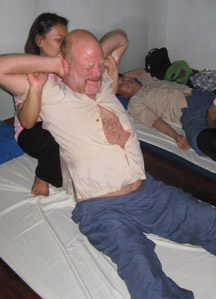
Massages at Bangkok’s Wat Pho are famous, but many Thais and westerners elect instead to go to the One Pho Original Thai Massage around the corner, where the prices are a bit better, all masseuses are Wat Pho trained, and the lines are shorter. In addition, it’s closer to the Thai Tien pier. And it’s air conditioned, which, as it turns out, is one of the major reasons Thais love coming here. 

When you enter, you’ll be presented with a card stating the rates per hour. You can also ask for a two-hour massage, at double the hourly rates. If you want a foot massage only, you’ll remain on the lower floor, but you’ll be led upstairs for all other massages, where you’ll strip down to underwear, put on pajamas, and receive your massage. 

Happy customer at Bangkok's One Pho Massage

At One Pho, prices for a one hour massage are as follows:
Thai original massage, 250 baht
Foot massage, 250 baht
Oil massage, 500 baht
Herbal compress, 500 baht.

How to get there

We recommend taking a Chao Phraya river taxi from the Saphan Takin pier (BTS Silom line) to the Tha Tien pier (#8), then proceed east for a few meters to One Pho.

One Pho Massage
256-258 Maharaj Road
Bangkok 10200
Tel: 02-222-9641
Open daily, 9 am – 8 pm

Hygiene at 30,000 feet: how to keep your butt clean in the air

Written By: herbrunbridge - Jan• 22•12

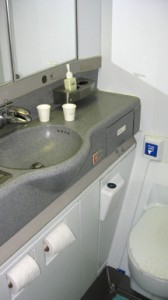
Plenty of room to jump up and wash. The roomy 747-400 restroom.

Here’s a subject a lot of people think about, but comparatively few are willing to discuss. How to keep your nether regions clean after using in-flight restrooms. Here at WoWasis, we’re big fans of the Thai toilet hose, Philippine toilet buckets, and any other cleaning processes that involve water and soap, rather than toilet paper, which we consider to be barbaric. So how do you remain squeaky clean on intercontinental flights, where your options are fewer?

If you’re flying a Boeing 747-400 (777-300 offers a similar scenario), we have an answer for you. Most restrooms are optimized for the soap & water birdbath ritual, with plenty of room to sit astride the sink while you clean up. Although the two in the rear of the fuselage are the most spacious, all offer a two-foot clearance from the front of the sink to the facing wall, and roughly three feet from the mirror backsplash to the facing wall. It’s as if the restroom designers made allowances for travelers who they knew would insist on cleaning up by sitting atop the sink and washing off. The major issue is with inflight restrooms that offer 3 feet or fewer from front of sink to backsplash mirror, which really doesn’t allow for enough clearance to do the job right.

Never cleaned up this way before? Here’s how. After you’ve finished your business on the toilet, flush, put down the lid, then put a foot on the toilet and lift yourself up astride the sink. The pump-activated soap bottle is right there, as is hot water. Simply wash as you would in a shower with lots of soap, rinse away all the water, dry everything with paper towels, and you’re probably cleaner than you were before you entered the restroom.

AsiaPromoBannerDo remember that others will be using the restroom, so after you’ve finished your ablutions, wash the entire sink area, front, back, sides, with soap and water, and dry it all off. We always take pride in the fact that we leave the bathrooms cleaner than when we entered. The flight attendant crew can’t be everywhere.

We’re sure other aircraft offer similar restroom options, but some restrooms are more cramped than others. You can’t weigh 300 pounds and still perform this ritual, either. But if you’re in shape and have an abhorrence for being dirty, taking an in-flight birdbath is the only way to fly.

WoWasis book review: Chinese prostitutes in 19th century San Francisco by Benson Tong

Written By: herbrunbridge - Jan• 18•12

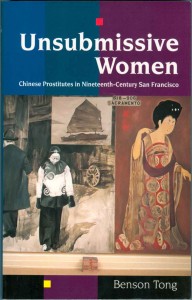
As Benson Tong attests in his book Unsubmissive Women: Chinese Prostitutes in Nineteenth-Century San Francisco (1994, ISBN 0-8061-3284-1), the Chinese prostitution dynamic in California has been thriving quite a while.  As WoWasis reported in April, 2011, Asian Apartment Massage Parlors (AAMPs) proliferate today through the San Francisco Bay Area and the west coast of North America. Tong’s focus is the period of 1860-1880, and he describes the entire milieu, from the business aspect on the part of customer, woman, and holding company, to the societal and legal aspects of the trade.

The average age of these women was 24-27. Although many were sold by their parents (an act agreed to by many women, eager to support their extended families), additional women came voluntarily. Some, as Tong pointed out, were taken against their wills, and many of them were successfully vetted by customs officials and returned home. The author describes the Tongs and Chinese Six companies, the wharfside public auctions of the women, and how the business of prostitution was run. Somewhat surprisingly, he reveals that being a former prostitute wasn’t necessarily a gating issue to Chinese men in search of wives.

The bête-noire of the prostitution business, as Tong points out, were middle class protestant Christian women, who often founded homes for “reformed” prostitutes. And as the title suggests, the author debunks the myth – still common in the United States today — of Asian women being subservient. His passages on the China Doll and Dragon Lady archetypes are compelling.

Many, if not most, of these women signed contracts of indentured servitude while in China, a situation contractually not unlike what’s happening now in the 21st century. Only the terms have changed. A contract from the earlier era reads:

Contract Between Ah Ho and Yee-Kwan

An agreement to assist the woman Ah Ho, because coming from China to San Francisco she became indebted to her mistress for passage. Ah Ho herself asks Mr. Yee-Kwan to advance for her $630, for which Ah Ho distinctly agrees to give her body to Mr. Yee for services as a prostitute for a term off four years.

There shall be no interest on the money. AhHo shall receive no wages. At the expiration of four years Ah Ho shall be her own master. Mr. Yee-Kwan shall not hinder or trouble her. If Ah Ho runs awav before her time is out her mistress shall find her and return her,  whatever expense  is incurred in finding and returning her Ah Ho shall pay. On this day of the agreement Ah Ho with her own hands has received from Mr. Yee-Kwan $630. If Ah Ho shall be sick at any time for more than ten days she shall make up by an extra month of service for any ten days’ sickness.

Now this agreement has proof. This paper received by Ah Ho is witness.

TUNG CHEE,

TWelfth year, ninth month, fourteen day.

Today, this contract is similar to those signed by those women who come to the U.S. under similar circumstances, in which they receive money for air fare. The term, however, is typically one year. But many —if not most — women engaged in this business recognize the value of payingtheir own air fare, and thus run their own business as free-lancers, working their own days and hours to their preference.

Tong’s book is a welcome respite, in the sense that it depicts women in the business who do have a tremendous amount of control over their own lives, vocations, and decisions, anathema to religious organizations bent on stopping the trade.  Buy this book now at the WoWasis eStore.

New Drug scam in Malaysia endangers tourists?

Written By: herbrunbridge - Jan• 17•12

The Good Manner: Advice on Asia from WoWasis’ Pa Farang
Today’s question: Drug scam in Malaysia?

Dear Pa Farang, 

A friend and I had a strange thing happen to us on a recent trip to Patong. While walking down a major thoroughfare, we were approached by two men who flashed badges at us, told us they were international drug police, and insisted on searching our bags.  Something didn’t seem right, so we insisted they accompany us to a police station, in a taxi.  They turned around and walked away. We’re still puzzled, but suspect something wasn’t quite kosher.  Anything you could tell us would help. 

     – Jim & Jerry 

Dear Jim and Jerry, 

Yes!  You were nearly the victim of a scam gaining popularity in Malaysia. If you had allowed your bags to be searched, they would have surreptitiously slipped some real drugs inside, “found” them, and tried to shake you down for cash in lieu of “arrest.”  This has been quite successful in recent months, in Patong as well as Kuala Lumpur.  Our contacts tell us that Asians, more than non-Asians, are often the victims, as they are perceived as being less confrontational. 

You did the right thing, by insisting on going to a police station right away, and good thing you suggested taking a taxi.  If you had accompanied them in their own auto, the end of the story might not have been favorable. Good job! 

Avoid all scams, show the Good Manner, and have a great time in Malaysia. 

– Pa Farang 

Read Pa Farang’s other columns for more advice on relationships and scams in Southeast Asia

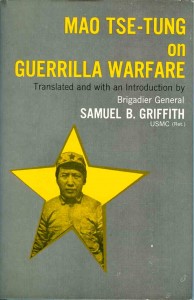
WoWasis book review: Mao Tse-Tung on Guerilla Warfare

Written By: admin - Jan• 07•12

Here at WoWasis, we’d guess that the collective United States military never got around to reading Mao Tse-Tung’s 73 page Yu Chi Chan, an expert treatise on the art of guerilla war, before it got hopelessly bogged down in the quagmire called Vietnam. Translated brilliantly by Brigadier General Samuel B. Griffith, USMC (Ret.) as Mao Te-Tung on Guerilla Warfare and published in 1961, it also contains an important and insightful 31 page analysis written by the translator, who would appear to be practically begging the U.S. not to become embroiled in guerilla war, led by Mao military disciple Ho Chi Minh, who had prior success, strategically and tactically, against the French. 

Mao’s book was originally produced in 1937 as a series of pamphlets mandating how a guerilla war should be planned, led, and fought, in this case against the Japanese. The tenets, though, can apply to any country, and time, any place (in his introduction, Griffith discusses Francis “Swamp Fox” Marion’s guerilla tactics again the British during the Revolutionary War fought in what is now the United States).  What Mao continually stresses is having non-combatants being complete believers in the guerilla action, to the extent that they support guerilla fighters by willfully proving food, shelter, and transportation when necessary. To this effect, Mao’s political officers were as important as the fighters, carrying the message to the people and fighters alike, discussing topics such as colonialism, land reform, and politics in discussion groups. 

In terms of fighting, Mao describes how guerilla fighting differs from conventional warfare: 

What is basic guerrilla strategy? Guerrilla strategy must
be based primarily on alertness, mobility, and attack. It
must be adjusted to the enemy situation, the terrain, the
existing lines of communication, the relative strengths, the
weather, and the situation of the people.
In guerrilla warfare, select the tactic of seeming to come
from the east and attacking from the west; avoid the solid,
attack the hollow; attack; withdraw; deliver a lightning
blow, seek a lightning decision. When guerrillas engage a
stronger enemy, they withdraw when he advances; harass
him when he stops; strike him when he is weary; pursue
him when he withdraws. In guerrilla strategy, the enemy’s
rear, flanks, and other vulnerable spots are his vital points,
and there he must be harassed, attacked, dispersed, exhausted
and annihilated.

Mao also includes a number of “Rules and Remarks” that promulgate important behaviors when in the field as they relate to local inhabitants:

Rules:

1. All actions are subject to command.
2. Do not steal from the people.
3. Be neither selfish nor unjust.

Remarks:

1. Replace the door when you leave the house.
    (doors were typically lifted off hinges and used as beds)
2. Roll up the bedding on which you have slept.
3. Be courteous.
4. Be honest in your transactions.
5. Return what you borrow.
6. Replace what you break.
7. Do not bathe in the presence of women.
8. Do not without authority search the pocketbooks
    of those you arrest. 

From the perspective of the West — and particularly that of the United States — perhaps the most cogent elements are found in Griffith’s introduction, which bears re-reading after Mao’s text. Here, Griffith explains the reasons many people feel that revolutionary military action is a necessity: 

A potential revolutionary situation exists in any country
where the government consistently fails in its obligation to
ensure at least a minimally decent life for the  
great majority of its citizens. If there also exists even the
nucleus of a revolutionary party able to supply doctrine and
organization, only one ingredient is needed: the instrument
for violent revolutionary action.

In many countries, there are but two classes, the rich
and the miserably poor. In these countries, the relatively
small middle class—merchants, bankers, doctors, lawyers,
engineers—lacks forceful leadership, is fragmented by un-
ceasing factional quarrels, and is politically ineffective. Its
program, which usually posits a socialized society and some
form of liberal parliamentary democracy, is anathema to
the exclusive and tightly knit possessing minority. It is also
rejected by the frustrated intellectual youth, who move
irrevocably toward violent revolution. To the illiterate and
destitute, it represents a package of promises that experi-
ence tells them will never be fulfilled.

People who live at subsistence level want first things to
be put first. They are not particularly interested in freedom
of religion, freedom of the press, free enterprise as we
understand it, or the secret ballot. Their needs are more
basic: land, tools, fertilizers, something better than rags
for their children, houses to replace their shacks, freedom
from police oppression, medical attention, primary schools.
Those who have known only poverty have begun to wonder
why they should continue to wait passively for improve-
ments. They see — and not always through Red-tinted
glasses — examples of peoples who have changed the struc-
ture of their societies, and they ask, “What have we to
lose?” When a great many people begin to ask themselves
this question, a revolutionary guerrilla situation is incipient.

This short book can be read in one sitting, and Griffith’s short but important analysis is a key element. Reading it should be a prerequisite to any military group wishing to wage war in another country where significant numbers of the indigenous population are not reaping proper and deserved benefit from the government being supported.  Buy this book now at the WoWasis eStore.
WoWasis book review: The Tragedy of Sri Lanka: William McGowan’s ‘Only Man Is Vile’

Written By: herbrunbridge - Jan• 06•12

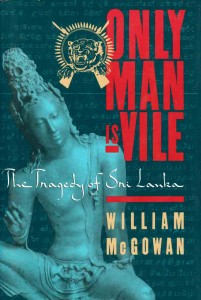
Sri Lanka has stabilized, to the extent that the country is now charging for tourist visas, instead of for years practically begging people to come. Here at WoWasis, we’re going there next month to investigate. So what were the Civil War years, from 1983-2009 really all about. As journalist William McGowan so cogently describes in Only Man is Vile: The Tragedy of Sri Lanka (1992, ISBN-13: 978-0374226527),  it wasn’t merely a flight between Sri Lanka government forces and the Liberation Tigers of Tamil Eelam (LTTE) Tamil Tigers, either. Numerous armies, guerillas, and political factors added to the mix, Including the Indian Peace Keeping Forces (IPKF), the United National Party (UNP), the Janata Vimukti Peramuna (JVP, People’s Liberation Front), and various permutations of Buddhism and Hinduism. 

Although the book is two decades old, it’s an important read, as McGowan travels the country in war time, interviews leaders, soldiers, and everyday people. He’s included a very good history of all involved groups, as well as a short history of the island once known as Serendip (yes the word came from that) and Ceylon. Some of his best writing – and there’s lots of it here — is on the subject of the hegemony of Buddhist conservatives over intellectual secularism, Buddhist monks as death merchants, reporters having to “keyster” their film and notes so they wouldn’t be found during military searches, the Sri Lankan “mind,” and the frustrations of Sri Lankan bureaucracy. 

Our favorite chapter was Prawn Farm, chronicling expat Dale Sarver’s attempt to provide jobs and profits to Sri Lankans, an ultimately failed enterprise, the causes of which today still ring true and are applicable to any western venture in an Asia land. Some of the best books on history are the older ones, especially those in which the writer has actively traveled through war zones. We consider this book an essential one for understanding the myriad of interplays and interplayers that contributed to this tragic but important era in Sri Lankan history. Buy this book now at the WoWasis eStore.

WoWasis travel clothing review: a Panama hat that’s packable and great looking

Written By: herbrunbridge - Jan• 03•12

Pantropic’s Cuenca Fedora Panama hat

Here at WoWasis, we use the durable  T3 Tilley Hat for just about everything we do in the bush, desert, jungle, and forest. But sometimes we need something a touch more fashionable when we’re wearing a light-colored summer suit in hot, tropical climates. And we can’t carry around a hat box, so we need a hat that’s packable in luggage and won’t lose its shape when worn. The Pantropic Cuenca Fedora Panama Hat passes muster, and here’s why:

First of all, it’s a great looking hat, brim up or brim down. Hand-woven in Ecuador, it is made from bleached leaves of the Toquilla palm, the traditional plant fiber used to make Panama hats. It has a tight soft weave and is soft to the touch. It can be easily packed into luggage by packing the crown with soft clothes like socks and keeping the brim flat. At about $95 USD, it costs a lot less than many Panama hats on the market, and it looks terrific.

French silicone breast implant scandal thought not to include SE Asia

Written By: herbrunbridge - Jan• 02•12

The scandal involving French implant company Poly Implant Prothèse (PIP)’s use of substandard, industrial silicone for breast implants concerns potentially tens of thousands of women in at least half a dozen European countries. So far, it appears that none of these implants, which reportedly are prone to rupturing, were distributed in Southeast Asia. 

As reported in the New York Times, “French prosecutors have said that Poly Implant Prothèse substituted a cheap, industrial-grade silicone for medical-grade silicone that is the industry standard. The French authorities have said the substandard product causes inflammation to body tissues when implants are compromised. But so far, they have emphasized, there is no evidence linking it to cancer. ‘“In case of rupture, you’d have a dangerous quantity of silicone in your body,’ said Laurent Lantieri, a plastic surgeon at a hospital near Paris… Breast implants, which are essentially small silicone rubber bags filled with a material, typically silicone or a saline solution, are used after breast cancer surgery or simply for cosmetic purposes. 

“More than 1,000 of the estimated 30,000 French women fitted with the devices have experienced ruptures or leakage. Tens of thousands more in other countries have had the company’s devices implanted, because PIP exported 80 percent of its products, many of them to Britain, Spain and Latin America. More than 40,000 British women are estimated to have received the company’s implants. The implants were also used in Brazil, Argentina, Chile, Colombia and Venezuela. 

“Prosecutors in Marseille have been investigating the company for possible fraud and reckless endangerment. They say it cut costs over the last decade by using an industrial silicone gel that was not approved for medical use and that cost a fraction of the medical-grade material.” 

Evidence of silicone leaking into other body areas is sobering, and former patients have reported symptoms such as burning breast tissue and globules migrating to the axillae. The French government has offered to pay for their removal, but not their replacement with other implant materials. 

The situation is considered serious enough that Interpol has placed former PIP director Jean Claude Mas Florent, now believed to be in Costa Rica, on its most wanted list

Again, these implants are not believed to have been used in Asia, but any woman who received these implants has been advised by authorities to seek medical advice.

Bachelor in Bangkok: Khun Lee on comparisons between Thailand and the U.S.

Written By: herbrunbridge - Dec• 25•11

Sitting in one of my favorite bars with a mate last night, we were discussing our various methods of charming the opposite sex and satisfying our disgusting animal urges.  My mate happened to mention that when making love to a woman “doggy” style he often attempts to enter another pleasure zone in that general region, often with less than satisfying results.  I told him that my method is to repeatedly attempt the same thing over and over again until the lass gets tired of swatting me away with her hand and finally gives in.  My friend laughed and said that in our country that would be considered sodomy.  InThailandit is just called “persistence!”

I have a good friend in the USA named Khun Bill (Bin or Biaw to the Thai lasses as they often cannot pronounce an “L” sound at the end of a syllable) and he sent me the following list of his comparison between the USA and Thailand:

Americans-too busy working to be happy
Thais-too busy being happy to think

Americans-women out weigh men 2:1
Thais-women out work men 2:1

Americans-bugs get into the refrigerator for food
Thais-people get into the refrigerator for bugs

Americans-12 ways to not smile that are real
Thais-12 ways to smile that are not real

Americans-famous for John Adams and apple pie
Thais-famous for boys with noAdamsapple

Americans-pay for a good deal at Carmax
Thais-pray a good deal for karma

Americans-women head for the beach for some good tan
Thais-women go out with a faan (boyfriend) for some good head

Thais-welcome their tanks into town to take over the country
Americans-protest their tanks taking over all other countries

Americans-man comes home to his wife and asks Why?
Thais-man comes home to his wife who greets with a Wai

It is that time of the year for all of us to decide what kind of changes we want to make in our lives in the coming new year.  Living inBangkok, which is the same as having New Year’s eve 365 times a year, I have come up with the following list of my own personal resolutions:

1) I will sleep at least 7 hours a night regardless of how many times I am expected to perform
2) I will exercise 3 times per week outside of the bedroom
3) I will drink alcohol no more than 5 times per week
4) I will limit myself to no more than 15 favorite gals at a time no matter how difficult it is to narrow down the list
5) I will party more often with Dean and his mates (really good blokes I must say)
6) When returning toBangkokfrom a side trip I will unpack within 1 week
7) I will phone my Mom at least once a week
8) I will read 2 new books every month
9) I will study Thai language 1 hour every day
10) I will accept people the way the are without being judgmental (quite a challenge in Bangkok)

Happy New Year 2012 to all of my loyal readers!

Read Khun Lee’s other WoWasis columns for more advice on navigating the adult dating scene through the backstreets of Bangkok