The sharper edge to traveling in Asia

WoWasis takes the Jiji Railway excursion train in Central Taiwan

Written By: herbrunbridge - Sep• 04•11

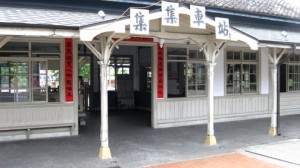
Jiji's beautiful colonial rail station

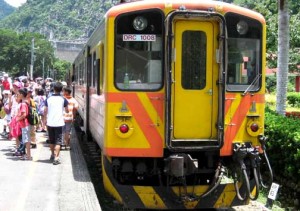
It’s been said that the excursion train running 20 minutes up the mountain from the town of Jiji is Taiwan’s most popular scenic railway. It could be, because even on a Tuesday, it was packed. This narrow-gauge railway was built to haul logs to a sawmill, but no more, now it just hauls people.   You can still see what we’d guess are the abandoned lumber buildings just as the train starts climbing out of Jiji. It’s picturesque, all right, but, like we here at WoWasis found out,  you’ll never get on the train if you don’t have a few of things figured out first:

1)      The Colonial-style Jiji railway station isn’t that easy to find. There are a few false starts in Jiji, but if you’ve got your GPS, it’s right at GPS: N23°49.600’  E120°47.120’

2)      The ticket agents don’t speak English, and there are several other train options in Jiji. The agents aren’t used to seeing westerners there, so can’t easily predict that we’re there for the excursion train. It costs NT$ 28, though, and one train always leaves there at 11:13. Just point to the price and time, or find a friendly person who speaks English (we ran into two women from Hong Kong who helped us out).

3)      Stay on the train, and don’t get off until it’s back in Jiji. Once it goes up the hill, it comes right down, so the 11:13 departing round trip returns to Jiji at 12 noon or so.

This is a fun, quick excursion that consists of a lovely ride aboard clean cars outfitted with moon doors, a wonderful Taiwanese touch that adds to the experience.  The town of Jiji, is located in Central West Taiwan, a few km east of the city of Nantou. It’s also on Highway 16, one of the roads going to Sun Moon Lake. 

For more information, visit:

Jiji Visitor Center
61Mingniou Road
Jiji, Nantou County
(049) 276-2546
Jiji station GPS: N23°49.600’  E120°47.120’

WoWasis book review: ‘Woman Islands,’ Taiwanese fiction by Chung Wenyin

Written By: herbrunbridge - Sep• 04•11

Chung Wenyin is one of Taiwan’s most prolific writers of fiction. Originally published in Chinese in 1998, Women Islands (2011, ISBN 978- 986-82340-1-7) now appears translated into English. This novel is the tale of a young Chinese woman torn between familial responsibilities, her own personality, and the fact that she’s unprepared for the job market in her adopted city of Taipei. Nominally raised by her mother (her father was an alcoholic that died at a relatively young age), Ahmam, at the age of 30, is in no rush to get married, anathema in a world in which the financial security of having a husband is considered necessary. She doesn’t particularly care about having children, either.

As the story unfolds, she returns home to her farm community for New Year, which brings her face-to-face again with her mother, relatives, and former boyfriends. Women are the strength of this town, as many of the men have died. Older women working their fields alone is common (the title of the book is a reference to “islands” where women work alone, and more than occasionally live alone), and Ahmam recognizes she has a choice: stay home for a predictable village life, or return to Taipei to a less certain future. This well-written and intriguing book will have a particular appeal for those wishing to understand the conflict of women in Taiwan struggling to succeed in a patriarchal environment. Buy it now at the WoWasis eStore.

WoWasis visits the Chaotian Temple in Beigang, Taiwan

Written By: herbrunbridge - Sep• 04•11

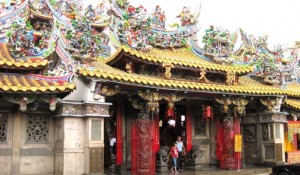
The exotic roofline at Beigang's Chaotian Temple is one of the many wonders to be seen there

Located a few km northwest of the central Taiwanese city of Chiayi is the city of Beigang, where the flamboyantly exotic temple of Chaotian is situated. It’s one of Taiwan’s most important temples dedicated to the sea goddess Mazu, the deity of one of the major folk beliefs in the coastal provinces in Taiwan and China. It’s not to be missed if you’re anywhere close to the area.

Millions of pilgrims come her every year, and the temple is always packed with activity. Shops surrounding the front of the temple are filled with colorful offerings and incense. It’s dramatically carved colorful roofs are a great part of its beauty, as are the numerous ceramic sculptures of animals and deities. Building of the temple began in 1694. The front hall includes the Sanchuan Hall with Dragon-Tiger Gates alongside. Sanchuan Hall is for conferrals of divinities to positions such as“wang” (prince), “fei” (concubine of the emperor) or “general.”  The original Sanchuan Hall was destroyed by the fire in 1894, and reconstruction includes elements made by the famous craftsman, Yingbin Chen, in 1912. The hall has been regarded as the richest and most delicate in terms of its carving and decoration.

We here at WoWasis recommend at least two hours at the temple, including a brief walk to the colorful shops at the front.

Chaotian Temple in Beigang
178 Jhongshan Rd.
Beigang, Yunling County
Tel (05) 783-2055
http://www.matsu.org.tw/IndexE.aspx
GPS: N23°34.101’  E120°18.274’

WoWasis book review: ‘Formosa in Fiction,’ by Rolf-Peter Wille

Written By: herbrunbridge - Sep• 02•11

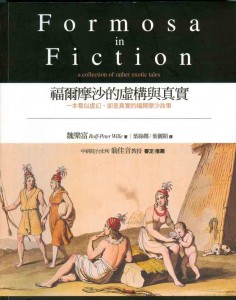
Rolf-Peter Wille is a German writer that has lived in Taiwan since 1978, which makes 33 years as of this writing. He is also a pianist who has performed all over the world both as soloist as well as in a piano duo with his wife, Lina Yeh, who also serves as one of the translators of this bi-lingual book (each left page is printed in Chinese, each right page in English), and is a professor at the National University of the Arts in Taipei. He certainly knows Taiwan enough to write a very interesting, informative, witty, and fun book, Formosa in Fiction: a Collection of Rather Exotic Tales (2011, ISBN 978-986-6789-99-1). We here at WoWasis were enchanted by it.

The ‘fiction’ to which the author refers is the selection of historical references made about Formosa for centuries, and Wille revels in each story. The book is a fun read, separated into four sections: Utopian Satire, Qing Travelogues, Western Pioneers, and Modern Legends. These sections are chronological, and are nicely illustrated in color with woodcuts, drawings, paintings, photos, and lithos from old texts. Wille quotes from a number of sources, from Daniel Defoe (a later version of Robinson Crusoe places him in Formosa) to Jonathan Swift and beyond. Wille clearly loves the country, its people, and its history, and his perspective is nearly always tongue-in-cheek. He’s a humorist with a keen eye for irony and satire.

A great example (this is a lengthy quote, but well worth reading), is his short essay on who really owns Taiwan, a question asked repeatedly by many politically-conscious folks over the past several decades:

“Taiwan, feeling quite lonely and hanging dangerously in the air, should quickly be restored to her rightful owner in such a manner as the International community readily agrees upon. Unfortunately though, that some confusion reigns in scholarly circles as to whom she should be returned, is common knowledge by now. If we take an impartial and scientific look at the historical list of pretenders, we shall quickly find the VOC, me Vereenigde Oost-Indische Compagnie, or Dutch East India Company, to be the true mother of this land. The Dutch were the first to unite those savage Formosan headhunters and pacify them by the ageless methods of missions and massacres. Most importantly, they imported guest workers from Fujian, and those diligent Chinese — as Dutch governor Nicholas Verburg put it — were “the only bees on Formosa that gave honey”. No doubt: The germination of Taiwan’s social integration and economic preeminence was originally stimulated by the VOC and Taiwan should be returned to it. Moreover, a transfer from ROC to VOC proves convenient as just a single letter needs to be changed.

“If, speaking figuratively, Holland is the mother of Formosa, then Germany is her dear father. The Netherlands, as a matter of fact, belonged to the “Sacrum Romanum Imperium Nationis Germanicae”, the old German Empire. Since ancient times, the Netherlands have always been the sacred territory of Germany, an inalienable part, so to say, split out in modem times. Ludwig van Beethoven, the grandson of a Flemish musician, is still a German composer. The Dutch language is practically a German dialect and a German with a bad cold will automatically speak Dutch. But let us carefully and objectively contemplate the reign of all the former owners of Taiwan and refute their respective claims to the island.

“After the VOC, Formosa (Taiwan) was owned by Koxinga and descendants, by the Manchu emperors of the great Qing Empire, by the Meiji and Showa emperors of Japan, by Generalissimo Chiang Kai-shek and descendants, as well as by some recent contenders. Koxinga was a pirate who stole Formosa from the Dutch with the help of a German deserter, Sgt. Hans Jurgen Rade (or Radis) from Stuttgart. Koxinga is slumbering in his grave and his Kingdom of Tungning has perished a long time ago. Taiwan cannot be returned to a dead man. His grandson, Zheng Keshuang, surrendered Formosa to the Qing without a fight, thus proving beyond any doubt, that he did not care for his possession.

“The Qing sent corrupt, degraded mandarins to the west coast of Taiwan, squeezed her people and repressed about 159 uprisings. Emperor Kangxi planned to abandon this “ball of mud”. Claims have been made that Taiwan, having been an annexed prefecture of Fujian province, be returned to China, because it “belonged to the Chinese Empire”; and historically unsound they are: China had been conquered by the Manchu. The great Qing Empire was a “Han-Man-Meng-Hui-Zang” one; besides China proper it contained Manchuria, Mongolia, Muslim areas and Tibet.  The emperor was Manchu. All subjects of the Qing Empire, including Taiwanese, were the emperor’s children. If the father is Manchu so are his children. Unfortunately Taiwan cannot be returned to Manchuria. The ancient Kingdom of Manchuria, as well as the great Qing Empire, have all ceased to exist. Maybe Taiwan could be returned to Lang Lang, the great Manchurian pianist.

“Unlike the Kingdom of Tungning, or the Kingdom of Manchuria, Japan still exists. Should Taiwan be returned to Japan? This, I believe, will be quite unnecessary. Every child knows, that Japan’s main interest today is business and in this regard she has never relinquished the island: Taiwan’s pianos are Yamahas, her cars Toyotas. Politically Japan has renounced all territorial rights to the island.

“Taiwan, still a province of the Republic of China, can obviously not be reunited with the ROC; no separation, no return; and it is more than superfluous, I believe, to consider a return to the PRC or the USA who have not possessed a square inch of Taiwan for even a single second; no ownership, no return. Equally nonsensical are claims that Formosa be returned to the aboriginals. These backward people—they had not even managed to pollute the island—were always just a part of the wild mountains and jungles and are automatically owned by whoever owns Taiwan. Who, in his right mind, would think of returning America to the Indians?

“The weak cases of all these contenders confirm without doubt that Taiwan should be returned to the VOC and Germany. The VOC created Taiwan and cooked the soup that was drunk by usurping successors. As he VOC was Dutch and the Dutch German, Taiwan should be returned to Germany as soon as possible. The fact that Taiwanese like beer and pig knuckle proves scientifically that German blood flows through their veins.

“It is true, I admit, that in my distant childhood I may have been German. Nevertheless, I trust the fair reader will not suspect any partiality on my part, as I have undertaken my scholarly research entirely in the service of truth and science. Yet, soundly again shall I steep when Taiwan is — finally — returned to Germany.”

Wille has written, essentially, a delightfully twisted love letter to his adopted country. He’s got short biographies of many of the authors whose works he cites, and focuses as much as possible on the disparity between what was written, and what was reality. Currently, the book is only available in Taiwan, so we suggest buying it at any of the bookstores in Taipei specializing in English books on Taiwan.
WoWasis product review: Garmin nuvi 1350 LMT GPS Navigator

Written By: herbrunbridge - Sep• 01•11

Here at WoWasis, we were early adopters of GPS technology, and probably the first travel site to include GPS coordinates for many of the out of the way and hard to find places to which we travel. But our trusty Garmin GPS III Plus, which we’d had for 13 years had been all over the world with us, was getting a bit long in the tooth. So we moved to the newer Garmin nuvi 1350, and what a difference! The first difference is in price: in 1998, our GPS III cost us $370 USD. The nuvi 1350 cost us $143, $227 less, for a bigger, color display, voice-prompting, and a few other updated features. We did have to buy an international MapSource CD for $116, but even then, we’re ahead $111, for better technology. 

Here’s why we bought the Garmin 1350, and why we recommend it. First here were our criteria for purchase:

1) Low price, we don’t want to spend a fortune
2) Light and small, so we can carry it while we’re walking and hiking
3) Legible, good display, big enough that we can read it sitting on our dashboard
4) Lifetime map updating service, free (essentially, we want to pay once, and never have to pay anything ever again)
5) World maps. We go to a lot of countries, so need maps for virtually the entire world
6) AC adaptor, so we can charge it in our motel room when we don’t have a car 

The price was a major factor in buying this unit. The fact that it was initially inexpensive was a huge selling point, as there are GPS units that sell for hundreds of dollars more We needed lifetime U.S. and Canada maps that were free. Ultimately, the cost of ownership of the 1350 is low relative to the market. 

Road test 

Compared with our old unit, this one is amazing. It’s much easier to use, especially when dialing in a destination (a touch-screen qwerty keyboard is a great feature), and the text-voice prompts and road calculations change instantaneously when you make a non-programmed turn. Both voice and screen prompt for every turn and exit well in advance. The 4.3” 3-D screen is easy to see when mounted on the windshield, and the detail is spectacular. The display can easily be changed from auto to walking view, which provides more minute detail. 

Want to see nearby gas stations, restaurants, etc? Just touch the car icon with your finger, and the display pops up with nearby locations. It’s so easy to use that you really don’t need a manual, and just a few seconds of playing around with it will make you an expert. 

What the kit contains 

1) Garmin nuvi 1350 GPS Navigator
2) Suction cup that will mount the unit on any windshield
3) Automobile power cable
4) USB computer cable
5) Lifetime U.S. and Canada maps (via one-time product registration) 

What you’ll need to buy extra 

1) AC power adaptor ($12.59 USD)
2) Travel case ($7.95), nice to have when packing your 1350 in luggage
3) World Map CD ($116 USD. For the nuvi series, available only from Garmin). Make sure you buy product number 010-10215-50, as previous MapSource CDs won’t work with the nuvi series 

Additional comments 

It does take a while to load new maps from Garmin to your computer, and then load them from the computer onto your GPS device, so we recommend starting the download process before you go to bed. 

If you’re like us, you’ll want to remove the annoying pop-up advertisements. To do this, you’ll need the unit plugged into your car, and disable “Traffic.” Go to Tools>Settings>Traffic, and uncheck the “Enable” box.

Overall, this is an outstanding GPS unit at a terrific price point. We’ve road tested it here at WoWasis and highly recommend it. Buy it now at the WoWasis eStore.

WoWasis visits Taiwan’s National Museum of Marine Biology & Aquarium

Written By: herbrunbridge - Sep• 01•11

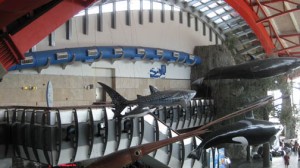
Visitors to Taiwan’s southern-tip Hengchun Peninsula should be certain not to miss the National Museum of Marine Biology & Aquarium. Here, you’ll see a vast, colorful array of corals and the fascinating creatures that inhabit the reef area, as well as a wonderful collection of sea animals that to a large extent, swim around you, giving you the feeling that you’re the exhibit. There are actually two main viewing areas, the Waters of Taiwan and the Coral Kingdom. The aquarium itself is huge, and you want to ensure that you see both areas.

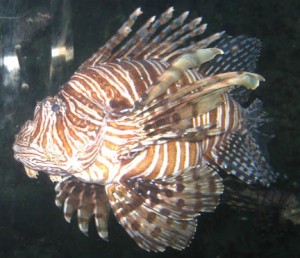
A friendly Lionfish resident of the aquarium, up close & personal

For us here at WoWasis, the Coral Kingdom’s Underwater Tunnel was a highlight, where rays, sharks, and colorful fish swim above and to either side of you, as you walk and stop along the glass-enclosed tunnel. In another tank, friendly belugas nuzzle the glass, curious about onlookers. In the large coral tanks, the colors of the corals and fish living among them are amazing, the Lionfish being among the most spectacular. Across the outside patio at the Waters of Taiwan exhibit, not-to-miss exhibits include the High Mountain Streams, Estuary, Intertidal Zone, Subtidal Zone, and Open Ocean.

There’s a lot to see, and you should plan at least half a day here. Be prepared, though, for lots of screaming kids, and overt commercialism (there’s a gift shop seemingly every 30 feet). Somewhat surprisingly, no shops carry any books in English on the sea life of Taiwan. One kids’ exhibit we really did enjoy were the touch pools, where, under the guidance of friendly staff, we were able to touch all sorts of tide pool creatures.

This is a remarkable aquarium, and there’s a lot to see here, in exhibition tanks that are visually interesting, and contain fascinating sea animals that you may not see in your own country.

National Museum of Marine Biology & Aquarium
2 Houwan Road
Tel (08) 882-5678
http://www.nmmba.gov.tw/english/index.aspx
GPS: N22°02.768’  E120°42.001’

WoWasis visits Taiwan’s Sanxia Zushi (Sansia Zushih) temple near Taipei

Written By: herbrunbridge - Sep• 01•11


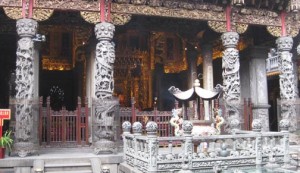
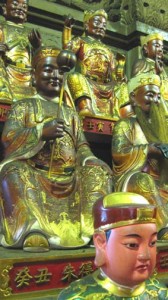
Magnificent stone and wood carvings grace practically every step at Sanxia Temple

The Taipei area is known for its beautiful temples, but for us here at WoWasis, none was more striking than Sanxia Zushi, 30 km southwest of Taipei. It’s a fairly close taxi ride away from the Yingge Ceramics Museum, so our suggestion is that you see both on the same day. In our opinion, Sanxia Zushi is not to be missed.

Originally built in 1769, this outstandingly beautiful temple has been restored three times. The stone and wood carvings are spectacular and the gilded doors and panels extraordinary. Unlike many other temples in Taiwan, you can climb to the second floor, where you’re treated to a close-up of the craftsmanship. Every nook and cranny of this temple has wonders to behold, so a meandering walk through the entire temple is recommended. Be sure to look above you, as the beam structure of the ceilings, eaves, and roof is a wonder in itself.

Exquisitely carved deities at Sanxia Temple

The temple is one of the most outstanding sites in the Taipei area. To visit it, we’d recommend either hiring a car, or take the train and bus to Yingge, then hiring a taxi to take you to Sanxia Zushi.

Sanxia Zushi Temple
1 Changfu Street
Sanxia (Taipei County)
Tel (02) 2671-1031

WoWasis book review: ‘Angelwings,’ queer fiction from Taiwan

Written By: herbrunbridge - Sep• 01•11

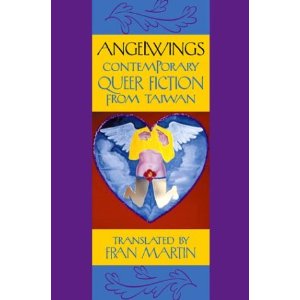
Oh how we desperately wanted to like Angelwings: Contemporary Queer Fiction from Taiwan (2003, ISBN 0-8248-2661-2). It had all the markings of a winner, ten short fiction stories told from a gay, lesbian, bisexual, transgender perspective (referred to in Taiwan as the tonqzhi and ku’er wenxue movements). Here at WoWasis, our problem was that the stories had few compelling characters. There was a lot of whining. And a common idea voiced in several of the stories was the disgust with older men paying younger lesbians for sex (the writers felt, apparently, that they themselves would never grow old, never be alone, and would have the luxury of free sex with beautiful people forever).

OK, we’re a bit spoiled, having immersed ourselves in John Rechy’s City of Night and a few others, fiction with gay themes where plots were intriguing beyond navel contemplation and  characters evolved beyond teen angst; in short, playing with the big boys (and girls) of the hetero fiction world on their own turf. Compelling stories and characters never go out of style, regardless of the sexual or social politics. Part of the problem here may be in the criteria used to choose these ten works for inclusion in the volume, about which translator Fran Martin writes:

“It would be impossible in a volume of this length to include every work classifiable as tonqzhi or ku’er wenxue, expansive as this field has become. Inclusions here are limited first by the date of their publication: Ten stories have been chosen that appeared between 1989 and 1998, roughly demarcating the decade of the 1990s. This is partly in order to describe the outline of the tonqzhi and ku’er wenxue movements that took recognizable shape only with the publication and reception of this material in the 1990s. Partly, too, the decision to omit earlier gay- or lesbian-themed fiction (most obviously that of Pai Hsien-yung) is due to my desire to present the work of authors whose writing has not been extensively translated into English before now. Another factor restricting what appears in this volume is length: Since this is a collection of short fiction, I have not been able to include work by writers who have to date only published novels, such as the young author of popular lesbian fiction, Du Xiulan. Inclusions are limited to one story per author, and individual stories have been chosen either for their exemplification of an author’s style, or for their special popularity with tongzhi readerships.”

Style and popularity don’t always a compelling tale make. We did like Fran Martin’s comprehensive 28 page introduction describing the history of the gay literature movement in Taiwan, which does a fine job of putting the movement into a historical and social context, and this, we believe, is the real strength of the book. Although Martin sails perilously close to the bane of scholarly writing (we never again want to read anything using the word hegemony), she manages to somehow avoid the rocky shoals of didacticism in providing a history that’s important to the literature. Any reader of queer fiction from Taiwan would find her introduction to be of value.

Our favorite story was Chen Xue’s Searching for the Lost Wings of the Angel, a somewhat abstract reading of the relationship between a mother and a daughter that we found ultimately fascinating. We also enjoyed Wu Jiwen’s tale of sexual transformation, Rose is the Past Tense of Rise, although we found that the constant back-references to geographer Sven Hedin’s 1934 expedition, embedded periodically througghout Wu’s story, broke the flow of the narrative. Particularly for Martin’s the history of this literary movement, we are thankful for the book, and are looking forward to reading more queer fiction from Taiwan as it continues to evolve. Buy it here at the WoWasis eStore.

WoWasis visits Taiwan’s Yingge Ceramics Museum

Written By: herbrunbridge - Aug• 31•11

Located roughly 30 minutes outside of downtown Taipei, the Yingge Ceramics Museum, located in New Taipei City, is well worth the visit. Housed in a dynamic glass-concrete-steel building, the museum houses some 2,000 pieces of pottery, many of which are remarkable. The history of pottery making in Taiwan is ancient, the quality outstanding. Permanent exhibitions include a history of Taiwan told through pottery, the history of the town of Yingge as a pottery center, Prehistoric/Aboriginal Taiwanese pottery, and Industrial and High-Tech Ceramics. The fascinating pieces in the museum span from the utilitarian to the decorative (the glazed roof tiles were among our favorites), and it’s easy to spend a half-day enjoying its 3 floors of exhibits. The museum is part of the larger Ceramics Park, with includes kilns and demonstration areas.

Special exhibitions are part of the museum experience, too. We here at WoWasis enjoyed the Classic Ceramics Brands of Taiwan exhibition, which included exquisite and utilitarian dinnerware and toilets. The curators are clearly proud of everything ceramically produced in Taiwan.

Yingge town, a few blocks away, has a pottery district centered on Old Pottery Street, but the shops’ output is pedestrian, and in our opinion, your time is better spent at the museum, one of the most intriguing, from a collection and presentation perspective, in Taiwan. A short distance away by taxi is the remarkable Sanxia Zushi Temple, one of the highlights of the Taipei area. We recommend you visit both of these compelling places on the same day, since you’re in the area.

New Taipei City Yingge Ceramics Museum
200 Wenhua Rd., Yingge District
New Taipei City
GPS: N24°57.002’  E121°21.122’
Tel (02) 8677-2727
open daily, closed first Monday of every month
http://www.ceramics.ntpc.gov.tw/en-us/Home.ycm
Directions from Taipei by train: From Taipei, depart at the Yingge Station. Exit at Wunhua Road and turn rigjt, you will find yourself in the old commercial street. Walk along Wunhua Road for about six minutes and you’ll come across a drainage crossing under the railroad. Turn right under the crossing and in three minutes you will reach the Old Ceramics Street (Jianshanpu Road). Turn left here and walk along Wunhua for three minutes and you will arrive at the Museum

WoWasis book review: Wang Wen-hsing’s ‘Family Catastrophe’ from Taiwan

Written By: herbrunbridge - Aug• 30•11

When originally written in 1972, Wang Wen-hsing’s ‘Family Catastrophe’ created a ton of controversy. His story of a dysfunctional family flew in the face of the Confucian concept of respect for parents. The story revolves around a young man named Fan Yeh, and is unfolded in a non-traditional time-lapse interpretation involving an older step-brother, a mother consumed by jealousy, and a hard-working but ineffectual father ultimately beaten down by a system over which he has no control.

Translated into English in 1995 by Susan Wan Dolling (ISBN 0-8248-1710-9, in paperback), the book provides a description of the slow decline faced my many families lacking education as Taiwan began evolving into a high-tech giant. Fan Yeh’s mainland-raised father is self-sacrificing in his ultimately successful attempt to get his son educated. He cannot, however, come to grips with social change as he destroys his relationship with his step-son due to the latter’s insistence on marrying a woman from an indigenous Taiwanese group. As Fan Yeh grows older, he becomes more disgusted by the squalor in which he’s been raised (his description of his boarding house outhouse on pp. 160-161 is revolting), but yet continues to live with his parents, conflicted in the fealty of living with his parents while holding down a teaching job that would have allowed him to better his own living conditions. As his father descends into dementia, Fan Yeh loses all patience with his family situation, giving the reader the sense that he wishes his parents would just die.

Wang’s descriptive qualities are finely reflected in Dolling’s translation. As a youth, Fan Yeh is introduced to the theatre, where he falls in love with the actress playing the lead romantic role, but his attitude suddenly changes when he encounters, along with his step-brother Erh-ko, the troupe on the street after the play:

Again they rode around and reentered that quiet street. This time they saw a small crowd of people gathered round a brightly lit noodle stand. Erh-ko’s curiosity was aroused, and he steered over to have a look. The brothers saw that the crowd had gathered to watch those same actors in the play they had just seen. Traces of stage makeup could still be seen on some of their faces around the brows and cheeks. His erh-ko parked the bike in a hurry and joined the circle of onlookers. He, too, squeezed in. He saw that these actors had on rather shabby clothes; the men were wearing old jackets on top of khaki pants, and the women were wearing old sweaters. He searched among them for Hsia Pei-li. He almost missed her.

She was wearing an old black sweater. Her face appeared a scummy yellow, making her look much older than before. Then he heard her say: “My stomach’s killing me. This stomach acts up whenever the belly goes empty. Hey, big boss, give us some more of that beef! And don’t stint on the MSG!” Just then a gust of wind swept past, and she let out a thunderous sneeze. Wiping her nose with the back of her hand, she flung the snot onto the ground. A man in a blue cotton jacket entered the picture. On closer inspection, he turned out to be Ch’u Cheng-wei. He heard him say to the others, “That son of a bitch. What a waste of time putting in those extra hours. That skinflint won’t pay us a cent over fifty dollars. And he won’t even give that till tomorrow!” The whole cast was in an uproar. Hsia Pei-li’s shrill voice was heard above the din, shouting, “Fuck his goddamn forefathers and their rucking sons’ I’ll give him a good thrashing, that pig of a fat Chu and his chicken prick! That lousy asshole with his slimy, sugary eyes thinks he can fool us with his sweet words and honeyed phrases and then turn around and stab us in the back. Well, I’ll go have it out with him if it kills me!” “Okay, okay, old mother hen, the noodles are here. Have some before you go killing anyone!” one of the actors said. “Right you are. I’ll have my noodles first, and then I’ll go settle accounts with him!”

He and his brother left after that remark. Right then and there his love for her vanished. It was as if the play had never been and his feelings for her had never been. He felt as if a great load had been lifted from his shoulders; he was traveling light on the journey home.

Disillusionment is a theme that runs through the entire book, on every level, with every character. Overall, the book is recommended as a fine interpretation of familial conflicts and Taiwanese cultural mores in a nation in the midst of transition. Order it at the WoWasis eStore.