The sharper edge to traveling in Asia

Taiwan’s Green Island Ferry from Fugang Harbor

Written By: herbrunbridge - Sep• 14•11

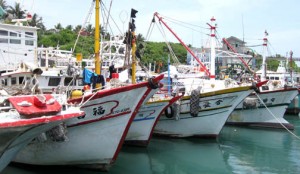
Colorful Fugang harbor's fishing fleet

Located 33 km off Taiwan’s southeastern coast, along the East Coast National Scenic Area, Green Island makes for a nice one or two-day stay. The beaches and sea views are worth noting, snorkelers can view colorful corals, and there’s a seawater-fed hot springs. The Green Island Human Rights Memorial Park, a former prison, has a museum that chronicles the conditions faced by the many political prisoners that were detained there during Taiwan’s martial era. The island is encircled by a 17 km road, and there is a visitor center (open 8:30 – 17:00) across from the airport in the island town of Jhongliao.

Green Island Ferry

The mainland ferry terminal from Fugang Harbor is located a few minutes north of the city of Taitung, just off highway 11. Signs for the ferry terminal are confusing, so follow the WoWasis GPS coordinates below. The ferry does not take cars, so if you’re traveling by car, you can park your car free near the ferry terminal, and stay overnight on the island (the last daily ferry for the mainland leaves at 16:30). The trip takes under one hour. From Green Island, you can also take a ferry to Orchid Island, two hours south by boat.

Farnlin Ferry to Green Island
Fugang Harbor
Tel: (089) 281-047
GPS: N22°47.448’  E121°11.531’
Fares: NT$ 460 one way, NT$ 920 round trip

Daily Schedule

To Green Island: 9:30, 10:15, 11:30, 13:15, 13:30, 15:15
Return from Green Island: 10:00, 12:00, 12:30, 14:00, 14:15, 14:30, 16:30
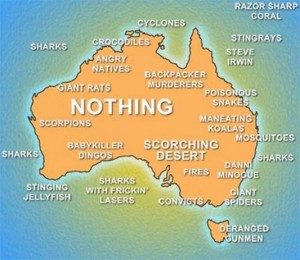
Why WoWasis considers visiting Australia

Written By: herbrunbridge - Sep• 13•11

Here at WoWasis, we’ve met tons of friendly Aussies the world over. We love their cynical sense of humor, and this questionnaire ended up in our mailbox, and we don’t know the source. So take a look at the map, read the questions and answers, and book your flight! 

Q: Does it ever get windy in Australia ? I have never seen it rain on TV, how do the plants grow? ( UK). 
A: We import all plants fully grown, and then just sit around watching them die. 
  __________________________________________________

Q: Will I be able to see kangaroos in the street? ( USA) 
A: Depends how much you’ve been drinking.
 __________________________________________________

Q: I want to walk from Perth to Sydney – can I follow the railroad tracks? ( Sweden)
A: Sure, it’s only three thousand miles.  Take lots of water. 
 __________________________________________________

Q: Are there any ATMs (cash machines) in Australia ? Can you send me a list of them in Brisbane , Cairns , Townsville and Hervey Bay ? ( UK) 
A: What did your last slave die of?
__________________________________________________

Q: Can you give me some information about hippo racing in Australia ? ( USA) 
A: A-fri-ca is the big triangle shaped continent south of Europe .
Aus-tra-lia is that big island in the middle of the Pacific which does not …
Oh, forget it.  Sure, the hippo racing is every Tuesday night in Kings Cross. Come naked.
 __________________________________________________

Q: Which direction is North in Australia ? ( USA) 
A: Face south, and then turn 180 degrees. Contact us when you get here and we’ll send the rest of the directions. 
 _________________________________________________

Q: Can I bring cutlery into Australia ? ( UK) 
A: Why? Just use your fingers like we do.
 __________________________________________________

Q: Can you send me the   Vienna Boys’ Choir schedule? ( USA)
A: Aus-tri-a is that quaint little country bordering Ger-man-y, which is …  
Oh, forget it.  Sure, the Vienna Boys Choir plays every Tuesday night in Kings Cross, straight after the hippo races. Come naked.
  __________________________________________________

Q: Can I wear high heels in Australia ? ( UK) 
A: You are a British politician, right?
 __________________________________________________

Q: Are there supermarkets in Sydney and is milk available all year round? ( Germany) 
A: No, we are a peaceful civilization of vegan hunter/gatherers.  Milk is illegal.
  __________________________________________________

Q: Please send a list of all doctors in  Australia who can Dispense rattlesnake serum. ( USA) 
A: Rattlesnakes live in A-meri-ca, which is where YOU come from. All Australian snakes are perfectly harmless, can be safely handled, and make good pets.
  __________________________________________________ 

Q: I have a question about a famous animal in Australia, but I forget its name. It’s a kind of bear and lives in trees. ( USA) 
A: It’s called a Drop Bear. They are so called because they drop out of gum trees and eat the brains of anyone walking underneath them.

You can scare them off by spraying yourself with human urine before you go out walking.
  __________________________________________________

Q: I have developed a new product that is the fountain of youth. Can you tell me where I can sell it in Australia ? ( ) 
A: Anywhere significant numbers of Americans gather.
  __________________________________________________ 
  
Q: 
Do you celebrate Christmas in Australia ? ( France) 
A: Only at Christmas.
  __________________________________________________
  
Q: Will I be able to speak English most places I go? (
 USA) 
A: Yes, but you’ll have to learn it first.

WoWasis visits Taiwan’s Shung Ye Museum of Formosan Aborigines in Taipei

Written By: herbrunbridge - Sep• 13•11

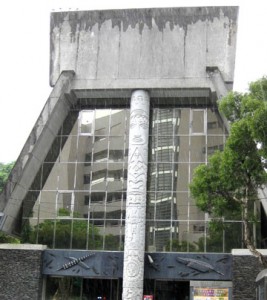
The Shung Ye Museum of Formosan Aborigines is located one block away from Taipei’s  National Palace Museum, and is a must for visitors wishing to learn more about Taiwan’s indigenous aboriginal peoples, which include the Amis, Atayal, Bunun, Kavalan, Paiwan, Puyuma, Rukai, Saisiyat, Sakizaya, Sediq, Thao, Truku (Taroko), Tsou, and Yami (Tao) tribes.

It was opened in 1994, and originally based on the collection of Shung Ye Group Chairman Safe C. F. Lin. Now housing over 1,000 items, the museum continues its research, collection, and field studies activities. Here, you’ll find wonderful exhibits on the clothing, implements, weapons, utensils, songs and dances, and marriage ceremonies of these groups. The museum also has what we here at WoWasis believe is probably the best selection of English language books relating to different ethnicities in Taiwan, and the guidebook (in English) is well worth buying, and essentially a book in itself.

The museum can easily be visited in one-two hours, and often features dancers and musicians performing aboriginal music and dance on its front steps. The National Palace  and Shung Ye Museums have combined on a special rate for a ticket to both museums. It’s not highly advertised, but all you have to do is ask at either one.

Shung YeMuseum of Formosan Aborigines
282 Jhihshan Road
Tel: (02) 2841-2611
Open Tuesday-Sunday
http://www.museum.org.tw/SYMM_en/index.htm
MRT stop Shilin, then take Red #30 bus

WoWasis book review: ‘Taiwan’s Aboriginal Peoples’ photo book

Written By: herbrunbridge - Sep• 13•11

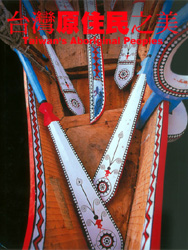
Visitors to Taiwan are often surprised by the richness of her aboriginal culture, but finding books in English describing the richness and variety of these cultures can be daunting. Taiwan’s Aboriginal Peoples (2002, ISBN 957-01-2744-9), with photographs and text by Wang Wei-chang, and English translation by Phillip Newell, is a lavishly photographed, bi-lingual, large-format book that brings the beauty and majesty of these cultures into light.

With the exclusion of the Pingpu western plains tribes, Taiwan’s aboriginal people are divided here into ten tribes: Atayal, Saishia, Bunun, Shao, Tsou, Rukai, Amis, Puyuma, Paiwan and Tao. This 200 page book contains scores of photographs of these peoples, their homes, crafts, clothing, and rituals. 60 of these photographs are reviewed, with additional text, at the end of the book. Wang is an exceptional photographer, combining documentary and art in a book that will appeal to ethnographers, travelers, and armchair adventurers. The creation of the book was a major undertaking planned and executed by Taiwan’s Council for Cultural Affairs through Yuanliou Publishers, as one inf the series of “Beauty of Taiwan” books.

We here at WoWasis discovered that this important book is not all that easy to find and purchase, even in Taiwan. In Taipei, it is always in stock at the Shung Ye Museum of Formosan Aborigines, though. Along with the Shung Ye Museum guidebook, it is essential reading for anyone interested in Taiwan’s aboriginal cultures.

For more about this book, visit the Council for Cultural Affairs website.

Bachelor in Bangkok: Khun Lee on the life story of a 21 year old Thai bar girl

Written By: herbrunbridge - Sep• 11•11

She is only 21 years old but already has 4 ½ years of working as an “entertainment provider” under her belt.  Now fluent in both English and Thai while studying Mandarin Chinese, this confident young lady and I sat down this week for a cup of coffee and she told the entire story of her life from age 15 to the present.  I have always been curious as to how the gals enter the naughty nightlife industry and I hope you readers will find her story as interesting as I did.  Noon is from Isaan in Northeastern Thailand and we first met when she was a go-go dancer in a Nana Plaza bar.  I didn’t know it at the time, but she was just 16 years old back then and she was new to the business.  Unfortunately this is not at all uncommon and many gals from the poor Isaan region are expected to begin helping the family financially well before they reach the age of 18.  We became friends as her roommate at the time was one of my regular companions, and much like most of the gals she has come and gone many times from the bars and freelance places, as well as having short to long term arrangements with customers and a few spells back home just relaxing.  This is a synopsis of her story: 

“When I was 15 my family moved from Isaan to Bangkok because my parents wanted to open a business making the inexpensive clothes that you see sold on the street and in the inexpensive places like Pratunam and Chatuchak.  We didn’t have the money for me to continue high school so I took a job working at Tesco Lotus Super Market for 5,000 baht a month.  One day while I was working there a female customer who was about my age told me she was working in Nana Plaza as a go-go dancer and she was making more than 10 times as much money as I was!  I had often heard stories of how much money these girls made, but until I actually met someone who gave me the details I really never believed it.  Thai men normally pay only a couple hundred baht for sex and I still can’t understand why foreigners pay so much.  Anyway, she brought me to the bar and introduced me to the manager and some of the other girls.  I decided to try working there just to see if I liked it and could make good money as my parent’s business wasn’t going so well and my family really needed the money.  It was actually a lot of fun at first as you only have to work 5 or 6 hours a night as opposed to the 12 hour days I was used to, and I had customers take me out of the bar nearly every night.  I made nearly 60,000 baht my first month and also had a lot of gold, jewelry and clothes bought for me by customers.” 

“After 6 months a guy from England wanted to live with me so he payed the bar 15,000 baht and we stayed together for 1 ½ years.  He was a pretty good guy but smoked too much and he almost never showered.  Then I returned to the bar and met another guy who was from Switzerland.  We stayed in Europe a year living in 4 or 5 countries.  I liked him a lot but he was old and never liked to do fun things.  He told me I couldn’t go out of the house except with him and it got really boring staying inside all the time.  I left him and went back to my old bar. I danced another year and then met my current guy who is from England, too.  I have been with him 6 months.  I really loved him at first, but I went home to see my Mother last month and when I got back the Thai guy at the front desk of our apartment building told me he had another girl in the room for sex.  Now I know he doesn’t love me.  You know I am a Thai lady (she gets a glint in her eye) I want to have love, but if I cannot have love I will have money.  Now I just spend all of his money and buy whatever I want.  He is stupid like a buffalo. When he has no more money I will return to the bar again.  In our language we like to say “it is impossible to have both money and love.”  The guys who are smart, confident and sexy will never give you money.  And the guys who give you money are never the guys who you can love.  It’s OK because I have a really sexy Thai boyfriend now but I don’t have much time to see him.  He works in a shipyard near Chonburi.  Now I am an old lady (almost 22) so I have to be serious about my future.  What do you think I should do?” 

Noon’s story is very normal in many ways.  She is from Isaan, has a poor family and hasn’t saved any of the money that guys have spent on her and given to her.  One comment I need to make here is that it is very important not to make your main gal lose face.  Her current boyfriend (sponsor) had sex with another gal in the apartment he is sharing with Noon.  The gals will ALWAYS find out about this as Thais stick together and a security guard, clerk, neighbor or someone else will tell her for sure.  Use the short-time rooms guys!

Read Khun Lee’s other WoWasis columns for more advice on navigating the adult dating scene through the backstreets of Bangkok

WoWasis visits Taiwan’s National Museum of Prehistory in Taitung

Written By: herbrunbridge - Sep• 08•11

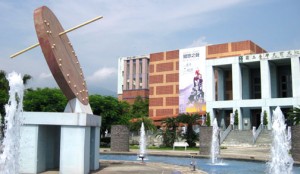
Although it’s not the easiest place to find (see our GPS coordinates below), we here at WoWasis think the National Museum of Prehistory in the southeastern Taiwanese city of Taitung is definitely worth a visit in you’re in the area. The building itself is gorgeous, designed by noted architect Michael Graves, and the displays are well-done. On the second floor, you’ll become acquainted with the prehistoric Austronesian peoples of Taiwan, including the Changbin group. Throughout the museum, you’ll find an outstanding array of artifacts, including pottery, jade, farm and hunting implements, coffins, megaliths, and stone wheels.

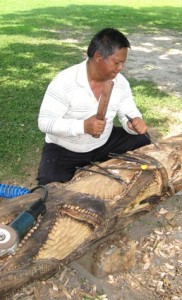
Log carver, Peinan Cultural Park

Within a mile or so is the Peinan (Beinan) Culture Park, housed on the site of a 2,000 year old Peinan town, with a smattering of wood houses representing Taiwan’s aboriginal peoples, an ongoing archaeological dig, and a visitor center. In addition to the archaeological work, you’ll see artisans here as well, such as the carver of aboriginally-decorated logs that we saw on our visit. These venues are located at Taitung, southern terminus of the East Coast National Scenic Area.

National Museum of Prehistory
1 Museum Road
Taiting
Tel: (089) 381-166
http://en.nmp.gov.tw/about01.html
GPS: N22°45.631’  E121°05.556’
Open Tuesday-Sunday

Peinan Culture Park
200 Culture Park Road
Nanwang, Taitung
Tel: (089) 233-466
GPS: N22°47.650’  E121°06.972’
Open Tuesday-Sunday

WoWasis drives Taiwan’s Northeast Coast National Scenic Area

Written By: herbrunbridge - Sep• 07•11

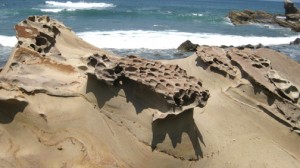
Colorful weathered rocks at Nanya

Beginning just 50 km east of Taipei is what we here at WoWasis believe to be one of the most scenic drive in Taiwan, the Northeast National Scenic Area route, along Provincial Highway 2. Here, you’ll see marvelous sea views, wonderful geological formations, and several lighthouses. It starts at Nanya, and runs 66 km south to Toucheng. If you choose to proceed south from there, you’ll see the Yilan coast as well, on your way to Taroko Gorge. Continuing south from Taroko, you’ll drive along the East Coast National Scenic Area.

Your first highlight is the Nanya Rocks, where brilliantly weathered rocks stand in a lovely seascape. . Nanya’s parking lot (the sign reads ‘Nanya Particular Stone’) is located on the western side of the road between the 81 and 82 km markers at GPS: N25°07.150’  E121°53.569’.

Santiao lighthouse

Bitou Cape is located 1.6 km south. Drive up to the Bitou Elementary School parking lot and take the trail to the 40 foot high Bitou Lighthouse, and be sure to notice the rocks weathered into patterns by the sea below you.

Into rock climbing? Longdon Cape (km 87) has 30 meter (110 foot) sandstone cliffs, and instruction is available.

Just south of the 100k Marker is the Fulong Visitors Center, where English-speaking rangers give out a very good English map of the scenic area.

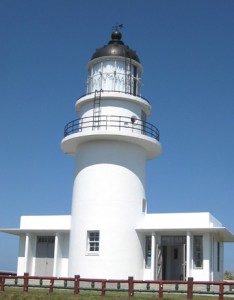
Santiao Cape, just south of km 108, is the easternmost part of Taiwan, and here the Santiao Chiao (San Diego Cape) lighthouse has gorgeous views, and a small exhibit area within the lighthouse itself (closed Mondays).

At the 117 km marker, you’ll find the town of Dali, home to the Dali Tiangong Temple, affording a beautiful view over the ocean. Dali is also the southern terminus to the Caoling Historic Trail, an 8km foot trail with nice ocean views and historical buildings and temples, which runs north-south, and bisects the cape.

The scenic area officially ends near the 135 km marker.  On the drive, you’ll pass many seafood restaurants and fishing towns, and great views. While you’ll see wonderful scenery, it won’t include many westerners, and English isn’t spoken much here (most people touring this area are Taiwanese, Chinese, or Japanese).  Sign language does wonderfully, though, as friendly Taiwanese residents are always happy to guide you to an eating or sleeping establishment.  The map you’ll receive at the Fulong Vistors Center (above) is important, as it’s bilingual, helpful for when you’re looking for something, as you can point to the Chinese script which accompanies the place you’re seeking.

This lovely drive is easily made from Taipei. If you don’t wish to continue south to Taroko Gorge, you can take Regional highway 2 at the 139 km marker, which links to highway 5, back to the Taipei area.

WoWasis visits the Taiwan Theater Museum in Ilan (Yilan)

Written By: herbrunbridge - Sep• 05•11

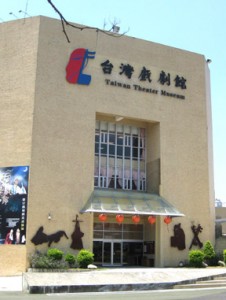
Just a few km south of the northeastern Taiwan city of Jaosi is Ilan (Yilan), home of the Taiwan Theater Museum. Formally opened in 1990 as the Taiwanese Opera Museum, its exhibits include artifacts relating to Taiwanese and Beiguan Opera, and Puppet theatre. In the opinion of your review team here at WoWasis, the puppets are the highlight of the collection making the museum well worth a visit.

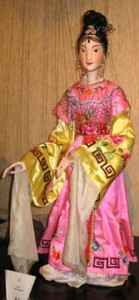
'Dan' sting puppet, Taiwan Theater Museum

The string puppet (marionette) collection is outstanding, and focuses on the Chuanchou school of Tainan, and the Kaohsiung and Jhangchou school of Ilan. They are beautifully costumed and displayed, with notations in English. There is also a great collection of Taiwanese glove (hand) puppets. The collection of Chinese opera costumes on the 3rd floor is compelling.

After your visit to the museum, the beautiful coastal highway 2 is a short drive away.

Taiwan Theater Museum
101 Fusing Road
Yilan
Tel: (03) 932-2440
Open Tuesday through Sunday, closed for lunch.
www.ilccb.gov.tw/en/about-detail.php?menuid=1
GPS: N24°44.987’  E121°44.689’

WoWasis visits hot springs and the Sietian Temple at Jaosi (Jaoxi), Northeastern Taiwan

Written By: herbrunbridge - Sep• 05•11

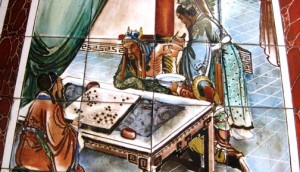
Man tattooed while playing a board game, painted tiles and Jaosi's Sietian Temple

If you’re driving south on the eastern Highway 2 from the Northeast Coast National Scenic Area, a refreshing stop is at the city of Jaosi (Jaoxi), just north of the city of Ilan (Yilan).  Jaosi is famous for its hot springs and temple. We’d recommend seeing the Sietian (Xietian) temple first, then staying, kike your WoWasis review team did, overnight at a spa/hotel for a relaxing soak.

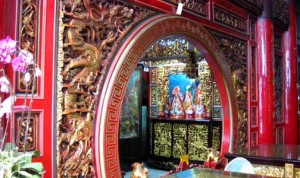
The Sietian Temple is not to be missed. Its carved doors offer beautifully carved wooden figures in high relief and moon doorways that offer delightful views of the interior of the temple. What caught our eye, though, were the artistically ravishing painted tile panels along the interior walls, depicting sea disasters, scholars, and the fascinating scene of a man being tattooed while playing a board game. Hidden in a corner of the old city, the temple is not all that easy to find, so follow our GPS coordinates below.

Interior of Sietian Temple

Jaosi is famous for its hot springs, and scores of hotels and spas offer private pools where you can soak and relax. We enjoyed the Yeager Hot-Springs House, with beautifully appointed rooms and spas, a few blocks north of the train station.

On departing Jaosi heading south, be sure to stop in the nearby city of Ilan to see the Taiwan Theater Museum, before heading back to the coast.

Yeager Hot-Springs House
Tel: (03) 988-3525
GPS: N24°49.913’  E121°40.420’

Sietian Temple
51 Jhongshan Road
Tel: (03) 988-2621
GPS: N24°49.077’  E121°46.145’

WoWasis visits Taipei’s Xingtian Temple and fortune tunnel

Written By: herbrunbridge - Sep• 04•11

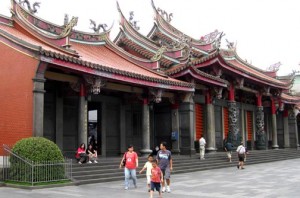
There’s more than first meets the eye at Taipei’s Xingtian temple. It’s deity is Guangong, patron saint of merchants. The temple itself has soaring, ship-prow roofs adorned with carved dragons, and inside you’ll see people standing in line to get blessed by nuns in blue robes, who wave incense onto the clothes of visitors in the practice of shoujing, which restores souls that have left the body in a frightened state.

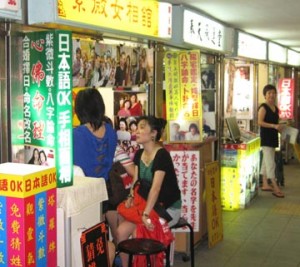
But we here at WoWasis also recommend that take a short walk through the pedestrian tunnel that goes under the adjacent roadway. Here, you’ll find one of the most famous series of fortune-telling shops in Taipei, where many discuss their futures before or after leaving the temple.

Xingtian Temple
109 Minquan East Road
Taipei)
Tel 2502-7924
www.ht.org.tw