The sharper edge to traveling in Asia

Bachelor in Bangkok: Khun Lee on Entertainment Providers, Sex Workers, and International Tourists

Written By: herbrunbridge - Jul• 04•10

I have an English friend in Bangkok who has gotten himself into quite a mess. This guy has the same “disconnect” that I see in so many western men in Thailand. Let me explain what I mean by “disconnect.” When I meet educated, successful men from Asia, Latin America, Africa, or anywhere other than Europe, North America, Australia etc., these guys always know that they have value and any woman who wants to be with them better be someone very special. They are right. Everywhere on this planet women are seeking men who are intelligent, educated, and successful and know how to treat a lady with respect.  Any man with these qualities can pick and choose from all the available women regardless of where he happens to be residing.  If he happens to be living in Southeast Asia, he will be easily in the top 1% of all available men. 

Somehow the men who come from the western world just haven’t figured this out.  Countless times I see western men who are masters of their domains in every other aspect of their lives, but yet have chosen a low class uneducated gal for a girlfriend/wife and are allowing her to walk all over him. Some of my western friends and ALL of my Asian friends are absolutely baffled by this phenomenon. My English friend referred to earlier is a classic example. Went to a fine university, executive for a top European company, flies all over the world teaching rich people what to do with their money—but yet he has a horrible Thai wife who treats him like a dog!  This is NOT a reflection on Thai women.  Most women will treat a man with disrespect once they have seen that he has no self respect.  Guys, no matter how horrible it may have been for you when you were living in Farangland, PLEASE  PLEASE never forget that you most likely possess most of the qualities women are seeking, and if you move to Thailand, be confident in the fact that you are desirable and sought after.

Last month I returned to Bangkok from my semi-annual trip to my little corner of Farangland.  One very simple chore will shed light on the difference between my social life here and my social life in the U.S.  When I landed in the U.S. I unpacked and put away all my belongings the very first night.  Well, I was back in Bangkok 2 ½ weeks before I got around to unpacking my bags! Yep, my bags sat on the floor of my apartment that long before I got around to doing something about it. 

Speaking of the U.S., one interesting thing to note is the reaction of my best buddy there to the photos of a few of my favorite Thai ladies. His first reaction was to say he believed they were all professional models. I’m not sure how much of this is a reflection on how beautiful my lady friends are, and how much is a reflection on how ugly the ladies are in my hometown. His second reaction was to say he had never seen such a big smile on my face as I had in the photos.  Now, how can I possibly explain to him why I never smile that big in the U.S.? He’ll just have to come here if he really wants to find out!

One dilemma in hanging out in the naughty bars so much is that most guys don’t know the proper term to use when referring to their favorite Entertainment Provider.  I think I just proved this point by stealing Dean Barrett’s term “Entertainment Provider!” Bar girl doesn’t work because most girls who work in bars don’t sleep with men for money.  Terms like prostitute etc. are offensive to most of the guys here as they have a negative connotation in Farangland, and really the ladies here give so much more of themselves than a normal prostitute would.  Girlfriend also is inaccurate as you certainly don’t pay your girlfriend to be your girlfriend.  Anyway, I was practicing my Thai by reading the Thai newspaper the other day and I found the perfect term.  Ladies in Thailand who entertain gentlemen for money use a term in Thai that translates as “sex worker.” That’s what they are! It isn’t negative (like prostitute) and not unrealistic (like girlfriend) it simply explains the nature of the work without being overly negative or positive. Now how do we get this term to catch on…?

One thing that really irritates me is all the bad press that Thailand gets in the western world.  There are so many negative stereotypes thrown around recklessly and with a certain amount of contempt.  Khun Lee is here to dispel one of the most common negative stereotypes that Thailand often has to endure.  Countless times in the western press Thailand is referred to as a place where middle aged fat western men come for the singular purpose of soliciting sex. Well, this sounds pretty good to me, but believe it or not this is considered to be a bad thing by many people. Anyway, this week I read in the Bangkok Post that Thailand has the highest percentage of female tourists of any country in Southeast Asia. Yes, 41% of the visitors to Thailand are female. To further illustrate my point, the other day I was at the Immigration Department in Bangkok and there was a really good cross section of visitors there.  Doesn’t matter if you are male or female, young or old, from Zimbabwe, Switzerland or Taiwan, you have to take care of the visa requirements.  Well, out of around 200 people there I believe I saw 6 western men.  Seldom have I seen such a wide variety of people.  I thought I was in the United Nations!

Read Khun Lee’s other WoWasis 
columns for more advice on navigating the adult dating scene through the backstreets of Bangkok
WoWasis visits the city of Mandalay, Burma

Written By: herbrunbridge - Jul• 02•10

Take a half-day tour of Mandalay!  While visitors will find that the city of Mandalay pales in comparison with Rangoon, and the ancient palace, lying within the moat, was mostly destroyed by fighting in WWII, it remains a fascinating city with its on vibe. Today, Mandalay is best visited as a home base for day trips to the monasteries of Sagaing and Inwa, the massive Mingun Paya temple in ruins, and tour the pretty hillside station of Pyin U Lwin (Maymyo). Mandalay’s spanking-new airport is indicative of Mandalay’s enhanced status as the portal to northern Burma. From Mandalay, tour Mingun Paya, tour Amapura, Inwa and Ava.

Here at WoWasis, we found the highlight of the city itself was the Mandalay Marionettes and Culture Show, a wonderful one hour show showcasing live music, puppetry, and dancing.  To support the theatre, you may also buy marionettes at their shop.
Mandalay Marionettes and Culture Show, Garden Villa Theatre
66th Street, between 26th and 27th Streets, near the Sedona Hotel
Tel: +(95) 234-446
Shows nightly at 8:30 pm
www.mandalaymarionettes.com

In addition to the day trips mentioned above, you may also use Mandalay as your entry point to Pyin U Lwin (Maymyo), a pleasant colonial British hill station situated 70 km northeast of Mandalay. Here, you’ll see remnants of colonial architecture, which you can see by walking, or taking horse-drawn mini-stagecoaches. Visitors revel in the cool climate, leisurely pace, and fresh air.  Pyin U Lwin is known for its exceptional vegetables and flowers, and boasts an attractive botanical garden

To get to Pyin U Lwin, you may either take a local bus (enquire for directions to the bus stop at your hotel) or hire a car and driver (price is roughly $25 per day).  The trip up the mountain takes approximately three hours. 

Mandalay also has several Resort/hotel spas.

To get to Mandalay, Air Mandalay (www.air-mandalay.com) receives inbound flights from Chiang Mai, Thailand each week, but does not offer outbound service back to Chiang Mai. Yangon Airways (www.yangonair.com) flies roughly the same domestic Burmese routes as does Air Mandalay, generally on alternate days. 

To get to the city of Mandalay from the airport, go to theairport taxi kiosk, where you can order a taxi to your hotel for $8-10.  The airport is a ways out of town, so be sure to give yourself enough time when flying out of Mandalay.

Tour Mandalay, tour Amapura, Inwa, and Ava, tour Mingun Paya!

WoWasis’ day trip to Sagaing and Inwa, from Mandalay, Burma

Written By: herbrunbridge - Jul• 01•10


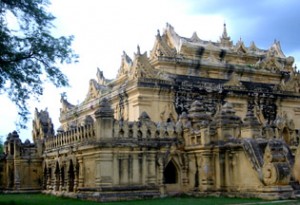
The monastery at Inwa, Burma

WoWasis visitors to the Burmese city of Mandalay will want to take this day trip to nearby Sagaing and Inwa. Formerly known by its traditional name of Ava, the town of Inwa was the capital of Burma from 1364 until 1841, when it moved to Amarapura following a devastating earthquake.  Today, there’s precious little left of either, but the beautiful masonry monastery, and 30 meter tall watchtower in Inwa are beautifully situated in a countryside setting. 

On the way to Inwa, you’ll want to make a one to two hour stop at Sagaing, home to dozens of monasteries.  The hillside Buddhist area is located slightly north of the city.  Sagaing was the capital of the Shan kingdom in 1315, prior to its move to Inwa.  It has nice views, and represents a peaceful break from the heat and bustle of Mandalay. 

To get to Sagaing and Inwa, hire a driver and car (approximately $25)  in Mandalay.  After Sagaing, your driver will drop you at the ferry.  From there, you’ll take a horse and carriage for a three hour tour of the Inwa area, for approximately 1,000 kyat.  On the return, ask your driver if he’ll make a brief stop at U Bein’s Bridge, a picturesque teak footbridge that crosses Taungthaman Lake.  With bends and curves, it’s over 1 km long. 

Mandalay visitors will also want to take a separate day trip to the magnificent ruined temple of Mingun Paya.

WoWasis visits the spectacular ruined temple of Mingun Paya, Burma

Written By: herbrunbridge - Jul• 01•10

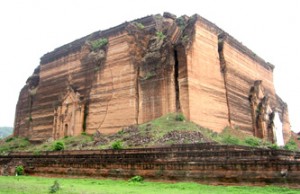
The mammoth temple of Mingun Paya. Chances are you’ll have the whole place to yourself.

Tour Mingun Paya! When you’re in Burma, the massive, ruined temple of Mingun Paya is not to be missed, and WoWasis visitors will discover that the river trip from Mandalay is just as rewarding as the visit to the huge structure itself.  Built by thousands of slave laborers commencing in 1790, work was halted in 1819 upon the death of King Bodawpaya. In 1838, an earthquake destroyed large portions of what many scholars believe to be the largest brick edifice ever built.  Huge cracks run down its sides, but you can climb to the top (barefoot, as it’s a Buddhist shrine) for a wonderful view of the river and surrounding area.   Although relatively easy to get to, there are relatively few visitors, so you may experience Mingun’s atmosphere all by yourself.

After descending Mingun Paya, you’ll want to walk a few meters north to the seven-terraced, circular white temple known as Hsinbyume Paya, with its monsters, niches, and shrines.  South of Mingun Paya, don’t miss Pondaw Paya, a five meter-high working model of what Mingun Paya was supposed to look like, when finished. 

There are plenty of places to eat and drink in the area, before you catch your boat back to Mandalay. You can even get a haircut in one of the shops.

To get there, take the boat from Mandalay, as there is no road to Mingun. The landing is at the western end of 26th Street, and leaves every day at 9 am. The trip takes 1-2 hours, depending on river conditions.  The boat will leave again from Mingun at 1 pm, and if you miss it, you’ll have to charter a boat back, as Mingun has no hotels. To be assured of a ticket, ask if you can purchase one at your hotel the day prior to departure. Tour Mingun Paya from Mandalay!

The Good manner: Farang western wife doesn’t want husband going to Bangkok

Written By: herbrunbridge - Jul• 01•10

The Good Manner: Love & Relationship Advice from WoWasis’ Pa Farang
This week’s dilemma: Farang wife doesn’t want husband going to Bangkok 

Dear Pa Farang, 

You might find it unusual, getting a letter from a woman, but I’ll confess, my husband put me up to it.  We’re both in our mid-30s, comfortably living in Los Angeles, and have two school-aged children.  Both of us come from non-traditional families, and he grew up in a commune.  Last year, he all of a sudden became a Buddhist, and now wants to go to Thailand on a spiritual quest.  I told him “over my dead body!”  I’ve read plenty about the aggressiveness of Thai women, and I’ll be damned if I allow him to put our marriage and family at risk by falling into the arms of some tart.  He knows how I feel about this, and showed me some of the letters people have written to you… what I want to know is this: am I crazy if I let him to go Bangkok or what? 

– California Dreamin’ Girl afraid of a Nightmare

 Dear CDG,

 I’ll be straight with you.  There is no denying the beauty and friendliness of our local women.  There is also no denying that California girls have an international reputation for physical beauty as well, and therein, as Shakespeare would say, lies the rub.  If you’re concerned that your husband’s purpose is to date other women, he’d certainly be doing it in California, and wouldn’t have to fly sixteen hours over the dateline (no pun intended) to participate in that activity.  An estimated 10 million visitors come to the Kingdom each year, a number of whom are Buddhists wishing to visit historic wats (temples), people wanting to ride elephants through the forest, and individuals desirous of the beautiful and often inexpensive arts & crafts made in the Land of Smiles.

Since your husband considers my opinion to be of value, I’m going to make two recommendations.  1)  I’d like you to show The Good Manner by exuding trust, and be accommodating of his journey.  Without trust, a relationship will founder like an ancient teak log against the venerable docks of the Chao Phraya River, churning angrily in the wake of a long-tailed boat.  2)  I’d like your husband to insist that you come along. Put up the kids at the grandparents’ for a bit, then you two take what I think is a needed vacation.  It’s along plane ride.  When’s the last time you two took that much time alone for a conversation?  Once you arrive, there is plenty for you to do here. Western women are usually bowled over by the food, the friendliness, and the fashion, and my guess is you’ll have a wonderful time shopping and touring while your husband’s away at the wat.  Based on your letter, I’d say your relationship is in need of repair. Many westerners spend thousands of dollars on marriage therapy, when instead they should be directing their cash reserves to spending quality time together.  I suggest you both come over, and work this out over som tam and tom yam goong

– Pa Farang 

Read Pa Farang’s other columns for more advice on relationships in Southeast Asia

WoWasis Top 5 sights in Rangoon (Yangon) Burma

Written By: herbrunbridge - Jun• 30•10

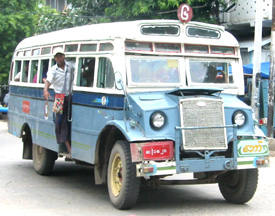
Tour Yangon now! Welcome to Rangoon (also known as Yangon), with its amazing golden Shwedagon Temple, traditional architecture, and ubiquitous tearooms.  WoWasis visitors will find Rangoon to be a fascinating, rambling city mixing new and old.  At night you’re likely turn a corner to find a street taken over by a raucously fascinating puppet theatre accompanied by with traditional Burmese music.  Interesting street vendors and ancient buses and trishaws make Rangoon a treat for the senses. 

Top 5 in Rangoon 

1)  Don’t fail to see the Shwedagon Paya, the most sacred of all Burma’s temples.  Towering over Rangoon, the Golden stupa is accessible by stairs, and soars nearly 100 meters above its base.  Numerous shrines surround the stupa, and ordination parades of young novices are constantly occurring.  The meticulous platform is constantly swept by a yellow-clad team, adding to the riot of colors and activity.
Shwedagon Paya
Between People’s Park and Arzarni Road, north of the central city
Open daily

 2)  The Sule Paya is a wonderful octagonal temple located in the center of Rangoon.  Unlike the austere Shwedagon, Sule is a vital part of the everyday life of the city.  Here you’ll find small shops selling all matter of goods completely unrelated to the spiritual world.
Sule Paya
Mahabandoola Road at Sule Paya Street 

3)  The National Museum has wonderful exhibits of Burmese arts and crafts.  Especially interesting are the dozens of mannequins featuring the colorful clothing of Burma’s traditional cultures, and the collection of wigs depicting hairstyles from Burma’s past.   He you’ll also find court costumes, royal furniture, and musical instruments.
National Museum
Pyay Road
Open daily, 10 am – 4 pm 

4)  The Bogyoke Aung San Museum, located in a beautiful traditional house, was the home of the revered general, assassinated in 1947.  His daughter Aung San Suu Kyi grew up here, where happy times were tempered by tragedy (one of her brothers drowned in the swimming pool, while a child.)
Bogyoke Aung San Museum
Bogyoke Aung San Museum Street, Bahan Township
Open Tuesday through Sunday, 10 am – 3:30 pm 

5)  WoWasis’favorite place to buy all things Burmese is the Bogyoke Aung San Market, where you can buy traditional Burmese clothes, jewelry, and antiquities. Plan for at least half a day here, as you may find items here that you’ll not easily find outside the capital.
Bogyoke Aung San Market
Bogyoke Aung San Road, across from 29th Street
Open mornings Tuesday through Sunday, until 5 pm 

Rangoon also has several Resort/hotel spas.

Getting to Rangoon from the airport: the airport has a taxi kiosk, where you can order a taxi to your hotel for roughly seven dollars.  The folks at the kiosk speak English, and will direct the driver to your hotel.  If you proceed outside the front door, taxi drivers will approach you, and do the job for $3-$5, but may not know the directions to smaller hotels. Take a fascinating one day tour of Yangon (Rangoon)!

WoWasis Top 6 sights in Inle Lake, Burma

Written By: herbrunbridge - Jun• 30•10

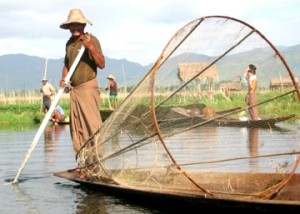
Fishing on Burma’s Inle Lake

Welcome to Inle Lake, one of Southeast Asia’s most picturesque and relaxing spots. Here, we at WoWasis found boatmen who power their wooden crafts by wrapping one leg around an oar, then pulling the oar through the water.  Their conical fishing nets add a wonderful local touch, and you’ll see them everywhere on this calm lake ringed by hills, and measuring 22 km by 10 km. The Intha people occupy the lake area, and there are 17 stilted villages, and several lakeside markets here. You’ll also find over 100 Buddhist temples or shrines, hundreds of stupas, and a flourishing crafts culture, encompassing weaving, blacksmithing, and cheroot-rolling. Tour Inle Lake now!

The pretty town of Nyaungshwe is on the northern side of the lake, and worth a short visit.  There are lakeside resorts that have wonderful views, and anything you can’t find at your hotel, you can certainly buy by paying a few kyat and hiring a small boat and boatman to take you to Nyaungshwe. 

On a day’s outing, hire a boat (your hotel will assist) to take you to markets, temples, and craftspeople, who operate in small shops or factories.   All are accessible by water channels leading outward from the alike. Cost for a day’s outing is roughly $10 USD. 

Top 6 Highlights 

1)  The town of Nyaungshwe boasts beautiful wooden buildings, and is worth a walk.  There are many temples (paya) in town, including the oldest, Yadana Man Aung, which has a stepped stupa.  While in Nyaungshwe, don’t fail to see the Museum of Shan Chiefs, located in a teak and masonry palace that was the home of the last Shan Prince, who died in Burmese captivity.  It’s the best surviving example of a Shan palace in Burma, and features Shan costumes, furniture, and a throne room.  The palace is a short carriage ride from the boat landing.

Museum of Shan Chiefs (Yaunghwe Haw Museum)
Open Tuesday through Sunday, 9:30 am – 3:30 pm

2)  Floating markets 

These operate on a five-day revolving plan, and are located at several spots around the lake.  The evening before your visit, ask your hotel to book you a boat to the market of the following day, and get there early to avoid the heat and tourist crowds. 

3)  Phaung Daw U Paya 

This impressive temple sits above the village of Ywama.  Each year, at the Phaung Daw U festival (September-October), four deities are taken around the lake, and you can see them enshrined here, and view the colorful boats which ferry them at the boat landing. 

4)  Indein village 

The impressive Shwe Inn Thein temple sits above the village of Indein, and the immediate area is filled with picturesque ruined stupas.  A long, covered walkway takes you to the temple, and you can find interesting artifacts in the stalls set up along the path.  The buildings are largely unrestored, and the veneer of the ages provides a charm not found in modernized temples. 

5)  Nga Phe Kyaung (Jumping Cat Monastery) 

Located a short distance north of Ywama is this beautiful wooden monastery built on stilts.  The monastery is famous for the cats that monks have trained to jump through hoops, but the highlights here are the architecture, lakeside views, and the Shan, Inwa, and Bagan styles. 

6)  Crafts villages 

On your visits to the markets, Phaung Daw U Paya, and Nga Phe Kyaung, ask for boatman to stop at a weaving factory, the blacksmith’s shop, and cheroot factory.  Several of these line the lake, and the goods are made by hand.  Here at WoWasis, we were impressed by the hand-forged scissors, which have the name of the shop stamped into the blade.  They make great gifts for friends at home, and never seem to get dulled. 

Hotels 

There are many in the area, but our favorite, right on the lake, was:
Royal Orchid Hotel
Inlay Khaung Daing Village
Tel: +(95) 812-919 

Getting to Inle Lake is easy by airplane from Mandalay, which takes you to the airport at Heho, a 40 km taxi ride from Nyaungshwe.   You can also take buses from Mandalay (8 hours) and Rangoon (overnight). The bus stops at the town of Taunggyi, 35 km from Inle Lake, and you can take a taxi.  Ask for bus information to Inle Lake at your hotel. From Bagan, you can fly to Mandalay, then take another flight to Heho, or travel by taxi (approximately $40 USD). Take a fascinating one-day tour of the Inle Lake area!

WoWasis visits the spectacular Bagan temples in Burma

Written By: herbrunbridge - Jun• 29•10

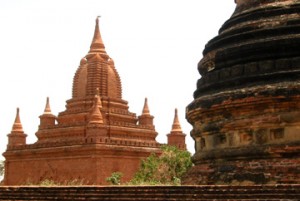
Welcome to Bagan, a WoWasis top destination in Burma, where thousands of ancient temples dot an open plain.You can spend two days here or a week, and Bagan boasts great resorts, good hotels, and an interesting museum.  Bagan is divided into two zones, the town of New Bagan, and Old Bagan, located in the Bagan Archaeological Zone.  You can explore by car and driver, carriage, or bicycle, and a highlight is climbing to the top of the temples of Mingalazedi or Bupaya to watch the sunset over the Irrawaddy River.  Tour Bagan now!

Highlights 

Bagan’s temples were built primarily between 1057 and 1287 ACE, until the area was taken over by Kublai Khan’s Mongolian hoards. Many temples have much to offer, and the following are among the dozens of our favorites: 

1)  Thatbyinnyu Pahto is one of the taller payas in Bagan, rising to over 60 meters.  Although you can no longer climb through its remarkable inside passages, the temple itself is impressive, and can be seen from virtually all temples in Bagan. 

2)  Sulamani Pahto, with its exceptional brickwork is also known for its beautiful glazed tiles, which even in ruin, are beautiful examples of ceramic arts.   

3)  Mingagazedi lies close to the riverbank, and offers outstanding views at sunset, both to the west (Irrawaddy River), east, where you’ll see other temples basking in the orange glow of sunset. 

4)  Ananda Phato was built in 1105, and has spectacular white walls streaked with black, topped by a golden spire.

 5)  The Shwezigon Paya, located 7km northeast of Old Bagan, is a revered place of pilgrimage, with a magnificent stupa surrounded by traditional wooden buildings. 

6)  The Shwesandaw Paya is an elegant circular stupa with staircases on four sides. An earthquake toppled the hti (finial), which can be seen in the courtyard. 

Other points of interest: 

Bagan Archaeological Museum

 This one room museum has a nice selection of Burmese antiquities.  If unopened during daylight hours, go to one of the buildings next door, and ask the caretaker to let you in.  The museum is short bicycling distance from the Bagan Hotel, near the Gawdawpalin Paya.  Open daily, except Mondays and holidays. 

Shwe Wa Thein Handcrafts Shop 

This shop has a wealth of Burmese artifacts that rivals anything you’ll find in Rangoon.  Hsun-ok (elaborate finialed bowls that hold food offerings to monks), marionettes, and old lacquerware are its specialty.  It’s located off the Bagan-Nyaung U road, up a dirt road that’s signposted, about 500 meters from the city gate. Tel: +(95) 267-032

 Myin-kaba lacquerware village 

Located two km south of Old Bagan, Myin-kaba has dozens of small lacquerware family workshops where you can see some of the best lacquerware made in Burma. 

Hotels 

There are many to choose from, but we at WoWasis found the service and surroundings of the Bagan Hotel to be exceptional.
Bagan Hotel
Near Museum, Old Bagan
Tel: +(95) 62-70145
http://myanmars.net/baganhotel

Bagan also has several Resort/hotel spas.

Getting to Bagan is easy by airplane from Mandalay, Heho, and Rangoon, via Yangon Airways or Air Mandalay, landing at the Nyaung U-Bagan airport.  Veteran travelers enjoy sitting on the right-hand side of the plane going from Mandalay to Bagan to get a good view of the river, and the reverse on the return flight. 

Buses and trains connect Bagan to both Rangoon and Mandalay, but are long.  You may also travel by boat from Mandalay to Bagan.  Minimum time is 9 hours.  Consult your hotel for the latest schedules.

Take a tour! See the best of Bagan on a one-day tour.

Top 3 in Vientiane, capital of Laos

Written By: herbrunbridge - Jun• 29•10

Here at WoWasis, Vientiane gets our vote as one of the nicest cities in Southeast Asia. Although it’s the capital of Laos, it’s relatively small, at just over 130,000 people, and is easy to navigate. It’s got a decidedly different vibe as a capital city, without Bangkok’s crowds, or Phnom Penh’s edginess.

Here, Lao traditions meld with colonial French, allowing you to have a baguette and coffee and one of Vientiene’s many bakeries before taking a day to visit Vientiane’s impressive Buddhist temples, then finishing it up with superior French cuisine at terrific prices. It’s laid back without being dull, and a wonderful place to spend a day or two on your way to the old royal city of Luang Prabang, to the north. 

Top 3 in Vientiane 

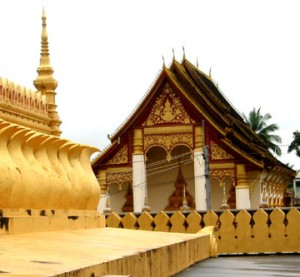
1) Pha That Luang is a temple complex that’s the most important monument in Laos, and its image is popular everywhere in the country, including a prominent place on the Kip, Laos’ monetary unit. Built in the 17th century, it consists of two temples flanking a golden stupa, which has three tiers of smaller stupas surrounding it. 

2) Wat Si Saket is a lovely temple surrounded by a cloister, and is best-known for its hundreds of Buddha images in niches. There are over 6,000 Buddha images interspersed throughout the temple, so plan for a couple of hours to take it all in. 

3) The Lao National History Museum documents the triumph of the Pathet Lao, and presents a nationalistic perspective on history that may be unfamiliar to Western visitors. Western cultures take a real beating in the labeling that accompanies many of the exhibits, and it reflects an “only-in-Laos” experience that we found worthwhile.

Tour Vientiane now!


Top 5 sights in Luang Prabang, Laos… the most beautiful city in Southeast Asia?

Written By: herbrunbridge - Jun• 28•10

Tour Luang Prabang now! Here are WoWasis, the gorgeous Laotian city of Luang Prabang gets our vote as the most beautiful city in Southeast Asia.  This oasis surrounded by hills, with more than thirty temples to visit, sits in a serene setting next to the Mekong River. The city has only 16,000 people, is easily walkable, and is the home of three tribal groups, the Hmong, Mien, and Thai. Luang Prabang is the old royal capital of Laos, and boasts beautiful architecture, a wonderful museum, inexpensive but very good places to stay, and great food. You can even take a terrific cooking class here.

Luang Prabang Top 5 

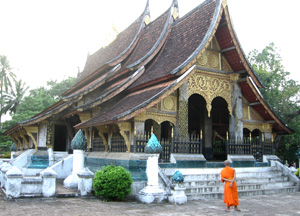
1) See Luang Prabang’s temples on a walk around town. With the possible exception of Thailand’s Chiang Mai, you’ll never see as many beautiful temples as you will here. The temples are prime examples of Lao temple architecture in three styles, the Luang Pranag, the Vientiane, and the Xieng Khuang. The city is so compact that you can see just about all of the temples in one day, but that’s jammin’ Take an extra day and get leisurely. The weather’s usually lovely, birds are singing, and you’re never far from your hotel. You can’t afford to miss the remarkable temple called Wat Xieng Thong, or the wonderful golden exterior reliefs at Wat Mai Suwannaphumaham. 

2) The Royal Palace Museum was built in the early 1900s as a home for King Sisavang Vong. This breathtaking mixture of Lao and Beaux Arts architecture was occupied by the ill-fated King Sisavang Vatthana and family until the mid-1970s. Now a museum, the building contains Buddha figures, royal apartments, furniture and effects, and is stunning. 

3) The Talat Dala market has remarkable contemporary tribal crafts, but the people themselves, in their colorful clothing and friendly demeanor, are the highlights. The market is much less crowded with tourists than markets in many other Southeast Asian towns and cities, and is not to be missed. 

4) Climb Phu Si hill. Right in the middle of town, Phu Si hill is only 300 feet high, commands a nice view of the town, and has several interesting temples that you can see along the way. It’s best to go early in the day or in the late afternoon when the weather’s cool and there’s a nice breeze. 

5) Take a ride through the countryside. You can do it by car and driver, and you can also do it on the back of a motorbike like we here at WoWasis did. Either way, you’re close to tribal culture, and the countryside and views while going through tribal villages are outstanding.

Tour Luang Prabang now!