The sharper edge to traveling in Asia

The Good Manner: Racial discrimination in Bangkok go-go bars?

Written By: herbrunbridge - Aug• 26•10

The Good Manner: Love & Relationship Advice from WoWasis’ Pa Farang
This week’s dilemma: Am I the victim of racial discrimination in Bangkok go-go bars?

Dear Pa Farang,

Three of us got 86’d from a go-go bar.  Our crime?  One of our group had just bought a drink for a dancer who sat beside him, then he reached around and pulled one of her breasts out of her top.  No problem, she’d just been topless on stage.  Suddenly, the manager was all over us, started yelling loudly in Thai, and made a scene.  We threw some money on the table and left.  I forgot to mention, we’re African-American.  Funny thing is, other guys were feeling up girls too, but we were the only ones bounced.  Looks like things here are the same as at home, racially-speaking.  I wanted to let you know, Pa Farang, so you could spread the word to the Bros. 

–  Stranger in Paradise 

Dear Stranger, 

Adam Clayton Powell once said the “white man only cares about two things, your vote, and your dollar”. The same can be said for owners of night establishments.  Whether you’re black, white, green, or pink, they all want you to walk in the door and spend “purple” (the color of the 500 baht bill).  While prejudice exists everywhere (all farang pay more than Thais for virtually everything, for example), you were vociferously asked to leave, not for your skin color, but for being a little too aggressive in touching the girls. 

Other guys were doing it?  You don’t know what the relationships were between those folks, or even the context of the touching (mind you, jahkatee tickling games are legion in these clubs).  Here’s a good rule, Stranger:  never grab a girl in a way that could be considered sexual, inside or outside of a Thai bar.  True, some bars are different, and a little more liberal in what interaction is considered acceptable between patrons and dancers.  But a good rule of thumb is that bar girls, despite — or perhaps because of — their jobs, want to maintain as much dignity as they can, in the tough and often unforgiving world they inhabit.  They deserve your respect and kindness.  A long-time Thai hand who managed several bars put it best, “every one of these girls is someone’s daughter”. Try it my way, Stranger.  Show The Good Manner by treating the girls the way you’d want another guy to treat your sister.  You’ll be welcome in every bar in the land. 

Mariyat-dee, 

– Pa Farang 

Read Pa Farang’s other columns for more advice on relationships in Southeast Asia
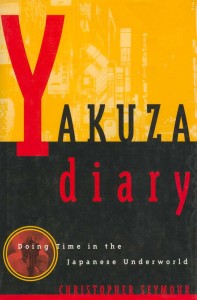
WoWasis book review: Christopher Seymour’s ‘Yakuza Diary’

Written By: herbrunbridge - Aug• 26•10

One of the joys of visiting used bookstores is finding past gems, like Christopher Seymour’s Yakuza Diary: Doing Time in the Japanese Underworld (1996, 0-87113-604-X).  Seymour, in riding around with and interviewing various Yakuza, seems to be, by the end of the book, clearly a fan of the Yakuza subculture. There are loads of great stories in this book, touching on AV (adult video) girls, the mizu shobai “water trades,” comprising geisha and massage parlors, shabu (crystal meth), and various business transactions between Yakuza and traditional “clean” businesses. 

Especially insightful are his interviews with Yakuza wives, who run the gamut from the traditional to the outré, and describe family life behind the scenes. Our favorite stories, though, related to classic business practices, from the Yakuza boss that specializes in building small but profitable ramen shops (p. 123-124), to a wonderful description of Yakuza assassination diplomacy (p. 164-165), in which the giving of gifts and allowing the potential target to save face often prevent the assassination from taking place. 

All in all, the book is a romp, and Seymour’s black humor is infectious throughout. Buy it now.

Building scams in Thailand: Why is my concrete structure falling apart?

Written By: herbrunbridge - Aug• 24•10

Ultramodern techniques ensure a clean concrete pour in Bangkok

We here at WoWasis first discovered a remarkable example of mass building fraud when we began looking to buy older condominiums in Bangkok. We probably looked at ten structures in the Sukhumvit Soi 1- Soi Asoke area. All condo structures had one thing in common: they were all literally falling apart. 

The most grievous structural problem appeared to be the inferior concrete used when the buildings were originally built. Huge cracks were apparent near foundations, at upper levels, adjacent to swimming pools, and in hallways. 

Some issues associated with inferior concrete are: 

1) Improper mixture of sand and cement: there are standard civil engineering codes for concrete mixture, including charts that advise on how the mixture is supposed to change with elevation of multistory structures. Hot tropical weather presents its own set of problems for proper concrete curing, too. Increasing the sand content is a fine way to save money on building costs while decreasing structural integrity. 

2) Unclean water: using water from polluted water sources adversely affects concrete strength through dicey molecular bonding. 

3) Utilization of recycled concrete: this material is prone to wear, cracks and water penetration. Recycled concrete is ground down and mixed with fresh concrete corrupting the structural integrity of the building. 

Contributing to the problem of cracks in concrete buildings is the possibility of poor foundation work, especially critical for a city essentially built on water (look at Bangkok’s sidewalks, always an adventure.)

There seems to be little evidence that the original engineering documents specified inferior materials. Rather, we suspect that original contractors bought cheaper materials, charged the developer full price for specified materials, and pocketed the difference.  The actual evidence for such fraud is generally buried as deeply as Jimmy Hoffa. This building corruption scam is popular the world around, and in Southeast Asia there are many examples on virtually every city block.  Bangkok is a virtual textbook of construction fraud. 

One our favorites stories around building integrity in Thailand occurred one rainy day when we visited a business associate in a relatively new highrise. Water was coming down in sheets outside his window as he glared at us from behind his desk. “I have a big problem today,” he said, as a maid, armed with a mop and bucket, slid his desk away from the window. You guessed it, the water was falling inside the window rather than outside the window, descending from a crack where the wall touched the ceiling. He was literally sitting in a lake, his pants rolled up past his knees. 

So what should you do when considering buying property in the Land of Smiles? We’ve blogged before on some of the legal issues you’ll face as a Westerner in buying property in Thailand . In addition, you should have some concern that if you ever wish to resell your now-new condominium, it may look so structurally wrecked in 10 years that no one will want to buy it. The owners of properties we looked at at the time of this report were almost giving their units away. 

Westerners living in Thailand are used to throwing their money away on gem scams, bar girls, and shady business ventures. Being scammed when buying a condominium in Bangkok may eventually be just as legendary. Rents are cheap in Bangkok, and you can always leave when your wall develops a crack and the rain starts pouring in. Still want to buy property? Caveat Emptor.

Miserable shopping experience for WoWasis in Taipei airport

Written By: herbrunbridge - Aug• 13•10

Taoyuan Airport in Taipei, Taiwan

The bookstore at the departure lounge in Taipei airport was staffed by three people, a girl at the cash register, a guy stacking magazines, and another guy just walking around.  Your WoWasis correspondents noticed a high-design writing pen behind a locked glass door, selling for USD $150, and we wanted to see it, so asked the stacking guy to open the door for us. “Ask the register girl”, he said, and went back to stacking magazines. She was in the middle of a transaction, and had four additional people in queue.  We walked around to the other guy (who was standing around, doing nothing) and asked him to open the glass door so we could have a look. “Ask the register girl” he said.  We looked at the girl, who now had six people in queue.  We noticed that virtually everyone in queue had postcards to buy.  “Look” we told him, “the girl’s busy, and we’re just trying to look at your $150 pen. Can’t you see she’s busy?  We’re trying to buy your most expensive item, and she’s busy with postcards.  Why can’t you just open the door and make it easy for us?”  

By now, everyone in line (all English-speaking) is looking at us, and they’re cracking up, laughing, because the scene is so absurd.  The guy looks at the pen through the glass, now sees the price, and mumbles something about the fact that it would lower his status and he’d lose face by opening it up. “No thanks”, we said, “We wouldn’t want to bother you with a high-end item, when the three of you are so busy with your postcard business.”  Our buddy was at the head of the cashier line now, where the girl was trying to charge him $20 for a magazine that was clearly marked $12.50. Even though he clearly pointed out the price to her, she insisted on $20.  We suspected a bad case of congenital ignorance had afflicted the entire staff, and left the bookstore without making any purchases, advising the remaining people in line to carefully watch what they were being charged for postcards. We’re just happy that these people aren’t on OUR payroll.

A colonial hotel and great restaurant in Vigan, Philippines

Written By: herbrunbridge - Aug• 10•10

Villa Angela

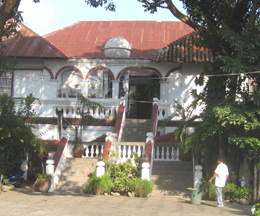
The picturesque northwestern Luzon city of Vigan is a colonial treasure, highly recommended by WoWasis for her outstanding architecture. While there, we stayed at the Villa Angela, a wonderful rambling colonial house that’s been turned into an inn, and found an exceptional restaurant, Café Leona. 

Villa Angela, on Quirino Boulevard, is within easy walking distance of everything you’ll want to see. It’s set back off the street, the sign is not easy to see, but it has a significant parking lot. Each room is full of antiquities, the small staff is friendly, and the rooms are inexpensive. They only have four or five rooms, so try to book in advance. There are places in Vigan that are more modern, but none have the charm and old-world elegance of Villa Angela. If you want a 4 star experience, this is not for you, but if you want to get a sense of what living in a colonial mansion is really like (with air conditioned rooms), you’ll love this experience. 

Villa Angela
26 Quirino Boulevard
Tel: 077-722-2914

The Café Leona, on Burgos Square, is located in the heart of Vigan, and serves a number of wonderful Ilocano dishes. Here is a great place to experiment at reasonable prices, with a friendly wait staff that is proficient at English, and always happy to answer questions about the local culture. Highly recommended.

WoWasis book review: Sterling Seagrave’s ‘The Marcos Dynasty’

Written By: herbrunbridge - Aug• 08•10

Travelers to the Philippines will invariably want to find out more about the history of the country after having seen it, but good books (and bookstores!) in the Philippines are hard to find. In particular, books on Philippine history are virtually impossible to be found anywhere. 

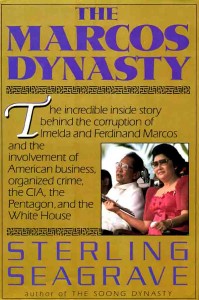
In the picturesque northern Luzon city of Vigan, for example, you’ll encounter two important historical houses, the Mansion Syquia, and the Crisologo Museum, homes of former political bosses Elpidio Quirino and Floro Crisologo. You’ll see lots of pictures and artifacts in those houses, but nothing objective about their careers. This is where The Marcos Dynasty (1988, ISBN 0-06-015815-8), a wonderful book by Sterling Seagrave and his long-time collaborator Peggy Sawyer Seagrave comes in handy, and don’t let the fact that the book was published over 20 years ago fool you. The information it contains about how politics in the Philippines works pertains pretty much today as it did when the book was written. 

As he did in his earlier book on the Soong Dynasty, Seagrave here conducts an exhaustive but fascinatingly written appraisal of a family that essentially controlled a country. Some of the fascinating threads in the book include those on the heroin trade, Japanese occupation, the CIA, the  Japanese Yakuza underworld, the perfidy of Gen. Douglas MacArthur, and of course, the shenanigans of Ferdinand and Imelda Marcos. 

Seagrave’s writing is especially interesting in view of his understanding of Asian cultures (he lived a significant part of his life there) and has a keen understanding of the fact that in Asia, actions generally are not a matter of black and white, but usually occupy a gray area not understood by most Westerners. Consider this excerpt from the Marcos book on the concept of “lying”: 

 In Asia, lying to strangers bears none of the social stigma attached to it in the West. When Chinese are asked about their background, they usually invent one to suit the occasion. So do the Burmese, the Thais, and the Malays. It is a venerable tradition to lie to protect the truth, to protect one’s ancestors, one’s family, and one’s fragile psyche, not to mention one’s neck. It is not lying, but the creation of a fiction that will gratify the interrogator, which—on reflection—is really an act of courtesy. 

Borrowing freely from others, the young Ferdinand Marcos created an entirely different identity for himself, a much happier one than his own, in which he was the hero, the boss, and the driving force. When he decided to go into politics, he went public with this fanciful legend, and used it to build a remarkable international career. In doing so, he was different from other charlatans only in the matter of degree. His success grew out of his resourcefulness, the gullibility of his audience, and the venality and opportunism of Washington. 

The legend creatively and effectively created by Ferdinand and Imelda Marcos becomes the great story of the book, and its subplots are remarkable in their intricacy. Like the earlier-mentioned book on the Soong dynasty, and Paul M. Handley’s exceptional The King Never Smiles (a biography of the King of Thailand) this book is essential reading for anyone wishing to understand why things operate the way they do in the country. As a visitor, one encounters situations every day which, frankly, can best be explained by an author unexposed to political retribution for investigating, then writing about them. In the Philippines, everything from un-navigable roads to political assassinations are the result of “politics as usual,” and Seagrave provides an important study of just how things came to be the way they are.

Bachelor in Bangkok: Khun Lee on Bangkok nightlife today vs. 1995

Written By: herbrunbridge - Aug• 08•10

I’d like to take the time to compare Bangkok and the entertainment scene today to the reality of what it was like in 1995 when I first came here.  I stress “reality” because I am constantly hearing whining voices saying “it was soooo much better in the good old days” and such nonsense as this. I suppose it is just human nature to be nostalgic when looking to the past and one must take all the “good old days” stories with more than a little skepticism. I am here to tell you that THESE ARE THE GOOD OLD DAYS!!!!! Make no mistake about it, Bangkok is the most exciting city in the world and there has never been a better time or place to be a single male than Bangkok 2008.  Many thanks to my mate Geoff for reminding me of this recently. 

Here’s Khun Lee’s take on 1995 versus 2010: 

NAUGHTY NIGHTLIFE—there have been a lot of changes in the naughty nightlife industry.  Most notably go-go bars are considerably less popular today and the freelance scene has grown exponentially. Many people comment on the slow decline of the go-gos and the reasons behind it. To get a feel for the reality of the situation, one needs to look at the reason guys go to go-gos in the first place. I would break down the go-go customer base into two categories.  Guys who go to party and guys who go to find companionship for the evening.  

Guys who go to party have ten times more choices now than they did in 1995.  The first time I visited Paradise I bought one of those politically correct guide books you see in the bookstores and under nightlife the author commented that Bangkok was heaven for single guys looking to pay for a gal for the evening but for anyone else there was little or nothing to do at night.  He was spot on.  There was Hard Rock café, those little jazz clubs on soi Sarasin such as Brown Sugar, and the lounges in the expensive hotels.  That was about it.  Bangkok 2010 has comedy clubs, more British and Irish pubs than you could count, great movie theatres, incredible shopping, bowling, ice skating, dozens of tremendous places to play pool or billiards, live music places, karaoke, traditional dance and music shows, theme bars like Bully’s and Gullivers, trendy nightclubs like Twisted on soi 11 and Q Bar, outdoor beer gardens with HOT Thai hostesses, bustling night markets for shopping or people watching, river cruises, and so many other types of entertainment  and places to party and drink with mates that I could write an entire book on the subject. 

 If you go out to have fun and not for the specific purpose of finding a “pay for play” gal the choices have multiplied at least ten fold.  What about the guys who are out looking for a companion?  In 1995 many of these guys went to the go-go bars, freelance places like Thermae and Grace Hotel, or beer bars.  In 2010 there are still about the same number of go-go bars (Pattaya has a ton more but this is a whole other story) but many more freelance places.  More importantly EVERY gal in the business now has a mobile phone.  This change is often overlooked or taken for granted, but in 1995 only a select few people had mobiles but now everyone does. Gals needed to work in a bar in order to meet potential customers.   I feel that this is the single greatest factor in the EXPLOSION of gals working freelance and therefore slow decline of the popularity of go-go bars.  

Don’t get me wrong, the cream always rises to the top and places like Angel Witch, Rainbow, Long Gun and Kings Castle are still raking in the big bucks. However, most of the go-go bars have seen declines in business of more than thirty percent. For many the drop-off has been more like seventy percent!!   Many guys say that in go-go bars the prices are too high, gals too mercenary, service poor and most cannot show all the female anatomy. All these arguments have merit, but the advent of the mobile phone has turned every working gal into a sole proprietor and independent business lady.  I know guys who come here for two weeks and leave with more phone numbers of gals than they can count. Customers pay no bar fine for these gals, don’t need to buy them any drinks and don’t have to wait for them to get off work. Often the going rate is lower for the freelance gal, even though the total cost is already lower without the drinks and bar fine. For us local guys, I don’t even take most of their numbers anymore because my phone only holds five hundred and I am too lazy to delete all the numbers that I don’t want or cannot recognize!   

Freelancers are everywhere, and for the gal she no longer needs to turn up for work at a go-go bar every night in order to have a steady stream of customers.  It’s a very easy life for them.  

A side note for all you guys sending money to your “ex-bargal” girlfriend in Bangkok.  In the past 5 years I have bumped into hundreds of gals who used to work in the industry but are now being taken care of by a naive foreign guy.  I normally ask them for their new phone number, and if I can call them when I need a little romance. NOT ONE TIME in all these years have I had a gal say that she cannot meet me because she has a boyfriend.  NOT ONCE!!  Trust me when I say that I am not handsome and never pay big money to the gals. Do not be confused, once they enter ‘pay for play” there is no turning back and they are always looking for a little side money or to trade up to a better provider.  I think this is a good thing and for ninety-nine percent of the guys and gals this situation works wonderfully.  However, there are always guys who try to fool themselves into thinking they can pay a gal to love them, or that they are going to save her. Please be smart out there and protect your money and your heart!  I do not tell you this to criticize or belittle you; I just want you to know where things stand so that you can make intelligent decisions! Yes, Bangkok naughty nightlife 2010 kicks the ass of 1995, no contest! 

Please come back early in October when I will continue my 1995 versus 2010 review covering changes in costs, livability, transportation, meeting “good gals” and more.

Read Khun Lee’s other WoWasis columns for more advice on navigating the adult dating scene through the backstreets of Bangkok

Welcome to the WoWasis China Bookshelf

Written By: herbrunbridge - Aug• 08•10

Chinese philosophy and business practices have long influenced Southeast Asia. Here at WoWasis, we found the following books to be especially compelling for Westerners, as the information in the books on this list, while particular to China, helps to explain much about life in Southeast Asia. We’ve grouped them into Nonfiction and Fiction categories. 

Nonfiction books on China 

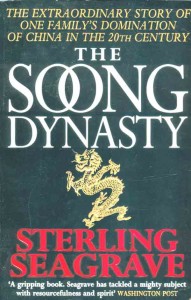
Sterling Seagrave’s The Soong Dynasty (1985, ISBN 0-552-14108-9) is indispensable for anyone wishing to understand 20th century history as it pertains to China, Taiwan, Southeast Asia, and even the United States. As Seagrave describes, the Soong family which included notables such as Sun Yat-sen, Chiang Kai-shek, and Madame Chiang Kai-shek, controlled a significant percentage of the political and business action occurring in Asia in the past century. Even today, the Kuomintang (KMT) of Chiang maintains control of much of the business activity of Southeast Asia’s Golden Triangle. Among the topics discussed in this fascinating book is the heroin trade, the history of the triads, the link to triads in San Francisco, the ascension of Chiang, and a female secret society charged with assassinating men. Seagrave is a historical writer with a flair for story-telling, making this 500-plus page book a pleasurable read. Buy it now at the WoWasis estore, powered by Amazon.

Whether you’re thinking of starting a business in China, or already have had the pleasure of that experience, Tim Clissold’s Mr. China (2004, ISBN 1-84119-788-2) is a must-read. The author, along with a group of US-based investors, managed to lose over $400 million in the space of a few months.  Self-effacing and engaging, Clissold describes the never-ending series of trials, tribulations, and interactions involving various Chinese governmental officials, factory directors, and workers’ groups.  On the way, he provides an interesting explanation of the Mandarin tongue, the Tsingtao stock market scandal, and other fascinating stories. 

Author Lee Feigon makes a strong case for re-evaluating the Maoist years in Mao: a Reinterpretation (2002, ISBN 1-56663-522-5). Here, Feigon investigates the Great Leap Forward, the Cultural Revolution, Sino-Soviet relations, and delves into the political relationships between Mao and Chinese and Soviet leaders. One of the more fascinating elements in the book is Mao’s philosophy for embracing the opposition, a decided break from the contemporary Stalinist philosophy endemic to many of the Soviet Bloc countries of the era. 

Fiction books on China 

Many agree that novelist Jack Reynolds’ Woman of Bangkok is the book that initiated the “Bangkok Fiction” school of writing.  In 1974, Reynolds published a wonderful collection of essays, interpreting his days as an ambulance driver and medic in post WWII China, Daughters of an Ancient Race (Heinemann Educational Books, no ISBN).  He makes keen observations on the human character, women, and Communist and KMT politics and culture.  Perhaps the most astonishing story is “A Bath Could Kill You,” describing the reasons an entire village would go without bathing, and its olfactory effect on the author. 

Novelist Paul Theroux unveils the climate of the handover of Hong Kong, using the metaphor of an old business in the uncomfortable position of having to change hands, in Kowloon Tong; a Novel of Hong Kong (1997, ISBN 0-140-26645-3.)  Theroux’s protagonist — to use the term loosely — is an old fashioned mama’s boy unable to understand the forces that have taken hold of his life, and what’s left of his company.  Along the way, there are plenty of interesting takes on the bar girl world:  “the beauty of being with bar girls as that you never told them the truth, because they did not care what you said.”   Buy it now at the WoWasis estore, powered by Amazon.

Su Tong is an acclaimed writer whose novella ‘Wives and Concubines’ was made into the feature film Raise the Red Lantern.  Under the latter title was a book consisting of two other novellas (1993, ISBN 0-14-02-6030), containing rich descriptions of village life in the traditional world of China, great plot lines, and exceptional character development.

Welcome to the WoWasis China blog pages

Written By: herbrunbridge - Aug• 08•10

Chinese philosophy and business practices have long influenced Southeast Asia. While China is not geographically in Southeast Asia proper, it does border on several of those countries, and its culture and politics to a greater or lesser extent affects them all. 

Our first blog post is called the Chinese Bookshelf, a review of several books that we at WoWasis fell are indispensable to understand the region.

The Good Manner: My religious brother married a Thai prostitute

Written By: herbrunbridge - Aug• 07•10

The Good Manner: Love & Relationship Advice from WoWasis’ Pa Farang
This week’s dilemma: My religious brother married a Thai prostitute

Dear Pa Farang, 

I come from a God-fearing family who prides itself on honesty and respect.  Last year my brother, who works in Thailand for a large multi-national firm, married a very nice Thai girl who he “met in a restaurant.” On this, my first trip to Thailand, I met his best friend, who casually told me that my brother met his wife in a go-go bar, where she was a dancer. Apparently, he paid cash money for her affections. How am I supposed to break this news to our Mom & Dad?  Can I be expected to lie for the sake of my brother?  What if she has AIDS? 

– Confused Sister 

Dear CS, 

Please consider giving this “very nice” girl a chance to be an accepted, respected member of your family.  She has no doubt come from an economic situation less favorable than yours, and has presented herself well enough to have gained your brother’s love.  He may or may not have paid her at one point (as always, beware of hearsay), but please bear in mind that gifts are given by men to women in any culture; in Thailand they are often given in cash, whereas in the west, goods such as jewelry and clothing are more the norm.  I would take the high road and assume she has neither AIDS, cancer, nor shingles; safe sex has been practiced in the Kingdom for years, and frankly, it’s no business of yours as to her sexual experiences before or during her relationship with your brother.  I would caution you to show The Good Manner and say nothing to your parents about the alleged work experience of their new daughter in law. However well-meaning you intend to be, such commentary is bound to be hurtful to everyone but you, and a lifetime of grief for all parties will most probably be the result of your cautionary, but ultimately cruel statement.  Take the high road; your brother may very well have made a good choice, and if so, his new wife will be a joy to the family for years to come. 

– Pa Farang

 Read Pa Farang’s other columns for more advice on relationships in Southeast Asia