The sharper edge to traveling in Asia

WoWasis book review: Steve Rosse’s ‘She Kept the Bar Between Them’

Written By: herbrunbridge - Mar• 11•11

Steve Rosse is a compelling storyteller and an excellent essayist.  He also knows Phuket like the back of his hand, and his short story, Two for the Road (read it here at WoWasis) displays a hard, poignant edge that is characteristic of his best writing.

Rosse’s latest book, She Kept the Bar Between Them, is only available in the eBook version (2011, eISBN 978-616-245-003-7), and we at WoWasis are ludditic enough that we still like to hold our books and manually thumb through the pages. We loved what we read, but do wish that it was sold as a traditional book.

Authors of Asian-based fiction in Baby Boomer generation are now writing about deaths of expats, mainly in the third person, but it’s transparently about their own futuristic passings. Most writers of that age, in the Bangkok Fiction genre, having seen friends and loved ones die lingering, painful deaths, are questioning when life really stops having any meaning. And many of their readers, in the same age category, have dealt with their own mortality, through strokes, heart attacks, and a myriad of deadly bodily invasions not generally visited upon the young. To the point, they’re figuring out how best to pull the plug, when it would be appropriate, and who (if anyone) to be involved in the collusion. What they know is this: death — whatever that is — is preferable to a twilight existence in a hospital or hospice. 

Which brings us to our favorite story in Rosse’s book, Pilgrimage (read it online), in which a veteran traveler arrives in Bangkok from his home overseas. He hasn’t got much time left, but his quest includes a beer and a cigarette, forbidden to him due to a medical condition. Bangkok has been etched in his memory, and the signs, smells, and street life create a feeling for “home” that he obviously didn’t have at home. We leave him at a bar, quest fulfilled, and life somehow resolved. It’s reminiscent of a woman, not very old, who we once met while leaving the Generalife gardens at the Alhambra in Spain’s Granada. The doors were being locked at night, and we mentioned this to her as she sat peacefully on a bench. “I stay here every night,” she told us, “the guards know I’m here, and I don’t have much time left. I’ve decided this is where I want to die.” 

Rosse’s never far from Jack Reynolds, the writer whose A Woman of Bangkok is considered to be the first book in the Bangkok Fiction genre (read Rosse’s essay on Reynolds). In An Old Man with No Stories to Tell, Rosse lives the thoughts of a man who lives his last hours through his memories, of the girl Malee, whose name we suspect was derived from the protagonist of a wonderful old book called Tiger Claw and Velvet Paw, in a serviceman’s bar called the White Leopard (the name of Reynolds’ femme fatale). Although having little control over his body any more, the hospital staff is bemused at his involuntary physical reaction, as evidenced by their ongoing commentary. 

Not every story in Rosse’s book is about older people. There’s plenty about life in Thailand, in its many permutations, and the author has always been a keen observer. But he does have a unique ability to see down the road through the telescope of life, and that’s what we’ll remember most about this book.

Giant Turtle sparks hunt in Hanoi’s Hoan Kiem Lake

Written By: herbrunbridge - Mar• 11•11

On the lookout for the giant turtle of Hanoi's Hoam Kiem Lake

Hanoi is buzzing over the fate of a giant 100 year-old turtle that lives in picturesque Hoan Kiem Lake in Hanoi. One of Vietnam’s oldest citizens, the turtle has a shell that measures 6 feet long by 4 feet wide. But these days, it’s not doing so well. 

Numerous lesions have appeared on its neck and legs, which authorities attribute to its contact with concrete objects and other detritus thrown into the water over the years, The sores have been infected, possibly by raw sewage, endemic to the lake, which is located in the center of Hanoi. 

Veterinarians are trying to secure the turtle, and have enlisted the assistance of the military, who tried to surround the turtle with a net and capture it. No luck, the turtle is too smart, and keeps escaping. Amidst the controversy, Hanoi officials are reviewing the pollution situation in the lake. As of this writing, the drama continues to unfold, as the citizens of Hanoi desperately hope to prolong the life of this beloved denizen of their city.

WoWasis book review: ‘Sightseeing’ by Rattawut Lapcharoensap

Written By: herbrunbridge - Mar• 09•11

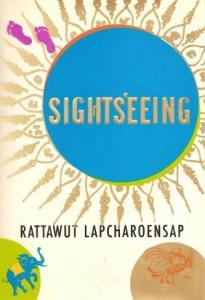
Rattawut Lapcharoensap was born in Chicago, raised in Thailand, and as an emerging writer, has written  a terrific book of short stories based in Thailand, Sightseeing (2005, ISBN 0-8021-1788-0).

The title is based on the story of a young man and his mother, who’s taking perhaps the last vacation she can visually enjoy, as her sight is failing. As with the other six stories in the book, it is told in the first person.  Ruttawut was 25 years old when he completed the book, and has a wonderfully canny feel for his personae: a young Thai man, a Thai adolescent, a young Thai girl, an aging western expat debilitated by a stroke.

Each tale oozes poignancy and subtly lambastes hypocrisy, whether it is Thai racism, western hubris, or the classic vices of gambling and corruption. Here at WoWasis, our favorites were Priscilla the Cambodian, the story of a poor immigrant girl with a mouth full of gold teeth, and Don’t Let Me Die in This Place, in which a cranky western stroke victim attempts to make peace with the fact that he’s come to die in a foreign land, living with his son’s Thai wife and their children.

The book’s such a delight that we’re wondering what Rattawut’s next writing project will be. Sightseeing is good enough for now, and highly recommended for its social insight, writing craft, and exceptional storytelling. Buy it now at the WoWasis estore, powered by Amazon.

WoWasis book review: Harold Stephens’ ‘At Home in Asia: Expatriates in Southeast Asia’

Written By: herbrunbridge - Mar• 08•11

Writer and sailor Harold Stephens sure gets around. He lied about his age so he join join the Marines and fight in the Pacific, was imprisoned by the Chinese communists, escaped on a junk, rode across Australia on a motorcycle, and built his own concrete boat, which split apart in a hurricane after seeing endless numbers of ports. Eventually, someone’s going to write a book about him. 

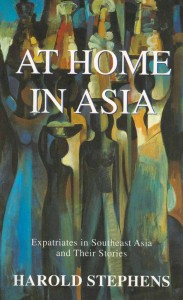
One of Stephens’ great interests is people, and in At Home in Asia: Expatriates in Southeast Asia and Their Stories (1995, ISBN 0-96425221-1-2), he chronicles some of them. 

It’s interesting to read this book, written more than a decade ago, from a historical perspective. John Everingham, who famously scuba-dived his girlfriend from under the noses of the Lao military, runs a successful travel agency as of this writing. Bill Heineke remains a well-known and regarded businessman in Bangkok. Some of the others have passed away. Living or dead, their stories are magnificent. Some, like Barbara Adams, had relationships with royalty (hers was in Nepal). Others, like Han Snel, became successful painters (he in Bali). And there are some fascinating tales of wonderful hoteliers, too, from Frans Schutzman at Singapore’s Raffles Hotel (he was fired by the Chinese owners for giving W. Somerset Maugham a free room), to Kurt Wechtveitl at Bangkok’s Oriental Hotel, to Boris Lissonevitch and Kathmandu’s Hotel Royal, as described in the chapter on his wife, Inger. 

This is the kind of book you don’t read in one sitting, as you want to luxuriate in the individual stories of the 14 people profiled in the book. They’re stories made up of adventure, serendipity, smarts, and a desire to live out of the box in an exotic world far from where these fascinating individuals originated. Buy it now at the WoWasis estore, powered by Amazon.

Western body odor takes Asia by storm, threatens the right to peaceably assemble

Written By: herbrunbridge - Mar• 06•11

Close quarters at Sukhumvit street stalls often present monumental olfactory challenges

Your WoWasis research team has discovered that Good-smelling SE Asians are increasingly discussing ways to remove Westerners with foul armpit odor from their midst, including throwing them in jail without the benefit of habeas corpus legal protection. And surprisingly, they don’t want Westerners to be able to bribe their way out of it. One nation is even considering special “BO Police” that would have immediate powers of arrest. A straw poll we conducted indicated that even some good-smelling westerners wanted their odiferous countrymen and women removed permanently from public areas. Although the writers of this blog do make an attempt to be objective, even we are starting to come around to the idea of some sort of punishment scheme for stinky westerners may be in order. Consider this story:

While at an internet shop recently, a gentleman of middle age from a Nordic country walked in the door, and his armpit odor immediately took over the space, offending everyone in the room. We walked up to him and asked if he spoke English, and he said “Yah, I do.” We told him that his horrible smell not only offended us, by the Thais as well. His response? “Sorry, I don’t understand.” But understand he did, which puts him the Category I of BO (body odor) enthusiasts and carriers, Read on:
AsiaPromoBannerWithout any fanfare from the press, a new generation of BO-friendly travelers has encircled the globe, congregating in areas such as Bangkok’s famous Khao San Road, with its affordable hostels, bargain restaurants, corn-row salons, and tribal tattoo shops.  What yesterday was denigrated as “body odor” has now taken on the trappings of a “culture” consisting of varying levels of acceptance and appreciation. With movie stars such as Julia Roberts proudly displaying armpit bushes, BO, for centuries a trait that poor people would enthusiastically rid themselves of through bathing, has now become a trendy characteristic of the well-to-do. Instead of driving an expensive sports car, trendy types engaged in conspicuous consumption are increasingly showing their wealth by smelling like a barnyard. Now, blind people can recognize trendy people without even talking to them.

We call this international practice of avoiding the washing of armpits as BO Kultur. BO Kultur, as codified by International Travelers, takes on four discernible permutations:

Category I) “Proud, political BO”: We got it, we know it, we’re proud of it
Category II) “Laissez-faire BO”: We got it; don’t care about it one way or another
Category III) “Lazy BO”: We got it?  Geez, didn’t know it… we’ll let it go ‘till wash day next month.
Category IV) “Accidental BO”: We got it?  Didn’t know it, but we’d better wash up.

Let’s elaborate on these categories:

Category I) “Proud, political BO”: We got it, we know it, we’re proud of it
A traveler to Belize wrote recently:  “Generally, I never wash under my arms, and enjoy carrying a deep aroma, which collects in the yellow areas in the underarms of my T-shirts.  While getting on a bus recently, I noticed a few fellow travelers who pointedly stayed away from me, their choice, of course.  A large girl with cornrows, however, made it a point of sitting next to me.  Later we both admitted to being attracted to each other’s powerful reeking smells. Lovemaking that night was intense, and we climaxed repeatedly.  She was keen to travel with me to my native Germany, but return occasionally to her city of London, where a number of her friends share our fondness for the sour smell of well-worn sweat.”

“Belize Traveler” carries BO Kultur with him in nearly a militant manner, refusing to become alarmed when others take pains to avoid him.  He is aware that under tropical conditions, body odors are intensified, and act as an attractor for like-minded members of the opposite sex (or same sex, depending on orientation).

Category II) “Laissez-faire BO”: We got it; don’t care about it one way or another
We ran into Andreas in a museum in Kuching, Malaysia, where his powerful underarm odor had managed climb down from the second-floor balcony where he was enjoying his beer, to offend passers-by on the sidewalk below.  Approaching such individuals is always challenging, in that the interviewer cannot predict the reaction of the individual, but Andreas was pleasingly non-plussed. “Yeah, I’m basically a lazy sod, and washing and doing the laundry don’t have as much priority as getting a beer.  I mean, look, give me five bucks, and I’ll eat, shit, piss, or wash, your choice.  I figure if most people don’t like the smell, then leave the room or the city I’m in. I live in Berkeley, where BO is an art form,” he said with a nod and a grin.

Category III) “Lazy BO”: We got it?  Geez, didn’t know it… we’ll let it go ‘till wash day.
Less militant than Andreas, and not as matter-of-fact as BT Traveler, folks in this category wear their BO as an afterthought.  Otto walked in the door and sat next to us at a restaurant on a hot day in Bangkok, where his startling smell of unwashed clothes inundated our salad and fruit smoothie. When told about our study on the culture of BO among international travelers, he offered the following: “You know, it’s been so many days since I washed these clothes, I just can’t smell anything anymore.  Am I offending?”  Tough question for us to answer, as BO Kultur is prevalent among western travelers, but without stinky subjects, studies like ours can’t be done.  We replied that if we were offended, what did Otto plan to do about it?  “Nothing, actually, I’ll just try to stop my arms from flapping.  I’ve got five more unwashed T-shirts in my luggage, and I’m not planning on doing laundry till I get back to Denmark in August (it was March).  Back home, lots of people more or less smell all the time, but no one really cares about this.”

Category IV) “Accidental BO”: We got it?  Didn’t know it, but we’d better wash up.
Anna and Jennifer are two San Franciscans who had been partying heavily at raves, where we met them in the lobby of our guesthouse on Ko Phan Ngan in Thailand. In the process of checking out, the ladies’ odors were righteous enough that the Thai receptionist had covered her nose with her free hand.  Veteran observers of BO Kultur on several continents, we admit we were curious as to the orifices involved in this strange mixture of body smells, so we asked.  “Ohmygod”, said Anna, “we just woke up, and forgot to take a shower, maybe we’d better run back upstairs.” We asked if they were truly concerned about offending others, or merely reacting because we’d said something, and Jennifer offered: “We didn’t mean to smell bad, but we sorta got outta the habit of washing after we got these cornrows, which are impossible to keep clean anyway.”  Impertinent, we asked if the issue of BO affected their ability to find boyfriends.  “Western guys will screw anything,” Anna laughed, and we admit to sneaking a peek at the Thai desk clerk, who managed to smile sweetly, yet roll her eyes at the same time.

Westerners aren’t the only ones 

We recently reported that Thai tour guides and operators are giving Russian visitors some serious space in deference to the BO problem. This caused us to poll a number of people in Thailand. We asked which visitors smelled worst. Here are a few of the responses:

“Watch out for Russians with blunt samovars lurking in your garden.” – Collin

“My sources say men from India, no contest.” – James

“Arabs and Indians smell the worst because they eat lots of “lamb, sheep, and onions.”  – a Soi Cowboy bargirl

“I have indeed heard rotten things about the way that Russian men smell but from what I’ve heard from ‘ying Thai in Bangkok and Pattaya, it’s usually the men from the Middle East who smell absolutely the worst!” –Sean

What’s interesting to us is that we’ve traveled extensively through the Middle East, where everybody we ran into smelled pretty good, and valued soap and bathing. And you won’t find a bad-smelling Indian tailor in Bangkok. Somewhere, in the vast land of Russia, we’re sure at least one person owns and uses deodorant.

Nevertheless, noses are clearly under assault in Bangkok, especially in crowded areas such as the market stalls on Sukhumvit between Sois 3 and 11. And we have it on good authority that higher-ups are concerned. 

Conclusion

BO Kultur is alive, well, and thriving in tropical countries, as flamboyantly fragrant Westerners bring a philosophical mix of opinions and practices to the East, where local populaces and westerners careful of hygiene alike are under olfactory assault daily by individuals who wear their armpit BO like an army general wears stars.

4 rules for western women who want to socialize in Bangkok

Written By: herbrunbridge - Mar• 05•11

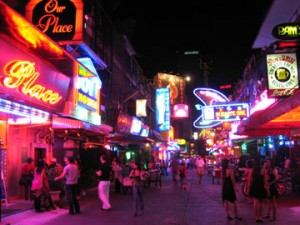
Bangkok’s Soi Cowboy

Here at WoWasis, we always like monitoring what’s being said about male-female socialization in Asia, and we find one of the more interesting bloggers is Jenna, who writes out of Taiwan.  She’s written a post today on how western women do (or do not) socialize in Asian countries, with a number of interesting observations and opinions. This one about Bangkok’s Soi Cowboy struck us as being worthy of addressing:

“ …there is plenty of nightlife and it’s mostly safe for the Western woman, but that doesn’t mean the average Western woman wants to partake of it (go check out Soi Cowboy sometime – you’ll see what I mean). Why go to a bar or club where you don’t know anyone, you’re quite possibly the only foreign woman there, and neither the men (foreign or local) nor the local women want to talk to you?”

Actually, we know of a number of western women who have enjoyed Soi Cowboy. Generally, they’ve come with friends, but if a woman is traveling alone, it’s a friendly place where buying anyone a drink will buy what will probably be an interesting conversation.  Contrary to popular belief, men are always curious when a woman from any culture buys them a drink. Thai bar girl stories are fairly predictable: “father is farmer, work in factory before, first time work in bar, no have boyfriend.” As a western woman, your story will be different.

We know of Irene, one U.S.-based lady who went to Soi Cowboy’s 5-Star bar, bought a bottle of champagne, treated the dancers to a drink, and had the time of her life.  Upon leaving the bar, she ran into writer Dean Barrett, with whose writings she was familiar. She still talks about her wonderful Soi Cowboy experience, and the ladies still talk about how friendly she was.

And then there’s Linda. Linda’s a British ex-pat who managed the Hollywood go-go bar for a while, can often be found having a drink in Nana Entertainment Plaza’s Big Dogs bar, and is loved and welcomed in every bar in Bangkok. Expats, bar girls, and visitors she meets become instant friends. Linda just loves everyone, and it’s infectious.

What Irene and Linda both have in common is that they’re friendly, love people, and are non-judgmental about western men, bargirls, and Thais. They’re convivial, and bring the party with them. People just flock to them, because they’re smiling, laughing, and having a great time.

Since a significant number of western women travelers read our blog, here are four tips to socializing in Bangkok bars that can be of great value:

1) Don’t regard every western man you see as a current or potential child molester. Men do tend to like women, that’s why they’re in Bangkok. And they’re not just here to meet Thai women. They also meet Ugandans, Cambodians, Brits, Yanks, Aussies, and Europeans. If you have a convivial outlook, you’ll find many men interested in talking to you.

2) Have a great attitude, and join the party. In places like Soi Cowboy and Nana Plaza, drinks are cheap, bar staff is friendly, and whatever your taste in music, you’ll find a bar that’s playing it. Places like 5 Star bar in Soi Cowboys have great live bands, too. You can get great insight into Thai life and culture by buying a bargirl a drink. A great way to break the ice is to ask where she’s from, and if she has brothers or sisters. If you have a map of Thailand with you, she’ll even point out show you where she’s from.

3) Resist the urge to dance onstage. Thais always smile, even if they can’t stand what you’re doing. The stage is for the girls that work there. It’s their place of business. If you start dancing on stage, customers will begin to leave, and the girls will lose money in drinks and bar fines.

4) Don’t take pictures of western men you’re just meeting. Religious organizations and NGOs are making a nuisance of themselves trying to bust every western man in Asia, and western guys will be suspicious if you want a “pal” photo too soon.  We met a very nice western couple who said hi to us and joined us for a conversation at one of Soi Cowboy’s outdoor bars. They mentioned they were there as part of a Christian group, but they didn’t bring out cameras and make themselves unwelcome. Whatever their reason for being there, they observed social decorum. We made it a point of not being judgmental of them, either.

In summation, attitude is everything. Friendly people are welcomed the world over, and with your great attitude, you’ll have no problem engaging people in conversations in any bar in Bangkok. If you just sit in a bar and look glum, no one will engage with you in a conversation. But if you get out of your chair, sit next to someone, and make a friendly comment or two, you’ll never be lonely.

WoWasis book review: Jillian Lauren’s ‘Some Girls: My Life in a Harem’

Written By: herbrunbridge - Mar• 04•11

Wags have suggested that in order for a reader to really bond with the premise of a book written in the first person, whether fiction or non-fiction, he or she must like the protagonist. And if not, at least identify with that individual, on some level. Jillian Lauren, in her Some Girls: My Life in a Harem (2010, ISBN 978-0-452-29631-2) seems to be trying mightily to get us to like her, or perhaps she’s just trying to like herself. Instead, the book comes off as being the diary of a self-absorbed neurotic, with precious little insight into the underlying machinations of the harem of Brunei’s Prince Jeffri, brother of the Sultan. 

She was there, for sure, and does offer some tidbits on the petty rivalries among the international set of harem girls. She sleeps with the Prince, does a lot of shopping. Her self-image is a wreck, as she confesses on page 138: “I could read every book in the library and still not walk out brilliant… Not cute enough, not smart enough, not popular enough, not talented enough, not special enough. I was just an average hustler who could sometimes talk my way into getting what I wanted.” Much of the book revolves around an identity crisis surrounded by therapy, pills, booze, sex, a search for her birth mother, identifying with the songs of Joni Mitchell, and getting tattooed. 

Oh, the tattoo. She waxes nearly poetic about getting a snake tattoo that winds its way down to her nether regions and “decorates my entire pussy with thorny monster teeth.” Here at WoWasis, we’re sure the Prince was impressed. 

We finished this 339 page diatribe because we were looking for something — anything really — to hook us on the story. But we couldn’t find it. Or maybe we did. In her brief tales about Fiona, the Filipina mistress who sat on the Prince’s right hand before rejecting a marriage proposal of sorts and moving clandestinely back home, we think we found a compelling character. She should have written the book. 

We found it curious that the book was written in 2010, when most of the events in the book occurred in or about 1993. That’s nearly two decades in the past. We’ve read other books by self-excoriating western females in the Orient. Our favorite was the late Cleo Odzer, author of Patpong Girls, who we would have like to have met. We’re not sure how Lauren turned out, whether she eviscerated her ghosts, or kept on seeking happiness somewhere, from somebody, or some thing. But she’s still got that toothed-pussy tattoo that she’s proud of. When we see her walking down the street, we’ll step to the other side, and pull our zipper up just a little higher. Buy it now at the WoWasis estore, powered by Amazon.

WoWasis book review: Steve Raymond’s ‘Poison River’

Written By: herbrunbridge - Mar• 01•11

Here at WoWasis, we’re aware of lots of reasons why you don’t want to get thrown in jail or prison in Thailand. When you do, you’re at the mercy of an unbelievable amount of corruption and bribery practices involving prison authorities, police, your own lawyers, and the justice system itself. As a foreigner, a great way to get thrown in prison (or lose your life) is to engage in business in Thailand, although, as Kay Danes’ book Deliver Us From Evil regarding a situation in Laos points out, it could happen in any country in Asia.

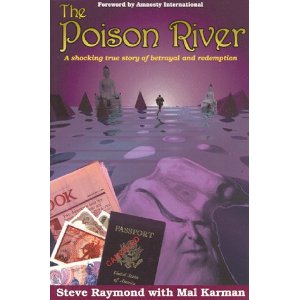
Which brings us to Steve Raymond’s sobering and compelling book of justice gone wrong in Thailand, The Poison River (1995, ISBN 0-9642533-8-0). A U.S. expat, Raymond ran a tour business from Bangkok. A confessed do-gooder, he took the step of taking in two Thai youths, who lived in his apartment. With the permission of the boys’ families, he was paying their school tuitions, giving them a clean place to live, and sending them off to school every day. He wasn’t sleeping with them.

But that didn’t stop Thai authorities from arresting him on child molestation charges, based on a spurious newspaper article which was then reported in Bangkok’s two English language newspapers. It quickly went out of control as U.S. authorities began the process of also prosecuting him under U.S. law. How did the problems begin? Who two individuals in the U.S. associated with the Religious Right, who powered a media frenzy over unfounded allegations of child abuse. An amazing aspect to the story is that Raymond was acquitted by the Thai justice system, but was held in jail in Thailand anyway because the United States Embassy had rescinded his passport. Without the assistance of Amnesty International, he still might be rotting in jail today. As the story unfolds, he was finally brought back to the U.S. as a prisoner, where a judge ruled that all charges were unfounded, and he was granted his freedom.

Although written more than 15 years ago, this book is hardly out of fashion. In Southeast Asia, particularly in Cambodia these days, a Western adult living with any underage individual in any non legally-binding relationship is a potential recipe for disaster. Indeed, as reported in countless stories in Cambodian newspapers, Western-based religious organizations and NGOs are trolling for any westerner seen in the company of any individual who even appears to be underage. They are taking films and photographs, paying taxi drivers and hotel staff, and taking the alleged “evidence” to police. In many cases, this results in financial shake-downs and incarceration of innocent people.

Raymond’s book is the best we’ve read to date on how innocent individuals helping children in Asia can be abused by justice systems influenced by innuendo, unfounded charges, and corruption.

Bachelor in Bangkok: Khun Lee on a trip to a Soapy Massage Parlor

Written By: herbrunbridge - Feb• 27•11

editor’s note: for more on the nuts and bolts of the soapy massage experience, read WoWasis’ post on soapy massages

For many years I have partied in Bangkok the traditional western way, which is to spend a great deal of my time in go-go bars and beer bars.  These places are filled with western men, most of the staff speaks at least a little English, and the internet is flush with information about where to go and what to do.  I have always known that these naughty nightlife options for westerners is just the tip of the iceberg in what can only be described as Disneyland for the naughty foreign male.  The quantity and variety of naughty boy options available in Bangers absolutely boggles the mind and imagination.  

Here are just a few of the venues available to the man who would like a bit of “companionship” for the evening: 

1)Go-go bars
2)Beer Bars
3)Hotel Lounges
4)Discos
5)Massage Parlors
6)Drive-in short time hotels equipped with curtains to hide your vehicle!
7)Open-air areas surrounding high trafficked  locations such as Nana Car Park
8)Street gals
9)Gals plying Parks such as Lumpini and Sanam Luang
10)Karaoke bars
11)Beer Gardens
12)Traditional massage places-these gals can be dirtier than the “parlors”
13)Foreign style restaurant/bars such as Gullivers and Bully
14)Coffee shops in older hotels such as Florida, Nana and Federal
15)Any place with gals representing beer companies-yes MANY are in the game
16)Thai clubs such as those at RCA and Ratchada Road
17)Venues with live bands-have picked up some hotties there!
18)Large (palatial) beer houses such as Tawan Daeng and Holland Beer
19)Small freelance shops such as Thermae Coffee Shop (can you get coffee there???)
20)Escort services-I have 1 mate who just goes to the small reception area of his local escort service and asks for whatever gal is brand new to the joint. He has had some amazing experiences. 

Of course, I am leaving out the internet here and there are dozens of ways to hook up with a local “entertainment provider” at both Thai and English sites.  I like to see my gals in the flesh before making a choice so maybe a reader can write in some helpful hints for the rest of us here.  Oh shite, I left out straight sex places such as Eden Club and……forget it there are just too damn many to name. 

This is a very small and incomplete list of the ways to rent some loving for the evening.  There are at least 3 times this many, and I don’t know if it is even possible to complete a comprehensive list of all the avenues available to the horny masses. I once read online a very creative list of 109 different venues to get laid in Bangkok and I wish I had printed a copy of it.  After 9 years of living in Paradise, at least once a month I get dragged to a place by a mate that I never knew existed and end up shaking my head in disbelief and mumbling something along the lines of “damn I didn’t know I could score a babe at a place like this. I didn’t even know this place was here.” 

That leads me to my current adventure.  I have always liked to party first and indulge later, so I never gave much thought to choosing a gal at one of those large massage parlors.  Some guys refer to them as “soapies” and in the old days they were called Turkish Bath Houses.  Anyway, this week I decided to indulge myself and wandered into one of the larger and more popular venues on Ratchada road.  In the back of my mind I have been meaning to go, as I have several Asian friends who swear by the places and rant on and on about how hot the gals are and how good the service is. 

 Well, I have to say I was absolutely blown away at how many perfect looking hotties were available for my perverted pleasure. I can honestly admit it was the greatest number of beautiful girls I have ever seen in one place in my life.  The gals were way hot, the price about the same as bar fining a gal from a go-go bar and using a short time room, and everyone was extremely polite and courteous.  Here is my synopsis of the good and bad points of indulging in this manner: 

GOOD1) Might as well start with the core issue! The gals are WAY hotter than the gals you will see in any western style venue.  There were over 60 gals available and I didn’t see a single gal who was fat, had a baby scar or was over 25 years old.  Think of those amazing gals you see walking around Siam Paragon and you get the picture. 

2) The price is all-in-you pay a set price and that covers everything.  You don’t buy her a drink, no bar fine, no charge for the room or even for the condom! 

3) The service and time is set. Unlike a “short time” at a go-go area where the gal tries to finish in 20 minutes and run off, this place you get 2 hours with the gal and she bathes you, loves you and …….well I got everything and more than I could have dreamed of.  You have 2 hours of sexual intimacy with the girl of your dreams. 

4) There is no pressure. I sat and enjoyed a beer (65 baht as opposed to 145 at foreign style gogos) and took my time perusing the inventory. 

5) The gals are so polite and accommodating.  The customers here are 95% Asian so bad attitudes and abusive language just isn’t tolerated. 

BAD 

1) It is point and shoot.  Yes, you can enjoy a beer and take your time selecting a gal, but there isn’t much partying between the customers and gals in the reception area.  You are supposed to go there for sex!  Sure you can have a drink and relax, but if you want to party and really let loose the more traditional places for westerners guys are a better choice. 

2) Price-I paid a little over 2000 baht all-in, and although that is about the same as bar fine, room and fee for the gal in a farang area, it is much cheaper to just accumulate mobile numbers of freelancers and call one in when you feel the urge. When I call a gal to come to my room I normally pay 1000 baht. 

You better believe I will be a regular customer from this day forward.

Read Khun Lee’s other WoWasis columns for more advice on navigating the adult dating scene through the backstreets of Bangkok

WoWasis book review: Frank Visakay’s ‘Jasmine Fever’

Written By: herbrunbridge - Feb• 27•11

In the experience of those of us here at WoWasis, most expat writers who have complimentary things to say about Thai women contrast them with disparaging views of Western women in general and Yank women in particular. Frank Visakay, a former New York chef, has penned a book that’s a hoot for guys who love the women of Thailand.

Visakay’s Jasmine Fever: Confessions of a Jaded Expat in Thailand (2007, ISBN-13: 978-981-05-8973-8) is a terrifically fun read. A lot of the book is about contrasting what the author would pay in New York for female companionship, sexual or otherwise, and what he pays in Thailand, including dinners, drinks, and paid-for sex. Lots of these tales are similar to those told by Khun Lee in his Bachelor in Bangkok column in the WoWasis blog, where naïve western men, many on their first trips to Thailand, give away small and large fortunes to bar girls one third their age. Visakay relates many of the usual aphorisms we’ve all heard, or should have heard: You’re not paying Thai girls for sex, you’re paying them to go home; How do you make a small fortune in Thailand? Come with a large fortune. And because the book is essentially about women and the men who love them, he offers this interesting quote: “The deviation between whores in Thailand and whores in America is that here the hookers try to make it a girlfriend experience and are so charming that you really could fall in love. In America when you pay a hooker for sex she couldn’t care less if you lived or died.”

Our favorite story was “Land of Opportunity,” where a sharp Thai lady taking a one month break from her husband and child in the U.S. manages to get a Canadian to build her a bar, get the guy permanently kicked out of the bar, and sell it for a small fortune, all within one month, prior to getting back on the plane for the States. The book is a great read for people already familiar with the Thailand bar scene, and a must-read for first-time visiting men who are intending to meet Thai women, in or out of bars.

Potential readers feeling uncomfortable about the concept of paying for sex really need not worry. Everyone knows that prostitution in Thailand is illegal. Buy it now at the WoWasis estore, powered by Amazon.

Additional note: Frank Visakay died on May 11, 2010, at the age of 71, of an apparent heart attack. The comments following his obituary in the Phukette Gazette indicates that left left dozens of friends and admirers.