The sharper edge to traveling in Asia

The Good Manner: Thai prostitutes are in my hotel

Written By: herbrunbridge - Feb• 26•11

The Good Manner: Advice on Thailand from WoWasis’ Pa Farang
This week’s dilemma: Thai prostitutes are in my hotel 

Dear Pa Farang, 

I’ve been brought over here from Singapore to manage a hotel, and, as a western-educated woman, I’ve become concerned that our hotel bar has become inundated with Thai prostitutes, who appear at all hours in our hotel bar. I didn’t have a prostitute problem when I managed our hotel in Kansas City, as we just called the police, and had them all thrown out. Here, I can’t tell the difference between regular girls and those selling themselves for money. When I ask my Thai employees to fix the problem, they just shake their heads and smile. Can you give me a pointer or two on how I can clean up my bar? 

–          Trying to go the straight and narrow 

Dear S & N, 

Welcome to Thailand. Western managers working in Thailand often find themselves in a situation where they can’t understand the Thai class structure, and the lack of the western concept of “sin.” Here’s an explanation. Thailand, like the U.S., is a democratic nation.  Unlike the U.S. it is class-conscious. A girl coming from a poor rice-farming family in the northeast has, most probably, a sixth-grade education.  After the age of 12, she’s expected to help out with farming tasks, and school takes a back-seat.  If she doesn’t want to continue doing back-breaking farm labor, she often comes to Bangkok, where she engages in either back-breaking construction work, or finger-breaking work at large factories.  Eventually, she’ll meet girls from her locality who meet travelers, have sex with them, and make more money in one evening than they could in a month of manual labor.  They elect to join them.  Thai girls do not necessarily think sex out of wedlock is a crime.  Instead, they look at this as not only a money-making activity, but also as a way to meet a potential husband. 

These are the girls you refer to as prostitutes.  They are making their way to the top, without the educational or job opportunities that western girls have.  And that’s the reason you have a difficult time telling the difference between regular girls and irregular girls.  Thai irregular girls send copious amounts of money home to their families, and in doing so, pay for farm mortgages and university opportunities for family members. That is why your Thai employees won’t help you.  The vast majority of them have relatives engaged in the same activity, and recognize that, in the Thai dynamic, this is the way things work. 

So what will you do?  Most hotels have recognized the fact that it’s up to the traveler to determine what, if any, interaction he’d like to have with a Thai girl from any class. You can, of course, make your club inaccessible to those without memberships, or high entry fees.  Then, you stand the risk of losing the very clientele you’re trying to attract.  Many hotels take the tack of letting things happen as they happen, and concern themselves with counting the money at the end of the day.  It is up to you to decide whether making money or keeping to your own personal moral code is the bottom line. 

Marayat dee,  

– Pa Farang 

Read Pa Farang’s other columns in WoWasis for more advice on relationships and cultural matters in Southeast Asia


WoWasis book review: Dean Barrett’s ‘Permanent Damage’

Written By: herbrunbridge - Feb• 26•11

It’s never easy getting Dean Barrett, author of a surprisingly vast array of books on Asian subjects, away from his favorite haunt at Bangkok’s Chao Phya 2. That’s why we here at WoWasis were pleased that he found time to pen another book in his Scott Sterling mystery series, Permanent Damage (2010, ISBN 978-0-9788888-2-4). 

At 382 pages, it’s a robust page-turner, the story of a series of crimes that originally began in war-era Vietnam, and continue through to present-day Bangkok. There are the usual dodgy characters that Barrett loves, comprising ex-military and ex and current spooks, spiked with romance, death, and plenty of compelling plot twists. Essentially, the story revolves around a Western woman coming to Bangkok to find the killer of her father. But in the usual Barrett style, nothing is really as it seems. There’s plenty of local color, much of it occurring in an expat bar in Bangkok’s Washington Square. The author’s done his spook homework, too, knowing, for example, that all mobile phones act as microphones even when turned off, unless their batteries are removed. We especially loved his treatment of the character of Chu-hua, a previous love-interest of Sterling’s, a protagonist who seems to be working simultaneously for everyone. 

Our only fault with the book was that it could have used a better proof-reader, as some of the names are mis-stated, and some of the grammar is skewed.  Barrett’s a real wordsmith, but authors can be their own worst proofreaders (we know, it’s happened to us, too). As another reviewer stated, “if you read this book be prepared to do some detective work on your own.” The reader can get through it, however, and the book’s a good one, and worth reading. Barrett’s amalgamation of the military, intelligence, and go-go bar worlds is always fascinating, and there’s not a boring page in the book. Buy it now at the WoWasis estore, powered by Amazon.

Russia invades Thailand: Big-bellied shock troops wearing thong bikinis storm Thai beachfronts

Written By: herbrunbridge - Feb• 21•11

Wags are asking: was the B.O. bomb launched from the Kremlin?

An estimated 200,000 Russian and CIS (Commonwealth of Independent States) tourists have come to Thailand within the last 60 days, spurred by tourism incentives directed toward Russia by Thai tourist groups and agencies. Veteran travelers to Thailand have long noted a strong Russian presence in the seaside city of Pattaya, but large Russian tour groups are all over Thailand these days, escaping the cold northern winter. 

Several Thai tour guides and tour operators were interviewed by your WoWasis research team, and asked about the impact of Russian  and CIS tourism on Thailand. Somewhat surprisingly, they all agreed on three aspects to the Russian/CIS onslaught: 

1) Russian and CIS credit cards are not welcomed due to the prevalence of Russian credit card scams. Thai tourism venues are typically requiring payments in cash only from these visitors.

2) Russian and CIS children are considered to be so ill-behaved in general that many smaller hotels have established a rule that only one Russian/CIS family may stay at a hotel at a given time. Damage to hotel rooms has been given as one of the major concerns by Thai hotel operators.

3) Many Russian and CIS visitors have a body odor problem, which Thais find offensive. The Thais we interviewed chalk it up to these visitors just not being used to bathing in their cold climate. When they visit a tropical climate, many Thais find the smell unbearable. 

Thailand is reaching far and wide for tourist revenue to offset the damage caused by two years of civil protests, which have contributed to lowering the numbers of visits by Westerners. Cashing in on tour groups from cold northern climates appears to be a financially lucrative program that at the same time is causing many Thais working in the tourism industry to scratch their heads and wonder if the next wave of Russian and CIS tourists will represent a social improvement over many of the individuals making up the current group.

WoWasis on censored & pirated books in Vietnam: Why you’ll probably want to buy elsewhere

Written By: herbrunbridge - Feb• 19•11

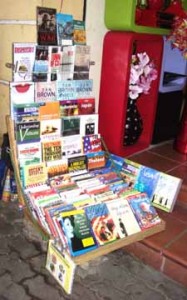
In streetstalls such as these, nearly all books are pirated and photocopied

Want to buy books while traveling in Vietnam? While you’ll have no problem finding books on Vietnamese art and culture in its many bookstores, you’ll find almost nothing on its wars, politics, or society, and precious little Vietnam-related fiction. The two main reasons for this are governmental restrictions on imported literature, and the prevalence of bootlegged, photocopied books

Governmental restrictions on imported books 

The government of Vietnam is extremely thin-skinned when it comes to books that it interprets as being critical of Vietnam.  As a result, it creates a bureaucratic nightmare for bookstores wishing to sell titles relating to Vietnam.  

Should a bookstore wish to import a given book, for example, it has to submit its title on a list, and wait for government clearance to import the book. When it’s imported, several copies immediately go to a regulatory body, where it’s read. The process of reading and reviewing takes up to two months. It can be rejected for any reason, and pundits believe any mention at all of the word “Viet” will automatically exclude it from approval.  

This arduous bureaucratic process creates a situation where, in reality, no bookstore wishes to bother with importing books.  

Bootlegged, photocopied books 

In response to the process described above, many Vietnam-related books are bootleg-printed, and sold by thousands of vendors in street stalls or walking the streets of Vietnam’s major cities. Obviously, no residuals go to publishers or authors.  The printing is legible although photos are not.  The selection is decent, and new books “appear” constantly, as bootleg presses keep running. 

WoWasisrecommendation?  Buy Vietnam-related books in your own country, or in bookstores in Bangkok or Singapore.  The selection will be greater there, the authors will get royalties, and photography less miasmatic.

Beer in Vietnam: a WoWasis survey

Written By: herbrunbridge - Feb• 19•11

With the exception of Laos, we at WoWasis feel that Vietnam has the best beer in Southeast Asia.  What you’ll find is that Viet beers are stronger than most beers at home, so plan your evening accordingly, understanding that you’ll be overcharged for everything if your seller, whether it be a food vendor, taxi driver, or bar girl, thinks you’re drunk. 

Vietnam is also the home of bia hoi, locally-brewed neighborhood beers that are made cheaply, and served in neighborhood restaurants from bulk containers.  To date, we’ve yet to run into a Westerner who actually liked beer hoi.  Most simply drink it because it’s damn cheap (as low as 1000 VND per glass).  Bia hoi beers have no brand, as there are as many varieties as Vietnam has home brewers. 

At many bars, you’ll see “beer girls”, waitresses dressed in logo clothes advertising various beers.  Their job is to convince you to buy their beer.  They’ll order it for you, serve it to you, and get a commission for each glass sold.  A nice custom, but insist in the beer you want, unless you’re in experimental mode. 

A quick list of Viet beers, available in stores and bars, with alcohol content: 

BGI (3.8%) is bottled by Fosters, and not a prime player, market-wise or in the taste department.
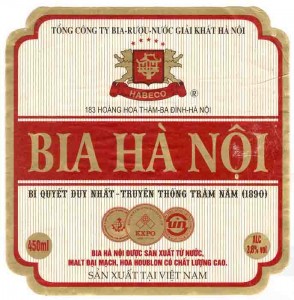
Bia Ha Noi has a nice, dark flavor, our favorite beer in Hanoi.  Bottled alcohol content is 3.8%, 4.2% in cans.
Bia Larue (4.5%) is devoid of anything resembling taste.
Halida is the preferred beer among many westerners, especially those living in Hanoi (5%).
Huda from Hué is a Danish beer (the name is a combination of Hué and Danish).
Saigon Export (with a red label) is a terrific beer at 4.9%, made by the same folks as 333.
Saigon Lager (4.3%) and Saigon Special (4.9%) both come in a green label, and are on the light side, comparable to American lagers.
333 Export (“Bia ba-ba-ba”) comes only in a can, and has a hearty flavor.  5.3% alcohol.

Vietnam tourists killed in Ha Long Bay boat tragedy

Written By: herbrunbridge - Feb• 19•11

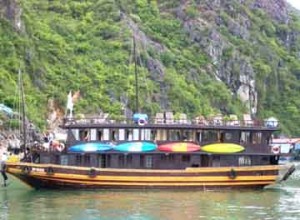
Ha Long Bay Sleepover boats have been temporarily docked, pending investigation by Vietnamese authorities

Twelve international travelers were killed this week in the sinking of one of Ha Long Bay’s ubiquitous “sleep-over” boats. The Truong Hai 06 listed precariously for several hours before finally plunging into the waters of the bay during the early morning hours as visitors were sleeping. 

Scores of these wooden boats take visitors on overnight bay stays each day, on Ha Long Bay, a favorite travel destination for visitors to nearby Hanoi. Vietnamese authorities have summoned the crew for questioning pending a full investigation, and have temporarily suspended overnight cruises on the bay. Day cruises remain unaffected.

WoWasis book review: Clifford Kinvig’s ‘River Kwai Railway’

Written By: herbrunbridge - Feb• 14•11

You’ve seen the terrific movie, you’ve read Philippe Boulle’s compelling book. Great stories, but they’re both fiction.  For a worthy overview of the situation as it actually occurred, we at WoWasis recommend reading military historian Clifford Kinvig’s River Kwai Railway: the Story of the Burma-Siam Railroad (1992, ISBN 1-84486-021-3). An estimated 100,000 workers died during the construction of this enterprise, which ultimately failed to live up to its military potential: the gradient was too steep for wood-burning locomotives, it was harassed by Allied bombing and strafing, and derailments required constant attention.

What makes Kinvig’s approach to the story most interesting is his adherence to the military reasons Japan acted the way it did, pushing sick POWs and paid coolies past their exhaustion points to death, in order to build a rail supply line that would compensate for the allies’ destruction of their merchant marine supply chain. There’s something of the old samurai philosophy of bushido as well, as Kinvig quotes Lt. Usuki, the Commandant of the deadly Konyu 2 camp which created Hellfire Pass: “The Japanese are prepared to work — you must work. The Japanese are prepared to eat less — you must eat less. The Japanese are prepared to die — you must be prepared to die.” And die they did, through overwork, cholera, and countless other reasons. Their graves fill two huge cemeteries in the Kanchanaburi province.

In contrast to what is stated in Boulle’s fine novel, the Japanese were not novice railroaders, having built bridges over tough terrain in other parts of the world. They were not stupid, and it seemed were always looking at new ways to win a war that was lost practically as soon as it started. As Kinvig points out, there must have been conflict at a higher level over whether the broken-down human resources of the West were ever going to be healthy enough to complete the task in just over a few months.  The Asian coolies who worked on the railway, many of whom were Burmese or Tamil workers from the rubber plantation of Malaya, suffered as much as the POWs. Many brought along their families with them as they worked. Cholera, dysentery, and a number of other killers condemned their families to death as well.

The cholera situation was grim, as the bacillus is passed by flies, in this case attracted by the open latrines. What about the brothel train, running along the tracks for Japanese soldiers? Kinvig reports that “on several occasions the girls gave cash and cigarettes to the destitute POWs.” If the book has a failing, it’s that the author’s prose is occasionally tedious. He relies on necessary facts and figures perhaps too heavily at the expense of storytelling. Many times throughout the book he makes reference to items that would appear to be fascinating: how could the locomotives have better climbed the gradient? What’s the story behind the brothel train? How were the women recruited? Such questions should, one would think, be at least addressed in endnotes

On the plus side, Kinvig does a wonderful job describing the plight of the Tamil workers from Malaya, who tend to get ignored in discussions surrounding contributions to, and deaths resulting from work on this railway.

All in all, a serviceable, competent book that could have benefitted from less of an emphasis on pure statistics, and more on some of the side stories that were, in all probability, fascinating enough that they would have made a worthy addition by their inclusion.

Taipei’s e-Library Waiting Lounge at Taoyuan Airport: Taiwan finally goes high tech!

Written By: herbrunbridge - Feb• 13•11

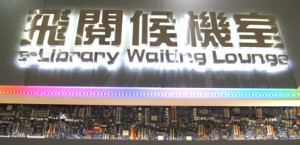
Cool sign incorporates printed circuit boards, a tribute to Taiwan's high tech tradition

Taiwan’s Taoyuan airport in the capital city of Taipei has been deservedly maligned as being possibly the most Neolithic — from a westerner perspective — capital city airport in Asia. Forget about Western food (Asians will tell you the Asian food stinks, too).  In fact, Taipei resident Jenna Cody, quoted in the February 13 issue of the Taipei Times, calls the airport food “an embarrassment to the nation.” The upstairs food court isn’t easy to get to from some parts of the departure lounge, and choices are limited.  Most travelers we know here at WoWasis have real opinions about Taoyuan, and none of them are good.

Finally, are the airport authorities listening? Maybe they are… the new  e–Library Waiting Lounge is terrific!

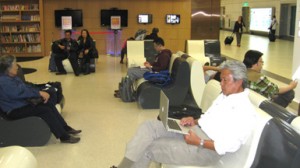
Comfort and access to technology and western power make a quantum leap for travelers at Taipei's Taoyuan Airport

The  e-Library Waiting Lounge. It’s adjacent to gate C5, a gate commonly used for international flights to San Francisco, 30 miles to the north of the high tech capital of Silicon Valley. Good planning, as lots of people carrying electronic communication devices will be on those flights.  The e-Library’s façade is designed from an amalgamation of circuit boards, a tribute to Taiwan’s high tech pedigree. There are free Wi-Fi, internet stations, e-book readers, and even a real library, with books in English and Chinese that you can read, with a promise to return them when you leave the lounge. And there’s a charging station, where power and cables exist for all your electronics. Each of the 42 comfortable molded-plastic seats sports two power outlets, with standard American 3-pronged service. Also, it really is a library. Not a TV or video game in the place, quiet enough that you can get some real work done. The e-Library venture appears to be a joint cooperative effort of the Taoyuan International Airport Corporation, Ltd., and the Ever Rich Foundation, affiliated with the duty-free shops that we suspect funded the construction of the space.

In short, the whole e-Library is a damn good design, terrifically planned. It’s a wonderful upgrade to an airport that essentially ignored Westerners for decades. And it makes us a bit excited in thinking of our next stop here, wondering if the Taoyuan authorities will be just as diligent in redesigning the entire concept of food service.

No doubt, some of this may be a result of EVA Air’s increasing presence in the U.S. as a very good and relatively low-cost carrier to Asia, bringing more Western travelers to EVA’s Taoyuan hub. EVA’s inflight food is a disaster though, just as bad as the cardboard-tasting fare served by China Airlines (we don’t care about the low prices, when the food is that bad. Asian airlines, please take note, as even western coach-fare passengers will go overboard to select a low-cost airline with better food).  If Taoyuan Airport’s food can ever be improved, perhaps EVA’s won’t be far behind. One can only hope. At least now there appears to be a glimmer.

In memory of Caryl Olivieri, Bangkok furniture designer and artisan

Written By: herbrunbridge - Feb• 12•11

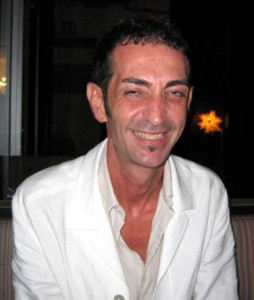
Caryl Olivieri, 2002

We at WoWasis originally found furniture designer Caryl Olivieri on the top floor of his Artitude shop at Bangkok’s Gaysorn shopping complex. We were impressed by the designer’s bold, colorful furniture uses of traditional rattan, but with a new twist: it was woven into fine strips, and molded in contours that snake around cushions, armrests, and feet.

Caryl’s personal story was fascinating.  Born in Corsica on September 19, 1957, where he lived until he was 16, he attended Paris’ prestigious Ecole Internationale des Arts Décoratifs, and soon found himself working in haute couture, designing clothes and accessories for France’s leading fashion houses. He also served as a model. Soon, he began designing watches and fashion accessories, wrote travel guidebooks, and lived in Brazil, China, and Taiwan before arriving in Bangkok on a jewelry contract in conjunction with Elle Magazine. Having fallen in love with Thailand, elected to stay, and was persuaded to bring his expertise to interior and garden design, in venues such as the restaurant Crêpes and Co., on Sukhumvit Soi 12. He co-founded Artitude in October of 2002.

The shop was a success from the beginning. Caryl was soon a social fixture around town, a live-wire who enlightened every party. His enthusiasm for Bangkok, particularly the area around Thong Lor (Sukhumvit 55) was infectious. He had a mystical sense for the numbers 3, 7, and 9, and donated 37.9%  of his earnings to HIV/AIDS programs, breast cancer research. He paid his workers above-market wages, and paid the school fees of his workers’ children.

Moving into the year 2004, he voiced concerns about complications arising from his transactions with a Thai business associate, who he refused to name. As is tersely stated in Brian Mertens’ book Bangkok Design: Thai Ideals in Textiles and Furniture, (2007, ISBN 13-978-981-232-600-3), “He died from a fall in 2004while tending the balcony garden in his high-rise apartment.” Neither The Nation nor the Bangkok Post, Thailand’s two leading English language newspapers, published the story or his obituary. It’s as if this high-profile, generous, and well-liked westerner just one day vanished. The French Embassy’s Death Dossier # 409 on him essentially repeats the police conclusion that his death was accidental. As with many other westerners who accidentally fall from tall buildings in Bangkok and Pattaya, case closed.

In an earlier web entry WoWasis made for Caryl’s work, we quoted him as follows, and added our own commentary:

“Essentially, I wanted to change the concept of outdoor furniture, bring unexpected colors to contemporary urban living, and create an interior environment that will be modern in Bangkok, New York, or Paris. Thailand has many workshops that make rattan, but our concept was unique; the real challenge was training the workers to work the material in a new way, and produce to a higher level of quality than they’d been accustomed.”  His interior concepts include panels, columns, lamps, and accessories to urban lifestyle, all utilizing rattan woven into rich textures, dyed and waterproofed.  His designs carry elements of several international styles, while being uniquely his.  A visitor may recognize disparate influences in his furniture such as clean Scandinavian motifs, bold Japanese perpendicular planes, and, in his room treatments which include panels, early twentieth century Russian constructivism.

“In 1998, I founded Atmosfer, which encompasses furniture and interior design consulting, but which will also eventually include music and other design elements which add to the urban environment evolving from our creations.”  He’s clearly on his way, having exhibited his furniture in France, and now having representation in Japan and California.

Well, we were wrong. He was instead on his way to an early death, yet another westerner who falls in love with a country that becomes his final stop. The books have been closed on the life and death of Caryl Olivieri now for some time. They’ll probably never be reopened, nor will the dossiers that tell the “story behind the story” that the world will never know.

Making merit: Tham boon at a Thai temple

Written By: herbrunbridge - Feb• 10•11

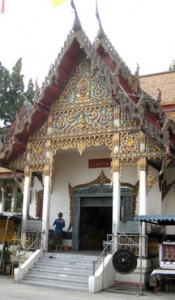
Bangkok's Wat Mahabut

Many — and here we’ll take the risk of saying Most — Thais make merit at a wat (temple) periodically. Making merit is the act of taking a small gift to the wat, presenting it to a monk, reflecting on good wishes in the name of others, and receiving a blessing from the monk.

Everyone has his or her favorite wat for tham boon (making merit), which, generally speaking, could be in one’s city of residence or one’s ancestral home.  A Thai friend invited WoWasis to accompany her to tham boon at Bangkok’s Wat Mahabut, and the entire ritual was quite interesting.  Here are the procedural steps to tham boon:

1)       Begin by buying a plastic orange bucket of personal items, from a shop just outside the wat. These buckets can be found for sale for various amounts of money, starting at 60 baht. They contain things like soaps and small towels, flashlights and small umbrellas. When you buy the bucket, you’ll be given a pink envelope in which to put money for the temple. You write your name on the envelope, insert the money, then tape it to the bucket, right beneath several sticks on incense.

Choosing a merit gift for the temple

2)      Inside the wat, there will be a smaller shrine area where one or more monks will be seated. Remove your shoes, climb the steps, and kneel before the monk, placing your bucket in front of you. We of course, didn’t know the ritual, but followed our Thai friend as she bowed and waiied. There was a white cloth with a red stripe before the monk, and our friend placed her bucket on the cloth, wheupon it was taken by the monk (women must place their offereings before the monk, who will never take it from them directly). The monk then began chanting in phrases, our friend repeating after each phrase.

3)      A small ewer full of sanctified water and a small bowl were placed in front of us by the monk. As we slowly poured the contents of the ewer into the bowl, the monk sprinkled us with holy water.

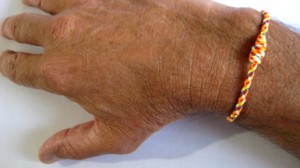
Sai sing merit bracelet

4)      He then gave each of us a “sai sing,” or holy string, which we later placed around our wrists. This string must be given by the monk, and is traditionally kept on the wrist until it falls off. The sai sing was traditionally white and hand-tied by the monk, but today is pre-tied, and is rolled over the wrist. The monk thanked us, and we bowed and left, taking with us the small bowl of water the monk had just blessed.

5)      Immediately outside the monk’s shrine area, there was a tiny garden of statuary surrounding a tree. Our Thai friend instructed us to concentrate on people who were important to us, then slowly pour the contents of the bowl at the base of the tree.

Thus ends the tham boon ritual. But there are other rituals to perform at the wat as well. Wat Mahabut, sits right next to Wat Mae Phra Khanong, the temple dedicated to the legendary ghost. Here, it’s more about animistic beliefs than Buddhism, but for millions in Thailand, the two belef systems are inexorably intertwined. At Wat Mae Phra Khanong,  you purchase a small garland of flowers, incense, and some gold leaf. Light the incense, place the garland near the statue of Mae Phra Khanong, then place gold leaf on her. There is a small bowl nearby containing plastic balls, each with a number. Reach inside and take a ball. The number you see corresponds to a fortune that you’ll find on paper, sitting nearby in a cubbyhole. The fortune is in Thai, which your Thai friend will be happy to read for you.

At other shrines in the wat, instead of a bowl of numbered balls, there is a wooden tube of numbered sticks, which you shake until one falls out. That stick has a number painted on it, which again, corresponds to a numbered fortune.

We found the tham boon ritual to be important in terms of understanding out Thai friends better, and were honored that we were invited. Our Thai friend mentioned that she was making merit not only for her family, but for her ancestors, her boyfriend, the family of her boyfriend, and even her boyfriend’s recently deceased dog as well. If you haven’t yet done so, consider asking a Thai friend if he or she will bring you along on the next merit-making trip. It will take only a few minutes, but can add immeasurably to your understanding of how Thais think and feel.

Wat Mahabut and Wat Mae Phra Khanong, are most easily reached by taking the BTS Skytrain to On Nut station. Adjacent to the station, find Sukhumvit Soi 77 and turn right.  Take a taxi or motorcycle taxi ¾ kilometer to Soi On Nut 7 and turn left. The wat is at the end of the road, approximately ¼ kilometer.