The sharper edge to traveling in Asia

Thai Prisons: Inside the belly of the beast via the ‘Thai Prison Life’ website

Written By: herbrunbridge - May• 13•11
Bangkok’s Samut Prakan Prison

One of the more fascinating museums in Bangkok is the Mahachai Prison Corrections Museum, but of course, prisons are only fascinating to those that aren’t living in them. We recently ran into a remarkable website run by Richard Barrow, who has befriended many prisoners in Thai prisons, most notably Panrit “Gor” Daoruang, who was imprisoned for drugs at Bangkok’s Samut Prakan Central Prison. Thai Prison Life is the name of the website, and here you’ll find an amazing compendium of information about life in Thai prisons, from executions, to living conditions, to contacting prisoners. There’s even a list of all of Thailand’s many prisons. 

Crowded sleeping conditions on the first day of arrival

Gor has been called “Thailand’s most famous blogger” by the Christian Science Monitor, and his blog is accessed from the site as well. Much of what Gor and Barrow write about is essentially methods of surviving in Thai prisons. Since there are thousands of foreigners currently incarcerated in Thailand (mostly for drug offenses), the site is a “must-read” for family members and friends of convicts, and serves also as a warning to visitors even thinking of partaking of drugs while in Thailand.

WoWasis book review: Longstreets’ ‘Yoshiwara: City of the Senses’ of Tokyo

Written By: herbrunbridge - May• 12•11

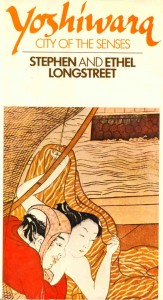
Yoshiwara was a district in Tokyo famous for adult entertainment options. Formalized in the 17th century, it thrived as a sex center until 1958, when prostitution was officially banned in Tokyo. Published in 1970, Stephen and Ethel Longstreet’s Yoshiwara: City of the Senses (no ISBN) is a history of the district, its culture, practices, and people. 

The Longsteets do a fairly good job on the historical side, explaining the reasons for the formation of the district (it was set up to move adult services to a confined geographical area within Edo, as Tokyo was called then). They cover disparate personae such as geishas both male and female, courtesans, mama-sans, sumo wrestlers, and samurai. Shintoism figured prominently in the belief system driving the district, and that is woven into the story, as are interesting minutiae involving kimono, hairstyles, and shoes. 

Some of the earliest “fishbowls’ in Asia must have been the showrooms of 17th century Yoshiwara, where a customer would select his favorite from among the women on display. As the book points out, not all courtesans were lower or middle class. After a “fall from virtue,” even Samurai families sent their women, known as yakho, to work in brothels for a period of 3-5 years. 

If this book has a flaw, it’s in the treatment of homosexuality. In discussing male geishas, the Longstreet’s opine “Most were degenerates, often homosexual,” one of several digs on the gay lifestyle. They also chide Westerners “who find excitement in large protruding breasts.” The authors, however, are not doctrinaire puritans, including a quote from Arthur Koestler on the invasion of Western puritanism into the Japan of the late 1050s. The faults we at WoWasis found in the book may be more a result of the time in which it was written. A better understanding of gay culture and personal preferences would come to many writers soon, and this may have happened to the Longstreets as well: this book was republished in 2009 as Yoshiwara: Geishas, Courtesans, and the Pleasure Quarters of Old Tokyo (ISBN 9784805310274).

WoWasis book review: ‘Sarawak’ photos by Hedda Morrison

Written By: herbrunbridge - May• 08•11

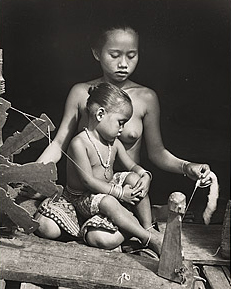
Hedda Morrison, who died in 1991, was the wife of Sarawak district officer Alastair Morrison. During her 20-year stay in Sarawak, she was able to accompany her husband on official journeys through the country, detailing, through writing and photographs, the lives of tribespeople. Her book Sarawak (1957) is an indispensible record of northern Borneo before it became part of the nation of Malaysia. It appeared in several editions. The first edition of 1957 has superior photo reproductions than those following, although we at WoWasis like the third edition of 1976, as it contains an updated bibliography of book related to Sarawak, Malaysia, and Borneo in general. Although long out of print, it’s worth canvassing used book dealers for this important book. 

Morrison was a keen observer and was able to gain the trust of her subjects, who gave her carte blanche to photograph rituals that today are rarely seen in their pristine element. Her ethnographic subjects included the Sea Dayak headhunting Ibans, Malays, Land Dayak Bedayuk, Chinese, Melanaus, Kayans, Kenyahs, Muruts, Kelabits and Oenans. 

She clearly loved the people she photographed, and enjoyed having a good time with them: 

An Iban woman spins thread

“The borak, the rather bitter rice beer which the Kayans and all the other people of the upper Rejang and Baram make, flows freely. Visitors have to withstand innumerable songs of welcome from pretty girls, each song ending up with a glass of borak which no guest can resist for the simple reason that if he refuses the girls seize him and pour the borak down his throat by main force. The only safe defence is for the visitor to burst into song himself—the house will happily join in the chorus whether he sings Onward Christian Soldiers or Waltzing Matilda or the Wearing of the Green — and address his song to one of the girls who in turn must drink the borak like a man. Kayan parties are fun. And just to round things off when the visitor leaves the next morning the girls come and smear his face with soot (most difficult to remove) and then throw him in the river, as a sign of friendship for, they say, ‘We are now such good friends that we can even play practical jokes on our guests.’ They take these liberties with even the most exalted visitors. Kayan-Kenyah life is not, of course, just one unending round of parties but they are certainly some of the happiest memories which the visitor will take away with him from Sarawak.” 

She also answers questions about longhouse life that every visitor to tribal areas asks: 

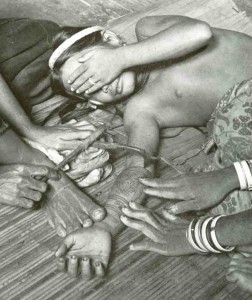
Painful process of tattooing in the upper Rejang

“Some Penans have settled down in longhouses. Those who have done so for many years follow a way of life that is very similar to that of Kayans and Kenyahs but the change is not too easy and a newly established Penan longhouse is far from pleasant. This is largely due to the fact that newly settled Penans have no pigs. There are no sanitary conveniences in any Bornean longhouses. Refuse is just thrown out of the door and the people relieve themselves in the bushes a little distance from the longhouse. It appears a most unhealthy and insanitary system but in fact the longhouses of the settled peoples are clean and free from flies. This is largely due to the keeping of pigs and it is these unpleasant but useful scavengers living under and around the longhouses which ensure that the neighbourhood is kept clean. But where a house without pigs is to be found there are innumerable flies and other insects and a general atmosphere of filth and squalor.” 

This method of human refuse disposal today remains the standard way of business in much of Asia (that’s why we here at WoWasis prefer to eat our ham sandwiches in the West). If you have any interest in the beautiful land of Sarawak, try it to find this book. It’s a treasure.

WoWasis book review: Kaowai & Robinson’s ‘In Grandmother’s House’

Written By: herbrunbridge - May• 07•11

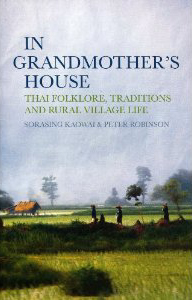
Visitors spending any time looking into the culture of Thailand will run into thousands of folk traditions and beliefs, and Thais are always impressed when a foreigner wishes to know more about them. Understanding these concepts is empirical, as one thing inevitably leads to another. We at WoWasis are still learning. And that’s why we welcome — and recommend — In Grandmother’s House: Thai Folklore, Traditions, and Rural Village Life (2011, ISBN 978-981-08-6658-7).  

The book is a fascinating amalgam of lore told to Sorasing Kaowai by his late grandmother, who was a village healer in the Isaan province of Uttaradit. Co-author Peter Robinson, a former Buddhist monk, does a great job of putting these beliefs and stories into a cultural context. Our favorite chapter deals with the ubiquitous Thai ghosts, including the feared excrement-eating and baby-killing Krasue. Each chapter, though, is compelling, with wonderful explanations on topics as disparate as eating bugs, local festivals, kaffir lime, marriage and death rites, facial moles, and Buddhist monks. 

It’s not easy finding this amount of information about Thai village traditions, and it’s well-covered here, in 240 pages. Buy it now at the WoWasis estore, powered by Amazon.

WoWasis book review: North Korean Gulag… The Aquariums of Pyongyang

Written By: herbrunbridge - May• 06•11

For anyone wishing to know more about what goes on behind the scenes in North Korea, Kang Chol-hwan’s The Aquariums of Pyongyang: Ten Years in the North Korean Gulag (2000, ISBN 0-465-01102-0) is  a must- read.

Kang’s expat North Korean family became wealthy in Japan and had a good life. At the urging of his Communist grandmother, the entire family decided to relocate back home, where they were promised all the well-to-do trappings of their lives in Japan. Immediately after returning, the realized they’d made a mistake. Beginning with relinquishing the family’s treasured Volvo, they were systematically robbed of everything they owned by the government, and all, with the exception of Kang’s mother, were sent to the remote and bleak concentration camp at Yodok. Hard work, poor food (rats and insects supplemented their meager fare), cold, and sickness accompanied political indoctrination.

AsiaPromoBannerThe treacherous practice of fooling wealthy and educated expats to come back home was identical to the technique used by the Khmer Rouge in Cambodia to exterminate much of its population, and the story of Kang and his co-author Pierre Rigoulot reads pretty much out of the textbook of Josef Stalin. The book is fascinating, compelling, and horrifying all at once, and essential reading for anyone interested in the North Korea-South Korea dynamic, doctrinaire Communism, or the North Korean empire established by Kim Il-sung and continued by Kim Jong-il. Buy it now at the WoWasis estore, powered by Amazon.

WoWasis introduces Krasue, Thailand’s most feared ghost

Written By: herbrunbridge - Apr• 30•11

Thailand is a country obsessed with ghosts, known as phii. Here at WoWasis, we’ve learned never to joke about them, because joking about them is considered to bring on bad luck to the speaker as well as all listeners. And never joke about a ghost before your girlfriend enters the shower, especially at night: everyone knows that ghosts love to hang out in showers. But there’s more to worry about.

Krasue (กระสือ ), sometimes also spelled  Kra-Sue or Kra-Suea, is a malevolent spirit that appears at the night and appears to be a beautiful woman with her internal organs hanging down from the neck, trailing below the head toward the ground, and dripping blood. She is probably the most feared ghost in Thailand, and has a predilection for eating babies, sometimes right out of the womb. She has fanged teeth, and is enamored of eating the placentas of pregnant women, which she can reach with her elongated tongue. For this reason, country women cover their doorways with thorny vines, which will prevent Krasue from entering the house. She also dines on human excrement and dead bodies, which is why Thai people don’t like to live adjacent to cemeteries, always a source of food for Krasue. Presumably, she hangs out in toilets, too. 

She crosses borders, and is known in Isaan Thailand and Laos as Kasu, in Cambodia as Ap (អាប), and in Vietnam as Ma Da. No cemetery or outhouse in Southeast Asia is apparently immune. As we mentioned before, travelers to Thailand will find out soon enough that ghosts are no laughing matter. More than one punter has made the mistake of inviting a Thai lady up to his room, only to have her leave angrily (and prematurely) when he joked about a ghost in the bathroom. Now you know why.

WoWasis book review: ‘Japanesque: The Japanese Print in the Era of Impressionism’

Written By: herbrunbridge - Apr• 30•11

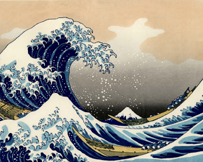
Hokusai's 'The Great Wave'

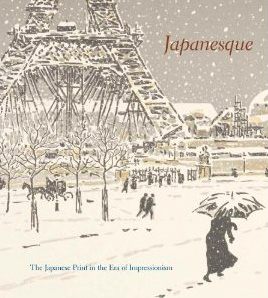
For centuries, Western art lovers have been fascinated by Japanese woodcuts of landscapes made by noted Ukiyo-e “floating world” artists such as Katsushika Hokusai and Utagawa Hiroshige, and of scenes from daily life by master artists Kitagawa Utamaro and Suzuki Harunobu. These woodcuts have directly inspired the work of Westerns artists, but perhaps never more so than when they were introduced to Europe in the 19th century. Karin Breuer’s Japanesque: The Japanese Print in the Era of Impressionism (2010, ISBN 978-3-7913-5082-0) details the history of Japanese woodcuts, and offers examples of how these prints directly influenced the work of Impressionsist artists such as Pierre Bonnard, Mary Cassatt, Edgar Degas, Paul Gauguin, Henri Riviere, Henri de Toulouse-Lautrec, and James Abbott McNeill Whistler. 

The book was developed to accompany an exhibition of the same name held at San Francisco’s Palace of the Legion of Honor in 2010-2011, and most of the images in the book come from its own collection. The essays in this 156 page book make for compelling reading for enthusiasts of the woodcut and Impressionist art alike, and the elements of theme, color, and design are interwoven into its four chapters: Evolution, Essence, Influence, and Inspiration. The Legion’s collection of Japanese woodcuts is strong, and its catalogue of Impressionist lithographs and woodcuts decent enough to provide rich material to form the basis of the book. The exhibition itself was astounding, and this book extends itself, through its scholarship and examples, to being far more than a simple guide to the event. Buy it now at the WoWasis estore, powered by Amazon.

Bachelor in Bangkok: Khun Lee on American wives and sponsoring Thai women

Written By: herbrunbridge - Apr• 29•11

Recently I have started to think that perhaps I need to work on my people skills.  Now, I have to say that I have never been the most diplomatic guy, and one of the things that I love about living in Thailand is the total lack of political correctness that is so pervasive in the West.  Here if someone says “why do Americans always talk so loud” or “why do the Thais walk so slowly” nobody is offended.  Anyway, the other day I was using online instant messaging with an old mate from the USA and the topic of his wife came up.  Jim is a hell of a nice guy, but unfortunately has a wife who weighs more than 3 Thai gals put together.  The really sad part is that since he has lived in the USA his entire life, he is totally convinced that he really can’t do any better so there is no real reason to complain.  Though he does seem to enjoy joking about it.  

He has a photo of his family on his desk at work, and the photo only includes Jim, his wife and 2 children when in fact he has 3 children. He purposely keeps this photo out on display so that when someone asks what happened to his 3rd child he can exclaim “I think my wife ate him.”  Keeping this in mind I really didn’t think I had to be shy about expressing my opinion on his wife’s glacier-like size. He was in the process of telling me that although most of his friends never get sex, he and his wife make love once a month and this alone has made him the envy of his hip crowd of mates.  

Now I have to pause right here to tell you Bangkok based readers that indeed, sex once a month is considered by many Americans to be an extremely active sex life and could possibly have one committed to a clinic for sex-aholics if one was heard to make this claim in public.  One of the things women are famous for back in my esteemed homeland is using the withholding of sex as a means to get what they want from their spouse.  Obviously this would never work in Bangkok as I think there are no less than 20 places to go for a little love on the side on the 700 meter walk from my apartment to the 7-11 store down the street.  Oops, I think I left out the blowjob bar, 2 hand job bars and the 3 Karaoke places.  There is the Coyote bar and I think I forgot the 2 billiards places where the girls go out with customers.   Now that I think of it I also forgot the bar with live music where the service gals are extremely frisky and known to cut deals on the side.  

Maybe I shouldn’t count that place as I have taken home 5 gals from there and one actually didn’t have sex with me!  The cheecky tart.  I clearly remember she said that “she liked me and just wanted to talk” I told her “that if I wanted to talk I would still be out with my friends actually having fun and talking about interesting things.”  People say that I am not diplomatic and need to work on my people skills?  Just look at how gentle I was with her.  I’m certainly not the one with the problem.  Actually there are just way too many places to rent love on the side to get an accurate count.  Let’s just say there is so much love for sale over here that if a woman withheld sex from her lover it might take him up to 3 minutes to find a suitable replacement for the evening.  In the USA, there really is no place to go for these poor saps who are whipped by their shrew wives, and as my mate was describing to me online how his wife withholds sex from him in order to blackmail him into draining his bank account, I slipped up and responded “when a 240 pound woman with 3 chins withholds sex from you she is doing you a favor.”  Do you think I was less than diplomatic?   He hasn’t contacted me since. 

I remember the one and only time that I allowed a gal to live with me (my insane period) in Bangkok.  She was young, hot and treated me like gold but I just got bored seeing her face every day so I eventually threw her out. Anyway, she used to be so cute whenever I would go out for the evening.  She would wait until I showered and began getting dressed, and then she would rape me and exclaim with a smile on her face “a real Thai gal never allows her man to go out at night with any water (semen) left in him.”  I guess she has never heard of Viagra? 

I know I always talk about how ridiculous it is to “sponsor” an entertainment provider by sending her money from overseas but this story has to be the most outrageous behavior I have seen to date.  There is a certain young, sexy lass that I have been intimate with on and off for 3 or 4 years.  When you live in Bangkok it’s necessary to accept the fact that the gals will always come and go.  I love it.  Gives me an excuse to move on when I have been with them too many times or to just explore the endless supply of gorgeous women here.  This particular gal was a go-go dancer when we first met, and since has had a string of jobs, providers and other reasons to disappear and resurface countless times.  Whenever she shows up in Bangkok she calls me (a booty call) and we have several rounds of hot, raunchy monkey sex.  The arrangement works for me. The best part is that many of the times she has had a sponsor, and on those occasions refuses to accept any payment from me.  These guys are sponsoring ME..  More accurately they are subsidizing my sex life!  

The last time that we met she phoned early in the morning (10:30 AM but that is early by Bangkok standards) and said she had only a few hours as she was in transit to England.  No problem I can have sex early in the morning if I absolutely am forced to so as per usual she came over and I have to say she was even more of an animal than normally, and for her that is really saying something.  Imagine my shock and disbelief when I left my apartment an hour or so later and she was eating lunch with her “sponsor” in the restaurant that is attached to my building. I subsequently found out that she was staying over night in my apartment building when she placed the booty call!  You really have to love these gals, they are absolutely shameless. 

Read Khun Lee’s other WoWasis columns for more advice on navigating the adult dating scene through the backstreets of Bangkok

Thousands flee Surin as new Thai-Cambodian skirmish erupts

Written By: herbrunbridge - Apr• 21•11

Early Friday morning, in the sleepy Thai village of Kopcheung, some 500 residents awakened to the thunderous sounds of rocket fire and machine guns as Cambodian and Thai troops fought nearby. It’s a new skirmish, but the same old story, this time taking place 150 miles west of the disputed territory encirling Wat Preah Vihear. An estimated 10,000 villagers in the Thai province of Surin have reportedly been asked to flee by Thai authorities.

WoWasis reported earlier this year on the ongoing series of military clashes between Thai and Cambodian troops on the border at the historic Wat Preah Vihear, where the situation remains in a state of flux. Military activity has now spread southwest, in the area that includes two more historic temples, Ta Moan and Ta Krabei.

Reportedly, Thai troops have already sustained casualties, and both governments are in discussion regarding the latest incident. Meanwhile, buses to Bangkok from Surin maintain normal schedules, carrying Thai residents wary of more sleepless nights.

Another man lives in my apartment with me and my girlfriend

Written By: herbrunbridge - Apr• 10•11

The Good Manner: Advice on Thailand from WoWasis’ Pa Farang
This week’s dilemma: Another man lives in my apartment with me and my girlfriend

Dear Pa Farang, 

My Thai lady and I are still getting used to each other, even after living together for a couple of years.  Last month, I got a surprise: her younger brother, a college student moved in with us while I was on a business trip. We’ve only got one bedroom, and he sleeps on the floor a few feet from our bed.  This is affecting our love life, needless to say.  The story I’m getting is he’s too broke to afford his own place, probably true. He watches television incessantly, bothering me to no end.  I feel like my home is no longer my home.  I might add that it took me a while to find this place, close to the Skytrain, building well maintained, and great views.  Is my problem a common one in Thailand?  Without offending my girlfriend, how do I fix this? 

–  Generous to a fault 

Dear Generous, 

At the risk of causing you more pain than you are feeling right now, are you absolutely 100% sure that this is her brother?  Enterprising young women have been known to move their boyfriends into the home of their sponsor (who assumed the role of boyfriend was his own) under the guise or brother, houseboy, or driver.  Television watching, beer drinking, and power napping soon become the rule of the day, as the homeowner eventually loses control of his own house.  If this is even a remote possibility, you’d be wise to hire an investigator to discreetly look into the matter. 

If, on the other hand, this really is her brother, you do need to insist that he depart.  If you are the major breadwinner for the extended family, you have, whether you like it or not, accepted the mantle of poo-yai, and will be expected to contribute to the welfare of the family.  Once opened, this is a fountain with a spigot that is not easily closed.  Many farang in your situation explain to their wives exactly what they can and cannot do to assist family members with financial needs.  This is something you’ll need to think through very carefully, because you don’t want your wife to be caught in the middle, where she’ll suffer a loss in having to choose between two sides. 

If you have the money and desire, you could rent an apartment for the young man, and sponsor his college education.  If this is not the case, you do have alternatives.  One approach is to tell her that you’d love to assist brother, but your funds, beyond household expenses, are heavily allocated to other projects.  These projects could even be in your own country, and could involve members of your own family.  Show The Good Manner by offering to fly her brother back to the city nearest his village, and provide bus fare back home.  This will enable brother to solicit other family members for funds necessary to attend university, and you will not be perceived as having been cold-hearted enough to have thrown brother out on the street.  Eventually, you may find that the Thai government does provide scholarships for college students, and that brother is eligible.  You may also discover that he’s been receiving the scholarship all along, but that it’s being plundered with alacrity by a family member responsible for brother’s welfare.  Many upcountry homes have been handsomely accessorized with televisions and motorcycles, utilizing such legerdemain.  It’s dilemmas such as these that make the Land of Smiles a complex, if interesting place, and keeps Pa Farang in the advice business. 

Marayat dee,  

– Pa Farang 

Read Pa Farang’s other columns in WoWasis for more advice on relationships and cultural matters in Asia