The sharper edge to traveling in Asia

WoWasis visits historic Lin An Tai House, Taipei

Written By: herbrunbridge - Aug• 29•11

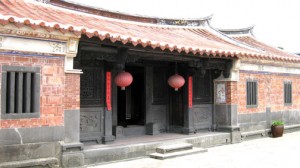
The façade of the Lin An Tai house conceals its 34 rooms

Like many other nations, Taiwan has done a great job of tearing down its old houses in its surge to create a modern country. Aside from its venerated temples, there’s precious little left of Taiwan’s architectural past. Fortunately, Taipei has preserved a very old house that was built in 1785 by Lin Chin-Ming, and moved it, piece by piece, to its own setting, where it can be visited. It’s not all that easy to get here: taxi drivers don’t seem to know it, but you can take the MRT to Yuanshan station, then hop on the R50 bus to the Xinsheng Park stop. And it will be worth it.

The house, comprising 34 rooms, contains period pieces of furniture and décor, and it’s off the beaten track enough that you’ll probably have it to yourself, a real bonus in Taipei. A fine example of Ming and Qing Fujian-style domestic architecture, it’s resplendent with carved fruits, vases, and family seals on the doors, lintels, and roof structure. Aside from the sheer beauty of the architecture, we here at WoWasis loved meandering around the rooms, imagining how different the human impact would have been when the house was in its prime, housing a successful merchant family with its constant activity. It now stands alone in a beautiful park built to showcase the house, a wonderful respite from the hubbub of one of Asia’s most densely populated cities.

Lin An Tai Historical House and museum
5 Binjiang Street, Taipei
Tel (02) 259-96026
open Tuesday through Sunday
MRT Yuanshan station, transfer to R50 bus to Xinsheng stop
GPS: N25°04.302’  E121°31.824’

WoWasis book review: ‘Eye of the Times: Centennial Images of Taiwan’

Written By: herbrunbridge - Aug• 28•11

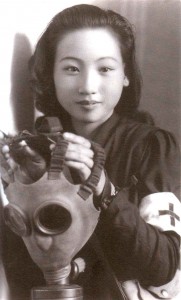
Girl Holding a Gas Mask, Wu Jin-miao, from 'Centennial Images,' collection of Wu Rong-xun

Taiwan is a country richly documented in photography. To celebrate the 100th anniversary of the founding of the Republic, the Taiwan Fine Arts Museum in Taipei in May of 2011 launched a photography retrospective documenting the many facets of Taiwan through historical and contemporary photography. The extraordinary richness of the exhibition is documented in its catalogue, entitled Eye of the Times: Centennial Images of Taiwan (2011, ISBN 978-986-02-7732-6). Available through its bookstore, the catalogue is a must-have for anyone interested in the history of the island.

The book is handsomely designed, with rice-paper wraps and a cloth binding, and contains 271 black and white and color images, taken by 117 photographers. The photographs are divided into the historical eras of  the Qing Dynasty (1871-1895), the Japanese Colonial Era (1895-1945), and the Post-War Era (1945-2011), followed by the special themes of Orchid Island, Mental Imagery, Fine Art Photography, and Portraits. The book includes curatorial statements, essays, a chronology of the development of Photography in Taiwan, and short biographies of the photographers.

The first photographs of Formosa, as Taiwan as then known, were taken by famed photographer John Thompson in 1871, and included photos of some of Taiwan’s indigenous people. Twenty of Thompson’s photographs are in the book. Special note should be made as well of the ten extraordinary ethnic images taken by Japanese photographer Torii Ryuzo lent to the Fine Arts Museum by the Shung Ye Museum of Formosan Aborigines. From 1905-1910, Lin Tsao documented Taiwanese families both rich and poor, and 24 of these compelling images are included in the book.

This comprehensive book is currently available only through the Taiwan Fine Arts Museum Bookstore. The museum itself is a must-see when you’re in Taipei, and we here at WoWasis  strongly recommend you pick up a copy of this extraordinary book on your visit.

WoWasis visits Taiwan’s magnificent Taroko Gorge

Written By: herbrunbridge - Aug• 27•11

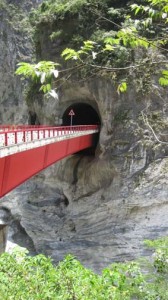
The Liufang Bridge is one of the many engineering marvels in Taiwan's Taroko National Park

Located between the Northeast Coast National Scenic Area and the East Coast National Scenic Area, the magnificent Taroko Gorge is Taiwan’s primary tourist destination after Taipei, and well worth the effort of going there. Bus tours can be easily booked from Taipei, and any traveler to Taiwan is recommended to carve out a day or two to visit it. It’s only 60 km southeast of Taipei on the eastern side of the island, but will take a day to get there. The ocean scenery on the way is spectacular.

Taroko National Park covers more than 92 square kilometers in the northern section of the Central Mountain Range. This park features high mountains and sheer gorges. 27 of Taiwan’s ‘Top 100’ (peaks towering over 3,000m in elevation) are located within the parks’ boundaries. Mountain vistas, gorge views, and diverse flora and fauna are among the park’s highlights.

Much of the remarkable scenery can be easily viewed on a 14 km drive through the gorge, with numerous stopping points, including several that include short, scenic walks that are right off the roadway. The road itself is a wonderful engineering feat, with scenic bridges and tunnels. You can easily spend several days here enjoying the numerous marked trails, or you can spend one day and still see some mighty impressive sights. Highlights from the road include the Tunnel of Nine Turns and Swallow Grotto trails, each of which includes magnificent gorge views, are of flat walking terrain, and take roughly one hour each.

When you get to the park, we here at WoWasis recommend buying the impressive and informative 175 page guidebook Trails of Taroko: Gorge and Su-hua Areas (2008, ISBN 986-00-2835-4), which includes comprehensive trail maps and an explanation of the geology, flora, and fauna of the park, as well as the story of the local Taroko indigenous people.
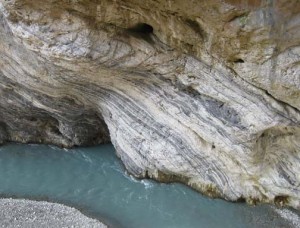
Rock weathering along Troko Gorge's Swallow Grotto Trail

If you’re traveling to Taiwan on business, you’ll be in Taipei or in the highly populated western part of the island. We strongly recommend that you consider taking a brief trip to Taroko to see a wonderfully scenic part of Taiwan that no visitor should miss.

The following information is from Taroko National Park’s website, which also includes maps, driving and train directions:

The formation of Taroko Gorge

According to theory of plate tectonics, the Penglai Orogeny was caused by the collision of the Philippine Oceanic Plate and the Eurasian Continental Plate. The Penglai Orogeny occurred 4 million years ago. At that time, thick layers of calcareous rock that had been raised from the marine depths during earlier orogenies were now gradually pushed high above the ocean surface to form lofty peaks. During this period of immense tectonic forces, the high pressures and temperatures of compression folded and metamorphosed the original rock (limestone) turning it to marble. At present, this region is still being uplifted at the rate of O.5cm a year. The area has experienced both geologic uplifting and river erosion by the Liwu River. This area is unique for its marble gorge that occasionally forms hundreds of meters high, a phenomenon seldom found elsewhere in the world.

Fauna

There are 34 species of mammals found in the park, including the black bear, Formosan Macaque (rock monkey), serow, wild boar, and sambar deer, etc. There are 144 species of birds, such as Swinhoe’s pheasant, Formosan blue magpie, Finches, and Formosan Laughing Thrush, etc.

Flora

The elevation ranges from sea level up to 3700m and includes several different climate zones. The vegetation found in the park includes: alpine juniper forest, dwarf bamboo formation, fir, hemlock, spruce, pine and hardwoods, Taroko oak and Chinese photinia.
WoWasis mailbag: Tourist rip-offs in Vietnam, Greece, and Egypt

Written By: herbrunbridge - Aug• 27•11

Vietnam may have its share of rip-offs, but not at beer halls, where it's always good!

We’re at WoWasis are always happy to get mail. Here’s an email we received this week:

Dear WoWasis, We surfed your website and the information you give about annoyances in Vietnam was very helpful to us. Just one thing: you mention that touts and rip offs in vietnam are as common as in Greece or Egypt.
We want to protest there: my girlfriend and I have been to Greece several times and never made any experience of that kind. In fact, as Greece uses the €uro scams and rip offs are much harder to organize. Maybe you can correct that bit of information? Thank you very much, Gregor & Anna.

Dera Gregor & Anna,

Thanks for writing. Obviously, you had a different experience in Greece than we did. What we found pervasive in Greece was the tendency to charge us more than the posted price. We generally caught it by counting our change. And we always had to count our change. We had to watch each item we bought as it was bagged or boxed, because goods would often be switched. Even in restaurants, we found that occasionally old food would be scraped from someone else’s plate and put on ours. We loved Greece, but found tourist rip-offs there to be common (a Greek friend of ours later told us that ripping off tourists is the Greek national pastime!) 

Bottom line, we think, is that no country is perfect, and every country has its good points as well as less-than-stellar aspects. As with Vietnam and Egypt, we’d gladly go to Greece again. But we’d still keep an eye out for the issues we encountered there. Being prepared for the occasional rip-off in any country will ultimately result in a more satisfying trip.

– The gang at WoWasis

WoWasis Taiwan shopping tip: buy a Fucashun multilingual world globe

Written By: herbrunbridge - Aug• 27•11

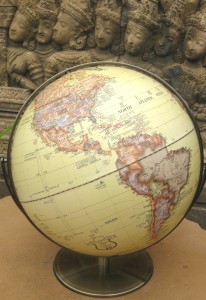
Attention to detail and overall readability make Fuchashun's MS-117 world globe a compelling buy

Looking for something extraordinary to bring back home with you coming back from Taiwan? How about a Fucashun Chinese-English world globe? We here at WoWasis, think there’s nothing like having a real globe at home and work. Atlases and internet graphics can never truly portray the scope and distance of various countries and world geographical features, and we found the 18” MS-117 globe made by Fucashum in Taiwan to be the best we’d ever seen.  Here’s why we went bonkers over this globe:

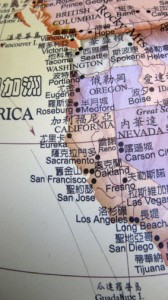
1) Place names are in both English and Chinese… that’s unique!
2) The sea is ivory-colored, so every island really stands out
3) It easily tilts on its supporting structure, so you can turn the world upside down at ease
4) It’s made of tough, translucent lucite, so ajacent sun or lamp shines a lovely light through its surface, and the printing is done on PVC, which covers the globe
5) Mountain ranges are raised

You can’t buy this globe on the internet, and we don’t believe there’s a source in the U.S. either, probably because it’s bi-lingual Chinese, and that’s a big part of its fascination.  Fucashun makes a number of other globes in different styles, including globes that have interior switched lights, but the MS-117 stands out as the best, for its clarity, overall quality, and uniqueness.

Be the only person you know with a globe that features place names in English and Chinese

So where do you buy it? The source we found is at a shop at Taipei’s underground City Mall, running underneath Civic Boulevard. A man named Mr. Kim runs a geography shop between entrances Y-17 and Y-19, where he sells atlases, globes, and other geo stuff. He speaks English, and we bought two globes from him (one was a gift for a 12 year old student in the U.S., and the boy just loved it!) The MS-117 comes in a 22”x25”x20” box that you can check in with your luggage for the ride home. It’s not heavy, so won’t add very much to your weight allowance (Mr. Kim delivered it to our centrally-located hotel, and he may do the same for you, too).  For a unique item that makes a wonderful addition to your office or a neat gift, the Fucashun MS-117 world globe is a winner.

Mr. Kim’s shop
City Mall, under Civic Blvd., adjacent to the Taipei train station
Entrance Y-17
Tel: (02) 2559-0070 or 0953-638-643

WoWasis book review: Amy C. Liu’s ‘Taiwan A to Z: The Essential Cultural Guide’

Written By: herbrunbridge - Aug• 22•11

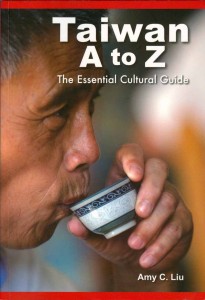
Amy C. Liu’s Taiwan A to Z: The Essential Cultural Guide (2009, ISBN 978-957-97847-6-4)is the book we wish we here at WoWasis had read prior to visiting Taiwan. Amy C. Liu was born in Taiwan, but came to San Jose, CA when she was 13 years old. She attended high school in the U.S., got a couple of degrees, then went back to Taiwan to investigate her roots. Essentially, she’s lived in Asia ever since. When we caught up with her recently, she was on her way to Tibet for a 30 day bike ride.

The book covers an awful lot of material in 182 pages. There’s a terrific amount of information here for first-time visitors to Asia, especially around basic concepts like saving face and Confucian relationships among individuals. What made the book a real plus for us (we qualify as old Asia hands by now) were the references to nuances that are specific to Taiwan, including her street food (pp. 48-52), and temple worship (pp.151-153). Those little crescent-shaped blocks that are thrown in Taiwanese temples are ubiquitous, and Liu unfolds their mystery. She also discusses the differences between Buddhism and Taoism, and how they’re reflected in both the architecture of the temples, and the behaviors of the worshippers in each.

She’s got a chapter entitled ‘Friendly Taiwanese.’ The Taiwanese are legendarily friendly, and their easygoing manner will make any visitor used to Southeast Asia feel right at home, even though the country isn’t geographically southeast Asian. They continually go overboard to assist the visitor, and every traveler to Taiwan probably wonders how this remarkable trait could be bottled, sent home, and be quaffed by his or her own countrymen. As Liu points out, words that describe the traditional Taiwanese traits would include friendly, polite, hard-working, kind, passionate, easy-going, reliable, open, and flexible. Most travelers want to be as nice to the Taiwanese as the Taiwanese are to them. A good reason for buying this book is to ensure that the Taiwanese will love you as much as you’re going to love them.

Finding any book in English in a Taiwanese bookstore can be a challenge, and this book is no exception. We suggest you order it online before you go, and read it on your flight over.

WoWasis visits Lugang, a picturesque Qing Taiwanese coastal city

Written By: herbrunbridge - Aug• 21•11

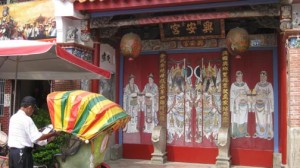
A ricksshaw is the best way to explore the picturesque streets and temples of Lugang's old quarter

Lugang (or Lukang) is a historical town featuring wonderful temples, a historical walk through old Qing-era shops, and a museum well worth seeing. It is located approximately 110 km southwest of Taipei, on the west coast of Taiwan. The Lukang Historic Preservation Area comprises a number of old market streets, and centers around Putou Street and the adjacent Yaolin and Dayu streets, tiny lanes of picturesque shops in period architecture, and Jhongshan (Zhongshan Road), the main thoroughfare. If you neither speak nor read Chinese, we here at WoWasis strongly recommend hiring a pedicab and driver to take you around the area, which comprises a number of beautiful Qing-era temples. It costs NT$ 600 for a 60-90 minute tour, and your driver will provide you with the free English/Chinese Lukang Visitor Guide map given out by Lugang’s Visitor Information Center, not always so easy to find.

In addition to walking through the old town and visiting Lukang’s interesting temples, you won’t want to miss seeing the permanent exhibitions at the Lukang Folk Arts Museum, housed in a spectacular three story colonial mansion. Although located not far from the historical district, the winding streets make the museumt challenging to find (use our GPS coordinates below to make it easier). The Lukang Folk Arts Museum was established in 1973, with all the buildings, land, furniture, utensils and collector’s items having been donated by the Koo family and other private benefactors. The museum holds more than 6,000 articles. We were enchanted with two bedrooms full of furniture, a Qing version and a colonial version, and the clothing and household items are exhibited well, with signage and notes in English.

Lukang Folk Arts Museum
152 Chungshan Road
Tel: 04-777-2019
www.lukangarts.org.tw
GPS: N24°03.222’  E120°26.171’

How long will it take me to learn Thai massage?

Written By: herbrunbridge - Aug• 20•11

The Good Manner: Advice on Thailand from WoWasis’ Pa Farang
Today’s question: How long will it take me to learn Thai massage?

Dear Pa Farang,

I am planning to visit Bangkok and i would like to have massage lessons but i haven’t have before any. How long you think it takes for a starter to learn? – Manos

Hello Manos,

There are a number of options available in Bangkok, but the one most highly recommended for learning Thai massage is the school at the famous Wat Pho, considered to be the most reputable massage school in Thailand. Courses vary, as does the time involved, but the basic course is 5 days. Click on WoWasis’ Wat Pho link, and you will find a description of Wat Pho as well as a link to their website, which has scheduling and cost information. This school is highly recommended by everyone, and a certificate from them is of tremendous value, professionally.

Marayat Dee,

– Pa Farang

Read Pa Farang’s other columns for more advice on relationships in Southeast Asia

What’s a Thai village marriage, and how do I arrange one?

Written By: herbrunbridge - Aug• 20•11

The Good Manner: Advice on Thailand from WoWasis’ Pa Farang
This week’s question: a Thai village marriage… what’s the story?

Dear Pa Farang, what is a village marriage as mentioned here (http://www.thaioasis.com/pf/pafarangcorner.php) and how would one go about arranging one?  Thanks in advance, Derek

 Hello Derek,

I have already written about some of the characteristics of village weddings, as well as some things you might want to consider avoiding as you move forward. Also check out my previous post which specifically deals with the issue of a dowry.

The “village marriage” is just that, a marriage in name only, and without any legal basis. It serves to legitimize, in the eyes of a Thai village, a relationship between two people. In the cases of farang (westerners), the groom is typically a western male, The bride a village woman. In such cases, the groom is expected to pay for a party, to which all friends and family are invited. In many cases, that means the entire village. That means all the booze, a roasted pig or two, etc. The groom is also expected to pay a dowry. How much? Read the column I referred to in the previous paragraph.

In terms of your question, how do you set one up? The woman in question will do it for you. She’ll make all the arrangements, tell you how much to pay for the party, and tell you how much to pay for the dowry, too (mom or auntie will help her with this, as westerners are typically sized up by the amount they look like they can pay.)

Of course, there’s also the matter of a legal marriage, which involves a signed document. The advantage of having a village marriage only is that in theory, anyone can walk away without involving the Thai court system. A Thai woman may very well just want to have the village marriage, for several reasons. She may want to see how the live-in situation goes before getting married legally, and the village marriage proves that you’re serious about each other (or serious about getting married, a different thing entirely). Caveat emptor: she may have a Thai boyfriend in the village (she’ll introduce him as a “cousin”), and the entire village respects the fact that she’s trying to cobble together some cash for her life with her future husband (not you).

It is common, when a Thai woman first has a legal marriage to a westerner, she will want to have a village marriage anyway, as all of her friends and family get to have a party and meet the groom.

Bottom line is let the woman take the lead on setting up the village wedding. Just ensure that you know where you stand in terms of the relationship, and what’s expected of you in terms of financial obligations.

Marayat Dee,

– Pa Farang

Read Pa Farang’s other columns for more advice on relationships in Southeast Asia

Want a quick getaway from Taipei? Take a one-day excursion to the spa town of Beitou and historic Danshui

Written By: herbrunbridge - Aug• 16•11

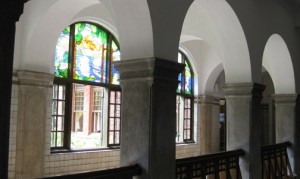
Inside the Beitou Hot Spring Museum

If you’re like us at WoWasis, you love cosmopolitan cities like Taipei, but have to get out once in a while. And maybe you don’t want to have to rent a car or take a bus to do it. From Taipei , you can take an excursion that will bring you to the historical seafront town of Danshui, where you can visit the fort and enjoy some of the local seafood at streetstalls. Return to the MRT Danshui station, then take the train back to the Beitou junction, take the link train to Beitou, then visit the Beitou Hot Springs Museum, and arrange to soak in the waters for an hour or so at a local spa.

All this can be done in one day, and starts by taking the Danshui MRT line all the way north to Danshui. The information counter inside the Danshui train station will give you a map, or do like we did, take Red bus #26, stop off at Alethia University (around the corner from the historic fort San Domingo) , see the fort, and walk the 1.5 km back into town, passing a number of other colonial structures along the way.

After a half day in Danshui, take the MRT back 6 stops to Beitou, then take the short commuter rail into Xinbeitou (this commuter train is the only one we’ve ever seen where seats were removed to accompany a big screen TV, which shows a Beitou promo video). In  Beitou, we recommend a quick visit the Beitou Hot Spring Museum, a restored bathhouse built by the Japanese in 1913. A few meters beyond the museum, look to your left across the street for the poor signage indicating “Thermal Valley,” where you can see some steaming sulphur pits. There is the Taiwan Folk Art Museum further up the hill with a modest collection of artifacts set in a Japanese-style house. On a hot day, the museum’s a hike, so you may want to consider a taxui.

At Beitou, treat yourself to a soak in hot spring water at any of a number of streetside spas. A n inexpensive public one is the Millennium Hot Spring, which charges 40 per 1.5 hours. It’s out in public, and they’ll sell you a bathing suit. We wanted a little more privacy, and found the Kyoto Hot Spring Hotel to be especially accommodating, paying NT$540 for a 1.5 hour soak in a Spartan room that suited us just fine (youcan pay more, and get a nicer room, too, more details below).

So there you have it, a neat one day excursion out of Taipei that ends with a good hot springs soak. Roughly ½ hour after your soak has finished, you’re back in central Taipei via the MRT.

Kyoto Hot Springs Hotel
105 Wuncyuan Road
Beitou
Tel: 02-291-2151
www.kyoto-spring.com.tw