The sharper edge to traveling in Asia

Transportation in Bangkok by rail, subway, road, and water

Written By: herbrunbridge - Jun• 02•10

Bangkok's Skytrain

You will soon find your enjoyment of Bangkok to be commensurate with your ability to get around the city quickly, efficiently, and comfortably.  Our preference is the BTS Skytrain for all points possible.  It’s quick, air-conditioned, and has great views.  The new subway is a decent second-best.  Take taxis and motorcycle taxis when necessary, and tuk-tuks when you’re amenable to being charged high fares with unwanted diversions to gem shops.  Inner-city buses are not an option we’d recommend.  Try one, and you’ll see what we mean. 

On the river, your best bet are river taxis, but don’t forget the Khlong Saen Sap canal taxis, which can get you from east to west faster than anything else in the city. 

With all the folding, unfolding, and tom yam goong spilling, you’ll need a sturdy map of Bangkok.  There’s none better than Insight’s plastic “FlexiMap” for Bangkok, available at bookstores everywhere. 

Here is your guide to getting around town: 

BTS Skytrain

Bangkok is best traveled on the Bangkok Transit System Skytrain, clean fast, efficient. BTS is a privately-held company, but rumblings are being heard that the government will eventually take over the Skytrain, as well as the new subway system, and eventually merge them into a single coordinated urban transportation unit. By taking BTS, you avoid the traffic snafus for which Bangkok is famous.  Fares are nominal, and the much-welcome air conditioning is free-of-charge.  For destinations not on the BTS line proper, we like to take BTS to the station nearest our destination, and then, if it’s too far to walk, take a taxi-meter or moto-taxi to our final destination. Skytrain is an elevated system with 25 stops. It runs from 6:00 am to 12:00 pm daily, with trains every three to five minutes.  To get a ticket, go to the automated kiosk on the platform, look at the BTS map, and push the numbered button that corresponds to your destination station.  The readout will tell you how may baht coins to feed into the machine.  Pop them in, and out comes a ticket and your change.  Proceed to the turnstile, insert your ticket arrow first, and collect it again as you pass through the turnstile.  Hang onto it, as you’ll need to insert it in the exit turnstile at your destination.  If a one-way ticket, it will not be returned to you. 

In addition to a single-ride ticket, there are two ticket options available, and you can purchase them, as well as get change,  at the ticket booth at every station.  

  • 1-Day Tourist pass, 100 baht, available at all BTS stations. This pass is for unlimited rides for one whole day until midnight.  
  • 3-Day Tourist pass, 280 baht, available at all BTS stations. With this pass, tourists can travel around Bangkok with unlimited rides for 3 nights,  4 days 

Bangkok’s new MRT subway line connects with the Skytrain at the Asok, Mo Chit, and Sala Daeng stations. 

 MRT Subway

 The Bangkok Metropolitan Rapid Transit Authority’s brand new 18-stop underground system opened in July of 2004.  Fast, clean, and efficient, the subway is hands-down the best way to get to the Hualamphong Railway Station. Fares are based on destination, range from 12 to 31 baht, and magnetized plastic tokens are used to enter and depart turnstiles.  Because the underground is a company separate from BTS Skytrain, the three underground stops corresponding to BTS stations have different names, as follows: 

BTS Mo Chit = MRT Chatuchak Park
BTS Asok = MRT Sukhumvit
BTS Sala Daeng = MRT Si Lom 

Because the systems are not part of a unified transit authority, separate tickets are required when passing from MRT to BTS, or vice-versa. 

Special note for business travelers using BTS and MRT:  Escalators at BTS and MRT stations are well-known to business people, as they are equipped with shoeshine buffers approximately one inch above the escalator stairs.  To buff your shoes, simply glide them along the brushes that line each side of the escalator, as you’re traveling up or down.  There is simply no excuse now for arriving as your business meeting without a high-gloss buff to your business shoes! 

Chao Phraya River Taxis: These fast boats ply the many piers along the big river.  Consult your map for their locations.  Fares begin at 6 baht, and you simply get off at your numerically-designated pier (quickly, as the boat touches the pier for mere seconds to take on new passengers).  All piers have maps that list other numbered piers, along with the fare.  Do save your ticket, and you may be asked to produce it at any point.  The river taxi stops at each pier every twenty minutes in both directions, and operates from 6 am – 7:45 pm only. 

The river taxi connects with BTS Skytrain Saphan Taksin station, but it’s tricky getting to the correct pier from the BTS station.  Upon exiting the station to the left, at the bottom of the stairs, you’ll see three piers.  The left one is a hotel shuttle (Peninsula, Marriott, and Oriental), the pier on the right is for a specific ferry that crosses the river.  The river taxi pier (Tha Sathorn pier) is the one in the middle.  See the ThaiOasis detailed explanation of river transportation, for more river options.
GPS for Sathorn river taxi pier: N13°43.132  E100°30.776

 Taxi-Meter:  Metered taxis are almost always reliable in Bangkok, the drivers courteous, and many speak English.  Try to have someone write your destination in Thai, which will help the driver immeasurably.  Second, insure your taxi has a meter “pronounced MEET-air”, and ask him to start it as you roll.  If you meet resistance, demand that the driver start the meter, as it’s the law! Unmetered taxis (usually found at hotels) will always charge more, and we don’t recommend taking them within Bangkok.  Incidentally, when you return from your hotel to the airport, unmetered taxis will charge you roughly double what the metered ones will.  If your hotel has a “taxi mafia” of unmetered taxis, walk out the door, jump into a metered taxi, drive to the lobby, and ask the driver to wait while you load your luggage for the airport.  Have a good flight, and use the money you just saved to help pay the 500 baht exit fee as you enter the departure lounge. 

Tuk-tuk: These charming three wheeled, LP gas-powered vehicles are a Bangkok tradition, and you should ride in them once, just for the experience.  As there are no set fares, you must bargain with the driver, in advance.  As a rule, offer ¼ of what he initially quotes you, so you can settle on ½.  Tuk-tuk drivers are notorious con artists, and are famous for insisting on taking you to gem stores and souvenir shops on the way to your destination, where they receive commissions.  While not dangerous, tuk-tuk drivers can be annoying in their desire to delay your arrival at your destination. 

Motorcycle taxi:  There’s no denying the danger of rocketing along Bangkok streets (and sidewalks!) at 60 mph on the back of a moto-taxi.  There’s also, much of the time, no faster way to get to your destination.  Fares are generally in the 20-50 baht range, and are slightly negotiable.  Moto-taxi stands occupy at least one corner of all major street intersections.  Just look for a group of motorcycles whose drivers are wearing vests of the same color.  

Khlong San Sap / Khlong Mahanak Canal Boats:  There really isn’t a fast way to go east-west in the northern part of the city, but if you’re near the San Sap canal, south of Phetburi Road, you can take the fast, cheap, and picturesque canal boats.  Fare is 10 baht.  As the boat gets underway, plastic tarps are raised to keep the nasty canal water off you.  While many guidebooks bemoan the pollution of Bangkok air and water, we find the carping annoying. “You’re not in Kansas anymore,” so do like the Thais, and smile as you go on your way.  Canal taxis go as far west as Thanon Ratchdamnoen, where most of the Banhlamphoo section of Bangkok is within a ten-minute walk. 

Inner-city local buses:  City buses are difficult for the traveler unaccompanied by a Thai, and the entire system routing is being revamped as of this writing.  If you have respiratory problems, the open-air city bus is sure to aggravate them, and they’re often slow and hot.  By the end of 2005, non air-con buses will be removed from the fleet, and minibus jitneys will be added.  There’s also talk about rerouting all lines to avoid making right-hand turns against traffic.  If this Byzantine system ever becomes useful for the first-time traveler, we’ll write about it here.  

Rental Car for use in Bangkok:  This is such a bad idea, we won’t recommend it, as Bangkok traffic is confusing, even to many locals.  To see the rest of the country by car, rentals are viable, but we suggest renting one at the airport so you don’t have to drive through the city on your way out.

Touring Thailand by train from Bangkok

Written By: herbrunbridge - Jun• 02•10

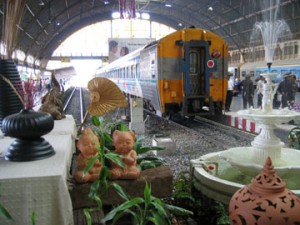
Bangkok's Hualamphong railway station

Virtually all trains leave from Bangkok’s centrally located Hualamphong railway station.  A few southern routes and commuter lines also originate at the Bangkok Noi/Thonburi station, which has a dock on the western side of the Chao Phraya River at the Tha Rot Fai pier).  The Wong Wian Yai station, located off Thaksin Road in Thonburi, also handles several routes.  To determine which cities are served at each station, and scheduling information, visit the State Railway of Thailand (SRT) website at: www.railway.co.th/English/index.asp  (online booking services are not available). 

Trains are not all that easy to book, so it is recommended to do so at least one week before desired departure.  Typically, mid-week trains are less full, so easier to get bookings on them than on weekends. 

Advance bookings at Hualamphong require cash, and there is an ATM at the station.  To book from 8:30 am to 4pm, go through the front doors, then head to the right-rear of the building.  Look for the sign that says ‘Advance Booking.’  From 5 am to 8:30 am, and from 4 pm to 11pm, advanced bookings may be made at platform ticket windows # 2 and 11. 

Hualamphong station is located at the corner of Rama IV and Krung Kasem, and is easily accessed through the MRT Hualamphong subway station. 

Important Note:  There has been a spate of baggage thievery in the “held baggage” room, and indicators are that it may be internal in nature.  So far, authorities have been reluctant to investigate.   Under no circumstances should you leave your bags at the train station while you’re touring around Bangkok!

Touring Thailand by bus from Bangkok

Written By: herbrunbridge - Jun• 02•10

Friendly bus conductor is always ready with a smile

Eventually, you’ll be heading off to a destination that will require bus travel, either because your airline doesn’t fly there, or you don’t want to rent a car.  Buses, especially the overnight VIP-type, are comfortable and air-conditioned. There are three major bus stations in Bangkok.   Here’s a quick user’s guide: 

Ekkamai Station:  For points southeast of Bangkok, including Pattaya and Rayong.  Located adjacent to Ekkamai BTS Skytrain station. 

Southern Station:  For points southwest of Bangkok, including peninsular areas.  Located on western side of Chao Phraya River, adjacent to Highway 338, at intersection of Nakhon Chaisi and Phra Pin Klao Roads.  Take a taxi here, or local buses 124 and 127. 

Mo Chit: For points in central, north, and northeast Thailand, including Chiang Mai and Isaan cities. (note: the old Mo Chit one station no longer exists; this station is farther from Chatuchak than was the old Mo Chit 1   We suggest you take a taxi to it from the Mo Chit BTS Skytrain station). 

Most western bus travelers will eventually use Mo Chit, but will find the station riotously confusing, as the 103 separate ticket windows on the upper level have no signs in English.  The best procedure is to go to the information counter immediately in front of the central second level entry doors.  Tell the person behind the counter where you’d like to go.  She’ll point you to a window, or write the window number for you.  At the given window, the ticket agent will immediately call upon someone to help you in English. 

After getting your ticket, proceed to the bus bays at the left rear of the terminal.  The front of your ticket will have a series of hand-stamped blue numbers, one of which represents the bay where you’ll find your bus.  Head to one of those bays, and helpful uniformed people will point you to the right bay.  Your route number is printed on your ticket, in English.  This number corresponds to a number painted on the outside of the bus.  There are actually two painted bus numbers, separated by a hyphen.  The first is the bus route, the second is the number of the individual bus.  Therefore, the bus number “968-336” would reflect the route # 968 (which is, in this case, the city of Yasothon), and the bus number is 336.  When in doubt, ask, then ask again, as buses have been known to switch bays at the last moment.  

Attached to your ticket, you may very well find a food and beverage coupon.  This is worth 20 baht, and will be used at a roadhouse along the route. Generally, it’s good for a small bowl of soup (available at a hectic food counter), or a drink.

Low cost air travel in Thailand

Written By: herbrunbridge - Jun• 02•10

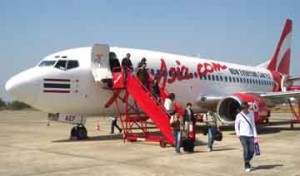
These are exciting times for visitors electing to travel by air within Thailand, as three low-cost airlines are vying for low-cost domestic fares, flying out of Don Muang airport, and offering fares to destinations such as Chiang Mai for as little as 500 baht ($13 USD).  While offering lower prices than traditional carriers such as Thai Airways and Bangkok Airways, there are a number of caveats.  Low-cost seats can be limited on each flight, and planes do not fly every day. To save on agency fees, low-cost carriers generally do not provide information to online travel agencies such as Travelocity, Orbitz, or Expedia. As these carriers are increasingly competitive with each other, promotions tend to change several times a year. Visit the carriers’ websites for full scheduling and fare information. 

Here is a brief overview of each of the three low-cost carriers, Air Asia, Nok Air, and One-Two-GO: 

1) Thai Air Asia.  Users must register at the airline’s www.airasia.com   website to purchase tickets.  The website has a good user interface, and is relatively quick.  You may also order tickets by telephone at +66 (02) 515-9999. You can also book by travel agent, and fares are based on how early you book, prior to departure dates.  Fares also vary depending on the day of the week you travel, Tues-Wed-Thurs being the cheapest.  You are not allowed to bring food or drink on the plane, but you can buy them on the flight, at prices higher than in convenience stores.  Air Asia has 30 planes in all, flying Thailand, Malaysia, Singapore, Philippines, and China. As only eight are allocated for Thailand, a glitch in the schedule of one flight may affect others down the line.  The fee to change your travel day after ticketing is hefty, roughly $20 USD, and their baggage allowance of 12 kg is not competitive. 

Caveat emptor!  If you miss a flight, even if it’s due to your first AirAsia flight arriving late, you will lose your money!  AirAsia sells relatively cheap travel insurance that will protect you, but it must be purchased at the time you buy your ticket.  Air Asia flights do have delays, so be prepared!

Our experience with Thai Air Asia: we took the Bangkok-Ubon Ratchathani route, and paid 1,411 baht each way (Thai Airways was 2,600 baht for the same time & date).  Our flight left roughly thirty minutes late.  Our return morning flight was cancelled (bad weather in the north had affected routing.)  The Ubon station chief drove us into town herself so we’d be occupied during our delay, exceptional customer service, especially given the fact that she didn’t know we were travel writers. 

2) Nok Air is a subsidiary of Thai Airways, and is generally 100 baht or so more expensive than Air Asia or One-Two-GO.  Nok Air, however, will put you on a Thai Airways flight if your Nok flight is delayed by three hours.  For an extra fee, Nok will have a limited  selection of business class seats at the front of each craft.  You can book via the website at www.nokair.co.th and pay by credit card, or call to its reservations center at extension 1318.  If you book by phone, you can pay at ATM machines at the Siam Commercial Bank, or at selected 7-Eleven stores.  For best fares, book at least three months in advance.  Food and drink can be purchased on the flight.  

3) One-Two-GO.  Owned by Orient Thai Airlines, this airline allows online booking at www.fly12go.com/en/booking/index.php     or by simply arriving at the airport and buying your ticket.  You’ll be charged an extra 100 baht fee if you book online, which requires a three-day advance prior to flight date, and also 100 baht extra of you book by telephone at +66 (02) 267-2999.  Be prepared for long wait times if you book by telephone.  This airline does serve snacks and drinks free of charge. 

Recently, One-Two-GO announced an all-inclusive fee structure of 1,700 baht for non-holiday weekdays to all Thailand destinations, including Bangkok, Chiang Mai, Chiang Rai, Phuket, Hat Yai, Surat Thani, and Krabi.  You’ll pay 500 baht more on weekends and holiday weekdays.  You can also change your travel day after initial booking for no additional fee.  Their travel allowance of 20 kg is generous, by low-cost air standards, and you will get an assigned seat.

Men’s spas in Macau

Written By: herbrunbridge - Jun• 01•10

Men used to paying the going rate for spa services in most Southeast Asian countries will find themselves paying more in Macau.  Nevertheless, one of Asia’s finest men’s spas is here, and you’re encouraged to hang out there for up to 24 hours, making it actually one of Asia’s best spa deals for men.  We’ll start off with the best, then list a few others you’re liable to encounter. 

Golden Sauna
Rua Cantao #121, 2nd floor (inside of the alley across from the Hotel Fortuna)
Ph: +853-2878-2123
GPS Coordinates: N22 degrees, 11.440′, E113 degrees, 32.780′

This may be the best men’s spa in Asia, with exceptionally good-looking masseuses, sauna, hot tub, good food, and a relaxing atmosphere.  Prices range from “AV Girls” at $1139 HKD, to Thai massage only at $399 HKD.  Customers begin by taking a sauna and hot tub bath, then choosing a masseuse for one hour service.  Afterward, customers are urged to lounge around in one of Golden’s comfortable lounge chairs, and eat, drink, talk with friends, and even get a foot massage.  Customers may stay as long as they want, as the spa is open 24 hours.  English-speaking customers may ask for genial host Alex.

 Darling One
Behind Jai Alai Casino
Ph: +853-2872-6666
GPS Coordinates: N22 degrees, 11.843′,  E113 degrees, 33.321′
Although hidden off the large street of Dr. Rodrigo Rodrigues, it’s actually easy to find, just in back of the more visible Casa Real Hotel.  Darling One offers full body massage at $1480 KD for 90 minutes, and visitors may choose among Chinese, Thai, or Vietnamese masseuses.  English speakers may ask for Tommy.

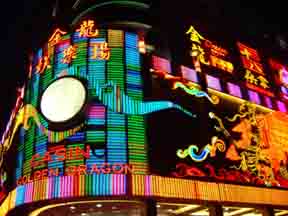
 Golden Dragon Hotel’s “Eighteen Sauna”
Rua de Malaca
GPS Coordinates: N22 degrees, 11.764′,  E113 degrees, 33.227′
This well-situated hotel has a 6th floor sauna, featuring masseuses from $1600-1800 HKD for one hour.  The “Crazy Happy” show also occurs on the 10th floor, and features cheoreographed “European-style” erotic dancers.

 Sauna Big Boss
Avenida de Praia Grande, No. 613-639
Ph: +853 2855-8877
GPS Coordinates: N22 degrees, 11.540′,  E113 degrees, 32.459′
Located near the corner of Avenida do Infante D. Henrique, Sauna Big Boss features one-hour masseuses ranging from $1538-$988 HKD.  Big Boss is located near the historical part of the city unlike the others listed above, located in the Casino zone.

Nightlife in Macau

Written By: herbrunbridge - Jun• 01•10

Virtually every large casino has a disco, and even the smaller casinos have karaoke lounges, most of which stay open all night long.  For bar and pub crawling, take a walk along Avenida Sun Yat Sen, running northeast, just up to the Macau Cultural Center.  Men’s spas and saunas offer a male-oriented respite from the red-hot gambling, shopping, and entertainment pace.

Macau’s historical colonial churches

Written By: herbrunbridge - Jun• 01•10

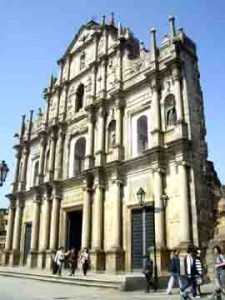
Sao Paulo church facade

Some of the nicest examples of Portuguese colonial architecture are to be found in her churches.  Their interiors are varied, and the ornamentation budget has clearly been spent on the exterior.  On a sunny afternoon, the color of the facades makes a beautiful contrast to the blue sky.  You can visit them in any order, but we found the path we took allowed us to see all of them in two hours, without backtracking.  In walking order, they are: 

Ruins of St. Paul’s (Ruinas de s. Paulo)
GPS Coordinates: N22 degrees, 11.842′, E113 degrees, 32.449′
Only the façade of the church, finished in 1640, and a few stones from the floor remain, but what a façade!  Considered the landmark of the city, it provides a wonderful clue as to how beautiful the church must have looked in its entirety, before being destroyed by fire in 1835.

 St. Dominic’s Church (Igreja de S. Domingos)
GPS Coordinates: N22 degrees, 11.617′, E113 degrees, 32.391′
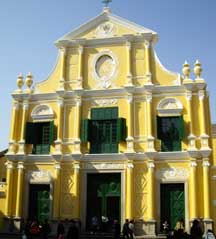
Established in 1587, this beautiful church sits in Senado Square, opposite Santa Casa de Misericordia.  Here, the first Portuguese newspaper in Chinese territory was published in 1822.

 Holy House of Mercy (Santa Casa de Misericordia)
GPS Coordinates: N22 degrees, 11.617′, E113 degrees, 32.391′
Founded in 1569, Misericordia was not a church, but rather a clinic and home to several other early welfare institutions in Macau.

 St. Augustine’s Church (Igreja de Santo Agostinho)
GPS Coordinates: N22 degrees, 11.524′, E113 degrees, 32.316′
Sitting in beautiful, St. Augustine’s Square, this church fronts the colonial Dom Pedro V Theatre (only open during shows), and the rear of St. Joseph’s Seminary. 

St. Lawrence’s Church (Igreja de S. Lourenco)
GPS Coordinates: N22 degrees, 11.415′, E113 degrees, 32.211′
Built in the mid 16th century, this church overlooks the sea, and on its step the families of Portuguese sailors would gather and wait for their return.

 St. Joseph’s Seminary and Church (Seminario e Igreja de S. Jose)
GPS Coordinates: N22 degrees, 11.501′, E113 degrees, 32.232′
Built in 1728, this exceptionally beautiful building houses the seminary where an academic curriculum, equal to that of a university, was taught to Catholic missionaries.

Macau’s Museums

Written By: herbrunbridge - Jun• 01•10

Taipa Houses Museum

Although you couldn’t really call Macau a museum destination, it has two very good ones, and a few smaller museums that are worth a quick look. 

Aside from our recommended museums below, you’ll find small museums of religious relics at some of the older church sites.  In our opinion, none of these were compelling enough to be worthy of a stop.  We’ve listed our favorite museums below, in the order of those we found to be the most worth your visit: 

Macau Museum of Art (at the Macau Cultural Center)
Avenida Xian Xing Hai
Ph: +853-791-9814
www.artmuseum.gov.mo
Open 10 am – 7 pm, closed Mondays
GPS Coordinates: N22 degrees, 11.319′, E113 degrees, 33.234′ 

This wonderful museum had two world-class exhibits when we were there, focusing on the Xiang Dynasty, and contemporary Chinese abstract painting.  Other great shows are pending, making this museum a “must-see” on your trip to Macau.

 Macau Museum
112 Praceta do Museu do Macau (at the Mount Fortress)
Ph: +853-2835-7911
www.macaumuseum.gov.mo
Open 10 am – 6 pm, closed Mondays
GPS Coordinates: N22 degrees, 11.860′, E113 degrees, 32.520′

This modern museum provides a nice history of Macau.  We particularly enjoyed the dioramas featuring the calls of various hawkers, and the tiny exhibit on fighting crickets the best. 

Lou Kau Mansion
Travessa da Se, #7
Open 9 am – 5 pm, closed Mondays
GPS Coordinates: N22 degrees, 11.647′, E113 degrees, 32.470′
Located a few steps from Senado Square, this traditional Chinese house, with its richly carved ornamental interior, is easy to miss, as it’s not well-marked.  It’s well worth a visit, and not inundated by visitors.

Taipa Houses Museum
Avenida de Praia, island of Taipa
Ph: +853-2882-7103
Open 10 am – 6 pm, closed Mondays
GPS Coordinates: N22 degrees, 09.222′, E113 degrees, 33.565′

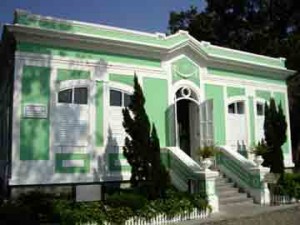
It’s just a 10 minute taxi ride out to this very pretty architectural museum on the island of Taipa, comprising 5 traditional green colonial Portuguese houses.  Of them, only the “Macanese House” has a compelling interior, reflecting the life of a colonial Portuguese family.  This is a nice place for a picnic lunch, and a nice, easy getaway from the city of Macau.

 Dr. Sun Yat Sen Memorial House
Avenida Sidonio Pais (opposite the police station)
Ph: +853-2857-4064
Open 10 am – 1 pm, 2:30 pm – 5 pm, closed Tuesdays
Of primary interest as the one-time home of the father of the Chinese republican revolution, this very pretty home contains early documents, photos, and the bedroom of his wife.
GPS Coordinates: N22 degrees, 11.987′, E113 degrees, 32.944′ 

Macau Tea Culture House
Lou Lim Ieoc Garden. Est de Adolfo Loureiro #10
Ph: +853-2882-7103
Open 9 am – 7 pm, closed Mondays
GPS Coordinates: N22 degrees, 11.980′, E113 degrees, 32.866′

Mostly you’ll find changing exhibitions here, in this beautiful building, focusing on the clothing, culture, and household goods of the peoples who make up “Tea Culture” in Asia.

Shopping Macau: boutiques, antiquities, and art galleries

Written By: herbrunbridge - Jun• 01•10

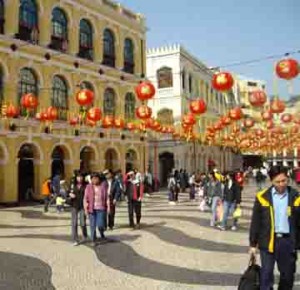
Macau's Senado Square

You can buy just about anything in Macau, from designer clothing, to jewelry, to antiquities, and pay less than you would in neighboring Hong Kong. Avenida Almeida Ribeiro is where you’ll find jewelry and Chinese goods, and upscale boutiques are centered around Senado Square, and in major casinos as well.  Antique furniture stores and art galleries are near the nexus of Rua de Sao Paulo and Rua Santo Antonio, and run for a block down each street, very near historic Senado Square. 

Here are two of our shopping favorites… 

Recommended art gallery :

St. Paul’s Fine Art
3,5,7 Travessa de Sao Paulo
Ph: +853-2842-2842
www.stpaulscorner.com/fineart
GPS Coordinates: N22 degrees, 11.880′,  E113 degrees, 32.476′
Located at the foot of the Ruins of St. Paul’s Church, this impressive gallery, dedicated to contemporary Macanese artists, opened in December of 2007.  It’s worth a look, if just to see the work of emerging local artists.

 Recommended furniture/antiquities shop: 

Mobilias Mei Choi
Rua de Sao Paulo, #26
GPS Coordinates: N22 degrees, 11.786′,  E113 degrees, 32.446′
Located at the foot of the Ruins of St. Paul’s Church, and just across from St. Paul’s gallery, Mei Choi has three floors of beautiful wooden trunks, furniture, mah-jong sets, and you-name-it.  All furniture stores in the area feature reproductions and originals, so be sure to ask which is which.  We found the selection of older pieces at Mei Choi to be quite good, and the staff helpful.

Macau’s Top 4 Sights

Written By: herbrunbridge - Jun• 01•10


Afternoon sun brings out the color in the sunny SaoDomingos facade

We’ll assume you already know about the casinos.  So what do you do if you’re not into gaming? 

1) Go to a museum!  The Macau Museum of Art is in a wonderful new building on the waterfront, and had two world-class exhibits when we were there.  Go to our Macau museums page for a review of Macao’s most interesting museums. 

2) Take a walk through historical Macau, enjoying the fine old Portuguese colonial architecture.  Macau’s historic churches including the landmark Ruins of St. Paul’s, offer some of her best architectural examples. 

3) Enjoy the view from the Guia Lighthouse above the city.  Built in 1865, the lighthouse sits above Guia Fortress, constructed in 1637.  Go there by taxi or by the wonderful automated cable car system.  Don’t miss the bomb shelter under the fortress, or the typhoon semaphores exhibited in a small room alongside the lighthouse.  Guia lighthouse sits at GPS Coordinates: N22 degrees, 11.786′, E113 degrees, 32.970′.  The cable car station on Guia hill sits northeast of the lighthouse at GPS Coordinates: N22 degrees, 11.955′, E113 degrees, 33.152′   The corresponding cable car station, below and north of the hill, is at GPS Coordinates: N22 degrees, 12.092′, E113 degrees, 33.094′ 

4) Shop the Senado Square area, which includes the antiquities shops just down the steps from the Ruins of St. Paul’s.  GPS Coordinates: N22 degrees, 11.617′, E113 degrees, 32.391′  puts you right in the middle of the Square.