The sharper edge to traveling in Asia

River Cruises on Chiang Mai’s Mae Ping River

Written By: herbrunbridge - Jun• 03•10

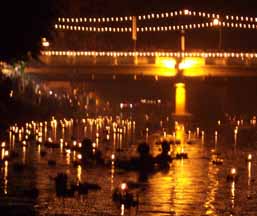
Ping River at night during the Loi Krathong festival

To get  a uniquely interesting view of Chiang Mai, Thailand, Mae Ping Cruises (053) 274-822, offers three short voyages along the Ping River, as follows: 

Dinner cruise: Two tours, the first begins at 7pm, and they will pick you up from your hotel.  Price is 450 baht. 

Day cruise 1: an 8 kilometer cruise taking between 1.5 and 2 hours.  300 baht includes fruit and a drink.  The cruise is available from 8:30 am – 7 pm, and you meet the boat at the Wat Chaimongkol pier, 1.5 km east of the old city.  Price is 300 baht, minimum 2 persons. 

Day cruise 2: a shorter cruise departs from the pier adjacent to the Riverside Restaurant, on the eastern side of the river, just north of Nawarat Road.  The boat stops at Tha Luk pier for 40 minutes.  Price is 100 baht, minimum two persons, and includes a free drink.  Departures are hourly, from 10 am – 3 pm.

Art galleries and art experiences in Chiang Mai, Thailand

Written By: herbrunbridge - Jun• 03•10

La Luna Gallery

Everyone seems to agree: while Chiang Mai is incredibly rich in antiquities and crafts shopsfashion venues, and museums, it still has a way to go in terms of the number of art galleries operating within the city environs.  Three of our favorite galleries are listed below, as well as a couple of art schools that promise to be a lot of un, too:

 La Luna Gallery, 190 Charoenrat Road, Chiang Mai 50000.  tel: (053) 306-678.  This exciting new gallery has done something really difficult by providing many different forms of art, relating to many tastes, and most of it quite good.  Here, you’ll find painting from the traditional to cutting-edge, papier mache, sculpture, ceramics, and photography.  The gallery space is open, and colorful. www.lalunagallery.com
GPS: N18°47.603’  E099°00.089’

Semi-apply, 24, Nimmanhemin Road, Soi 1, Chiang Mai 50200.  tel: (053) 894-878.  Located on Soi 1, just southeast of the junction of Nimmanhemin and Huai Kaew roads, this gallery has a good collection of contemporary paintings and wood sculptures.
GPS: N18°47.977’  E098°58.097′ 

Suvannabhumi Gallery,  116 Charoenrat Road 9/10 Chiang Mai. Tel: (81) 031-5309.  Open 10 am – 9 pm.Here you’ll find a fascinating collection of Burmese paintings and watercolors made by over 50 contemporary artists.  Owner Mar Mar is passionate and informed about the artists, and prices are extremely affordable for art that is unique, difficult to find, and more than occasionally compelling. www.suvannabhumiartgallery.com

Five days to glory: becoming an artist in Chiang Mai

One of the beauties of Chiang Mai is the astounding number of great things you can learn through semi-formal schooling lasting a surprisingly few number of days.  One of our favorites has to be Nova ArtLab, an institution offering 1 to 5 day workshops in photography, jewelry, sculpture, leatherwork, and painting.  The CVs of the instructors are first-rate.  The school is located off Tha Phae road, and course fees run at a daily rate of 1,100 baht. Nova ArtLab, 16/1 Tha Phae Soi 4, Chiang Mai 50100.  tel: (053) 207-212.  www.nova-collection.com

Want to learn photography in Chiang Mai? 

Veteran photographer Steve Kramer will take individuals and small groups all over Chiang Mai, teaching the intricacies of the art of photography.  He’s an expert at several formats, and can be reached by calling (01) 952-7378.
www.photoenvisions.com

All things mosquito: an hour at Chiang Mai’s incredible World Insects and Natural Wonders Museum

Written By: herbrunbridge - Jun• 03•10

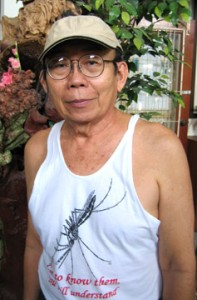
Khun Manop at home in his Insect Museum

Some people have passions for cars, others for art, others for cooking.  Manop Rattanarithikul has one for mosquitoes, and since 2000, he, along with wife Dr. Rampa Rattanarithikul, has hosted his own museum in Chiang Mai, Thailand, largely a tribute to his favorite insect. After ringing the doorbell (it’s always locked, but visitors are welcome), one immediately finds a statement written by “the mosquitoes of Thailand:” 

“The life of human and the mosquito is as short as the burning candle.  The mosquito’s taking blood is necessary for their survival.  No blood is needed for seeking greed and wealth.  This is the difference between the mosquito and civilized people.” 

Manop began collecting natural wonders back in 1950, and here has a fascinating, if slightly disjointed, selection of butterflies, beetles, rocks, walking sticks, hornets’ nests, and seashells, spread over two floors.  Along the way, there are a dozen or so religious platitudes (we wish we’d seen “In God we Trust — all others pay cash”).  Then there are the mosquitoes.  He’s got data on all 420 species, and good information on the 44 of them that carry pathogens dangerous to humans.  He’s got elephantiasis covered well, and enthusiastically explained how the limbs and organs grow large with the dead bodies of the dreaded filariasis worm.  

Manop is a lawyer as well, and his wife’s a noted scholar, on assignment to the Smithsonian Institution.  For 200 baht, this small museum, run by a real fan of an insect we all love to hate, is a bargain, a tribute to the passion of a collector, who has made a museum out of his home.  You may also buy one of his custom t-shirts bearing the image of a large mosquito over the phrase “Get to know them, you will understand.” 

Address:  72 Nimmanhaemin, Soi 13, Sirimangkhlachan Road, Chiang Mai. tel: (053) 211-891.  Located 1 km west of the moat, this museum offers a fascinating glimpse of the rich variation of insect life in Thailand.  Open 9 am – 4 pm, daily, ring the buzzer if the door is locked.  GPS:  N18°47.776  E098°58.233’

Museums in Chiang Mai and Mae Rim Valley, Thailand

Written By: herbrunbridge - Jun• 03•10

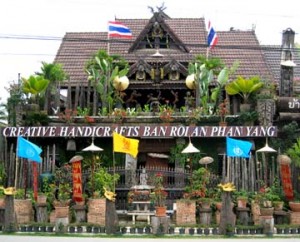
Creative Handcrafts Ban Roi An Phan Yang is a must-see in Chiang Mai

There are a number of interesting museums worth visiting in Chiang Mai proper, and in the Mae Rim Valley to the northwest.  Museums in the city of Chiang Mai 

Chiang Mai National Museum, Highway 11, Chiang Mai. Tel: (053) 221-308. Located 2 km north of the city, the museum specializes in Buddha images, work implements, and traditional house wares.  Open 9am – 4pm, Wednesday through Sunday. 

Museum of World Insects and Natural Wonders, 72 Nimmanhaemin,Soi 13, Sirimangkhlachan Road, Chiang Mai. tel: (053) 211-891.  Located 1 km west of the moat, this museum offers a fascinating glimpse of the rich variation of insect life in Thailand.  Open 9 am – 4 pm, daily, ring the buzzer if the door is locked. GPS: N18°47.776  E098°58.233’ 

Sbun-Nga Textile Museum, Old Chiang Mai Cultural Center, 185/20  Wua Lai Road, Chiang Mai.  Tel: (053) 200-655.  This exceptional regional museum contains extremely beautiful, high-design displays of gorgeous textiles and costumes from northern Thailand and Burma.  Khun Bpom has been collecting for years, and has built a fascinating museum that is the equal to any of the best public museums in Thailand. GPS:  N18°46.308’  E098°58.815’

 Tribal Museum and Research Institute, Ratchamangkhla Park, Highway 107, Km 5,  Chiang Mai.  tel: (053) 210-872.  Located 5km north of the old city, west of Rama IX gardens, this museum features displays of tribal costume and culture.  Overall, we feel the museum is somewhat lacking in display savvy, and is a bit out of the way.  For exceptional tribal costuming, we strongly recommend the Sbun-Nga Textile Museum instead.  The tribal Museum is open 9 am – 4 pm, Monday – Friday. GPS:  N18°49.300’  E098°58.442 

Museums southwest of the city of Chiang Mai 

Creative Handcrafts Ban Roi An Phan Yang, 255/4 Chiangmai-Sanpatong Road (between Km 19-20).  Tel: (053) 355-819.  There is nothing in Thailand to compare with Charoui Na Soonton’s incredible wood carving museum and shop, which takes up three floors of his beautiful house.  The shop, on the ground floor, sells some of the best examples of the woodcarvers art in Thailand, and the museum, which takes up the upper storeys, is a magnificent collection of interior and exterior living spaces, shrines, and delights for the eye at every turn.  The 200 baht entry fee for the museum is a pittance, considering the reward.  This remarkable home and museum is a can’t miss, for both Chiang Mai and Thailand.  Open daily from 8:30 am – 4:30 pm. GPS: N18°39.057  E098°54.269’ 

In the Mae Rim Valley    

Darapirom Palace, Highway 107 at Km 16, Mae Rim.  Located on the grounds of the Dara Rasmi Border Patrol Police Camp; turn west between the footbridge and police station, then straight for 200 meters.  This was the final home of Chao Dara Rasmi, the daughter of a Lanna king, who was married to King Rama V.  Here, exhibits describe the golden days of turn-of-the-century Lanna royalty.  Open 9 am – 5 pm. GPS: N18°54.793’  E098°56.524’ 

Queen Sirikit Botanic Garden, Highway 1096, Km 12, Mae Rim.  Tel: (053) 298-171.  These extensive gardens, which were initiated in the 1930s, consist of eight discrete zones.  The grounds were expanded in 1992, and feature three nature trails, a museum, and arboretum, replicating a rain forest.  This large park is well worth a visit, and, a car is recommended, as the distances between zones preclude walkers from seeing the entire park in one day.  The Garden is roughly a ½ hour drive from Chiang Mai.  Open 9 am – 5 pm.

Antiquities shopping in Phuket, Thailand

Written By: herbrunbridge - Jun• 03•10

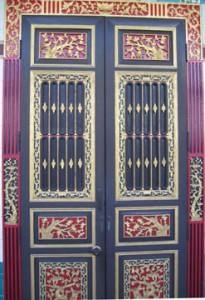
Ornate doorway in Phuket

Given its significant number of yearly visitors, it’s not really surprising that the island of Phuket has a number of good stores dealing in antiquities.  As in the rest of Thailand, much of the best that you’ll find in these shops in Burmese in origin. With the exception of the Soul of Asia shop in Phuket, and Chan Antiques on the 402 Bypass road, all shops below are within 10 or 15 minutes of each other, near the junctions of highways 4030 and 4025. 

Chan’s Antique House, 99/42 Moo 5, Chalermprakiat R.9 (Bypass Road), Tambon Rassada, Phuket. Tel: (076) 261-1416.  Chan’s offers a very good selection of sculptures, crafts, and decorative antiquities.  The first room upon entering houses reproductions; the best of their collection is in the rear.  Chan’s is not the easiest place to find, as Route 9 is also called 402 Bypass (which differs from 402, which runs more or less parallel to the east. Chan’s can be found on the northwest side of this busy highway. www.chans-antique.comGPS: N07°55.572’  E098°22.327’  

Heritage Collection, 382/45 Phuket Laguna Road, Cherngtalaay, Thalang, Phuket.  Tel: (076) 325-818.  This large store has antiquities and reproductions, but we weren’t all that happy with the repairs on some of the pieces.  Worth a visit, but caveat emptor.GPS:  N07°59.787’  E098°18.249’ 

Palace of Art, 103/3 Moo 4, Srisoonthon Road, Talang, Phuket.  Tel: (076) 273-533. Palace bills itself as having “the best Fine Art & Décor objects in the country”, and its claim may be warranted.  This beautiful collection, housed in a state-of-the-art villa, is as close to a museum as an antiquities venue could be, certainly the best in Phuket. www.thaiart.com  GPS N07°58.765’  E098°19.500’

Siam Arts Collection, 382/5 Mu-1 Srisoonthon Road, Talang, Phuket. Tel: (076) 325-207.  This small shop, near the Laguna Resort turn-off, has an exceptional collection of Burmese antiquities.  Owner Thida is friendly, knowledgeable, and Burmese. GPS:  N07°59.651’  E098°18.346’ 

Sivalla, Plaza Surin, 5/50 Moo 3, Cherntalay, Phuket.  Tel: (076) 271-546.  Sivalla has a nice collection of antiquities and jewelry, but the diffident owner impatiently drummed his fingers, waiting for us to leave, while loudly playing French pop music.  Worth a visit, but see Soul of Asia next door while you’re there in the Plaza. GPS: N07°58.584’  E098°56.062’ 

Soul of Asia, Plaza Surin, 5/50 Moo 3, Cherntalay, and 37, 39 Rasada Road, Phuket.  Tel: (076) 211-122.  Soul of Asia has three shops (one in Phuket town), but we liked the friendly atmosphere and good collection at Plaza Surin best.  The charming manager there took great pains to explain differences in Thai, Burmese, and Lao Buddha sculptures. www.phuketdir.com/soulofasia GPS: N07°58.584’  E098°56.062’

Trekking, rafting, and ATV adventures near Chiang Mai, Thailand

Written By: herbrunbridge - Jun• 03•10

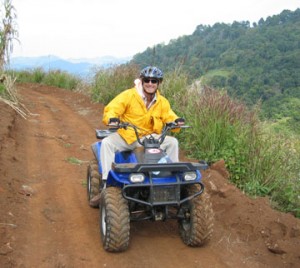
All terrain vehicle adventure near Chiang Mai

Chiang Mai, Thailand, has loads of interesting things to experience, above and beyond merely enjoying th city. Here are a few exciting options:

We’ve always thought those nifty ATVs (all-terrain vehicles) looked like heaps of fun, and finally had it confirmed one day in the Mojave Desert’s Dumont Dunes area.  In Thailand, you can experience these fun vehicles as well, and travel through off-road areas in the Mae Rim area at: 

Imac ATV
37 Moo 9, Km 10, Mae Rim-Samoeng Road
Thanon Mae Rim, Chiang Mai
Tel: (053) 939-113 

Ever thought about flying in a Microlight?  In Chiang Mai, you can take 15 and 30 minute flights, seeing the city and environs for less than 3,000 baht ($75 USD).   To find out more, visit: 

Chiang Mai Sky Adventure
143 Moo 6, Chiang Doi
Saket, Chiang Mai 50220
Tel: (053) 868-460
Free pick up and return to your hotel can be arranged.
www.skyadventures.info 

How about off-roading, or strenuous climbing?  If you’ve got a serious yen to go banging around, visit: 

Peak Four by Four Off-Road Center Co.,Ltd
302/4 Chiangmai-Lumpoon Rd. Thanon. Watgate A. Muang, Chiangmai
Tel:  (01) 951-6529; (053) 820-777
www.thepeakadventure.com 

Rafting and trekking experiences in the Chiang Mai region 

Many visitors travel to Chiang Mai specifically to do rafting and trekking trips.  There are dozens of companies offering experiences from the easy to the arduous.  Veteran trekkers meet their guide first to discuss itinerary and expectations.  Also, it’s a good idea to tour with a maximum of 5 or 6 people, as larger tours take away from the personal experience of a trek to villages.  Finally, discuss how you’ll be treated in the village.  If you’re hounded constantly to buy trinkets, you will not love the experience.  On the other hand, if you’re officered the opportunity of buying crafts from individual families, your trek will be enhanced. 

If you’re interested in elephant trekking or rafting/kayaking, do ask the operator how long you’ll be in the bus, the quality of food, and sleeping provisions.  

Here are just a few of the many companies offering treks and adventure experiences: 

Chiang Dao Nest, 144/4 m.5, Chiang Dao 50170, Thailand, tel: (06) 017-1985.    Chiang Dao Nest is a mini-resort located in a town 60 km north of Chiang Mai, and offers two and three days treks to Akha, Lisu, Lahu, and Karen hillside villages near the Chiang Dao area.  They also will coordinate elephant treks, birding tours, and rafting trips.  Tours depart from both Chiang Dao and Chiang Mai.  http://www.chiangdao.com/nest/ht32ahilltribetrek.htm 

ChiangMai.com offers internet-only booked elephant and village treks.  Visit: http://www.chiangmai.com/tours.html  

Contact Travel,  73/7 Charoen Prathet Road, Chiang Mai 50100  tel: (053) 277-178, located next to the Diamond Riverside Hotel, one block from the Night Bazaar, offers 3 day, 2 night rafting trips on the Ping River.  Tours leave every Monday, Wednesday, and Friday from Chiang Mai during the rafting season, which runs from June through January.  Kayaking trips are also available, as are bicycle tours. http://www.activethailand.com/rafting 

Eagle House, 16 Chang Moi Gao Road,  Soi (Lane) 3, Chiang Mai 50300. tel: (053) 874-126.  Located a few blocks northeast of the moat, Eagle House specializes in small-sized trips to villages that are less-frequented by tourists, and its meal are said to be exceptional. http://www.eaglehouse.com 

3rd Eye Travel, 220 Moo Chang Khian Soi 9, Chiang Puak 50300.  tel: (053) 892-405.  Located near Wat Umong, 4 km west of the old city, 3rd Eye offers outdoor tours oriented toward spirituality, Buddhism, and social issues.  http://www.3rdeyetravel.com 

Wayfarers Travel, 20 Ta Phae Road., Soi 4, Chiang Mai 50100.  tel. (053)208-271.  Located near the Tha Phae gate, Wayfarers offers everything from village and elephant treks, to rafting and kayaking.   http://www.wayfarersthailand.com

Massage at Bangkok’s famous Wat Pho

Written By: herbrunbridge - Jun• 03•10

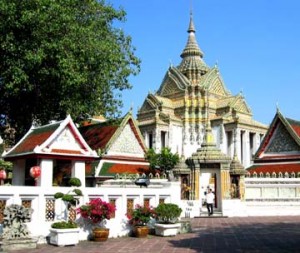
Historic Wat Pho

Not only is Wat Pho oldest and largest wat (temple) in Bangkok, it’s also the Thai center for teaching the healing art of massage.    Containing the largest collection of Buddha images in Thailand, this extraordinarily beautiful site, resplendent with spires of intricate ceramic mosaics, occupies a centuries-old holy site, essentially rebuilt in 1781.  Highlights include Thailand’s largest reclining Buddha image, made from plaster-coated brick, and gold-leafed, the spires themselves, and a magnificent series of carved stone statues of royal, holy, and warrior figures, and animals. 

Untold thousands have visited Wat Pho for individual massages as well as to attend the wat’s well-known massage school. 

You can have your own massage in one of the two massage buildings inside the wat, along the eastern perimeter wall.  Prices are reasonable, and we elected the ½ hour for 180 baht.  Inside, a dozen or so men and women are busily engaged in providing full body massages, while half a dozen or so are engaged in providing foot reflexology to tired feet. 

In terms of clothing, here, you only remove your shoes, and the rest of you clothes stay on.  In just a half-hour, we had feet rubbed, shoulders and back massaged, fingers pulled, and thighs and calves throttled, all under a series of fans that kept the high-ceilinged interior comfortably cool on this otherwise hot day.  We kept our eyes shut, enjoying the experience, interrupted by the occasional unpleasant notion that we should instead have bought the one-hour ticket, and enjoyed the experience to the fullest.  

Wat Pho’s Thai Traditional Medicinal and Massage School has been in operation since 1955, its courses running from one week (30 hours) to three years.  Courses also include therapeutic and healing massage, oil massage and aromatherapy, and infant and child massage. 

How to get there 

Wat Pho is a large complex bordered by the Grand Palace to the north, and Maharaj  Road to the west.  We recommend taking a river taxi to the Tha Tien pier, then proceed east for a few meters to Wat Pho’s white-clad walls.  The massage area is inside, along the eastern wall.  The wat is open from 8 am – 6 pm. www.watpomassage.com 

Prices for massage 

Half hour: 180 baht
One hour: 300 baht
One hour with herbs: 400 baht
45 minute, foot reflexology: 300 baht

Email, internet, & telephone in Bangkok

Written By: herbrunbridge - Jun• 02•10
 

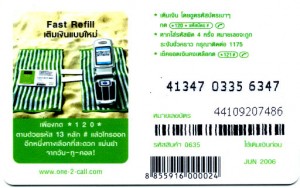
Telephone upgrade card

Email access in Bangkok is easy virtually everywhere along the Sukhumvit and Silom BTS Skytrain lines, and in hundreds of other places in the city.  Don’t ignore the different sois (streets) branching off of main thoroughfares, as generally, hourly rates are cheaper there.  Signs advertising email access frequently hang from upper stories, easy to see when strolling from major streets.  Typical rates range from 60 baht to 150 baht per hour.  WiFi hotspots are a growing trend, particularly in major hotels, and coffee shop chains, but are generally not free of charge.  Typical WiFi rates are 100-150 baht per hour.

Buying a mobile phone 

If you’ll be in-country for a week or longer, you may want to buy a digital GSM mobile phone, which in Thailand operates at 900/1800Mhz  (there is no support for analogue mobiles or GSM using 1900Mhz, the US Standard).  Prices start at around $23 USD for a new  mobile phone (read the WoWasis review of the Nokia 1280 phone, an inexpensive, durable phone that’s our favorite).  You’ll buy your new phone a SIM (Subscriber Identification Module) card, which you insert into the phone.  The SIM card contains your phone number (it will also store your personal phone numbers and settings). There are a number of telephone phone vendors, but Telecom Asia (True) can link the SIM to your passport number, when you buy at their shops.  That way, if your phone is lost, no one else can use your phone, provided you call True to report your lost phone. 

You can buy phones virtually anywhere, but we found the best service at the Emporium complex at BTS Skytrain PhromPhong.  Nokia has a store on level 3, as does Telewiz, a good shop for updating the minutes on your phone cheaply as well. In those shops, the reps speak English, important since they can tell you how to set up a voicemail box, and give you additional pointers.  Prices there are roughly the same as anywhere else.  Many Thais like buying phones and accessories at MBK in Siam Square, but English is a rarity, the place is crowded, and generally, clerks don’t have the time to deal with Farang, or can’t understand them. 

If you think you’ll be wanting to access your Thai voicemail box from your own country, buy a multi-band phone that will work in your country.  When you return home, turn on the roaming facility, and you’ll be able to access email. 

Voicemail from a mobile phone in Thailand doesn’t work all of the time, so pay attention to the following: if you have a standard Thai provider, and pay a monthly bill, you will have a relatively dependable voicemail system. If you’re using “pay-as-you-go” phone cards, such as the “1-2 Call” card found at most convenience stores, your voicemail will probably not work, even when you set it up by calling customer service, and having them walk you through the bizarre series of steps to establish a voicemail box.  Thailand is not ready for prime time, as far as telecom is concerned, so be forewarned!  

Warning:  roaming charges are expensive, up to 80 baht per minute, to call Thailand from your country, on your Thai-based mobile phone!   Before you leave for home, contact your service provider, and get a customer service telephone number that will work from your country.  Occasionally, users have found it problematic at first to use the phone overseas, and customer service will assist you if you have the proper number.  Additionally, all service providers do have websites with English information.  When you buy your SIM, be sure to ask the name of the provider.  

You add calling minutes to your phone by purchasing a plastic card, such as the “One-2-Call” card available at convenience and food stores and telecom outlets, which contains a scratch-off code number. Upgrade cards differ for each SIM vendor, so be sure to ask which one to buy when you acquire your phone.  To update your minutes, scratch to reveal the code, dial your upgrade dial number, enter the code number, and you’ve upgraded (instructions are on the card).  With most upgrade cards, you can buy upgrade minutes in increments of 300 and 500 baht.  Minutes must be used within a variable-monthly period, or will temporarily expire.  When you eventually buy another upgrade card, your old unused minutes will be re-established, and added to the total. When the calling minutes on your phone runs out, you’ll receive an inbound text message advising you to buy more time.  What do you do with your old, used-up cards?  Some convenience stores will give you a 10-30% discount on purchases, if you turn in an old card at point-of-sale.  As always, the information above is subject to change. 

Please Read This!  Caveat emptor: 

Upgrade cards can be expensive, but most of them offer promotions, which lower your baht-per-minute phone rate.  You must ask about these promotions when you buy your phone, as two-tiered pricing (westerner vs. Thai national) remains in effect.  Example: at 10 baht per minute, the “One-2-Call” card can be pricey.  By calling *777, you can find out about promotions that will give you more calls per card, within certain restrictions. If you press the key for “English”, you will be notified of promotions, but they will not be available to you when you attempt to activate them.  If a Thai friend makes the same call, they will be available.  Therefore, if you don’t have Thai friends just yet, have the Thai who sells you the phone describe the promotions, and have him or her activate them for you.  This way, you can ensure that you’re paying the lowest price possible for your calls. 

Also, when your minutes elapse, you must add minutes within a variable period, generally 30-45 days.  If you don’t, the telephone number registered to your SIM may disappear forever, and you’ll be forced to buy a new one. 

Instructions for adding minutes to your phone via “One-2-Call” brand refill cards, available at food stores:  At the counter, ask to buy a “One-2-Call” card.  Purchase in 300 baht or 500 baht increments.  Unwrap plastic covering, which will reveal the silver scratch-off box.  Scratch off the covering material with a coin.  Dial your phone, with digits in the following sequence: 

1) *120* [scratch-off number you’ve just revealed] #, then press the “call” button.
2) Immediately, you will receive a text message telling you the amount of baht on your SIM, and the expiration date. 

To view the number of minutes left on your phone any time, dial the following sequence (time remaining will be shown on your display): *121# 

Telephone calls be made at the diminishing numbers of phone booths in Bangkok.  The simplest way to do it is to buy a Domestic or International phone card at a convenience store, such as 7-Eleven.  The trick here is to buy the proper card, as there are three different types of phones.  Orange telephones and booths are run by TOT, and require a TOT card, which you can buy for as little as 100 (baht) roughly $2.50 USD.  CAT phone booths are yellow, and there are both Domestic and International variations (the latter differentiated by the word “International” atop the booth).  Often, both versions of CAT booths are side-by-side.  TOT cards don’t work in CAT phones, and vice-versa.  CAT domestic cards will not work in CAT international booths.  The cards have computer chips embedded in them, which count down to zero baht.  International calls are prefixed by “001”, then your country code.  Domestic numbers are always preceded by a “0”.

Bangkok river transportation on the Chao Phraya

Written By: herbrunbridge - Jun• 02•10

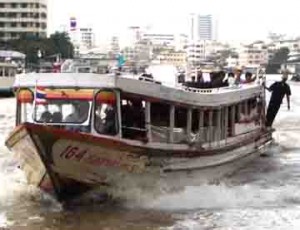
Chao Phraya river taxi

There are plenty of ways to go here, from basic dock-to-dock transport, to dinner cruises at dusk. 

Basic transportation 

Chao Phraya River Taxis: These fast boats ply the many piers along the big river.  Consult your map for their locations.  A quick guide to a few of the high points along the river is at the bottom of this page.  Fares begin at 6 baht, and you simply get off at your numerically-designated pier (quickly, the boat touches the pier for mere seconds to take on new passengers).  All piers have maps that list other numbered piers, along with the fare, and schedules for all three levels of service.  Plan time for your trip.  Travel from Pier one to Pier 11, for example, takes at least twenty minutes on the local service river taxi.  Do save your ticket, and you may be asked to produce it at any point.  The river taxi stops at each pier every twenty minutes in both directions, and operates from 6 am to 7:45 pm only. 

There are three levels of river taxi service, as follows:

  • Boats flying yellow flag: express service to a limited number of piers.  Fare is 15-25 baht
  • Boats flying orange flag: express service to a limited number of piers.  Fare is 10 baht
  • Boats flying blue flag (or no flag): local service, to all piers.  Fare is 6, 8, or 10 baht

The river taxi connects with BTS Skytrain Saphan Taksin station, but it’s tricky getting to the correct pier from the BTS station.  Exit the station via the left stairs, facing the river.  At the bottom of the stairs, you’ll see three piers.  The left one is a hotel shuttle (Peninsula, Marriott, and Oriental), the pier on the right is for a specific ferry that crosses the river.  The river taxi pier is the one in the middle, Sathorn Pier.  GPS for Sathorn river taxi pier: N13°43.132  E100°30.776′ 

Chao Phraya Tourist Boat:  larger than the river taxi, the Tourist Boat sells a ticket good all day for 75 baht, and runs as far north as Phra Athit pier (#13).  The boat runs from  9:30 am to 3:00 pm, and stops at each pier every half hour. 

Cross-river ferries have their own piers, adjacent to virtually river taxi every pier, and depart every few minutes for a corresponding landing across the water.

Dinner cruises

Three leave from the River City Wharf, adjacent to the Royal Orchid Sheraton, and on the river side of the River City antiques plaza. 

The Grand Pearl leaves from River City Pier 1 at 7:30 pm, and returns at 9:30.  Price is 1,100 baht, including dinner.   The Pearl ships are essentially large cabin cruisers, and have several discrete dining areas, plus good jazz musicians to accompany your cruise. 

The Chao Phraya Princess leaves River city Pier Two at 7:45 pm, and returns at 9:45.   Price, at 850 baht, is lower than the Pearl, but we’ve witnessed a real cattle-call as everyone jammed onto the Princess, and the dining situation is anything but intimate.  Unless you’re really counting money, we think the Pearl is a better value, even though you’ll pay 250 baht more.  

The Wan-Fah, which leaves River City Pier Two at 7 pm, is a luxury-style wooden boat that includes classical music along with your dinner.  Its price is 1,200 baht, and it returns at 9 pm.  Seating is less-hectic, and perhaps more intimate, than on the other two boats. 

River tours 

There are many day-only tours, here are but three: 

Bang Pa-In (Royal Summer palace) cruise (Sundays only)
Departing from Maharaj pier (near the Grand Palace) at 8 am, the Chao Phraya Express boat takes you to a crafts center, then to the elaborately decorated palace of the Chakri Dynasty.  On the return, you’ll visit an ancient Wat.  Please dress appropriately, i.e., no sleeveless tops, shorts, or sandals.  The tour ends at 6 pm. Adults 350 baht, children 250 baht.   (02) 623-6001. 

Koh Kred cruise (Sundays only)
Departing from Sathorn pier (near Taksin BTS station) at 9 am, and the Maharaj pier (near the Grand Palace) at 9:30 am, the Chao Phraya Express boat takes you to Koh Kred island, where you’ll visit a 200 year old Mon temple with exceptional plasterwork.  On the return, you’ll visit a floating market, and cruise along a khlong, viewing traditional khlong culture.  The tour ends at 3:30 pm. Adults 300 baht, children 250 baht.   (02) 623-6001. 

Ayutthaya Temples cruise
Grand Pearl offers a one-day excursion that buses you to see Ayutthaya in the cooler morning hours, then boats back to Bangkok in the afternoon, arriving at 4:30.  Price is approximately 1600 baht.  Book through your hotel or call (02) 688-6222. 

High points along the river, accessible by river taxi 

There’s lots to see, so here’s a short list of a few places that many visitors end up gravitating toward.  We’ll begin at the Taksin Bridge BTS Skytrain stop, and proceed north.  The given pier is in bold face. 

Tha Ratchawong is the gateway to Chinatown, Bangkok’s oldest shopping district, and home to over 100 gold shops (all of which close at 6 pm).  The Thai word for pier is “tha.” 

Tha Sapan Phut (Memorial Bridge) is adjacecent to Phak Khlong Talad, a market famous for colorful flower stalls, which opens at dawn.  Locals feel the best time to see the market is late at night, from 10pm to midnight, well after the river taxi has stopped, which means you’ll take a taxi or tuk-tuk.  The colors are magnificent, the scents and colors extraordinary, and you can buy a bundle of 50 roses wrapped in newspaper will cost you 30 baht (under $1).  

Tha Tien is across the river from the magnificent Wat Arun, crafted from a pastiche of mosaic and gold.  After landing at the pier, take the ferry or a longtail boat across.  On the eastern side from which you came, you may also want to visit Wat Pho, the oldest and largest temple in Bangkok, home to over 1000 Buddha images, most salvaged from the ruins of Ayutthaya and Sukhotai. 

Tha Chang Wang Luang is where you’ll find Wat Phra Kaeo and the Grand Palace, two of the more outstanding sites in Thailand.  If you have only one day in Bangkok, this is the place to spend it. 

Tha Phrannok is the departure point for Siriraj Hospital’s not-for-the-fainthearted Museum of Forensic Medicine

Tha Phra Chan is where you’ll find the National Museum.  Open W-Sun 9 am to 4 pm. 

Tha Bangkok Noi (Tha Rot Fai) is fairly close to the Royal Barges Museum, which sits in a small nook on the northern side of Khlong Bangkok Noi.  You can either take a 5 baht boat from the pier, or walk along the khlong, parallel to the railroad tracks, cross over the khlong, then meander over.  We’ll take the boat.  The Barges Museum is open daily from 9 am to 5 pm 

Tha Phra Athit is a few short blocks from Banglampoo’s Khao San Road.  Khao San is a haven for backpackers, with cheap lodgings and several excellent streetside clothing shops boasting good quality merchandise at exceptional prices.

Khlong Saen Saep Bangkok water taxis: Quick, but not for the faint-hearted

Written By: herbrunbridge - Jun• 02•10

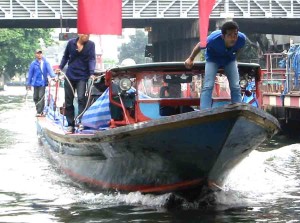
Your taxi's here, just don't get splashed

Not to be confused with the river taxis that travel the Chao Phraya River, the khlong taxis that ply Bangkok’s Saen Saep khlongs (canals) offer quick transportation at a great price, but with a major caveat.  If the Royal Palace could be considered Bangkok’s heart, and Wat Pho its soul, the khlongs can rightly be called Bangkok’s intestines, carrying the water-based detritus of this city of 13 million people to the Bang Prakong River, in Chachoengsao province, and out to the sea.  Here, black water, brown water, and grey water are mixed in a foetid arterial soup.  Khlong taxis are used primarily by locals, but offer good service that can be a real alternative, especially during hours of high traffic where city streets are clogged.  Primary service areas parallel Phetburi and Ramkhamhaeng roads. 

Construction of the Saen Saep khlongs was begun prior to the era of King Rama III, but it was under his reign that they were expanded circa 1837, primarily as a means of carrying supplies to Thai troops fighting wars against Cambodia and Vietnam. 

There is a dearth of signs in English on the piers, except for a hand-lettered sign designating the pier name.  The western “terminal” for the khlong taxi route is in western Bangkok, where Khlong Saen Saep intersects with Krung Kasem Road at the Boe Bae Market pier.  Here, you’re a 10 minute walk from the Banglamphoo section of the city.  Going east, the route passes Jim Thompson’s house, the Pratunam, Chitlom, Nana, and Asok districts, before heading northeast at the Sapankhlongtun pier under Phetburi Road near the Sukhumvit Soi 71 intersection.  This route parallels Ramkamhaeng Road, through the Bangkapi district, and ending at the Sri Boonreung pier in Hua Mak. 

Bankok also offers other smaller khlong taxi routes.  One favorite begins at the Prakhonong Bridge Pier, on the bank just northwest of the bridge.  The pier is located roughly between the Phra Khanong and On Nut Skytrain stations.  Here, the long-tail khlong taxi runs north to Wat Mahabut, then runs east, paralleling Soi Sukhumvit 77 (On Nut), to a pier near the intersection of Pattanakarn and On Nut.  The khlong area around Wat Mahabut is surprisingly beautiful, a small riverine oasis.  

Khlong taxis aren’t for everyone, but do allow you to see life along the khlongs as it is lived today by thousands of Thai families, who eat, sleep, and do laundry along the waterside.  They’re fast: our trip from the Nana Nua to Sapankhlongtun pier took less than 20 minutes, where a street tax during rush hour might have taken 45.  Khlong taxi service runs generally from 7 am to 7 pm, daily, and fares are roughly 10 baht. 

Caveats 

The water is toxic, and many riders cover their faces to avoid spray (taxis do employ moveable plastic water-guards, which help a bit).  Taxis stop for only a few seconds, so you have to anticipate your stop.  Before getting on your taxi, tell your conductor where you’re going, and he or she will indicate whether you’re on the correct boat.  As farang customers are relatively rare, they’ll usually tell you when your pier arrives, if not busy. 

Plan for adventure, and have a good attitude.  This is not a Disneyland ride, so exit your boat with care.  If you overshoot your pier, get off at the next one, and backtrack.  You may find yourself smiling, because you’re seeing sights that many of your tourist friends will never see.  Do keep your mouth closed, and stay healthy.