The sharper edge to traveling in Asia

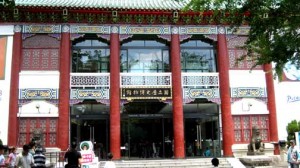
Looking for intimacy? Taipei’s National Museum of History has them all beat

Written By: herbrunbridge - Aug• 16•11

If you’re an art, history, and culture fanatic, you will get bowled over by Taipei’s massive National Palace Museum. As are thousands of others, every hour.  It’s a zoo of humanity, tour groups, school children, you name it. That’s why we really love Taipei’s National Museum of History. Yes there will be school kids, but the docents are great about keeping their voices low, and the kids silent and unobtrusive.

There are rewards here, especially the collection of Tang ceramic statuary, the amazing bronzes, the silver ingots once used for money. And the lighting! The exhibits are lit and staged to perfection, so somehow, even if there are other people around you, you feel that you’re interacting with the piece alone. Sure, there could be more captions in English (even the very nice guide to the collections, in book form, is essentially Chinese only), but we here at WoWasis can always read in a library. We go to museums to see 3D artifacts that speak to us in a way that 2D images on a page or a screen never can.  In terms of beauty of presentation, this may be the best museum in Taiwan. Does miss it while you’re in Taipei.

Next door, incidentally, is the 20 acre Taipei Botanical Garden. Walk around the back of the museum for one of the most impressive lily ponds you’ll ever see. Continue around the bend to see the rest…

National Museum of History
49 Nanhai Road
Tel: 02-2361-0270
Open Tuesday-Sunday
www.nmh.gov.tw
WoWasis visits Taiwan’s National Palace Museum in Taipei

Written By: herbrunbridge - Aug• 16•11


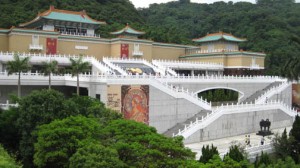
Taipei's massive National Palace Museum

The National Palace Museum, located in Taipei, is Taiwan’s marquee museum, and should be at the top of the list for every visitor. Additionally, one block away is the Shung Ye Museum of Formosan Aborigines, well worth the visit. These two museums have combined on a special rate for a ticket to both museums. It’s not highly advertised, but all you have to do is ask at either one.

Here’s all you really need to know as to the importance of Taiwan’s National Palace Museum: started during the Song Dynasty (960 ACE), this collection of the best off China was continually expanded upon until 1948 when Chiang Kai-shek, concerned about facing defeat at the hands of Mao Zedong’s Communists, began shipping it to Taiwan for safekeeping. Chiang believed he’d be returning, so storage in Taiwan was considered temporary. By 1965, when this museum was built to showcase many of these pieces, the Taiwanese government had finally admitted that the collection was staying in Taiwan, and not returning to the mainland.

Only a fraction of the museums vast holdings can ever be exhibited at one time in this huge building. But here you’ll find spectacular Buddha images, jade carvings, sculptures, bronzes, and paper. Crowds can be a factor in your enjoyment of the museum, as people are brought in by the busload (go to Taipei’s National Museum of History if you want to view exceptional historical pieces in a more intimate setting).  It’s worth braving the crowds, though, to see these historically significant pieces all in one place.

The smaller Shung Ye Museum one block away is a must for visitors wishing to learn more about Taiwan’s indigenous groups. Here, you’ll find wonderful exhibits on the clothing, implements, weapons, utensils, songs and dances, and marriage ceremonies of these groups. The museum also has what is probably the best selection of English language books relating to different ethnicities in Taiwan, and the guidebook (in English) is well worth buying, and essentially a book in itself.

National Palace Museum
221 Jhishan Road
Tel: 02-2881-2021
Open daily
www.npm.gov.tw
MRT stop Shilin, then take Red #30 bus

Shung YeMuseum of Formosan Aborigines
282 Jhihshan Road
Tel: (02) 2841-2611
Open Tuesday-Sunday
www.museum.org.tw

Nightlife in Taipei… what doesn’t kill you, makes you stronger

Written By: herbrunbridge - Aug• 16•11

Mural in Taipei's Blue Note

At an estimated 2.5 million people (and an almost unbelievable 25,000 people per square mile), Taipei’s gotta have some entertainment options. We here at WoWasis don’t have much left in the ear department after our visit to Taipei’s Brown Sugar bar, and we’re still trying to get our stomach back in order after an hour in the adult district known as the “Combat Zone.” We put some heavy work into nightlifing, and you’ll be the beneficiary.

The best

For our money, the best two clubs in Taipei are both tiny, and are in the same small building. They are the Blue Note and Oldie Goodie. They both have great bands, nice staff, and are not oppressively loud, so you can actually hold a conversation with your companion. Blue Note is a jazz club, and it’s been around since 1974. It’s on the 4th floor of 171 Roosevelt Road. There’ a NT$350 cover, and it takes care of your first drink. A great place to start an evening, and the music begins at 9:40. Walk down to the second floor for Oldie Goodie, where we enjoyed a terrific salsa band.

  • Blue Note
    171 Roosevelt Road (at Shida Road), 4th Floor
    Tel: 02-2362-2333
    Cover charge: NT$350, includes first drink
    MRT: Taipower stop
  • Oldie Goodie
    171 Roosevelt Road (at Shida Road),2nd Floor
    Tel: 02-2369-3686
    No cover charge
    MRT: Taipower stop

Good, but not always prime choice

Carnegie’s is a classic expat hangout. We heard a Canadian bending the year of the Yank sitting next to him about ice hockey (we moved down a few stools). Then a Yank businessman came in and ordered a Budweiser (we always wondered who drank that stuff). I would guess you wouldn’t go to Carnegie’s to discuss the fine points of Taiwanese culture, so let’s just say that Wednesday, Friday, and Saturday nights are when the crowds show up. There’s a cover charge those nights, but the friendly barmaid told us that your hotel can probably get you a free pass, so ask.

Only a couple of blocks away from Carnegie’s is where you’ll find EZ5 (they’re both in Taipei’s Da’an neighborhood), which specializes in live music. The night we were there, and energetic guy fronted a band that played a bunch of Lionel Ritchie/Stevie wonder-type stuff, heavy on audience participation. All in all, a fun bar, with a NT$1000 cover that includes two drinks.

The friendly bar maid at Carnegie’s told us Sunday was the night to go to Brown Sugar, and sure enough, it was jam-packed. People were there to dance to the very good salsa band. I hope they brought their own dates, because the music was so loud — even 30 feet away from the stage — they couldn’t have participated in a conversation anyway. Maybe their dates were ugly. The place was nearly pitch-black, so making out anyone’s facial features beyond a few feet was impossible. In our experience, a really dark dance bar means there’s a strong cougar-cub scene there, so if that’s your thing, maybe this bar is for you.

Scraping below the surface

  • The “Combat Zone” on Shuangcheng Street behind the Imperial Hotel. Worth a review in itself.

3 small Taipei Museums near the Songjiang Nanjing MRT station

Written By: herbrunbridge - Aug• 15•11

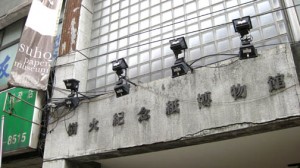
Blink and you'll miss it: look upwards for Suho Paper Museum signage

Taipei is full of museums, so we here at WoWasis love to group them into geographical areas where we can see them all in a day, or an afternoon. The following 3 museums are all close to either the Songjiang Nanjing (Luzhou line) or the Zhongxiao Xinshong (Bannan Line) stations, and can be easily seen in a morning or afternoon:

Suho Paper Museum
68, Chang An East Road
Tel: 02-2507-5535, x24
Open Monday-Saturday
www.suhopaper.org.tw
This tiny museum, offers exhibitions on making paper and hosts both permanent and temporary exhibitions, all relating to the aesthetics of paper.

Miniatures Museum of Taiwan
B1, #96 JianGuo N. Road
Tel: (02) 2515-0583
Open Tuesday-Sunday
www.mmot.com.tw
Located 2 blocks east and 2 blocks north of the Suho Paper Museum, this museum features dollhouse-sized replicas of furniture, housing, people and designs, running from Louis XV style to the kitschy.

Museum of Jade Art
#96 Jianguo N.Road
Tel: (02) 2509-8166
www.museumofjadeart.com
MRT stop Zhongxiao
This museum is the passion of Burmese-born jade designer and collector Sofeen Hu. The most remarkable pieces in the collection include flora with exposed, tiny roots of jade, insects, and spectacular color.


Taipei’s 2 modern art museums are conveniently located in the same neighborhood

Written By: herbrunbridge - Aug• 15•11

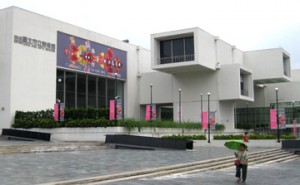
An unconventional use of floorspace adds to the aesthetic at TFAM

Taipei is full of museums, so we here at WoWasis love to group them into geographical areas where we can see them all in a day, or an afternoon. The Taipei Fine Arts Museum (TFAM) and the Museum of Contemporary Art (MOCA) are only three MRT stops away from each other (or you could walk the Zhongshan Metro Mall beneath the streets, which connects them; MOCA usually has an exhibit down there as well).

We’d recommend starting at TFAM first, as you’ll probably spend more time there. A big part of the TFAM experience is the architectural structure itself, which has created interior spaces that do not allow the visitor to view art in the standard linear procedural fashion. It’s set in a series of horizontal blocks that replicate an Asian letter, so it’s easy to become lost. Which is precisely the point. One of the three exhibitions during our visit was a retrospective of the work of Read Lee, a local painter, visionary, and teacher. He died having sold only one painting, and the only reason he sold that one was to assist one of his students. Some 2,000 works of Read’s were displayed. Like Picasso, he had “periods.” The curators of the show correlated the periods to various rooms, but the rooms weren’t necessarily contiguous. It was very much, it seemed to us, as though we were walking inside the evolving, ever-changing, emotional mind of the painter. In essence, the museum layout of the museum’s permanent interior space drove the metaphor. Having seen thousands of shows and museums in our time, this experience really stood out. TFAM shouldn’t be missed.

MOCA’s forte leans more to performance and conceptual art. Although we at WoWasis are fairly well-schooled in classic performance art (e.g. Vito Acconci, et.al), we still josh around a bit about museums such as MOCA always having a place to throw some wood shavings in a corner and call it art. And sure enough, they did. MOCA is housed in a beautiful brick two story building that was once Taipei’s City Hall.

These two museums are so close together that we encourage you to see them on the same day. If you’re an art lover, there’s bound to be something at either of these two art establishments that you’ll find compelling.

Taipei Fine Arts Museum (TFAM)
181 Jhongshan North  Road
Tel: 02-2595-7656
Open Tuesday-Sunday
www.tfam.gov.tw
MRT stop Yuanshan
This tiny museum, offers exhibitions on making paper and hosts both permanent and temporary exhibitions, all relating to the aesthetics of paper.

Museum of Contemporary Art (MOCA)
39 Changan West Road
Tel: (02) 2552-3720
Open Tuesday-Sunday
www.mocataipei.org.tw
MRT stop Zhongshan

WoWasis visits Taipei’s exceptional MRT Metro rail system

Written By: herbrunbridge - Aug• 14•11

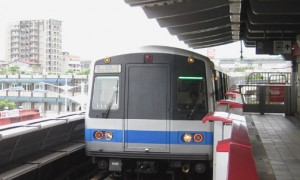
Taipei's Metro get you there fast an inexpensively

Here at WoWasis, we like to say that great transportation systems make great cities even greater.  Urban above or below-ground rail systems are transformative. In Bangkok, for instance, the BTS Skytrain has opened entire neighborhoods to new commercial and tourism opportunities. In pre-Skytrain days, getting through Bangkok’s traffic was a nightmare. That must surely have been the case as well in Taiwan’s capital city of Taipei.

From the centralized hub at Taipei’s main train station, three main lines intersect, with four feeder lines intersecting at outlying stations (the Luzhou line, the most recent, was finished in 2010). Each station has easy-to-use pay stations for tickets, and easy to find wall maps detailing the station’s layout as well as its relationship to the immediate locality. Each station has an information booth, the attendants speak English, and most of them have a city transit map in English if you ask for it. The system is fast, clean, easy to use, and inexpensive (most short trips are NT$ 20, under 1 dollar USD).  There is even a formidable underground “city” of sorts, comprising the Zhongshan Metro Mall, the Station Front Mall, and the City Mall which sits under the train and adjacent bus station, and connected to the Metro stations accessable from the Main Station MRT stop.

The system closes down at roughly 11:30 each night, a time where taxis are a reasonable alternative. During the day, Taipei’s long traffic lights and voluminous traffic make the Metro system your best choice for travel around Taipei.

Fortunes won and lost below the streets of Taipei

Written By: herbrunbridge - Aug• 14•11

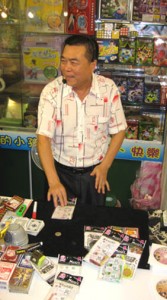
Selling underground magc

One of the hottest commercial scenes going on in Taipei happens every night at the underground transit mall running between Taipei’s train and bus, and MRT Metro stations, right under Zhongxiao Road. Known in English as the Station Front Metro Mall, some of the best action here seems to occur between the Z4 and Z6 exits between 5 and 7 pm, where a large fortune telling station services 4 people simultaneously, with waiting chairs available for the next bunch in line. Or how about magic? Right across from the fortune tellers, a magician does his tricks and hawks the apparatus to perform them. That’s stuff for adults, but how you gonna take money away from kids? Through “claw” booths, where kids ask the vendor to put a wanted prize on the platform inside a locked glass box, then pay for a few chances to pick up the item with a three-clawed device that was optimized to look like it could pick up anything, but in reality picks up nothing, other than picking the pockets of its customers.

Where fortunes are made

Station Front Mall, incidentally, is just one of three interconnected underground malls that all more or less come together under the train station. The other two are City Mall (under Civic Blvd) and Zhongshan Metro Mall (beneath the Danshui line). There are hundreds of tiny shops in those three malls, selling everything from food to shoes.

Part of the charm in any Asian country are all the elements, consisting of hard and soft goods mixed with great spiels, that separate the consumer from his or her money, in the name of luck.  “Step right up!” is a term in the West, associated with hokum, carnival sideshows, and snake oil. What’s going on in Taipei under the streets, between Z4 and Z6, would be seemingly quite convincing evidence that the Chinese are far more adept at separating money from the gullible than westerners are, and have been doing it for a hell of a lot longer, too.

WoWasis ranks English bookstores in Taipei

Written By: herbrunbridge - Aug• 13•11

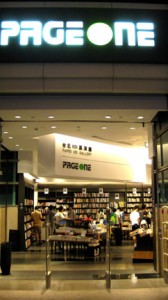
PageOne, WoWasis' choice as the best English bookstore in Taipei

Even though Taiwanese are voracious readers, most Taiwanese bookshops have little for westerners wanting to read in English. We’ve visited four bookstores in Taipei that offer — in varying degrees, books for western readers. Here at WoWasis, our focus is on bookstores that offer books in English on Taiwanese culture and history. Navigating these stores can be a challenge. Books on Chiang Kai-shek will not be found in the Taiwanese history section, because he’s considered politically to be from the mainland, a Taiwanese form of political correctness that ends up being transferred to the shelves.  The number one English bookstore in Taipei is Page One, on the 4th floor of the Taipei 101 building. We recommend you stop there prior to visiting the others.

Bookstores featuring books in English on Taiwanese themes:

Page One
Taipei 101 Center, 4th Floor
Tel: 02-8101-8282
Open Sun-Thur 11 am – 21:30, Fri-Sat 11 am – 22:00
www.pageonegroup.com
MRT stop Taipei City Hall (a free shuttle bus runs every half hour to Taipei 101, or you can walk 10 minutes).
The best English bookstore in Taipei, without a doubt 

Eslite Books
Dunnan Main Store
2F, 245, Sec. 1, Dunhua South Road
Tel: (02) 2775-5977 x250
www.eslite.com
MRT stop Zhongxiao Dunhua
This is Eslite’s “open 24 hours” location, and there’s an all-night café open right next door, too. Eslite’s always got a promotion going on, namely buy NT$ 1000 worth of books and get a 5% discount, or NT$ 3000 and get a 10% discount.

Eslite Books
Xinyi Store
No. 11 Songgao Road, Xinyi District
Exit #2, Taipei City Hall MRT stop
www.eslite.com
MRT stop Zhongxiao
This iEslite shop opens at 10 am, closes at 12 midnight. The selection of English books is poorer at this particular Eslite store, so we ‘d recommend sticking to their main Dunnan store (above).

Cave Books
54-3 Zhongshan Road
Tel: (02) 2599-1169
www.cavesbook.com.tw
MRT stop Yuanshan
This is a new location and telephone number for this well-regarded store. Clerks all speak English, and are quite helpful. It’s just one block away from the Taipei Fine Arts Museum, near the Yuanshan MRT station.

Adult nightlife in Taipei: Save it, granny, we’ll do our punting in Bangkok

Written By: herbrunbridge - Aug• 12•11

Shuangcheng Street: the porchlight's on, but...

We here at WoWasis aren’t prejudiced against age. But we’d rather see Granny working a food cart than peddling her feminine charms to passerby, which is exactly what dozens of ladies of a certain age are doing on Taipei’s Shuangcheng Street every night.  Our guess as to the age range of the working ladies on this street is 40-60 years old, certainly not the stuff regaling the pages of glossy magazines. This small street runs behind the Imperial Hotel, and begins what is known as Taipei’s “Combat Zone,” or adult district.  Walk down the street and these aged charmers will grab your arm, cajole you into a bar, then ensure you get charged NT$ 350 for a ladydrink. That’s $11 USD. Two of them wanted to drink with your WoWasis correspondent. That would have been $22 USD, the going short/time rate for a model class girl working the Nana Hotel parking lot in Bangkok. 

It’s never difficult for a western man to “hook up” in Asia, so renting, vs. buying is usually the foundation for the discussion. And judging by the situation on Taipei’s Shuangcheng Street, rental options in Taipei are mighty slim. Our recommendation is to save Taipei for museum visits and temple-hopping, and do your canoodling in another city with far more accommodating options. If you’re just looking for a watering hole or a little live music, click the WoWasis Taipei nightlife review page.

5 necessary basics to driving successfully while touring Taiwan

Written By: herbrunbridge - Aug• 10•11

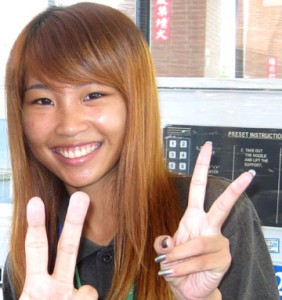
Friendly Taiwanese gas station attendant always read to fill you up with a smile

Particularly in eastern and southern Taiwan, driving your own car is a wonderful expeience. Three great drives, with wonderful ocean vistas, include:

Northeast Coast National Scenic Area 

East Coast National Scenic Area

Kending National Forest Recreation Area and Hengchung Peninsula

In other posts relating to driving a car in Taiwan as a visitor, WoWasis has addressed how to rent cars in Taiwan, and a bit about the challenges of driving in Taiwanese cities (unless you can read Chinese).  Here are a few basics that will make your driving experience more pleasurable:

1)      Whenever possible pass any vehicle that blocks your view. You’ll need to see every sign on the road as far ahead as possible, so pass, pass, pass. If you don’t, you’ll be constantly lost from missing important signs hidden by the truck or bus ahead of you.

2)      Just because you know the rules doesn’t mean you’ll always want to obey them. It isn’t legal to turn right on a red light, but people in Taiwan do it all the time. Lots of cars go 120km or more in a 110 km speed zone. Lots of people pass slow vehicles on mountain roads by going over double yellow lines.

3)      We’ve never ever seen a cop stop anyone for anything other than an accident. Taiwanese are, in general, safe at high speeds, and the cops seem to be aware of this. WoWasis would never encourage you to speed, but we’ve been known to get to our destination well ahead of schedule.

4)      Those roadside bathrooms are really clean. Rest stops occur every few km on major roads, and they have food courts there, and gas stations too, where the attendants to the pumping while you go and investigate the plumbing facilities. Cleanup crews work constantly, cleaning mirrors, sinks, toilets, everything.

5)      Taiwan has some of the best roads in Asia, that’s why we don’t mind paying the tolls on the freeways. We gotta believe we’re in paradise. Great freeways, no cops, relatively little traffic. Did we tell you how much we appreciate good roads? We wrote a blog post last year on how bad the roads in the Philippines are, particularly those that cross the cordillera. Worst we’ve ever seen, in any country, anywhere. We once wrote too, that you can judge the quality of a country by how good its sidewalks are (are you listening, Thailand?). That goes for its roads, too, and Taiwan sets the standard in Asia, as far as we’re concerned.