The sharper edge to traveling in Asia

The challenges of a westerner driving in Taiwan: touring Tainan

Written By: herbrunbridge - Aug• 09•11

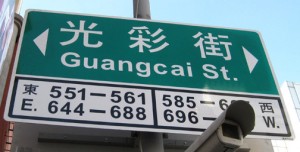
We wish all street were as well-signed as Chiayi's Guangcai Street

Here at WoWasis, we love to drive, and you can see some of the best stuff in Taiwan fairly easily if you have a car. The roads are the best we’ve seen in Asia, and Taiwanese drivers are exceptional in terms of courtesy and technique. Taiwan’s  freeways and expressways are as good as nay we’ve seen anywhere. And for the most part, signage in English, pointing to historical sites, is pretty decent.

Where driving in Taiwan becomes cumbersome is when you’re in the city, and trying to find anything from a hotel to a historical building. This was never more apparent than in the historical city of Tainan, which has 700,000 people, and 8 or 9 historical places (e.g. Confucian Temple) that a visitor would want to see.  Those spots are spread around the city, and English signage is just about non-exist ant. We got lost immediately, and were assisted by Wayne Hsieh, who we accidentally ran into while scratching our heads, reading a map. Wayne took us around the city for an hour or so, bought us a great bowl of soup, and gave us a thumbnail history of his city.  In our opinion, the only way for a westerner to see Tainan is to book a tour from your own hotel, where you can engage a local person to navigate the city.

Later that same day, we found ourselves in Chiayi, looking for a reasonably-priced hotel. There was only one building we could find that looked like a hotel, but $200/night was beyond our limit. The nice lady at the desk found us a good, inexpensive alternative, booked it for us, and gave us a map and directions.

So if you’re driving in Taiwan, and neither read nor speak Chinese, here are a couple of things to remember:

1)      Not every Taiwanese speaks English, but those that do will do anything they can to help you, and they will often go out of their way in the process.

2)      When you’re hopelessly lost, the desk staff at a major hotel will probably speak English, and will graciously help you, even when they know you won’t be staying there.

3)       Particularlly in eastern Taiwan, places to stay, such as B&Bs, may not have English signage. Go to a business that sells to westerners (e.g. 7-11 stores), and you can generally find someone who speaks some English that can point you to a place to stay.

All in all, driving in Taiwan is fun, but there’s still a good degree of adventure involved. Unlike the Romance languages, you’re not going to pick up knowledge of Chinese characters overnight. But friendly people love to help here, and the serendipity of meeting them will add to the enjoyment of your visit.
WoWasis visits the Kending National Forest Recreation Area in southern Taiwan

Written By: herbrunbridge - Aug• 08•11

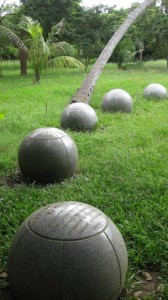
Located in the heart of Taiwan’s Hengchun Peninsula,and southwest of the East Coast National Scenic Area,  this immense botanical forest and garden encompasses over 1,000 acres. It’s no quick buzz-through, as the quirky trail design takes some getting used to, and the numbering system doesn’t follow a logic intelligible to us. We’d recommend a minimum of three hours to make the trail loops. The Kending National Forest Recreation Area (KFRA) is primarily known for its collection of trees native to the area and a series of coral formations that have become caves highlighted by great numbers of stalagmites and stalactites. Animal, bird, and insect life abound here, and the din of the insects and birds is almost deafening. Warning signs indicate poisonous snake, centipede, and wasp hazards, so we kept to the trail.

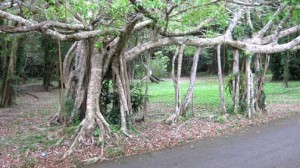
The ficus benjamina just starting out

Our favorite tree was the massive ficus benjamina, or Weeping Fig, sporting dozens of limbs that deploy roots directly to the earth below. Left alone, they grow up to 100 feet tall and make a giant footprint. It’s rare to see one left pretty much unchecked, and that’s just what happens here.  There’s an observation tower in the park that allows for a view of the entire peninsula, and the KFRA website contains some interesting data on what the Rec Area has in store for the visitor.

Scuba diving in the Kending area of southern Taiwan

Written By: herbrunbridge - Aug• 08•11

We here at WoWasis love to scuba dive. And we heard the coral reefs were great here at the southern tip of Taiwan. The bad news is we didn’t go diving, and we’ll tell you why. The good news is there may be a solution.

Our adventure began when a couple of nice guides at Kending National Park told us we could find dive operators at both Baisha and Houbihu villages, a few short clicks away. Baisha had nothing, and Houbihou had a few shops, but no one spoke any English, there were no PADI signs, nor anything to indicate anyone was certified for anything. We need an English-speaking dive master, because there are always a few things we want to discuss before the dive:  conditions, the buddy system, depth, you name it. One woman who owned a shop asked her daughter to translate. I asked if they offered scuba. No one knew what “scuba” was. So mom pulled out a piece of cardboard with both English and Chinese writing, moved her finger down to the word “scuba,” then said “yes, we scuba, how many go?” and opened her order book. Needless to say, we didn’t have the warm fuzzies about diving in Houbihu.

On the way back to town, our luck appeared to change, with the appearance of a professional-looking, full-blown dive operation called the LongJing Dive Resort, run by a friendly English-speaking woman named Vivi. Although we’d run out of time for diving, this operation looked first class, was a PADI 5-star shop, and divers can stay there, too, at NT$ 800 per night per cabin, and fit up to 4 people in each cabin. Here’s what Vivi charges, all in NT$ money:

1) Dive from a boat: $1200
2) English-speaking dive master: $1500
3) Regulator, BCD, mask, snorkel, fins, weights: $1000
4) Tank $200

That’s under $150 USD, and I’ll bet you could add a tank for another dive, do a little Taiwanese-style bargaining, and have a pretty good day of it. Here’s the contact info:

Long Jing Dive Resort
Corner Highways 153 and 26
Near Kending, Taiwan
GPS: N21°58.153’  E120°45.373’
Tel: +886 095-836-057
www.longjing.com.tw
vivi@longjing.com.tw

Rafting on Taiwan’s Siougulyuan (Xiuguluan) River

Written By: herbrunbridge - Aug• 06•11

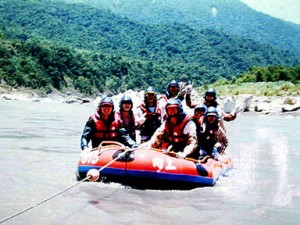
Located along the beautiful East Coast National Scenic Area is the Siougulyuan River. Veteran and beginning rafters alike will enjoy  the moderately challenging Siougulyuan River, with additionally provides a nice getaway from the heat and humidity. It’s easy to do, once you arrive in the eastern town of Rueisuei, a few km inland from the Changhong (Rainbow) Bridge, where you pick up the road. The raft trip runs from roughly 10 am to 2 pm, broken up with a break for lunch. When you arrive at the Rueisuei Rafting Center (get there at 9 am for the mandatory safety talk in Hokkien Chinese), you’ll get grouped with enough people to make up 7 or 8 people per raft, get your life jacket strapped on, and you’re on your way. Friendly Taiwanese will do everything to help you have a great time, although they probably won’t speak your western language. When WoWasis was there, we were the only western people among the 200 or so rafters (also maybe the only one over 30 years of age). The price is NT$ 650, which includes lunch, and a ride to and from your hotel.

About the river

Starting in the Coastal Mountain range and flowing for 103 km, the Siougulyuan is eastern Taiwan’s longest river. It drops 65 meters over the 22 km raft run. On the first segment, the course runs past deeply uplifted, stratified rock formations before reaching the Amis aboriginal settlement of Qimei (where you’ll break for lunch). These first few km of the 22 km trip are the easiest, allowing for rafters to work on their skills. The post-Qimei part of the river requires the most skill, and contains the  most challenging of the trip’s more than 20 groups of rapids. In June or July each year, Taiwan’s biggest rafting competition takes place here.

You will get wet, both from the cataracts as well as fellow rafters, who delight in using buckets to splash those in every raft within eyeshot. It’s always hot in April through October, when the water runs best, so a good splash from a passing raft is always welcome. The rafting company will help you to bag your dry clothes, label it, and will have your bag ready for you when the trip ends at Rainbow Bridge, right at the ocean.

For more information

Rueisuei Rafting Service Center
215 Jhongshan Road, Section 3
Rueisuei Township
Tel: (03) 887-5400
For additional rafting options, visit the East Coast National Scenic Area rafting website

Sculptural furniture from Taiwan that’s standing Asia on its ear

Written By: herbrunbridge - Aug• 05•11

Here at WoWasis, we’ve found great art in so many far-flung areas of the globe that seemingly nothing surprises us anymore. Artists and artisans can’t create without that secret sauce called “artistic temperament,” so they live where they want and damn all converntions. Which brings us to Kan Hsin-Yi of Taiwan. He lives in a town so remote that it’s not even a town, and you have to literally stumble across his JOKI CoffeeShop-ArtGallery way out east on Taiwan’s central shore, along the magnificent East Coast National Scenic Area.

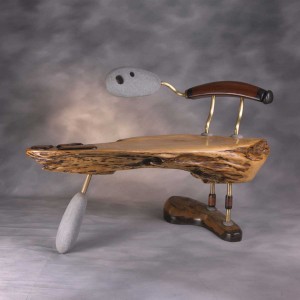
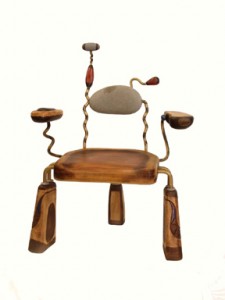
Kan does both free-standing sculpture and sculptural furniture, but the latter that impressed us. Whimsical, well-crafted and unique in terms of materials, Kan makes art you can sit on or at, and the influences seem to be many. There’s the abstract quality of Ernst, references to Surrealism (his Hualien stones are reminiscent of Dali’s loaves of bread), and an anthropomorphic quality to many of his more compelling pieces. His preferred materials include a smooth beach stone commonly found in this area of taiwan, bronze, copper, and terrific selection of lovely woods. And he works them all together, with an eye to balance and a nod to humor. His sculptural art and furniture is quite varied, far more so than is representated by the pix in this post.

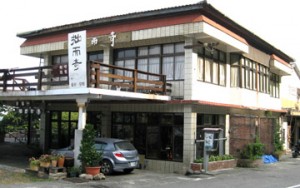
So how do you see his work? He’s got a website (see below), but good luck if you don’t read Chinese. Or you can take the plunge and visit his studio in Taiwan. A layover in Taipei isn’t going to help much,  you’ve got to take a day just to get down there. But that studio’s worth visiting, because there’s some exceptional material there. Below, you have his address and GPS coordinates. Because you’d never associate his building as a gallery from the outside, we’ve included a picture of that, too, as well as GPS coordinates so you can make this artistic scavenger hunt a successful one.

JOKI
No.3 Shihmen, Fongbin Township
Hualien County
Taiwan (R.O.C .) 97792
Tel: (886) 3-878-1206
www.joki.com.tw
GPS: N23°31.363’  E121°30.165’

WoWasis visits Jioufen: a Taiwanese town with one of the best market walks in Asia

Written By: herbrunbridge - Aug• 03•11

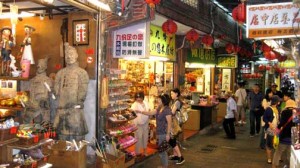
Calligraphy stall in Jioufen

At first glance, it’s easy to disregard Jioufen. Initially appearing to be yet another hillside town of nondescript buildings, the town unveils itself under the cover of a series of narrow alleys lined with shops, selling everything from calligraphy to condoms. Walking through the alleys of Jioufen takes the better part of an afternoon, and don’t worry about getting lost, just follow the red lanterns above, which marks the route. A great place to start is by entering Jishan Road, which is actually an alley to the right of the 7-11 (the town’s constantly referred to meeting point). As you mosey down Jishan Road, occasionally look right and left down stairstepped alleys — you may see something worth diverting to.

Jioufen's alleys are easy to navigate, just follow the red lanterns

Only 40 minutes or so from Taipei, Jioufen has a colorful history. Gold was discovered in the late 1890s near here, and a boomtown was born. It was occupied by the Japanese during WWII, and was soon chosen by artists and craftspeople for its beautiful locate (the seaviews are wonderful) and affordable rentals (your walk down Jishan Road will eventually take you to Shuchi Road, a more “arty” street than Jishan, where you’ll see great views of the sea at virtually every corner).

Deceptively simple from without, Jioufen's fascinating once you're inside

Jioufen was the location chosen by director Hou Hsiao-Hsien for his film City of Sadness, a story of post-war Taipei, drawing huge number of visitors every year. Tour buses love Jioufen, so we here at WoWasis encourage you to try to come during the week for a less-hectic experience. If you’re just in Taipei for a few days, though, you won’t want to miss the charm of Jioufen.

WoWasis visits Wulai: an aboriginal cultural village & hot springs in Taiwan

Written By: herbrunbridge - Aug• 02•11

An Atayal weaver

WoWasis drove to Wulai, only 40 minutes south of Taipei. The trick, once we got there, was finding the Atayal-run Wulai Aboriginal Cultural Village. Wulai is a village noted for its hot springs, and there are plenty there from which to choose. The Atayals, who run the cultural village across the river, are one of fourteen indigenous aboriginal groups officially recognized by Taiwan, and here you can watch weaving, be exposed to Atayal sounds and dances in native dress (shows are three times a day, varying by when the occasional tour bus rolls in.)

To get to the Atayal village, cross the Nanshih River on the colorful footbridge, then walk up the stairs across the street to the “log train” electric tramway for a rickety-delightful 1.6 km ride to the village. At the village, you’ll also be able to see the Wulai Falls, and even pay an exorbitant $7.50 USD for a 30 second cable car ride above the falls. At the village, though, you’re never far from Atayal music and dance, performed by dancers that consist of what surely must be some of the most beautiful women in Taiwan.

Additional note Wulai Village is located down country Highway 9, just off Freeway 3. You’ll know you’re in Wulai when you get to GPS: N24°51.770’  E121°33.005’.

Renting a car and driving in Taiwan: easy if you know how to do it

Written By: herbrunbridge - Aug• 02•11

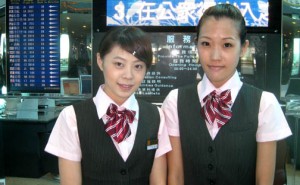
Friendly info team at Taiwan's Taoyuan Airport are eager to help

Taiwan is a gorgeous country where, outside of a few major population areas, relatively few speak English, a difference for the Westerner used to being understood in Southeast Asia or Asia Minor. Unlike Thailand or Turkey, asking directions on the streets in Taiwan generally won’t even get you fractured English We here at WoWasis wanted to rent a car at Taipei’s Taoyuan airport, but we couldn’t do it in advance on Travelocity. Look ma, no rental car counters! Actually, they do have counters, but we never saw a person behind them. But our problem was solved via the friendly, efficient, and English speaking woman who worked at the Terminal 2 Departures Information Desk on the 3rd floor, your best bet for point through the car rental process. The friendliness and effectiveness of the people working that counter is legendary, but ensure that you’re at the right one. There’s another inside the arrivals area that isn’t always manned, so make sure you go to 3rd Floor departures and start there.  Here’s what we found as we rented our car for touring Taiwan:

1)      Car rental counters (there are at last two) aren’t manned. At least they weren’t when we were there.

2)      Go to the Information counter, Terminal 2, 3rd Floor departures lounge. There, the attendant called a rental company, translated everything in both directions. She even became our “voice” when we said the price was out of line with what we wanted to pay.

3)      Cars aren’t located at the airport, they’re in nearby locations, such as the Taoyuan High Speed Rail station. You have to be driven there.

4)      There’s a book store that sells maps upstairs at Terminal 2, next to Burger King. The Taiwan Map King is the better of the two you’ll find there, but it’s still damn hard to read, not very good in general (although a better situation that you’ll find in the Philippines). When driving, you’ll be using a combination of asking directions and using your map. Bring a GPS if you have one.

5)      Driving is on the right hand side, just like the U.S. Taiwan’s roads and drivers are good. Although English signage is not comprehensive, you won’t get badly lost, as the island isn’t all that big. Some folks recommend just hiring a car and driver, and doing away with the hassle. We like to do our own driving and exploring. If you do, either bring along a fellow traveller to read the map while you’re driving, or get used to occasionally pulling over to piece it all together yourself.

If this all sounds unworth it, consider this: there aren’t that many countries in Asia with great road systems that are relatively untrammeled by western visitors. Taiwan happens to be one of these, and you’ll still go whole days here without seeing a westerner, once you’re out of highly populated cites.  Taiwan’s a unique experience, and a car’s a great way to go.

Additional note: At Taipei’s Taoyuan airport, you can buy your telephone SIM from FarEasTone, located a few steps away from the tourist information counter, Terminal 2, 3rd level Departures.

WoWasis book review: ‘Dragon Lady’ by Sterling Seagrave

Written By: herbrunbridge - Jul• 31•11

China’s Dowager Empress Tzu Hsi (1835-1908) was truly the stuff of legend, but as veteran Asian historian Sterling Seagrave (along with co-researcher Peggy Seagrave) points out, most of the legend was false. In Dragon Lady: The Life and Legend of the Last Empress of China (1992, ISBN 0-679-40230-6), the author debunks the myths that unfairly maligned a woman who, he suggests, was rarely in control of the inner forces that drove Chinese political policy. 

The traditional historical take on the Dowager Empress was that she violently controlled, through murder and intrigue, family members, court officials, and public servants. Seagrave takes the reader on a revisionist path, describing the false documents used by Sir Edmund Backhouse to discredit her, and influence the writings of journalist George Morrison, who is perhaps most responsible for the public interpretation of the Dowager in the west. At 601 pages including notes, the book is exhaustive, so his four page “cast of characters” chapter at the beginning of the book is something the reader will continue to return to. The book is essential readers for scholars of Chinese history, and rights a significant factual error in the story of one of the most fascinating women in Chinese history. Buy it now on the WoWasis eStore.

Pa Farang on taxi scams in Bangkok

Written By: herbrunbridge - Jul• 30•11

The Good Manner: Advice on Thailand from WoWasis’ Pa Farang
This week’s dilemma: My taxi driver refuses to turn meter on: taxi scams in Bangkok

Dear Pa Farang, 

What gives withBangkok taxis?  Half the time the driver refuses to turn the meter on, and quotes me a rediculous price.  Am I being taken to the cleaners? 

–  Confused visitor 

Dear Confused, 

The are three major cab scams running in Thailand. They are:

1)      Driver refuses to turn on the meter
2)      “Taxi mafia” at your hotel drives unmarked cars, charges you inflated flat rates
3)      You agreed to pay a tuk-tuk driver 10 baht to go to a temple.  Instead, he drives you to a gem shop. 

Let’s tackle 1 and 2.  #3 I’ll cover in  a later column, as it’s a topic all to itself.

Driver refuses to turn on the meter.  By law, all taxis sporting the “Taxi-Meter” sign on their roofs must have a working taxi meter.  Flag fare is 35 baht.  When you get in your cab, tell the driver where you’re going, and if that meter isn’t on when you depart, point to it and say “meter!”  If he refuses to turn it on, or tries to set a fixed price to your destination, order him to stop, then leave the cab.  His fixed price will be at least double what would otherwise be on the meter. 

Taxi mafia.  ManyBangkok hotels have a pool of drivers in unmarked sedans, usually dark blue in color.  You will usually be accosted by them every time you leave the hotel.  They charge flat rates to a number of places, and you’ll again pay roughly double of what you’d pay in a metered cab.  You do not have to take “taxi mafia” cabs, even to the airport, regardless of what the hotel says.  Veteran visitors do it this way:  on your departure for the airport, walk out of your hotel, flag down a taxi-meter, tell him you’re going to the airport, but to drive into your hotel first.  Upon his arrival at the lobby doors, jump out, grab your stuff, get back in your cab, and you’re off. 

Avoid all scams, show the Good Manner, and have a great time inThailand, 

– Pa Farang

Read Pa Farang’s other columns in WoWasis for more advice on relationships and cultural matters in Asia