The sharper edge to traveling in Asia

WoWasis tours the Pottuvil Lagoon mangroves near Arugam Bay, Sri Lanka

Written By: herbrunbridge - Feb• 24•12

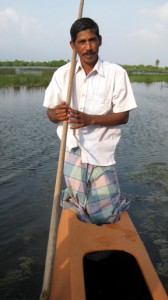
Poling through Pottuvil's mangrove lagoon

Arugam Bay in southeast Sri Lanka is fairly well known for surfing and other water sports, but you’ll be missing something extraordinary if you don’t take a nearby mangrove eco-tour in the village of Pottuvil. The tour is by outrigger, polled through the mangrove waters by local people, is managed by the Hidiyapuram Fisheries Cooperative Society, and takes approximately two hours, with two brief stops along the way. Your ticket assists the Society to replenish mangrove flora, caring for wildlife, and assists in the livelihoods of people living adjacent to the lagoon. You can book a tour from any hotel, and a tuk-tuk will arrive to drop you off at the lagoon dock, and take you back. 

The only sounds in the lagoon are the sound of the outrigger being pulled through  the water, and the ever-present birdlife. Here, you’ll see four types of kingfishers, cormorants, sea eagles, and spoonbills, among others. Fish-eating snakes and crocodiles live below the water. There are 27 species of mangrove plants here. And you’ll see a number of tiny fishing huts and lean-tos along the way… it’s a working lagoon. 
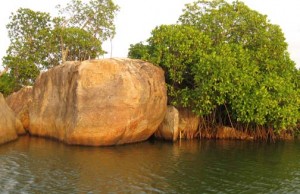
Sunset casts a wonderful glow on the rocks comprising the eastern border of the lagoon

In the afternoon, the setting sun casts a beautiful red glow on the rocks occupying the eastern border of the lagoon. We here at WoWasis recommend the tour as a great getaway from the hubbub of Arugam Bay, especially in high season, and supports local people in their quest to provide for their families in a manner that complements the environment.

WoWasis bids fond goodbye to publisher Barney Rosset

Written By: herbrunbridge - Feb• 24•12

Legendary publisher and WoWasis friend Barney Rosset died this week at the age of 89. Although primarily known as the publisher of Grove Press and the Evergreen Review, he is particularly memorable in Thailand for publishing Patpong Sisters, the late Cleo Odzer’s role-switching romp through the nightlife of Bangkok. We interviewed him back in 2004 on the subject of Odzer, and he divulged that he prompted her to add her personal memoirs to her PhD dissertation, a voila, an amazing book emerged. He sent us a copy of Odzer’s Goa Freaks, an out-of-print book that he somehow dug out of his own library. Barney was creative, brought vibrant new material to publishing, and was a champion of First Amendments rights. He lived an amazing life, and we’ve included a couple of links at the bottom of this post if you’d like to read about him. Barney was one of these people who made a difference, and we’re celebrating his life this week. So long, Barney, and thanks for being you. 

Bangkok writer Dean Barrett wrote about Barney this week: 

The death of Barney Rosset is not unexpected exactly; he was 90 and was living mainly on gin when I knew him in Manhattan over ten years ago.  He was a man who changed the literary landscape of America forever.  When no one would touch Samuel Beckett, Henry Miller, the Beatniks, and, yes, what was considered pornographic in the 50’s he published them and went to court to fight for the right to publish them. 

Besides starting Grove Press, the most innovative and daring press in the 60’s and on, he started Evergreen Review magazine and Blue Moon Books, which was the largest publisher of erotic novels in the world. He also read [my book] Mistress of the East, loved it, and said it was notches above his Blue Moon line but he would give me back the publishing rights in three years if I would let him have it.  He kept his word and I have republished it for Kindle, etc., as A Love Story: The China Memoirs of Thomas Rowley. 

Barney loved Asia and especially Asian women and especially Korean and Thai women.  He told me a story once about how he walked into Billy’s Topless bar in Manhattan, spotted a beautiful dancer, and he talked with her.  She turned out to be Thai but she was leaving for Thailand the next day.  He wasn’t a young man at the time but asked if he could go with her.  She was surprised but shrugged and said yes.  He did.  He later lost track of her and wanted to find her again but he was in Manhattan.  So he asked Christopher Moore if he could help him, and Chris did his detective thing and located her for him. 

The last time I saw him was in Thailand, Sukhumvit soi 11.  He was going to Chiengmai to put on part of a Beckett piece at Chiangmai University that even American directors found too difficult to stage.  I had a feeling it was Barney’s excuse to get back to Thailand one last time. 

Truth is, they don’t make them like him anymore.

More on Barney Rosset: 

http://mubi.com/notebook/posts/barney-rosset-1922-2012?utm_source=Publishers+Weekly%27s+PW+Daily&utm_campaign=7fff058459-UA-15906914-1&utm_medium=email 

http://www.nytimes.com/2012/02/24/books/barney-rosset-loved-breaking-publishings-rules.html?_r=1&hpw

WoWasis beer review: Some great beers from Sri Lanka

Written By: herbrunbridge - Feb• 23•12

Similar to the situation in which we found ourselves while reviewing Vietnamese beers, we here in your WoWasis beer tasting room can’t find any reason not to stay exclusively with Sri Lankan-produced beers while in that country. Sri Lankan stouts and lagers rank with the best in Asia. Here’s our report: 

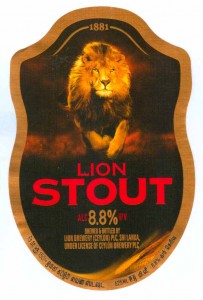
For sheer everyday drinkability, we think Lion Lager, at 4.4% alcohol, is your best bet. It has a great taste, perfect after a long day climbing through Sri Lanka’s ancient cities. To polish off our evening, we’ve enjoyed both the ABC (Archipelago Brewery Corp.) and Lion Special stouts (8.8%). 

Here’s a short list of Sri Lanka’s beers, in order of alcohol content:
ABC Extra Stout (Asia Pacific Brewery), 8.8%
Lion Special (Stout), 8.8%
Lion Strong (Lager) 8.8%
Baron’s Bison (Lager) 8.5%
Anchor Pilsener, 4.9% (note: this beer was decidedly our least favorite)
Baron’s Lager, 4.9 %
Lion Lager, 4.8%
Three Coins Dark, 4.3%
Three Coins Lager, 4.3% 

In summation: We think you can’t go wrong with Lion, all their beers are excellent. ABC Stout is quite good, too. But drink Anchor Pilsener at your own peril, it’s a bit rough.

Was I nearly the victim of a drug scam in Malaysia?

Written By: herbrunbridge - Feb• 23•12

The Good Manner: Advice on Asia from WoWasis’ Pa Farang
Today’s dilemma: was I nearly a victim of a Malaysian drug scam? 

Dear Pa Farang, 

A friend and I had a strange thing happen to us on a recent trip to Patong.  While walking down a major thoroughfare, we were approached by two men who flashed badges at us, told us they were international drug police, and insisted on searching our bags.  Something didn’t seem right, so we insisted they accompany us to a police station, in a taxi.  They turned around and walked away. 

We’re still puzzled, but suspect something wasn’t quite kosher.  Anything you could tell us would help. 

– Jim & Jerry 

Dear Jim and Jerry, 

Yes!  You were nearly the victim of a scam gaining popularity inMalaysia.  If you had allowed your bags to be searched, they would have surrepticiously slipped some real drugs inside, “found” them, and tried to shake you down for cash in lieu of “arrest.”  This has been quite successful in recent months, in Patong as well asKuala Lumpur.  Our contacts tell us that Asians, more than non-Asians, are often the victims, as they are perceived as being less confrontational. 

You did the right thing, by insisting on going to a police station right away, and good thing you suggested taking a taxi.  If you had accompanied them in their own auto, the end of the story might not have been favorable.  

Remember to avoid all scams, show the Good Manner, and have a great time in Asia, 

– Pa Farang 

Read Pa Farang’s other columns for more advice on relationships and scams in Southeast Asia

WoWasis visits Sri Lanka’s magnificent Aluvihara rock monastery

Written By: herbrunbridge - Feb• 20•12

In the ancient cities area of Sri Lanka, on the road from Dambulla to Kandy, 3 km north of Matale, is Aluvihara, an undervisted and non-commercial shrine that we here at WoWasis feel is well worth a stop,

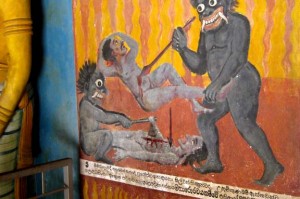
Aluvihara reminder: don't try this at home

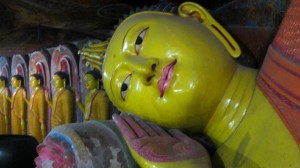
We loved the Dambulla cave temples nearby, but the overt commercialism there we found to be disconcerting. Aluvihara, on the other hand, a bit off the beaten path, was a welcome respite, and a wonderful monument. Aluvihara consists primarily of several rock caves, the first containing a wonderful polychrome reclining Buddha, with magnificent lotus frescoes painted on the ceiling. The next cave contains frescoes depicting the horrors of hell, a series of tortures interestingly juxtaposed amid carved guardian statues. The last cave features torture sculptures. Finally, you can climb a few steps to a stupa overlooking the valley below.

The Buddhist view of hell is always interesting to see when depicted through art, whether it’s the elaborate wooden carvings you’ll find in Hanoi, or the frescoes of Aluvihara. What makes Aluvihara outstanding is that most of the time there are few tourists, and you’ll have it to yourself. The polychrome Buddha and guardian statutes are some of the finest we’ve seen.

Sri Lanka is still relatively little-visited due to the recent civil war, but promises to become more crowded with tour buses as time goes by.  Aluvihara is best seen now, when you’ll have the luxury of having it all to yourself.

WoWasis visits Sri Lanka’s Spice Garden hawkers

Written By: herbrunbridge - Feb• 19•12

Spice gardens prove to be a welcome stop along the Colombo-Kandy highway

On the road from Colombo to Kandy, especially near the area close to the Elephant Orphanage (which we feel is overpriced and unworth the visit, unless you’ve never seen an elephant before), you’ll find a number of signs saying ‘Spice Garden,’ or ‘Spice Grove,’ fronting local spice operations. We visited one of them, The Island 25 Spice Grove, on the main road skirting the town of Mawanella. and think you should too. Here’s why…

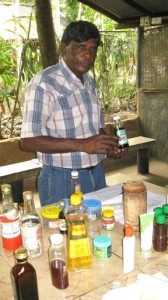
This grove is a private enterprise, has been there over 100 years, and has a number of spice trees and bushes growing there. You’ll be taken on a short tour, then return to a table where your guide — who triples as a hawker and masseuse — will extol the virtues of various balms and oils, and offer to give you a rubdown, free of charge (a small tip is appreciated). It’s a load of fun and a welcome break. We here at WoWasis bought some citronella balm for mosquitoes that was fragrant and effective (in that particular area of Sri Lanka), and the spice garden experience we thought was wonderful, especially since we still had a 3 hour drive to Kandy.

The Island 25 Spice Grove
25, Uthuwankanda, Mawanella, Sri Lanka
Tel: 0094-35-224-1637

WoWasis book review: Nihal De Silva’s ‘The Road from Elephant Pass’ Sri Lanka

Written By: herbrunbridge - Feb• 18•12

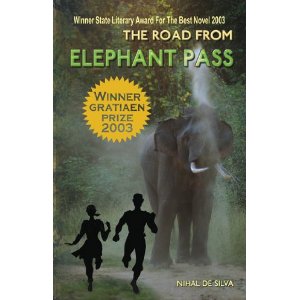
Every so often an exceptional book by an emerging author reaches out and strikes the reader unaware. Somewhat less often does the book encompass more than 400 pages.  And rarer than that are cases in which the author, in some sense, predicts his own upcoming death. In an apt metaphor, the finally-fledged Sri Lankan writer Nihal De Silva, an amateur naturalist whose novels wax prosaically about native bird life, was killed before his career took full flight. The Road from Elephant Pass, his first book and the winner of the Gratiaen Prize of 2003 for the best Sri Lankan book in English (2003, ISBN 978-955-8095-38-6) is a significant first novel that represents a compelling read with every page, and contains an ironic and tragic twist, relating to the author’s own life.

The 428 page book is placed during Sri Lanka’s bloody Civil War, in which a Sinhalese officer is sent to escort a female Tamil Tiger (LTTE) informant through enemy lines, back to Colombo. On their way, they are forced to carry alone on foot through Sri Lanka’s Wilpattu National Park, a wilderness area populated by significant numbers of exotic birds. De Silva provides wonderful descriptions of the birds, their habits, and habitat, and the two enemies begin realizing that, in spite of sharing radically different political views, their common love and understanding of bird life provides a welcome, if brief, respite from reality. Jungle survival and forest craft (our favorite was the use of pulped cold fire ashes as toothpaste) take on an important element as the two trekkers flight through mosquitos, swamps, drought, and irregular army challenges.

From a romantic and war perspective, there’s a bit of Hemingway here, but the book is all De Silva, and impossible put down. The book is a red-hot read, the characters believable, the background well-researched. On page 358, through his protagonist, Captain Wasantha Ratnayake, the author displays his horror of landmines: “I’d rather handle any number of soldiers than risk stepping on a mine.” But neither Nihal De Silva’s awareness of mines, nor his knowledge of Wilpattu National Park would save his own life. He was killed by an LTTE landmine there in 2006. A businessman who had turned to writing in his later years, he was a little more than half-way through his fourth book when he was killed.

If you’re curious about the Sri Lankan war, birdlife, forest craft, or the human condition, this book is for you. It’s compelling on all fronts as an adventure novel of the first rank, and a sober reminder of a great writer who never lived to see much deserved international recognition. Buy it here at the WoWasis eStore.

Thai debate continues over Article 112 lese majeste laws

Written By: herbrunbridge - Feb• 13•12

Thongchai Winichakul discusses Article 112 at FCCT, Bangkok

The renewed emphasis on enforcement of Thailand’s lese majesté laws, which are used to prosecute individuals accused of insulting the royal family, is a topic on the front-burner of Thailand’s press these days. In a talk given by veteran Thai political observer Thongchai Winichakul (currently professor of Southeast Asian History at the University of Wisconsin), at Bangkok’s Foreign Correspondent’s Club of Thailand (FCCT) on February 13, 2012, he discussed the historical background of criminal code Article 112, which forms the legal basis for lese majesté prosecutions.

With at least one Special Branch officer in attendance, Thongchai was careful to point out that the problem didn’t lie with the Monarchy (the royal family), but rather with Monarchists, who he defined as “upper floor” operators within Thailand’s power structure. Although written into law in 1949, lese majesté laws were begun to be enforced in the 1975-1980 era against communists in Thailand. From that era, Thongchai suggests a “royalist democracy” philosophy gained influence, which he defines as “a regime whereby elite groups exploit the monarchy for their political legitimacy.” He also blames “hyper-royalism,” which he defines as “a cult and a hallucinogen for Thai through education and media machinations, resulting in self-censorship, hypocrisy, fear, and rumors.”

While admitting that a press conference on this controversial subject couldn’t have occurred in the recent past, Thongchai seeks to increase public discussions over Article 112. He’s not the only one. The Nitirat group, consisting of a number of scholars advocating for an amendment to Article 112, has, as of yesterday, received permission from Thammasat University to appear on its campus, within limitations, to hold activities. The foreign press is concerned as well, as at least one individual writing on Thai-related topics on an international website has been prosecuted and arrested in Thailand.

One element of Thongchai’s talk seems certain. Regardless of one’s public stance on Article 112, it is undeniable that the law does cause journalists to self-censor their writings on the Thai political climate, particularly on the subject of Thai succession, always a sensitive topic. Opinions of Article 112 are strong, and more than occasionally heated. Continued debate among politicians, the military, the press, and constitutional scholars would seem to remain the order of the day for the foreseeable future.

WoWasis visits Dambulla, home of Sri Lanka’s Buddha cave temples

Written By: herbrunbridge - Feb• 12•12

Sri Lanka’s cave temples of Dambulla lie approximately 2 hours north of the city of Kandy, and one hour south of the ancient city of Sigiriya. The site, at first, certainly doesn’t appear to be very holy, with a garish, kitschy front entrance, hoards of hawkers, and an aura of commercialism that you won’t find in any of Sri Lanka’s nearby ancient cities. It is worth seeing, however, and in our opinion, not to be missed.

Lavish ceiling frescoes provide a stunning backdrop for Buddha sculptures at Dambulla

The site is officially known as Royal Rock Temple, and the visitor begins by walking up the slope of a rock face, accompanied by hawkers, guides, and beggars. Eventually, this grind is rewarded with a stunning view of five contiguous whitewashed temples built into a cave complex, each of them representing the opening to a different cave. The five caves contain remarkable examples of Buddhist art. All boast a number of sculptural Buddha images (there are an estimated 150 in the site), and the ceilings are covered with immaculate and colorful frescoes painted on the rock itself, painted primarily in the 19th and 20th centuries.

Especially after the tour buses depart, the place has an amazingly calm and quiet atmosphere, and we enjoyed moseying from one cave to another, in the absence of tour guides. We enjoyed it best when we were alone, and the noise of lecturers and tourists was absent.

Upon arrival at the ticket booth below the caves, it’s easy to become quickly disillusioned with the place. It’s terribly commercial. And even after you pay your 1500 rupees for admission, you’ll still be dunned for a few coins in the caves themselves, if you want the lights on (just push your money into the convenient slot). There’s a large Buddhist radio station onsite, and we suspect that somehow support for that radio station is part of the over-commercialism. One person we met was so put-off, that he didn’t pay admission, and just walked up the hill into the caves; no one was there to take his ticket. We’re telling you this because we urge you to hold in the contents of your stomach, try to ignore the commercialism, and see the site anyway. It’s well worth it,, and will be a highlight of your trip to Sri Lanka.

WoWasis book review: of tea plantations in Sri Lanka

Written By: herbrunbridge - Feb• 11•12

Herman Gunaratne is a well-known Sri Lankan tea planter, executive, and politician, who worked himself up through the ranks at the lowest levels in plantation life. He has written his fascinating memoirs in The Suicide Club (2010, ISBN 978-955-0000-02-9), the title of which refers to an exclusive and informal club, of which his illustrious grandfather was a member. In addition to being a highly regarded tea planter, his grandfather was an inveterate gambler, who essentially lost the family fortune by gaming it away. 

The book consists of a series of essays that comprise his memoirs of days on the plantations, nine of which employed him, or were owned by him. It provides a fascinating glimpse into the relations between English tea company owners and agents and Sinhalese and Tamil tea workers, and explains well the political situation surrounding planting life, which particular focus on workers unions and national elections. 

Many of his stories revolve around the social clubs involving various tea plantations, describing behavior, dress, and perhaps most interestingly, eating habits (the Sinhalese made it a practice to determine how to best work with formal English eating protocol and table habits, as a necessary means to promotion). The book is a fast read, has some wonderful anecdotes, includes a few famous people, including Lord Louis Mountbatten of Burma and a number of historically important Sri Lankan political leaders, and all in all is a wonderful description of a life that no longer exists. By the end of the book, the author is making legendary Virgin White tea on his own tea plantation in Handunugoda. 

The book could have used a table of contents and index, and the reader struggles to find actual years associated with the events in the book, but overall, it represents a successful foray into the old Ceylonese plantation tea world, and is recommended reading. The book is available in Sri Lankan bookstores, including those in the departure area at Colombo’s airport, or through the publisher’s website, at www.sriserendipity.com  And for a memorable exerience in Sri Lanka, don’t forget to visit a road side tea house, enjoy a cup, and think for a moment or two of how people like Herman Gunaratne helped to create an industry.