The sharper edge to traveling in Asia

Is skin-lightening cream a danger?

Written By: herbrunbridge - Mar• 18•12

The Good Manner: Advice on Asia from WoWasis’ Pa Farang
Today’s dilemma: my Thai girlfriend uses skin lightening cream

Dear Pa Farang,

I would guess that like many other western men are like me, and appreciate and enjoy the dark beautiful skin color of their Thai wives and girlfriends. Lately, my GF has started to use a skin-lightening cream. She won’t stop using it, but in addition to the fact that I don’t like its effects, I’m not sure it’s safe. Any ammo you can give me to get her to stop?

Best regards,

– Into The Dark

Dear ITD, 

Skin lighteners aren’t just popular in Thailand, but in every Asian country as well. Pundits claim that this is due to the idea that poor people worked in fields and got dark from the sun, while rich people kept in the shade, and therefore had lighter skin. So white skin became a status symbol.  I’m not sure you can change your girlfriend’s mind around this concept, but you can help to ensure she doesn’t endanger herself (and you).

The U.S. Food and Drug Administration published an advisory about the dangers of using skin lighteners that contain mercury. Their warning is as follows:

Issue: FDA notified healthcare professionals and warned consumers not to use skin creams, beauty and antiseptic soaps, or lotions that might contain mercury. The products are marketed as skin lighteners and anti-aging treatments that remove age spots, freckles, blemishes and wrinkles. Adolescents also may use these products as acne treatments.

Recommendations: Consumers are advised to check the label of any skin lightening, anti-aging or other skin product used. If there is no label or no ingredients are listed, do not use the product. If “mercurous chloride,” “calomel,” “mercuric,” “mercurio,” or “mercury,” are listed on the label, stop using the product immediately. If you suspect you have been using a product with mercury, stop using it immediately. Thoroughly wash hands and any other parts of the body that have come in contact with the product. Contact a health care professional or a medical care clinic for advice.

In addition to being toxic, mercury travels well, and can easily affect people in physical proximity to the user, as well.  You may not be able to win the war, but perhaps you can win the battle.  First of all, insist that she not use a product that contains mercury or a mercury derivative in the product.  Mercury is pronounced tâat-bpà-ròt in Thai, and is spelled   ธาตุปรอท

Also, ask her not to buy skin lighteners that have no listed ingredients. The manufacturer could be hiding the fact that mercury is an ingredient.

Your own aesthetic preferences aside, you have a valid concern that could affect her health, as well as yours and that of her family and friends as well. Doubly important if she’s around children.

Best of success in steering this ship in another direction!

Remember to show the Good Manner, and have a great time in Thailand, 

– Pa Farang 

Read Pa Farang’s other columns for more advice on relationships and scams in Southeast Asia
Dr Laura Agustín and Thai sex workers: Anti-trafficking Rescues are Our Biggest Problem

Written By: herbrunbridge - Mar• 16•12

Dr. Laura Agustín

Perhaps the most controversial topic we write about here at WoWasis is the excesses of the NGOs and governmental bodies involved in policing the sex trade in Asia. $30,000 Pedophilia NGO scam: if allegations are true, who’s watching the Watchers?    NGO Pedophilia controversy heats up in Cambodia and Is it time for a website to archive NGO abuses in Cambodia? are three posts that discuss the subject. This week, we ran across a compelling website and blog run by Dr. Laura Agustín, author of  Sex at the Margins: Migration, Labour and the Rescue Industry Markets (2007 Zed Books), which turned her into a lightning rod for international controversy. Her own blog post of March 15, 2012 discusses the subject from the view of some of the women who were “rescued” and were angered at the action. It makes for compelling reading. Here’s what Dr. Agustín reported:

We have now reached a point in history where there are more women in the Thai sex industry being abused by anti-trafficking practices than there are women exploited by traffickers. This statement comes from the founder of Empower on the occasion of their report Hit and Run: The impact of anti-trafficking policy and practice on Sex Workers’ Human Rights in Thailand. This assessment, carried out by more than 200 sex workers over the course of 12 months in bars, restaurants and brothels across the country and in Burma and Laos, begins:

We travel for days up the mountains, across rivers, through dense forest. We follow the paths that others have taken. Small winding paths of dust or mud depending on the season. I carry my bag of clothes and all the hopes of my family on my back. I carry this with pride; it’s a precious bundle not a burden. As for the border, for the most part, it does not exist. There is no line drawn on the forest floor. There is no line in the swirling river. I simply put my foot where thousands of other women have stepped before me. My step is excited, weary, hopeful, fearful and defiant. Behind me lies the world I know. It’s the world of my grandmothers and their grandmothers. Ahead is the world of my sisters who have gone before me, to build the dreams that keep our families alive. This step is Burma. This step is Thailand. That is the border.

If this was a story of man setting out on an adventure to find a treasure and slay a dragon to make his family rich and safe, he would be the hero. But I am not a man. I am a woman and so the story changes. I cannot be the family provider. I cannot be setting out on an adventure. I am not brave and daring. I am not resourceful and strong. Instead I am called illegal, disease spreader, prostitute, criminal or trafficking victim.

Why is the world so afraid to have young, working class, non-English speaking, and predominantly non-white women moving around? It’s not us that are frequently found to be pedophiles, serial killers or rapists. We have never started a war, directed crimes against humanity or planned and carried out genocide. It’s not us that fill the violent offender’s cells of prisons around the world. Exactly what risk does our freedom of movement pose? Why is keeping us in certain geographical areas so important that governments are willing to spend so much money and political energy? Why do we feel like sheep or cattle, only allowed by the farmer to graze where and when he chooses? Why do other women who have already crossed over into so many other worlds, fight to keep us from following them? Nothing in our experiences provides us with an answer to these questions.

A hundred-page report follows. Excerpts from Sex ‘trade’, not ‘traffic’, a news story on the report include:

The survey determined that more than 50,000 sex workers have been involved with Empower since it started [in 1985] including migrants mainly from Laos, Burma, China and Cambodia…

Migration, it was noted, is part of the “culture” of sex work, and the brokers involved in transporting people are generally seen as helpful. Most don’t charge exorbitant rates for their service…

“We came to build new lives for our families, not to be sent home empty-handed and ashamed,” explained Dang Moo, another Burmese sex worker in Mae Sot…

“Before I was arrested I was working happily, had no debt, and was free to move around the city,” said Nok, a Burmese. “Now I’m in debt, I’m scared most of the time, and it’s not safe to move around. How can they call this ‘help’?”…

For those dropping into this website for the first time and not familiar with the issues except for what you’ve seen on television or in the newspapers, I have put together a list of links to stories about ‘rescues’ not appreciated by those defined as victims. This does not mean the migrants or sex workers or prostitutes were all perfectly happy with everything about their lives; it means they did not want whatever attempt to help was forced on them as part of anti-sex trafficking operations, and in many cases felt their lives had been ruined by Rescue. The Rescue Industry tag on this website includes many more posts with more resources, but here is an array of striking commentaries on what so few people question: the efficacy of Rescue operations.

And just to make it clear this problem of imposing victimisation and Rescue on women who sell sex is quite old, consider

–Laura Agustín, The Naked Anthropologist

WoWasis book review: the life of a surgeon in Sri Lanka, by Dr. Philip Veerasingam

Written By: herbrunbridge - Mar• 16•12

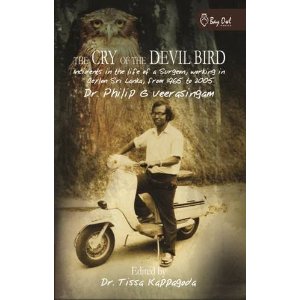
Dr. Philip G. Veerasingam worked in the Department of Health, Ceylon/Sri Lanka, from 1965 to 2000, and discusses his life as a surgeon in a memoir, The Cry of the Devil Bird: Incidents in the Life of a Surgeon (2010, ISBN 978-955-1723-13-2). It is essentially the story of a country doctor, working in at times arduous conditions, as he evolves his career in medicine. As we here at WoWasis found when we visited Sri Lanka, those conditions include numerous road hazards, and the author tells many a tale of fixing up the victims of automobile accidents. He also carried on the profession during  harsh monsoons, times of financial struggles, and country’s civil war. Some of his most memorable stories involve the war, including hospital incursions and casualties. Not all of the injuries were inflicted on the intended victims. Here’s one such tale, involving one such victim who picked up a tin cigarette can (cigarettes were sold in tin cans, in those days), and a creative surgical technique: 

As the heat of the JVP insurrection was cooling off, a teenage boy was admitted as a patient to the Casualty Unit, at the General Hospital, Kandy. He had been playing with a couple of his friends in the Children’s Park, at the Ampitiya end of the Kandy Lake. They had seen what looked like a wrapped up cigarette tin lying on the ground. The boy had picked it up and shaken it. He heard a rattling sound. One of his friends said that there might be a mouse inside. The patient had then held the tin tightly in his hand and struck it on a stone, with the idea of stunning the mouse. Upon impact the tin exploded, severely injuring his right hand. He came to the casualty ward. We took him to the operating theatre and inspected his shattered hand, under a general anaesthetic. His right thumb was missing and there was loss of skin in the palm. The other fingers had skin lacerations. The wound was cleaned well, and dressed. Three days later we re-examined him in the operating theatre and found the wound to be clean and free from any discharge. The small lacerations on the fingers were sutured but that still left the problem of the large ‘skin-loss’ in the palm. I fashioned what is called a ‘pocket flap on his right thigh. This is done by cutting the skin on the upper outer side of the thigh to raise a flap of skin in the shape of a trouser pocket. I stitched this skin flap to cover the raw area in his palm. The patient’s right upper limb was strapped in place in a position as though he was keeping his hand in his trouser pocket. The limb was left for four weeks to allow the flap to get an additional blood supply from the injured hand. Four weeks later when a new blood supply from the injured hand was established, we detached the flap, trimmed it and stitched it in place in the injured palm. I had ‘borrowed’ good thick skin from the thigh, to cover the area of skin loss in the palm. The wounds looked cosmetically acceptable. The skin of brown, the colour of the skin of his thigh, in pale whitish colour of the palm.  

About three years later, I was back in Kandy after my return from the UK. One day, I was walking near the Dalada Maligawa with my daughters when I approached a pavement boutique, to buy some roasted ‘Kadalai’. A young boy came out of the boutique and greeted me with clasped hands, bending low in greeting me. He asked me whether I remembered him. I could not place his face and told him so. He then put up his right hand. Only then did I recognize my handiwork of three years earlier. The flap was beautifully in position and gave him a serviceable hand but without the advantage of his thumb. The fingers were working beautifully.  

Some of the author’s most memorable essays occur toward the end of this 269 page book, with subjects including his strong advocacy for the anaesthesia profession, his poignant speech against internal racism in Sri Lanka, and his thoughts on the urban terrorism which challenged the entire nation. Travelers in Asia often find themselves in situations where they need medical treatment, and Dr. Veerasingam’s book provides an often fascinating look behind the scenes that patients rarely know about, and most of the rest of us tend to take for granted. This book is available by mail from the author, who will ship to international addresses for $15 USD postpaid. Visit the author’s blog, and scroll to the bottom for ordering instructions.

WoWasis book review: ‘Chinaman,’ a fictional Sri Lankan cricket tale by Shehan Karunatilaka

Written By: herbrunbridge - Mar• 12•12

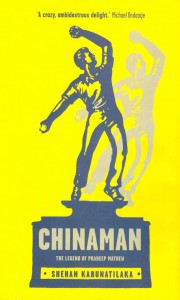
There’s some damn good fiction coming out of Sri Lanka these days, but it’s not all that easy to find. Bookstores exist in Colombo, but they’re not exactly on tourist routes. We at WoWasis found really great stores — including the Odel shop — in the shopping gallery at the airport, near the exit gates for international flights. There, we loaded up with books written by Sri Lankan authors, including the phenomenal The Road from Elephant’s Pass by Nihal DeSilva, which we reviewed in an earlier WoWasis post. And then there is Shehan Karunatilaka’s remarkable novel of a lost cricket player and the doomed-by-alcohol sports writer trying to find him, Chinaman: The Legend of Pradeep Mathew (2011, ISBN 978 81 8400 152 5). One of the amazing aspects of this well-written story is that the reader is never quite sure that Mathew didn’t exist. And the author has gone to the trouble of creating a website that describes this fictional character’s bowling deliveries, and seeded the internet with other Pradeep Mathew stuff as well. Just Google him. 

The vehicle for the story is the game of cricket, but you don’t have to know anything of the game to be immersed in the story. It’s a tale of great but unrequited sleuthing, of failed relationships, of fixed sporting events, and the Sri Lankan Civil War. Most of the story is told in first person by sportswriter and cricket enthusiast WG Karunasena, whose fanatical enthusiasm for cricket and booze have soured relationships with wife, son, friends, and business associates. His quest is to find the man he considers to be the greatest cricketer who ever lived, Pradeep Mathew, a man who’s literally been written out of the statistical record. WG is driven by the book he’s trying to finish on Mathew, and despite reports of his death, he believes him to be living. He loves Sri Lanka, but not necessarily Sri Lankans: 

Nations are prey to my genetic Murphy’s Law. Ideally, we Sri Lankans should have retained our friendly, childlike nature and combined it with the inventiveness of our colonizers. Instead, we inherit Portuguese lethargy, Dutch hedonism, and British snobbery. We inherit the power lust of our conquerors, but none of their vision. 

And there’s a nifty turn of events that takes up the last 50 pages of this 395 thriller that we won’t divulge here, except to say that WG’s long lost son takes pen in hand to assist in the outcome of the book. Like his father, Garfield is bit of a philosopher as well: 

I have no desire to own a woman or be owned by one. I like to have sex with women and to be friends with them. Both of which seem to cease after rings are exchanged. Marriage is two people deciding whose turn it is to be unhappy. I have been there and been unable to do that. 

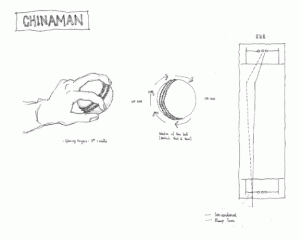
The book is full of twists and turns, and after the first 50 or so pages, takes on its own life, and we found it impossible to put down, really needing to see how the tale would evolve. And the title? “Chinaman” refers to a bowling technique first thrown by Elliss Achong, who was a Chinese descent (fact, not fiction). It describes an unorthodox left-handed delivery that puts an unusual spin on the ball. 

Overall, the book is an exceptional thriller that gains momentum with every page, and we recommend it, for fiction fans, cricket buffs, and those desirous to peek into the hard shell of Sri Lankan society.

Macau’s King of Gambling’s Tricky Abdication

Written By: herbrunbridge - Mar• 08•12

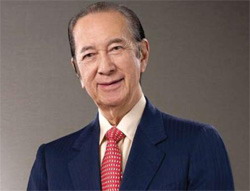
Dr. Stanley Ho

(Written by guest author Jenny O’Donnell) For almost five decades, Stanley Ho has dominated Macau’s gambling industry. But as Macau’s ‘king of gambling’ prepares to pass on control of his empire, it’s a succession that’s proving to be fraught with difficulties.

Macau’s king of gambling

The fortunes of Dr. Ho and Macau are closely intertwined. Born in Hong Kong in 1921, Ho first arrived in Macau in 1942. Ho’s first successes came from smuggling luxury goods over to mainland China. The proceeds these generated were subsequently invested in more legitimate businesses. 

Ho’s empire continued to expand after World War II, and his big break came in 1962, after he and his associates were awarded a gambling monopoly in Macau. Over the following decades, Ho was instrumental in driving the rapid growth of casino gambling in Macau and its economy. 

Macau’s casino market is now open to competition, but around 50 cents of every Dollar bet in Macau still goes to the Ho family. Despite his ‘king of gambling’ nickname, Ho’s business interests cover everything from air and sea travel, to shipping and real estate. It is estimated that his companies account for around a third of Macau’s GDP. 

Ho himself is no stranger to controversy, most notably for his alleged collaboration with the Japanese during the WWII occupation of Hong Kong, and his connections with China’s communist regime during the Cold War. But the positive impact he continues to have on Macau’s economy shouldn’t be underestimated.

A difficult abdication

This point was hammered home when the billionaire entrepreneur was hospitalized for seven months in 2009. Given his age, this prompted the difficult question of his succession. Ho’s plan is to split up his empire equally among his 16 surviving children. However, the process has been overshadowed by arguments within the family. 

This came to a head in early 2011, after Dr Ho filed a writ against two of his daughters over the unauthorized transferral of stock. The writ, issued on February 16, 2011, claimed that Pansy and Daisy Ho, “improperly and/or illegally” transferred Ho’s $3.1 billion stake in SJM, Asia biggest casino operator, to a company they control without his blessing. 

Ultimately, the matter was settled out of court in March 2011 after the family came to an agreement of “mutual understanding and mutual accommodation”. Nevertheless, given the stakes involved, it remains to be seen whether this truly is the final chapter in the story.

About the author

This post was provided and co-written by Jenny O’Donnell,  writer and content editor for www.onlinecasino.sg  She actively follows Macau-related casino and cultural news.

WoWasis book review: ‘Blue Stories for Adults’ erotica from Sri Lanka

Written By: herbrunbridge - Mar• 07•12

In her introduction to Blue Stories for Adults (2010, ISBN 978-955-8897-20-1) editor (and contributing author) Ameena Hussein writes that one of the aims of the book is to challenge stereotypes of Sri Lankan sexuality. She also mentions that it does not “claim to be the representative literature of Sri Lankan erotica… but it is a milestone in Sri Lankan writing in English.” The sixteen pieces (some are poetry, some are fiction) comprising this book include pieces on straight, gay, lesbian, and Islamic sexuality, and include a wide range of treatments.

At 146 pages, it’s a quick read. Some of the stories are compelling, and our two favorites here at WoWasis were Shehan Karunatilaka’s Veysee, the story of a man conflicted in his marriage, and Ameena Hussein’s Undercover, the tale of a forbidden romance in a movie theatre, with an Islamic woman as the protagonist. There are some surprises here, too. In Tariq Solomons’ Bus Stop, a fan club for the U.S. instrumental surf music group The Ventures plays a prominent role. Who knew instrumental surf was big in Sri Lanka?

The bad news is that all-in-all, the stories are spotty. Much of the writing seems juvenile, and the characters often aren’t very well developed. There’s a lot of teen-age crush angst here. Overall, perhaps Hussein, though has met her goal, that of establishing a forum where Sri Lankan writers dabbling in erotica can actually get published in their own country. And if that is successful, perhaps many of the writers in this book will continue to polish their skills, develop better plots, and invent characters with character.

Cebu Pacific Airlines dancing flight attendants in the Philippines

Written By: herbrunbridge - Mar• 07•12

Asian airlines continue to push innovative marketing and customer service strategies and practices that surprise and delight travelers, especially those from western countries, who sadly have become expectant of encountering to crabby flight attendants in their own lands. Late last year, we here at WoWasis reported that PC Air, flying out of Bangkok, was now flying with ladyboy crews. Not to be outdone, the Philippines’ Cebu Pacific Airlines occasionally flies with dancing flight attendants, who parade and spin while delivering their air safety message.  Two compelling dancing flight attendant videos have surfaced on YouTube, one of which was filmed as the airliner was taxiing, the other during a studio rehearsal. The girls and the passengers seem to be having an awful lot of fun.

Everyone seems to agree that it will be a cold day in hell before airlines based in western countries will ever do anything this edgy. Unions and conservative management will see to that. In defense of airlines operating out of the west, their curmudgeonly attitude tends to place top value on safety, whereas Cebu Pacific’s has been spotty.

Vietnam Airlines, not to be outdone tried both a bikini video and calendar, but was rebuffed and fined by the government. Southeast Asia, however, has done a lot to put the fun back in flying, something found sadly lacking on western airlines. One hopes that eventually, they’ll get the point.

WoWasis book review: ‘The Cultural Triangle of Sri Lanka’ by UNESCO

Written By: herbrunbridge - Mar• 06•12

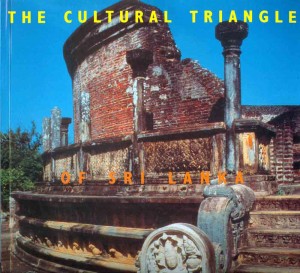
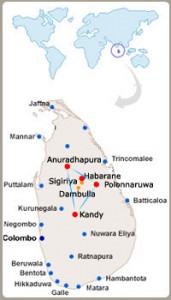
Sri Lanka’s Cultural Triangle embraces an area encompassing the ancient sites of Anuradhapura, Dambulla, Polonnaruwa, and Segiriya, and the city of Kandy. This area is perhaps the area most visited on the island, and is well worth the trip. Each of the ancient sites have book kiosks in the museums, and there are a number of hawkers selling books as well. Many of the books have pretty pictures but are not all that informative. Others are essentially archaeological monographs dedicated to one area. For our money, the most comprehensive of all of them is The Cultural Triangle of Sri Lanka by UNESCO (2006, ISBN 9789231028748), comprising a series of essays and pictures on the Abhayagiri Vihara and Jetavana sites in Anuradhapura, and the other sites at Polonnaruwa, Sigiriya, Dambulla, and Kandy.

The book is large format (11.5” tall x 9.5” wide) and has 200 pages. It is available in most onsite museum bookstores, but buyer beware: depending on weather and storage conditions in the shops, you may find pages stuck together, the book warped, some mildew, etc. The best conditioned copy we found was in the museum shop at Sigiriya. But we’re sure glad we found it, it’s a beauty. 

The book features the work of nine essayists, and the writing’s surprisingly good, especially the work of P.L. Prematilleke and L.K. Karunaratne, who turn a few good phrases in their descriptions of Polonnaruwa. What surprised us here at WoWasis is how much we missed when we toured the sites ourselves: a lot at Anuradhapura (we should have taken two days), and the beautiful lotus pond at Polonnaruwa. There’s a lot to be said for taking the book back to your hotel room at night, and reading about the site you’re at before you leave it. The minutiae is fascinating, too. Polonnaruwa and Anuradhapura were both covered by jungle for 600 years; it took 93 million (!) bricks to build the Jetavana; locals were asked to donate 1 rupee a day to help restore Jetavana; small souvenir sculptures of the striking frescoed apsaras were made in the era when those beautiful women were originally painted. And there’s a terrifically informative essay at the end, describing UNESCO’s involvement with these Sri Lankan sites as well as their initial push to save Egypt’s Abu Simbel from inundation. 

All in all, this is the book you’ll want to buy when you’re in the area, and makes for compelling reading before and after you visit the sites.

Pa Farang’s advice: am I being set up by a Thai lady in Macau?

Written By: herbrunbridge - Mar• 05•12

The Good Manner: Advice on Asia from WoWasis’ Pa Farang
Today’s dilemma: am I being set up by a Thai lady in Macau?

Dear Pa Farang,

I’m Korean-American, but work in HK and frequent Macau saunas once in a while.  I don’t even look at the Chinese girls.  My eyes shift directly to Thai girls and if two are available, I’m in.  I’ve been seeing this one girl at Darling for over 6 months.  Last night, I was feeling adventurous and let her invite a friend.  Amazing!!

I’m enjoying it and they seem to be having fun together.  I mean, what kind of woman likes that stuff, but they worked well together.  It’s very obvious these girls who work at saunas/massage parlors are talkative amongst each other.  While my regular girl is showering, the new girl is telling me that the regular girl talks about me all the time.  When the regular girl was finished, I asked her if that was true.  She is a little strong headed and didn’t want to admit that, but was very flush in the face.   

As I was about to leave, she asked me to visit her in Thailand in the future so I could be her tour guide and show her Bangkok.  I’ve seen her at least 5 or 6 times and I’ve never been to Thailand.  Sounds like a “kill two birds with one stone” situation to me.  I think I’m a good judge of character, and from our conversations, she seems to have just got a crap hand at the start of life, and she’s doing what she’s doing to survive. At the end of the day, who knows?   

I’m not really emotionally attracted to her, but she seems fun.  It’s obviously come at a price each time, but am I setting myself up for unexpected “bad” surprises if I were to meet her on her home-turf?  I’m not naive to think she’s crazy about me and that that she could be totally setting me up for ripping me off, but I want to give her the benefit of the doubt.  Am I not thinking this through well enough?  What’s your take on the genuineness of these Thai girls who are working in Macau?

Kind regards, Lone Traveler  

Dear LT, 

I don’t think it’s a rip-off in the traditional sense, necessarily, but let’s begin by stating a few facts:

1) She already knows Bangkok better than she’s letting on. All Thai MP girls know Bangkok.
2) You’re a nice guy and a good customer, pay your bills, and treat her well.
3) She may be looking at you as provider material (also known as ATM), because you don’t live in Thailand.
4) At the very worst, she’ll get a free ride to discos, will bring along her friends, and you’ll pay the bill.

All that said, it may be a good idea to take her up on her offer, with several caveats. Bangkok is a lot of fun, and there are tons of ladies and massage parlors there. Your Thai girl may try to monopolize your time, so she can prevent other girls from taking your money (in her opinion, it belongs to her). She also may want to charge you a fixed rate per week, or per short-time, so you’ll want to discuss the financial arrangement in advance.

On the other hand, it might be free of charge, but as many foreign men have discovered in Bangkok, free sex costs more than paid sex (“going shopping,” where the lady takes you to the Emporium, Gaysorn, or any other high-priced mall, and you pay for stuff, is pretty common).

You probably don’t want to get tied down to one lady on your first trip to Bangkok. It’s decidedly not Macau, and you’ll see beautiful, available women everywhere, all the time. So here are my recommendations:

1) Ask your lady friend what she’ll charge you, per day or for sex, in Bangkok. Ignorance is not bliss.
2) If the answer to #1 is satisfactory to you, go to Bangkok alone, and tell your friend you’ll call her when you arrive, and arrange for a dinner or drink. Tell her you have other Korean friends there, and that you can’t spend 24/7 with her. If she wants to spend time with you and your imaginary buddies, tell her they drink too much, they talk business all the time, and therefore she wouldn’t have any fun because you’re all speaking Korean, so that’s impossible.
3) Take it as it goes with your Thai lady friend. She may be a great lady (many of them are), and you’ll enjoy her company immensely. Or it may be a nightmare, so take things easy at first.
4) Thai women can be enormously and dangerously jealous. Remember to stay in control at all times, and don’t make the mistake of giving her your hotel key.
5) Your imaginary Korean buddies are your best friends. They are your excuse for owning your own time.

Many visitors have made lasting friendships with Thai women. Many have married them, or have special arrangement whereby they live together when the visitor goes to Bangkok. You may have met a friend for life, or someone you won’t want to see anymore. So take Pa Farang’s advice, keep both eyes open, and enjoy your stay in Bangkok. It’s one city you shouldn’t miss.

Remember to show the Good Manner, and have a great time in Thailand, 

– Pa Farang 

Read Pa Farang’s other columns for more advice on relationships and scams in Southeast Asia
WoWasis visits Buduruwagala, home of Sri Lanka’s massive carved Buddha statues

Written By: herbrunbridge - Mar• 02•12

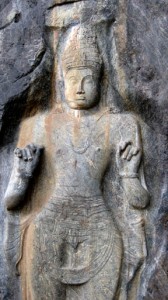
Although the carvings at Buduruwagala are more than 1000 years old, the detail is extraordinary

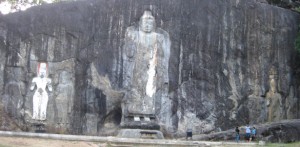
Buduruwagala is easy to miss, sitting 4 km off the main road, roughly 5 km south of the town of Wellawaya, on the A2 road, off the turn-off to Tissa. But you shouldn’t miss it. There are several massive statues carved into the rock, some of which have fine detail, including a Buddha statue that, at 15 meters, is the tallest in Sri Lanka. They all are thought to date from the 10th century. We here at WoWasis just loved this spot, far enough away from standard tourist routes that you’ll have the luxury of enjoying it in the company of just a few others, or perhaps you’ll have it all to yourself. 

Ad Buduruwagala, the 45m Buddha statue is flanked by six other remarkable statues carved out of the rock

If you happen to take the scenic train south from Badulla to Haputale, Buduruwagala is 15 km east of Haputale. Turn south at Wellawaya, and look for the Tissa road, with signs marking Buduruwagala on your right. Drive 4 km down that side road, and you’re there.