The sharper edge to traveling in Asia

WoWasis visits Sri Lanka’s mountain tea houses

Written By: herbrunbridge - Mar• 01•12

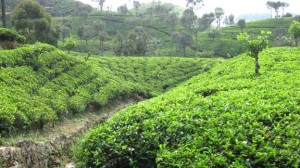
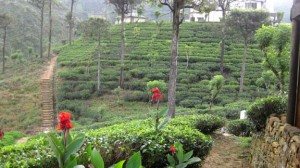
Tea terraces line Sri Lanka's mountain countryside

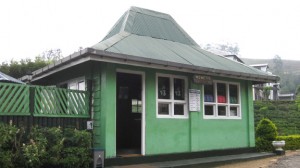
Tea is an essential part of Sri Lankan culture, and is their second leading export commodity, behind textiles. Sri Lanka’s hill country is liberally dotted with terraced tea plantations, and many of them have wonderful tea houses right at the road side where you can relax, drink their teas, and enjoy the mountain atmosphere. And you can buy their teas there, too. You’ll also see a large number of tea factories, many of them right along the roadside, where you can take tours, enjoy a cup, and buy their teas.

Sri Lanka's tea country offers numerous roadside tea houses

Some fascinating books have been written on the tea business in Sri Lanka, and if you spend any time at all in the hill country, you’ll often be immersed in tea plantations, as far as the eye can see. Each plantation has its own specialty, and workers from the same family have often been employees for generations. We here at WoWasis recommend taking a tea break whenever a roadside tea house comes into view. It’s a wonderful way to break up a road trip, and they often have some of the cleanest rest rooms in Sri Lanka, too.

WoWasis travel tips and avoiding scams in Sri Lanka

Written By: herbrunbridge - Feb• 29•12

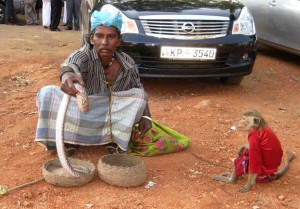
This snake handler sets up shop in a car park in Anuradhapura, Sri Lanka

Sri Lanka is a wonderful place to visit, not as touristed as other countries in the area, and full of friendly people and terrific sites. Like any other country, there are some things to keep in mind, and a few things to avoid. We here at WoWasis have already written an informative post on hiring a car & driver in Sri Lanka, so we’d encourage you to read it if you’re considering that option. Here are some other issues and challenges you’ll want to keep in mind as you travel this most fascinating island. 

1) Buy a SIM phone and get a Sri Lankan SIM card. You can buy a cheapie, like the versatile, durable Nokia 1280 phone, and buy a SIM card in any town. You’ll need your phone to call ahead for hotel reservations, as travel times in the country aren’t always predictable, due to road conditions. Unless you’re on a pre-packaged tour, our bet is you’ll have to change hotels on the fly at least once, and probably more. 

2) Driving is slow. Destinations are measured in kilometers, and what looks like an easy 100 km trip can take a whole day. Buses, trucks, animals, pedestrians, police barriers, and island driving can play havoc with a schedule. Always allow extra time to reach your destination. 

3) Touts are everywhere. It’s a fact of life in Sri Lanka, no matter how remote the location, vendors will approach you with carved elephants, Buddha statues, books, postcards, maps. Show any interest, and you’ll be followed forever. Your best bet is to politely walk away, without looking at anything, unless you really do want to buy something. A friend had a great standard line invoking nightmares, when confronted with ambitious vendors (“postcards give me nightmares”), which usually stopped them in their tracks, and kept him from being followed. 

4) Unless it’s your chosen destination, avoid gem shops, gem mines, gem museums, and crafts shops. There’s always a tout or a driver wanting to make a commission on gems, and gems museums and mines are essentially shops. The standard line is that you’ll buy cheaply, then make a small fortune reselling them when you go back to your own country. This doesn’t happen, unless you’re already a gem expert. Crafts shops too, represent a scam of sorts, where the person who brings you there gets a commission on everything you buy. For that reason, people always want you to visit a gem establishment or crafts shop. If you want to make a purchase, stop at an establishment that you pick. 

5) Do you absolutely need a guide when visiting historical spots? You’ll be told at many ticket booths at historical spots that you need a guide (who happens to be standing by). You don’t have to have a guide, as your ticket gets you in. Only hire a guide if you want one. 

6) Bring (and use) DEET for mosquitoes. There’s a reason virtually all mid-range and mall hotels have mosquito nets. You won’t be able to avoid mosquitoes, but you can mitigate the annoyance by using a DEET-based repellent. Sri Lankan mosquitoes are quite inventive, biting through sheer garments, and traveling up sleeves and pant legs, so use the stuff liberally. 

OK, you’re now set to go. Following our tips will make your stay in Sri Lanka much more enjoyable!

WoWasis visits the Peradeniya Botanic Gardens in Kandy, Sri Lanka

Written By: herbrunbridge - Feb• 29•12

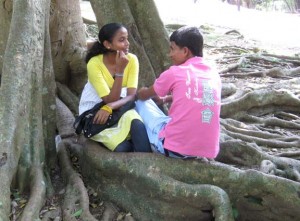
Peradeniya is a favorite getaway for Kandian couples

Kandy is a rambling old town that requires no more than a day to see just about everything. At night, the best spot we’ve found is the Pub Royale, located in the Queen’s Hotel building, where — on a good night — a magnificent 4 piece accordion band plays Besame Mucho and other hits from the past. 

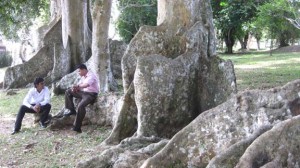
Here at WoWasis, we found the venerable Peradeniya Botanic Gardens to be a “can’t miss,” and highly recommended for a few-hour stroll. Located 6 km outside Kandy, the garden dates back to 1371, but was formally laid out by Alexander Moon in 1821. It includes more than 300 varieties of orchids, spices, medicinal plants and palm trees, and encompasses 147 acres. Highlights include the avenue of palms, the avenue of cannon ball trees, and the magnificent ficus picosa, with its extensive roots system. In our opinion, the highlight of the garden is the avenue of Giant Java Almond trees, all of which have majestic roots resembling leaves of fungus. They’re spectacular. Meandering through the paths is lovely, particularly on a hot day, where the shade is welcome. In the middle of the park, there’s the lovely Royal Botanical Garden Café, where you can sit on the verandah or inside, and have tea and coffee. There’s a bookshop there, too.

Giant Java Almond trees at Peradeniya Botanical Gardens

Peradeniya Botanic Gardens, Kandy, Sri Lanka
GPS 7°16′16″N 80°35′44″E
Open daily 7:30 am – 4:30 pm
Take bus 654 from the Kandy clock tower

WoWasis visits Galle, colonial city of southwestern Sri Lanka

Written By: herbrunbridge - Feb• 27•12

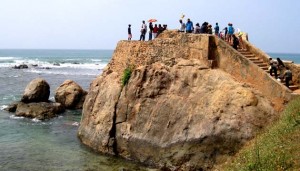
Galle's fort walls extend to the sea

Built by the Dutch in 1663, the colonial city of Galle is a pleasure to walk through, keeping within the confines of the fort area. Our journey took us there on a Sunday, which happened to also be Mohammad’s birthday, so all museums were closed. Everything else was open, including boutiques, antiquities shops, restaurants, and old churches. Here at WoWasis, we’re museum junkies, so we were forced to walk around instead, an extremely pleasurable experience. And we found what we felt was the most comfortable inexpensive hotel in Sri Lanka (more on this later). 

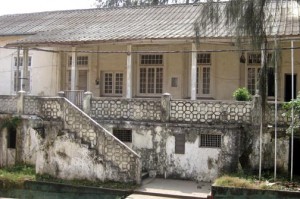
The Galle experience for us was the sheer joy of looking at old residential buildings, with their fascinating doors, windows, and facades. Many are being reshored and refurbished, and we walked into a few of them, no workers on Sunday, but the doors were still open for us and our cameras. Galle is still delightfully ramshackle, and our guess is that this is how Macau must have once looked, before the beautiful old Portuguese buildings there got refurbed. Macau is still beautiful, but Galle is more of a snapshot in time, before the onslaught of commercialized tourism, which we figure will eventually hit here, too. Now’s the time to come here, before it does. 

About that hotel, the New Old Dutch House. We make it a point to stay in mid-range hotels and B&Bs, close to real people, and away from high prices and staff that frankly doesn’t care whether you come or go. But mid-range in Sri Lanka can mean dodgy, too. And we’d been saying in some awfully dodgy places before Galle. So the New Old Dutch House was welcomely refreshing, a small oasis within the walls of the fort, and close walking distance to everything we wanted to see. The rooms are beautiful, air con and mosquito nets work, and internet and breakfast are included. Rifai, who owns the place, is wonderfully accommodating, and it turned out to be our best stay in Sri Lanka by far. We recommend phoning ahead for reservations, and the phone number has changed from that given in a number of guidebooks, so use the one below. As we suggested in another post, buy a SIM phone or carry yours with you, and get a Sri Lankan phone number as soon as you can, especially if you’re travelling by car & driver, where itineraries can change at a moment’s notice. More about that hotel: 

Ramshackly colonial buildings add to the mystique of today's Galle

New Old Dutch House
21 Middle Street
Fort, Galle, Sri Lanka
Tel: 0094-91-223-2987
Mobile: 0094-777-900-903
www.newolddutchhouse.lk

Are guests getting fleeced at Bangkok’s Nana Hotel by accounting and checkout staff?

Written By: herbrunbridge - Feb• 26•12

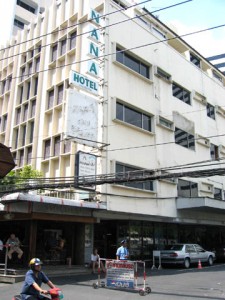
Word has reached WoWasis this week that at least one guest at Bangkok’s Nana Hotel on Sukhumvit Soi 4 recently had his bill accidentally increased by a factor of ten (!) when he paid his bill by credit card upon his departure. The problem? Nana Hotel didn’t want to credit the $3000 USD back to the guest’s credit card! Here’s the story: 

A frequent guest checked out recently to catch an early morning flight. Nana Hotel added a “zero” to the end of the amount, the guest didn’t catch it, signed the slip, and left. The original charge was approximately $300 USD, and Nana chargedthe guest $3000 USD. This could have been regarded as an honest mistake. But even though Nana admitted it was their error, they refused to credit the amount back to the guest’s credit card, saying “we cannot fix the amount from the visa card, because the bank would not allow us to do so… BUT we will refund the money to you for the amount of 100,000 baht in cash when you come back here.” 

The guest responded that he wouldn’t be back in the near term, insisted on having the overage refunded to his credit card account, and Nana Hotel’s response was to give the guest the name of the hotel’s accountant. There was no promise to credit back the overage to the credit card account, either. 

It is unknown at this time whether this represents shoddy business practice, or may in fact be a scam run by the accounting department at this hotel. If the latter, some Nana employee could possibly have the free use of $3000 USD until the guest returns to the country. If the guest never returns, someone would keep the money. If the guest does return, goodness knows what documentation he’ll need to try to recover his funds. 

Either way, the management of the hotel may not even be aware of the problem. In the classic “kreng jai” philosophy that governs much business in Thailand, it wouldn’t be surprising if the staff responsible for the error, as well as the accountant that refused to credit the overage to the guest’s credit card, completely hid this situation from management. 

In the meantime, the guest sought relief from his credit card company, who investigated, and returned the guest’s funds immediately. The guest tells us that the credit card company was dumfounded. They thought they’d heard everything, but this was a new one on them. 

If you’ve faced a similar situation at Nana Hotel, or any other hotel in Thailand, let us know. We’d like to understand whether this was an anomaly, or common practice.

WoWasis tours Sri Lanka on the Haputale – Badulla hill country train

Written By: herbrunbridge - Feb• 26•12

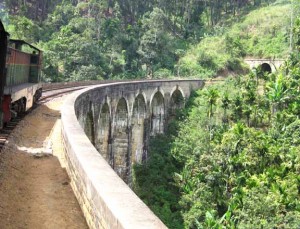
Bridges and tunnels occur many places along the Haputale line

We here at WoWasis love to take scenic trains. And there is none finer in Sri Lanka than the route along the Colombo-Kandy line that runs in the hill country north from Haputale to Badulla (see the video), through the towns of Ella, Demodara, and Bandarawela, and into the countryside. Or you can go south, in the opposite direction. We recommend buying tickets at either the Haputale or Badulla stations, so you can experience the whole route, which takes approximately 1.5 hours. You don’t need a first-class observation car, either. Third class is just fine, and the best views are at the windows on the left side of the car, if you’re heading south on the route. 

On the route, you’ll see things you’ll never get to enjoy as well by bus or auto, including mountain and valley vistas, tea plantations, rail bridges and tunnels, and the minutiae of daily life in the countryside. People hanging wash on the bushes, kids playing, farmers working their fields, mountain streams, and terraced gardens are just a few of the wonders to be seen on this short but remarkable ride. 

Tea plantations are among the magnificent views along the Haputale train line

There are at least two trains per day running in each direction, sometimes more, and your ticket is of the old-fashioned hand rafted cardboard variety. If you’ve hired a car & driver, just have the driver drop you off at one station, then pick you up down the line. He’ll get to your destination a few minutes before you do. For a slice of life that you’ll never get by highway, try this train trip for an experience you’ll remember.

WoWasis touring product review: the incredible Booster Pac ES2500 auto battery charger

Written By: herbrunbridge - Feb• 26•12

This thing acks a mighty wallop, and is a must for every offroad travel experience

Here at WoWasis, we’ve got off road vehicles, sports cars that go on rallyes, you name it. We’re often in the middle of nowhere, and occasionally the car battery runs out. We’ve always carried booster cables, but what do you do if there are no other vehicles around to give you a jump? If you’re in a really remote area, you could be in plenty of trouble. But not with the Booster Pac ES2500, you’re not, and that’s why we recommend it, it could literally be a life-saver. 

This relatively small pac carries a mighty punch. It charges up to 5 vehicles, holds its charge seemingly forever, and is initially charged for a period of 24 hours through a socket at your home. It boasts 900 peak amperes/300 cranking amperes, 21″ #4 gauge cables, and industrial grade, hot jaw clamps. 

We recently had to use it on a cold night on a vintage Porsche, where the battery is ensconced in a tiny compartment under the hood. The cable fit perfectly, and the car powered up instantaneously. Needless to say, we carry it everywhere. If there’s one electronic gadget you absolutely have to have when traveling in remote areas, this is it. Although it retails for $230 USD, you can buy it now from the WoWasis eStore for about $100 USD.

Than Phuying and Khun Ying: what do those titles mean in Thailand?

Written By: herbrunbridge - Feb• 25•12

King Rama V

Western readers of Bangkok newspapers often are challenged by the titles of Thai individuals — particularly women — that they see in the papers. Two of the most common are Than Puying and Khun Ying. What do they mean? 

These are honorific titles based on The Most Illustrious Order of Chula Chom Klao,  established in 1873 by Chulalakorn,  King Rama V, to commemorate the 90th Jubilee of the Chakri Dynasty. It bears His Majesty’s Name and signifies His Majesty’s Birthday color of pink, or Tuesday. These, as well as other royal decorations, are bestowed today in ceremonies presided over by King Rama IX. From that point onward each individual uses them for  ceremonies of any kind, and they are also used when they are mentioned in the media. One such individual is Dr. Khunying Porntip Rojanasunan, Director of Thailand’s Central Institute of Forensic Science. 

In terms of the specific titles mentioned above, married recipients of the  Dame Grand Cross (First Class) and the Dame Grand Commander (Second Class, higher grade) are entitled to use the honorific title of “Than Phuying,” while married recipients of the  Dame Commander (Second Class, lower grade) downwards are entitled to use the honorific title of “Khun Ying.” 

The Cabinet website of the Thai government describes the entire Chula Chom Klao system as follows: 

 Classes and Numbers to be Conferred  

  For men, there are three classes:  

  Class I (two divisions)  

  Knight Grand Cordon (Special Class) of the Most Illustrious Order of Chula Chom Klao

  Knight Grand Cross (First Class) of the Most Illustrious Order of Chula Chom Klao

  Class II   (two divisions)    

  Knight Grand Commander (Second Class, higher grade) of the Most Illustrious Order of  Chula Chom Klao

  Knight Commander (Second Class, lower grade) of the Most Illustrious Order of Chula Chom Klao

  Class III  (three divisions)    

  Grand Companion (Third Class, higher grade) of the Most Illustrious Order of Chula Chom Klao

  Companion (Third Class, lower grade) of the Most Illustrious Order of Chula Chom Klao

  Junior Companion of the Most Illustrious Order of Chula Chom Klao 

  For ladies, there are four classes:

  Class I      

  Dame Grand Cross (First Class) of the Most Illustrious Order of Chula Chom Klao

  Class II   (two divisions)    

  Dame Grand Commander (Second Class, higher grade) of the Most Illustrious Order of  Chula Chom Klao

  Dame Commander (Second Class, lower grade) of the Most Illustrious Order of Chula Chom Klao

  Class III

  Companion (Third Class) of the Most Illustrious Order of Chula Chom Klao

  Class IV

  Member (Fourth Class) of the Most Illustrious Order of Chula Chom Klao   

  Titles for Female Recipients    

  Married recipients of the  Dame Grand Cross (First Class) and the Dame Grand Commander (Second Class, higher  
 grade) are entitled to use the honorific title of “Than Phuying”

  Married recipients of the  Dame Commander (Second Class, lower grade) downwards are entitled to use the honorific 
  title of “Khun Ying”

  Single recipients are entitled to use the honorific title of “Khun”

  Royal recipients of the Dame Grand Cross (First Class) and the Dame Grand Commander (Second Class, Higher Grade),
 who are members of M.R. class downwards,  are entitled to use the honorific title of “Than Phuying”      

 Inheritance

 Rank

 Should a person be conferred the Knight Grand Cordon, his son should inherit the insignia upon the place. It should,
 then, be passed on in the family until no male heir is to be found.

 Should a person be conferred the Knight Grand Cross, his son should inherit the insignia upon the place.

 Should a person be conferred the  Knight Grand Commander or Knight Commander, his son should inherit the insignia
 upon the death of that person.

 Rule

 The person inheriting the insignia must be the eldest son of the family. Should he be inappropriate, the insignia should
 pass onto the younger sons.

 Should the person inheriting the insignia be insane or dead, it should be passed onto the son of that person.

 Conferment

 Should the person inherit the insignia from his father, he should be conferred the  Companion.

 Should the person inherit the insignia from his grandfather he should be conferred the  Junior Companion.
WoWasis book review: Bangkok forensic science maven Porntip Rojanasunan’s new book ‘The Dead DO Talk’

Written By: herbrunbridge - Feb• 25•12

The Director of Thailand’s General Institute of Forensic Science is the famous Dr. Porntip Rojanasunan, who co-founded the agency in 2002. With her jet-set hair, stylish wardrobe, and enthusiasm for forensic science, she’s one of the most photographed women in Thailand. She’s also well-loved and humble, and was voted by Reader’s Digest readers in 2010 as the most trustworthy person in Thailand. We at WoWasis met her in person and introduced ourselves in 2010 at a site where a bomb had been thrown, and she graciously spent a couple of minutes discussing the situation with us. Her openness with the Press is welcome in a country in which the opposite is often the case. Now she’s written a book about her life and some of her better-known cases, The Dead DO Talk (2012, ISBN 978-981-4302-73-9), which is essentially a translation of her book for Thai readers, Mor Muen Sob (A Doctor with 10,000 Bodies). The book is well worth reading. The book is far more than a “tell-all” of true crime cases. Rather, it’s a fascinating glimpse into the police and military power structures in Thailand, how and whether they investigate mortal crimes, and how they interact with Dr. Porntip’s General Institute. Extrajudicial killings by individuals associated with police or military institutions have existed in Thailand for years, and Dr. Porntip has riffled more than a few feathers. In her opinion, science is an objective means of determining death, and the responsibility for bringing those responsible for those deaths should reside with the legal system. She conducts her office with decency and respect, and is a devout Buddhist, and is thus able to weather political storms in Thailand. The first part of her book describes her youth, adolescence, and career path, a bit slow-going, but worthwhile background information. In part two, she gets more into politics, forensics, and social issues, and that’s where the book really shines. She’s no fan of former Prime Minister Thaksin Shinawatra, and discusses extrajudicial killings on his watch. The killing of Muslim protesters by the Thai military at Tak Bai is another fascinating chapter, as is her description of the challenges of processing the dead immediately after the tsunami of December 26, 2004. She also offers an interesting analysis of the difficulties in determining those responsible for roadside bombings in Southern Thailand. In her final pages, she sums up her philosophy regarding the position of her General Institute of Forensic Science within the framework of Thai Society: 

… Thailand remains in stasis with regards to the tracing of missing people, the identification of unknown remains, and the more prominent use of forensic science within the Justice system to help uphold human rights.

Thailand remains a long way from achieving the international standard of solving 90 per cent of missing persons cases. Our track record of identifying unidentified remains is even worse. The government needs to ensure that the police do their jobs and properly investigate such cases, rather than do the minimal possible to ensure they can tap the lucrative budgets without getting involved in any serious casework.

So if there is anything that I would want the Thai people to do, it would be to continue the efforts to push for a national missing persons register, better facilities and proper training relating to forensic investigation. The tsunami demonstrated the importance of having these resources in Thailand, but these resources should be at the disposal of the Justice system every day, not only for the identification of the dead or for diagnosing the cause of death, but for use in everyday cases. I wish that people would see this and stand up and demonstrate that they want to press for justice so that people who are disadvantaged, poor or lack the knowledge to adequately defend themselves in court can rely on forensic evidence in their defence. This will create more equality than the current system where ‘justice’ is too often only within the grasp of those who are rich and powerful enough to call on or influence the use of law. The police too.

There may be many people who misunderstand why and how I have had differences with the police or how it is that we are at odds all the time. Actually, we have to analyse the reality of the situation and take a long look at the reasons. Being a policeman is a career job. The police are very close to the people and, importantly, they possess both power and weapons. Whenever these things are used in the wrong way, the people become upset and they suffer. As to what motivates me to keep fighting for justice, I would ask [hat everyone demonstrates to the police exactly what the justice system really is. Anyone who has not borne the brunt of this injustice will never know what kind of agony it can cause.

The book represents a keen analysis of judicial politics and the current state of forensic crime detection in Thailand, and is a must-read for anyone living in Thailand or interested in Thai politics. It’s also a first-rate discussion of the relationship between forensic science and society in general. Buy it now at the WoWasis eStore.

WoWasis visits Arugam Bay, Sri Lanka

Written By: herbrunbridge - Feb• 24•12

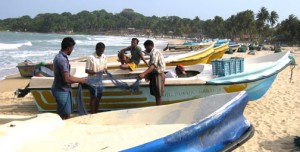
Always time to mend a few nets at Arugam Bay

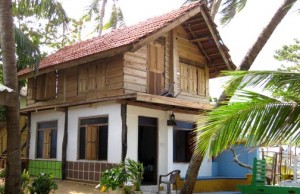
Arugam Bay in southeast Sri Lanka is fairly well known for surfing, and waves are best in the high season, between April and October. In low season, it’s still a great getaway, with plentiful inexpensive beach bungalows and hotels, picturesque fishing boats, and an opportunity to swim in the warm waters of the Indian Ocean. Low season is the time to get serious hammock time down reading a book or two, and typically all you’ll hear is the sound of the surf. For dinner, we recommend the Stardust Beach Restaurant, located in the hotel of the same name. The food is great, décor terrific, and bottles of decent wine are not all that expensive.

Bungalows at Arugam Bay are just steps away from the Indian Ocean

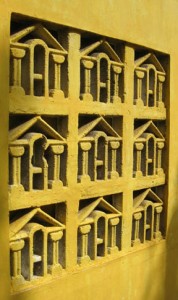
Arugam Bay is also a convenient dropping-off point to take the outrigger mangrove tour in the nearby village of Pottuvil, where there are also some ancient ruins called Mudu Maha Vihara, right out near the ocean dunes. Here, a 3 meter high Buddha statue gazes at two others adjacent to it, and the whole complex sits next to a mosque with some of the nicest stylized windows in the area.

Window at Mulu Maha mosque