The sharper edge to traveling in Asia

7 Andaman Sea dive spots remain closed In Thailand, as coral under recovery

Written By: herbrunbridge - Feb• 11•12

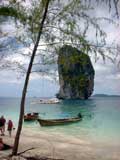
Your WoWasis diving team has found Thailand’s Andaman Sea to be a prime scuba area, but one that has seen so much activity in the past few years that corals are being damaged. Coral bleaching and impact destruction are continuing problems, so Thailand’s National Parks Wildlife and Plant Conservation Department closed 18 dive sites in January 2012. 
In November of 2012, according to a recent article in the Bangkok Post, 11 were reopened, but seven remain off-limits to most divers. They are Koh Hin Ngam, Hat Sai Khao, eastern Koh Dong, southern Koh Dong, , and Koh Ta Kieng at Tarutao Marine National Park in Satun province; Koh Chuek at Hat Chao Mai National Park in Trang; and Hin Klang at Nopparat Para-Mu Koh Phi Phi National Park in Krabi province. 

In several sites, rope barriers are installed, dive numbers are limited, and dive operators requested to follow the regulations. In areas such as Koh Hin Ngam, diving will only be allowed during high tide, to prevent divers from stepping on coral. Thai officials anticipate that coral in these areas will be fully recovered in approximately 4 years.

WoWasis travel clothing road test: the Sri Lankan handloom sarong

Written By: herbrunbridge - Feb• 11•12

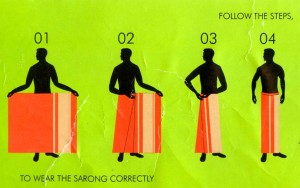
Virtually everyone in Sri Lanka seems to own a number of sarongs, wrap-around garments that keep one cool in the hottest of seasons. You can buy colorful sarongs — identical to the longhi from Burma — in just about any marketplace. They are typically machine woven in Sri Lanka or India, and usually sell for 600-1000 rupees (roughly $5-8 USD).

But for an upscale sarong experience, we here at WoWasis suggest a handloom sarong made in Sri Lanka. It will be a bit more expensive, but the colors will be deeper, and the tooth of the garment will, in many cases, be raised, giving it a plusher feel. In Sri Lanka, or in any country, for that matter, we use the sarong around the house and in informal situations outdoors. It’s cool, wears well, is easy to wash, fits just about every body type, and can be worn by both men and women. Lounging around your hotel room or pool? Why not use a sarong, instead of a bathing suit?

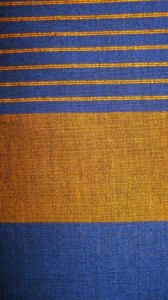
We like our machine-loom sarongs, but absolutely adore our handloom sarong (check out the colors in the adjacent picture). You can look around a few marketplaces for handloom sarongs, but our favorite place to buy one was at Odel’s Alexandra Place store in Colombo. It’s cheaper there than at the Odel airport store, and the selection is better, too. A good handloom sarong is 2,650 rupees (about $22 USD) at Odel. If you buy one, you’ll have a great looking travel garment you can also wear at home, and be the envy of your neighbors! 

Odel, 5 Alexandra Place, Colombo 07, Sri Lanka
Tel: 011-462-5800   www.odel.lk

New Bangkok 5-star hotel to be razed in building dispute?

Written By: herbrunbridge - Feb• 11•12

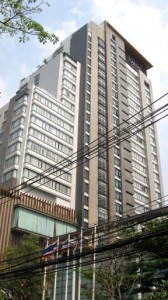
Aetas Hotel: OK boys, tear it down... or is one of you driving a beater???

One of our favorite topics here at WoWasis is building scams in Thailand, so we just couldn’t resist what we think may be the juiciest story this week: the plush, new Aetas Bankok Hotel and Conference Center has been ordered to be demolished, because it’s in violation of a municipal code. Here’s the story:

In Bangkok, no building over 8 storeys tall can be built next to a road that’s fewer than10 meters in width. The Aetas Hotel was built on prestigious Soi Ruam Rudi  in violation of that statute, and a lawsuit was brought to bear by neighbors, influenced by a number of developers that decided not to build on that street due to the restriction. This week, according to an article in the Bangkok Post of February 11, 2012, Bangkok’s Administrative Court has ordered the hotel owner, the Larp Prathan Co., to demolish the building within 60 days. The owner has 30 days to appeal, and the process will almost certainly take a number of years.

How was a construction permit ever allowed in the first place? Who is to blame? The architects, engineers, city employees? What is known is that the width of the street was exaggerated. What is suspected by veteran Bangkok watchers is that someone’s driving a brand new car, has acquired a new expensive condo, or has opened a trendy bar in an exclusive area of town. What is also suspected is that the hotel will never come down. When the dust has cleared and the case is no longer in court, it is expected that yet another person will be driving a new car, acquiring a new condo, or opening a trendy bar.

WoWasis visits Anuradhapura, ancient city, and Sri Lanka’s first capital

Written By: herbrunbridge - Feb• 11•12

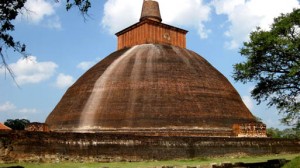
The massive Jetavanarama Dagoba

The ancient city of Anuradhapura is located roughly a 4 hour drive northwest of Sigiriya, which, along with Polannaruwa, comprises Sri Lanka’s three most significant ancient cities. This city is, to a large extent, defined by a series of dagoba’s, monumental stupas featuring massive domes. 

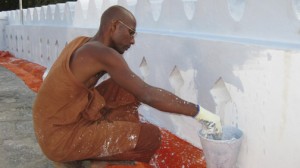
Whitewashing at Thupurama

Although the small museum at GPS: N08°20.897’  E080°24.225’ is nothing to write home about, it is within a short walking distance to the Jetavanarama Daboba, a massive edifice in a state of disrepair which is nonetheless impressive, in that it shows off its underlyling brick structure. At the time of its creation (3rd century), it was the third tallest monument in the world at 100 meters (today it’s 70 meters), ranking behind two Egyptian pyramids. 

We at WoWasis found the Thuparama Daboba to be perhaps the most elegant in the city, and considered t be the oldest visible stupa in the world. It is surrounded by a circular vatadage, is located in a shady woodland area, and is away from the traffic and general  hubbub at the city’s other sites. It can be found at GPS: N08°21.316’  E080°23.765’

The world’s oldest historically documented tree, the Sri Maha Bodhi, is located here in Anuradhapura, at some 2,000 years old. Said to have been brought to Sri Lanka from India by Princess Sangamitta, it is considered a significant holy spot by the Sinhalese.

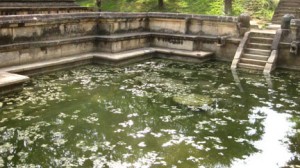
 Considered to be the finest examples of bathing tanks in the city are the remarkable Kuttam Pokuna (Twin Ponds), found at GPS: N08°22.243’  E080°24.103’ . Any many visitors make a stop at the Samadhi Buddha at GPS: N08°22.254’  E080°23.680’, a 4th century statue, which Sri Lankans consider to be among the finest in the country.

Although Anuradhapura is well worth seeing, we feel about ½ day is about right. The monumental dagobas are wonderful, and can be seen as well to good effect at sunset at nearby Mihintale.

 Anuradhapura ticket entrance and museum
Open daily, 7 am  – 5:30 pm
GPS: N08°20.897’  E080°24.225’
Price: $25 USD

WoWasis visits Polonnaruwa, home of Sri Lanka’s monumental rock carving masterpieces

Written By: herbrunbridge - Feb• 11•12
 

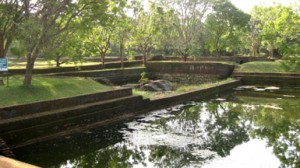
a Giverny-like atmosphere pervaides the bathing pool at Polonnaruwa

Polonnaruwa, roughly a two-hour drive east of the ancient city of Sigiriya, is famous for its monumental rock-hewn Buddha images, but also boasts remains of some finely-designed palace and religious structures as well. Declared a UNESCO World heritage site in 1982, the site is extensive, best traveled by auto or bicycle. The ruins are scattered into four main groups running north to south. 

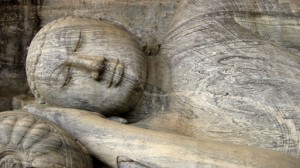
Reclining Buddha, carved from granite

Most people consider the stunning, massive carved Buddha images at Gal Vihara to be the highlight. There are four of them, carved out of a single piece of granite. Of particular note is the 7 meter tall standing Buddha, and the 14 meter wide reclining Buddha. The site is spectacular, but the modern steel structure, sheltering the images from the elements, will prevent you from getting the same photographs you see in the guide books. 

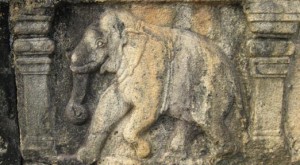
Detail from the base of Polonnaruwa's Council Chamber

Another remarkable area that we here at WoWasis found to be absolutely exceptional is the Quadrangle at GPS: N07°56.833’  E081°00.112’ , the high point being the circular vatadage, with outer and inner terraces that are architectural gems. The entire site is worth pursuing, and will take a day to see. Don’t miss the exceptional archaeological museum, featuring a number of exceptional sculptures and artifacts found on this extensive site. 

Polonnaruwa ticket entrance and museum
Open daily, 7 am  – 5:30 pm
GPS: N07°56.507’  E080°59.907’
Price: $25 USD

WoWasis visits Sigiriya: Sri Lanka’s answer to Machu Picchu

Written By: herbrunbridge - Feb• 11•12

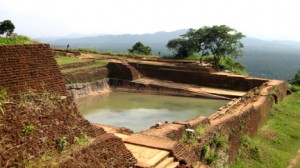
Pool on Sigiriya's summit

Most western visitors looking for the South Asian experience travel to India. In doing so, though, they run the risk of missing out on Sri Lanka, home to the amazing World Heritage site of Sigiriya. This site comprises a series of foundations, walls, terraces, waterworks, and frescoes, leading up to the remains of a rock-top fortress. Created in the 5th century by King Kashyapa (Kassapa), the site is thought to have been used in a political or religious capacity well before then. In terms of view, atmosphere, and building technique, it reminds us a here at WoWasis of Peru’s Machu Picchu. In addition to Polonnaruwa and Anuradhapura, it’s on the ancient cities route in north central Sri Lanka. All three are at most three hours drive from the inland city of Kandy. 

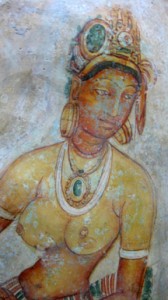
One of the many frescoed divas

Sigiriya rock, a magma plug from an extinct volcano, rises 200 meters above the small town at its feet. Abandoned in the 14th century, it was rediscovered in 1898 by archaeologist HCP Bell. It was declared a UNESCO World Heritage site in 1982. 

The site is entered through the Royal and boulder gardens, where picturesque landscapes combine with water features that are a feast for the eye. Further, you’ll encounter a circular steel ladder that will take you to the frescoes. Once there were as many as 500 portraits of buxom, semi-nude women, but now there are only 22 left, an unfortunate result of vandals. Best seen in the afternoon, they display wonderful colors and form, and date from an as-yet to be undetermined era. Romantics consider them consorts of the king, but this has yet to be proven. Below the frescoes is what’s known as the “mirror wall,” in which old graffiti extolls the virtues of these women.

Sigiriya's Royal Gardens

Above the frescoes, you’ll encounter giant stone lion’s paws, through which you ascend through a series of steel ladder switchbacks, up the face of the rock, to the summit. The view here is stunning, the foundations under restoration, but perhaps the highlight is the large pool, measuring 27×21 meters, beautifully carved out of the rock. Upon your return, don’t miss the archaeological museum, full of remarkable scultptures and tartifacts found at the site.

We determined that Sigiriya was the single most compelling reason to visit Sri Lanka. It should not be missed, and is the highlight of any trip to the island.

Sigiriya ticket entrance and museum
Open daily, 7 am  – 5:30 pm
GPS: N07°57.473’  E080°45.205’
Price: $30 USD

WoWasis visits an ayurvedic spa in Polonnaruwa, Sri Lanka

Written By: herbrunbridge - Feb• 08•12

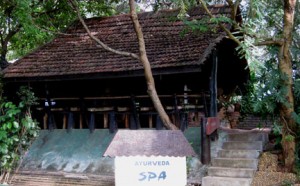
This half-hidden spa in Polonnaruwa is a great stop after a hard day at the ruins

Polannaruwa is one of the three ancient cities that we here at WoWasis feel everyone visiting Sri Lanka should see. The star attraction is the multicolored, stratified, monumental reclining Buddha, but there’s enough everywhere else to make it a one-day stop. And it can be one hot, sweaty day, too. So we here at WoWasis just jumped when we heard there was an ayurvedic spa in town, right at the hotel we were staying, too. 

For 4,500 rupees (about $36 USD), we got a world-class spa experience, including head-to-toe body massage, face massage, herbal steam bath, and herbal hot bath. The spa is located a few feet down a slope from the hotel. After disrobing, the process begins with a rubdown using thick, aromatic ayurvedic oil, said to improve circulation, make muscles flexible, etc. We’re not sure of any of that, but it sure felt good. And so did the facial, steam bath, and hot herbal bath that followed it. For good measure, we left the oil sitting on our bodies all night, just in case the claims proved to be correct.

 We’d recommend this spa if you need a relaxing break in Polannaruwa. The modern hotel it’s attached to is fairly common, and unexceptional (for the $120 USD price, the hot water should have been working). The spa, however, is fantastic, and you don’t need to be staying at the hotel to use it.

Ayurveda Spa
Hotel Sudu Araliya
Polonnaruwa, Sri Lanka
Tel: 027-222-4849
www.hotelsuduaraliya.com
Open daily, 8 am – 9 pm

WoWasis visits My Spa: a therapeutic, non-sexual massage in the heart of Bangkok

Written By: herbrunbridge - Feb• 08•12

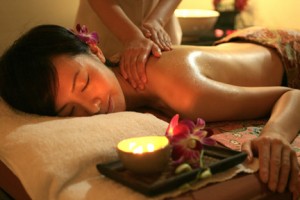
The MySpa experience, worth a stop in Bangkok

Though you might not believe it, judging by Bangkok’s reputation as the soapy massage capital of the world, therapeutic, non-sexual massages do exist, and we found a great one in the heart of Bangkok, one minute from the Asok BTS Skytrain station. My Spa, located on the 3rd floor of the Times Square shopping complex, has been in business since 2003, offering body scrubs, facials, peels, and all manner of massages. 

Recently, we went in for a Moroccan Argan oil treatment, featuring a mangosteen body scrub (we could have done salt, but a recent bout with mosquito bites kept us to the more gentle mangosteen), Argan oil aroma massage, and Argan oil facial treatment. It took us 2.5 relaxing hours out of our busy day where, instead, we could have fought traffic, heat, street noise, and everything that makes Bangkok the hustling town it is. The price was 2,500 baht (roughly $45 USD), and it was sooo relaxing that we fell asleep twice. 

The body scrub came first, a half-hour with tiny morsels of mangosteen fruit worked into the pores, mixed with the exotic Argan oil from Morocco. Showering down after the treatment, we were lead back to the massage table. The body massage and facial treatment kinda blended into each other, two hours that seemed like 20 minutes. It was relaxing enough that we frankly started snoozing, but woke ourselves up so that we didn’t miss out on the experience. 

My Spa was a great stop, easy to get to on the BTS, with good prices, and a friendly staff, highly recommended for exceptional stress relief in the City of Angels. 

My Spa Massage
3F Times Square Bldg.
Sukhumvit Soi 12-14
Bangkok 10110
Tel: 02-653-0905
Open daily, 10 am – 10 pm
www.my-spa.com

Bangkok street stall thugs endangering pedestrians and shop owners alike

Written By: herbrunbridge - Feb• 06•12

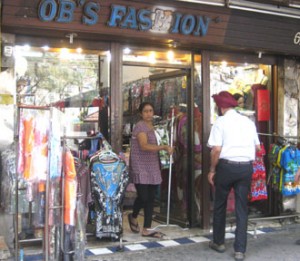
Bob's Fashion: at the mercy of thugs and "influential people"?

One of the most common complaints we at WoWasis hear from people living near the intersection of Sukhumvit Soi 3 is the illegal proliferation of stalls selling the usual tourist “junk,” running from So 3 to roughly Soi 15. The stalls are on both sides of the sidewalk, making the sidewalk virtually unusable for foot traffic when corpulent and backpack-cladded tourists descend on the area to buy the same junk they can buy anywhere in Bangkok. As a result, pedestrians have taken to using the streets, slowing down vehicle traffic as well.

Of course, these sidewalk stalls are illegal. But, as was reported in the Bangkok Post of February 5, 2012, they thrive as a result of illegal payments made to Nana city inspectors, called tesakij, on the order of 500 baht per month. The police of Bangkok’s Metropolitan Police Bureau Division 5, who some critics have suggested are also involved in the scheme, claim they have no knowledge of the problem.

This illegal system has gotten ugly recently for a legitimate business called Bob’s Fashion, on Sukhumvit Soi 3. This company, which has been in business for 35 years, is in dispute with a stall owner occupying space in front of the shop, and has reportedly been threatened by a team of local thugs, allegedly being paid by the stall owners. Police have refused to intervene.

This incident has opened up a nasty can of worms, in the sense that it has exposed the process by which pedestrians essentially lose their rights to free passage along sidewalks. The fact that the stalls are illegal means nothing when all sorts of hands are in the till. We suspect that it will take a few individuals getting killed while using the street to walk to their destinations  before anything is done to fix this problem. Until then, sidewalks will be continually gummed up with new street stalls, influential people will be paid off, legitimate businesses will lose traffic, and navigating Bangkok’s sidewalks will become an increasing challenge for residents and visitors alike.

5 rules to hiring a car & driver in Asia: avoid these mistakes and you’ll have a great time

Written By: herbrunbridge - Feb• 06•12

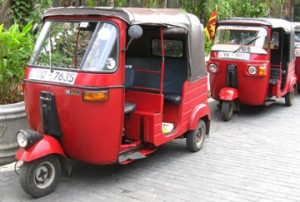
Thousands of semingly uncontrolled tuk-tuks are one of the reasons you may want to hire a car & driver in Sri Lanka

(Also read our post on avoiding scams in Sri Lanka) As much as we love to drive ourselves in Asia, occasionally we here at WoWasis find it necessary to hire a car and driver. Sri Lanka was one such country that pretty much required it. Our GPS unit was virtually useless, as the roads aren’t linked up with the satellites yet. Road signs are rare, and neither trucks, buses, cars, pedestrians, nor dogs play by the rules. It’s easy to accidentally hurt or kill an animal or person, or get hurt of killed yourself. So we hired a diver, a good guy, but relatively inexperienced in dealing with westerners. Another time, we needed to hire a driver in Chiang Mai, Thailand, to take us out to the Mae Rim Valley, a bit of a disaster. 

Here are a few things we encountered with our drivers, and how we fixed them: 

1)      Our Chiang Mai driver arrived with a car that was completely filthy, with windows greatly smudged with accumulated dirt. Cranks were missing from the windows, and the air con wasn’t working all that well. We should have fired him on the spot, because it just got worse from that point on. Rule #1: If the driver doesn’t show up with a car that isn’t spotless, he isn’t taking the job — or the customer — seriously enough to be worth investing in him. Save yourself some grief by releasing him on the spot, before you drive more than a half-kilometer.

2)      At the beginning of the trip, each of our drivers always wanted us to go to someplace that specialized in taking tourists for a ride. These included overpriced elephant parks, snake and crocodile farms, gem “mines” that were really stores, craft shops, and spice gardens. In each of those places, he expected to get a commission for any money we paid for anything. So right away, first day, we told him we wouldn’t go too any of those places. For the first few days, he’d drop a hint, but we kept him on the straight and narrow. Rule #2: It’s your trip, and you’re paying the driver, so you get to be boss. Act like one.

3)      Our driver had a habit of determining what hotel we stayed in, and we discovered early on that each of these gave him a commission for our stay. In one case, he wanted us to stay at an expensive hotel 12 km off our route. We therefore began booking our rooms, using a guidebook and a mobile telephone, which cost us $25 USD, including the SIM card. Rule #3: Buy a mobile phone, and book your own hotels, that way you’ll get to pick where you stay.

4)      We got a complaint from the owner of a hotel we stayed at, because our driver tried to get a commission on our stay, as well as a tour we booked to a mangrove swamp. Our driver advised us never to book our own rooms and tours, as he could get us price breaks. Instead, he was shaking down management to give him a commission that he didn’t earn. Rule # 4: Book your own tours, too. You don’t the discomfort of having your driver to be hustling your tour operator for money.

5)      Drivers tend to think all westerners like the same things, so make assumptions on where to take people. We happen to like ancient temples and cities, and actually had to tell him why, namely because we don’t have places that old in our own countries. After a couple of days, we actually started planning our routes, and told him where we wanted to go on the morning of departure. This took a lot of work, and we even had to help with the roadmap. But it was worth it. Rule #5: Take control of your daily route, and insist that your driver follow it, or give you a good explanation why not.

Now that we’ve stated the challenges and fixes, we’ve gotta tell you that we ended up loving our Sri Lankan driver. Sure he was a slight bit of a scoundrel, but he was a poor man trying to feed his family. We couldn’t in good conscience call him dishonest, perhaps just a bit overly opportunistic. He worked hard for us with no complaint (one day he began driving at 6 am, and finally stopped at 10 pm). He was easy to work with, took direction well, finally got it when we told him for the 3rd (and final) time, “no gem shop.” He was a wonderful guy, but our experience was good because we weren’t afraid to set the rules. If you do the same, you’ll have a great experience, too. So here are those rules again: 

Rule #1: If the driver show up with a filthy car, save yourself some grief by releasing him on the spot, before you drive more than a half-kilometer.
Rule #2: It’s your trip, and you’re paying the driver, so you get to be boss. Act like one.
Rule #3: Buy a mobile phone, and book your own hotels, that way you’ll get to pick where you stay.
Rule # 4: Book your own tours, too. You don’t the discomfort of having your driver to be hustling your tour operator for money.
Rule #5: Take control of your daily route, and insist that your driver follow it, or give you a good explanation why not. 

Follow those rules, and you’ll have a great time renting a car and driver in Asia.