The sharper edge to traveling in Asia

Dhaka, Bangladesh: the worst traffic in Asia?

Written By: admin - Jan• 02•13

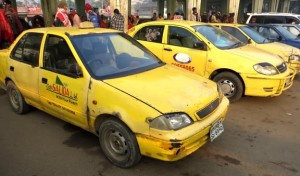
Bumperguards and dents are the hallmarks of virtually every vehicle in Dhaka, Bangladesh

Here at WoWasis, we hate traffic. No seriously, we really hate traffic. We do know of some workarounds, like taking the BTS Skytrain or MRT subway in Bangkok, and rarely going anywhere in town that’s not serviced by those, or water taxi routes. As bad as Bangkok is, we weren’t prepared for the traffic hell that is Dhaka, capital of Bangladesh. There are 20 million people in this metropolitan area, with few traffic signals, no rail-based public transit system, and an estimated 80,000 rickshaws that are both too wide and too slow. Add tons of buses, cars and trucks, millions of pedestrians, dozens of thousands of street and sidewalk stalls, and a total disregard for any traffic laws, and you’ve got utter chaos. And if you think we’re kidding, a huge number of Dhaka’s vehicles sport bull bars to fend of other vehicles. Take a look at the accompanying picture of two of Dhaka’s taxis, and you’ll get a graphic view of what’s going on. Dhaka traffic is essentially legalized bumper-cars. Our taxi either hit or was hit by an auto-rickshaw. The two drivers both apologized, then went on their respective ways. Probably both vehicles were dented, but no one bothered to get out. It’s hard to find a vehicle in Dhaka that doesn’t have a dent, and why make a repair? The thing would just get dented again tomorrow.

The traffic will also prevent you from easily seeing Dhaka’s sights. As one local wag put it, go to a destination and see everything around it, because you’ll never make it to the second destination.

The purpose of this blog post is twofold: to warn you what you’ll be getting into, and to encourage you to leave Dhaka for other parts of Bangladesh as quickly as possible. Because staying in Dhaka will impede your enjoyment of Bangladesh, and you don’t want to judge this fascinating country by its cover.

At Dhaka, your fun starts immediately. When you arrive from an international destination by airline, it will take you two hours to get to your hotel in Dhaka, although it may only be 5 miles away as the crow flies. Peak traffic hours are 8 am through 10 pm, no breaks. The next day, you’ve been told to go to the old city to see the sights. It will take you a long time to get there, whether by car or rickshaw, and longer still to go from one old city destination to another. Walking isn’t the answer, as the city is not based on a grid, and there are no street signs in English. You’re going to have to join the traffic melee.

As a pedestrian, you’ll face the real danger, too, of being hit by a bus, tuk-tuk (auto-riskshaw or “CNG” are other terms for theses lime-green three-wheelers) or bicycle rickshaw, particularly at night, when visibility for everyone is poor. And don’t worry about breathing: the exhaust fumes may get you before you reach your destination. This is one dangerous, tough-to-get-around-in city.

The entire nation of Bangladesh realizes Dhaka’s traffic is a major problem. Journalist Khairul Kuader painted a really dismal picture in the Daily Sun’s Morning Tea weekend magazine in the December 28, 2012 issue. People are dying in ambulances, en route to hospitals they’ll never reach. 3.20 million business hours are lost every year due to people being late for work and meetings. As a rule of thumb, a city’s minimum requirement for area allotted to roads is 25%: in Dhaka, it’s 7,5%, and, as Kuader’s article states, 30% of this precious 7.5% is lost to “hawkers, salesmen, and shopkeepers.”

It’s not going to be fixed soon. So here’s our advice. Get out of town quickly. Go to places like Rajshahi or Khulna, where you’ll revel in the non-traffic freedom. Dhaka’s train station is no walk-in-the-park either, from a westerners’ perspective, but the trains are fast an efficient, provided you can actually figure out how to buy a ticket, then board your train.

Bangladesh is a fascinating country, with friendly people, and lots to see. But you’re not going to see a lot in the capital of Dhaka unless you’re a real masochist.

WoWasis Bangladeshi restaurant review: The Casuarina at the Naz Garden Hotel, in Bogra, Bangladesh

Written By: admin - Jan• 02•13

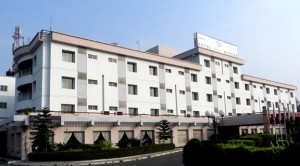
Here at WoWasis, we don’t do many restaurant reviews. There are too many, and too many websites doing that. It’s rare that we rave about a dining experience, but we’ve just got to tell you about this one because it was so unique. It’s the Casuarina restaurant located in the Naz Garden Hotel in the city of Bogra in Bangladesh. You’ll eventually pass through Bogra when you go to the ancient historical sites of Puthia, Natore, Paharpur, and Mahasthangarh, which are the major sites in the Rajshahi-Bogra area. 

We ended up at the Casuarina for lunch and found a menu combining Western, Thai, Chinese, and Bangladeshi cuisine. And we were skeptical, having eaten a large number of marginal meals in Bangladesh. Here, we ended up having our best meal in Bangladesh. Everything was spectacular, and it hardly cost anything, by western standards. 

Our selections were simple but varied. We had egg fried rice @ 270 taka, Thai fried chicken (6 pieces) @ 350 taka, Chinese mixed vegetables @ 140 taka, soft drinks, water, coffee and tea for an additional 285 taka, for a grand total of 1,045 taka , or $13 USD. That’s for two people. The portions were huge, and we were stuffed. The egg fried rice appeared to have been cooked in butter, and we’ve never had better. 

It’s not all that easy getting a superb western meal in Bangladesh sometimes, and this place, located seemingly out in the middle of nowhere, surprised the heck out of us. When go you to the historical sites of Puthia, Natore, Paharpur, and Mahasthangarh, you’re going to need to get lunch or dinner. Get it here, and we’ll bet you’ll be raving, too. 

Casuarina Restaurant
Naz Garden Hotel
Silimpur, Bogra-5800
Tel: 051-78088
www.hotelnazgarden.com

Banisanta: a sex workers’ hell in Bangladesh

Written By: admin - Jan• 02•13

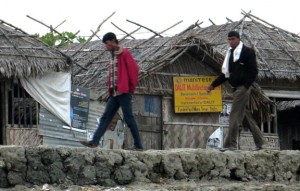
On their way: visitors hurry to a liaison in Banisanta, Bangladesh

Just south of the southern Bangladeshi city of Mongla is a tiny town on the Pushur River, consisting of a number of houses and shops made of mud, straw, wood and tin. It’s called Banisanta, and it’s home to dozens of professional current and retired sex workers, mama-sans, barkeeps, shopkeepers, and their children. Its evolution can be traced to sailors plying the river and the Indian Ocean, but it services the needs of the entire region, including the cities of Mongla and Khulna, where there are no legitimately recognized brothels. 

For Bangladeshis, the price for a completed sex act in Banisanta is 300 taka ($3.75 USD). For foreigners, it skyrockets to 1000 daka ($12.50 USD). Of course, everything is negotiable, both up and down the scale. Culturally and visually, it’s reminiscent of the Chicken Ranch in Sihanoukville, Cambodia. You’re not going to find showers or clean bedding here. The girls of Banisanta are predominantly quite young, but are aged well beyond their years. Look under the heavily-applied makeup, and you’ll see girls of 15 that lappear to be 35; the age is confirmed by several local Bangladeshis.   

Their lot in life is not a happy one, and one story in particular seems to represent a common theme. At an early age, many are taken out of villages by confidence men, who convince their parents that they will be going away to a good job in the city, and will send money home. Whether the parents really believe this is conjecture. The con man sells the girls immediately to brothel owners, and they are indentured. 

The life is hard, and many die young of aids-related diseases. Don’t be too quick to judge the mama-sans: they were bought and sold at a young age, too. 

Literally fresh off the boat, a group of twenty or so young Bangladeshi men walk up the bamboo plank ladder and cross the earthen ramparts of Banisanta. Before they can all cross, they are forcefully engaged by a group of women, who verbally challenge them and attempt to pull them into their shops. Bargaining takes place rapidly and at high volume, its frenetic pace accelerated by the sudden arrival on the banks of a rival group of women from a nearby house. At least one sex worker is not in either group. Last night, she went aboard an anchored ship, and as she told it, got drunk, fell overboard, and opened a two inch gash in her forehead that required stitches. But she wasn’t necessarily going to lose out tonight. It’s only 4:30 pm, and Banisanta’s evening has only barely begun.

WoWasis book review: ‘The Dwarf,’ a Korean novel by Cho Se-hui

Written By: herbrunbridge - Dec• 27•12

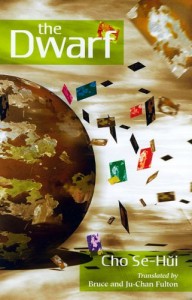
Originally written in 1978, Korean writer Cho Se-hui’s novel The Dwarf (2006, ISBN-10 0-8248-3101-2) isn’t an east grasp for westerners. The story represents characters in black and white, and the tale, of workers vs. management, is didactic. Two things helped us here at WoWasis through this otherwise well-crafted novel, translator Bruce Fulton’s afterword, and the fact that we finished the book while traveling in Bangladesh. Doesn’t make sense? Read on.

As Fulton points out, South Korea’s first five-year economic plan, launched in 1965, was the beginning of a four-decade initiative that resulted in that country becoming one of the most important economic countries in the world. Under president Parch Chung Hee, workers’ rights were considered insignificant in the drive to change the country’s economic fortunes. And the seven interconnected stories that form this book hearken back to the similar stage in which the U.S. found itself at the beginning of the 20th century. Nations on a quick march to development tread on the backs of the underprivileged, and this book has that in spades.

Where Bangladesh figured in, for us, was this. We’re traveling in a country that is in a similar state to that which Korea found itself when the book was written. The train station in the capital of Dhaka has no signs in English, no information counter, no uniformed personnel in the station or on the platforms. Travelers not speaking Bengali are on their own. That’s assuming they were able to buy a ticket in the first place.

Like the Korea of post-World War II, this country desperately needs an economic miracle. The Dwarf forced us to ask the question. Many people here are suffering tremendously at the lower end of the economic spectrum. What if a Bangladeshi Park Chung Hee surfaced, suggested the country take on an aggressive plan for economic growth, and admitted that some people would have to make tremendous sacrifices. Would there be any serious internal rebuttal? The promise of glory is a beckoning siren that has bedeviled humankind throughout history. This book shows the consequences in human terms of unchecked economic growth. Countries like today’s Bangladesh prove how enchanting and inciting the prospect of that growth can seem. Buy this book here at the WoWasis eStore.

Historic Wat Preah Vihear mines to be cleared as Thai-Cambodian controversy continues

Written By: herbrunbridge - Dec• 23•12

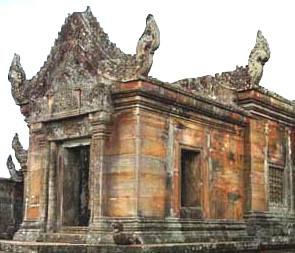
The historical temple of Wat Preah Vihear has been the subject of skirmishes for decades

In a story reported in the Bangkok Post of December 21, 2012, Thailand and Cambodia have begun thawing relations related to skirmishes surrounding the historical Wat Preah Vihear temple. Although sitting in Cambodian territory, the temple has been claimed by both countries.

At a meeting of the Thai-Cambodian Joint Working Group (JWG) held in Bangkok this week, the group agreed to a joint national force that will create five zones and clear all land mines surrounding the temple. For years, visitors to the temple have been warned not to venture away from the temple due to unexploded ordnance. The JWG expects all mines to be removed by the end of April 2013.

The International Court of Justice (ICJ) continues to clarify matters surrounding the site, including a ruling on July 18, 2012, that ordered both countries to withdraw from a 17.3 square km area surrounding the site. The court also agreed to review its original ruling over the ownership of the 6.6 square km temple site, which favored Cambodia.

Other issues pertaining to the Wat that will be addressed over the next several months by a number of international bodies will include the timed introduction of a team of Indonesian observers to oversee mine removal, logging laws and rights, and the upgrading of Cambodia’s Highway 48, which leads to the site.

Meanwhile, saber-rattling among conservative groups in Thailand over the issue continues. The yellow-clad People’s Alliance for Democracy (PAD) is holding demonstations on the streets of Bangkok, calling the Thai government a “traitor” for following international law by accepting the ruling of the ICJ.

Top 5 palaces and shrines in Seoul, South Korea

Written By: herbrunbridge - Dec• 16•12

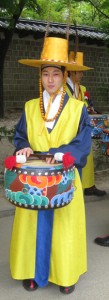
A drummer waits for the changing of the guard procession to begin at Deoksugung Palace

Here at WoWasis, we’re history enthusiasts, and love going to old palaces, temples, ruins, you name it. Seoul has suffered her share in various wars, and to a very large extent, it’s a modern city. Nevertheless, Seoul does have a number of palaces worth visiting, with compelling architecture reflective of varying degrees of restoration. 

We’d suggest, in this order of importance, a visit to the following palaces and shrines: Changdeokgung, Gyongbokgung, Jong Myo Shrine, Deoksugung, and Gyonghuigung. The first three are all within easy walking distance of the Anguk metro station. Gyongbukgung to the west, Changdeokgung to the east, and Jong Myo (which actually isn’t a palace, but a shrine) is to the south of Changdeokgung. When you buy your entrance tickets to these sites, be sure to pick up the free English guide pamphlets adjacent to the ticket booths. They are well-written and essential to understanding what you’re seeing. For the convenience of visitors wishing to see both the Changdeokgung and Gyongbokgung palaces, the former is closed on Monday, the latter on Tuesday. 

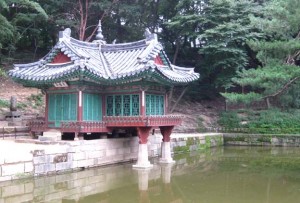
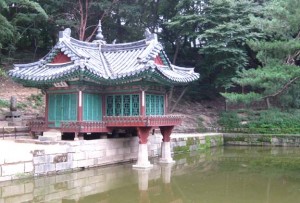
In Changdeogung’s Secret Garden

1) Changdeokgung Palace was constructed in 1405. The Secret Garden, its highlight, and requires a separate entrance. There are English guided tours three times per day (see the schedule below), but on Thursdays between April and November, you can go unescorted. The garden is fascinating, with a magnificent pavilion overlooking a lily pond, and many other ornate buildings and ponds set on a breathtakingly beautiful hillside setting. Usually, we here at WoWasis like to avoid formal tours, but the English guided tour was wonderful. The guide was knowledgeable, and the stories behind the structures and ponds were worth hearing. When you arrive at the Palace, we recommend that you book your tour for the Secret Garden immediately. Between your arrival and your tour time, you can visit the magnificent palace and other structures.  

Chandeogung Palace and Secret Garden
Open Tuesday-Sunday
April-October 9:00-6:30
Dec-Feb 9:00-5:00
Nov – Mar 9:00-5:30
English Tours of the Secret Garden: 11:30, 1:30, 3:30 (90 minutes in length) 

Intricate restoration work is the hallmark at Gyeongbokgung Palace

2) Gyeongbokgung Palace and environs are immense, and include two museums. The National Palace Museum, which houses robes, jewlry, and artifacts related to Joseon royalty, is immediately to your left as you enter the palace grounds, or you can enter separately, as admission is free. The National Folk Museum is also free but only as an adjunct to your paid admission to the palace. The Folk Museum is huge, worthwhile seeing, but a challenge to navigate. Plan on two or three hours to see the palace and grounds and another two to three hours to fully investigate the museums. The changing of the guard ceremony occurs outside the main gate hourly, from 10 am – 4 pm 

The palace was built in 1395 and served as Korea’s main palace for more than 500 years. It was burned by Japanese invaders in 1592 and left derelict until 1867, when it was rebuilt, consisting of some 500 buildings. As the palace was the symbol of national sovereignty, 90% of the palace and buildings were destroyed by the Japanese occupying forces in 1915, an act which will never be forgiven by Koreans. Restoration of Gyeongbokgung was begun in 1990, and remains in effect today. 

Among the most interesting sights are the two-story Geunjeongjeon palace building and the Gyeonghoeru, which rests on piers and overlooks a pond. Do not fail to see the intricately beautiful Hyangwonjeong pavilion, which rests serenely in the middle of the Hyangwonji pond. And for a real treat, visit the Taewonjeon complex to the far left rear of the palace grounds. Here, busloads of screaming schoolchildren rarely emerge, and one gets the sense of the peace and quiet that once permeated the royal grounds. 

Gyeongbokgung Palace
Open Wednesday-Monday
March-Oct: 9 am – 6 pm
Nov-Feb: 9 am – 5 pm

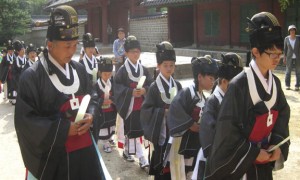
A procession at Jongmyo Shrine

3) The Jongmyo Shrine is an exquisite World Heritage-listed site just to the south of Changdeokgung Palace. It houses the spirit tablets of Joseon royalty and their servants, and is a pleasant respite from the general hubbub of busy Seoul. Among the more fascinating elements of Jongmyo are the traditional processions and rituals that are held there. Just outside, local citizens gather to play games such as janggi and baduk, and take calligraphy and painting lessons, providing the visitor with a welcome non-touristy view of Seoul customs.

Jongmyo Shrine
Open Sunday-Monday
March-Sept: 9 am – 6 pm
Oct-Feb: 9 am – 5:30 pm

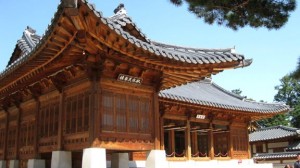
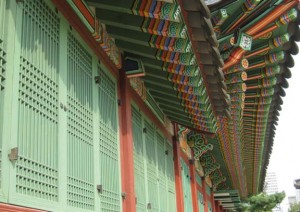
Exceptional design and woodworking at Deoksugung Palace

4) Deoksugung Palace is located just across the street from Seoul City Hall, and has a number of buildings of varying architectural styles, including the neoclassical Seokjojeon. Deoksugung served as the main palace of the Great Han Empire (1897-1910) and was built ca. 1593. There is a fascinating changing of the guard ceremony several times a day (10:30, 2 pm, 3 pm) from February through December, in which more than 50 participants dress in period costumes and play period musical instruments.

Deoksugung Palace
Open Tuesday-Sunday
9 am – 9 pm

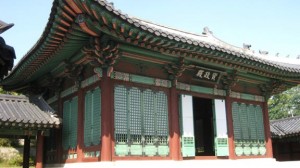
Gyonghuigung Palace is an austere and welcome respite from the hubub of Seoul

5) Gyeonghuigung Palace is a short walking distance from the Gwanghwamun metro stop and is in an austere setting, away from most of Seoul’s other attractions (the Seoul Museum of History, though, is right next door). It was a villa for Joseon royalty, and its buildings have beautiful woodwork. A great part of its fascination lies in the fact that it’s off the tourist beat and offers refreshingly quiet, reflective moments to the visitor.

Gyeonghuigung Palace
Open Tues-Sat: 9 am – 6 pm, Sunday 10 am – 6 pm

Only one day in Seoul? Visit ‘Biwon’ the Secret Garden at the Changdeokgung Palace

Written By: herbrunbridge - Dec• 15•12

Changdeogung’s Secret Garden is a “can’t miss” in Seoul

Maybe you’ve only got one day in Seoul, a common occurrence for people who find themselves with a free day between layovers at Incheon Airport. If you’ve got a day or even a few hours, the one thing you don’t want to miss is the Secret Garden, located in the back of the Changdeokgung Palace. You can take the bus from the airport to downtown Seoul, which will allow you to get off right outside the Anguk metro station. From there, the palace is a short walk or taxi ride away.

Changdeokgung Palace was constructed in 1405. It’s well worth seeing, but the Secret Garden, its highlight, requires a separate entrance. There are English guided tours three times per day (see the schedule below), but on Thursdays between April and November, you can go unescorted.

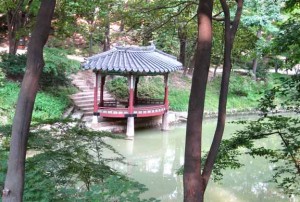
Small pavilions accent the hidden ponds found at numerous places within the garden

The garden is fascinating, with a magnificent pavilion overlooking a lily pond, and many other ornate buildings and ponds set on a breathtakingly beautiful hillside setting. Usually, we here at WoWasis like to avoid formal tours, but the English guided tour was wonderful. The guide was knowledgeable, and the stories behind the structures and ponds were worth hearing.

When you arrive at the Palace, we recommend that you book your tour for the Secret Garden immediately. Between your arrival and your tour time, you can visit the palace and other structures. Be sure to pick up the free 30 page English guide to the palace, which you can get when you buy your palace ticket.

Chandeokgung Palace and Secret Garden
Open Tuesday-Sunday
April-October 9:00-6:30
Dec-Feb 9:00-5:00
Nov, Mar 9:00-5:30
English Tours of the Secret Garden: 11:30, 1:30, 3:30 (90 minutes in length)
AsiaPromoBanner


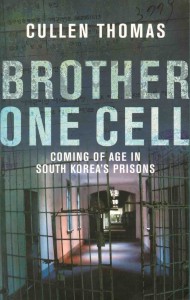
WoWasis book review: ‘Brother One Cell,’ Korean prisons by Cullen Thomas

Written By: herbrunbridge - Dec• 15•12

There are quite a few books written on prisons in Asia, from Kang Chol-hwan’s  sobering Aquariums of Pyongyang to Steve Raymond’s Poison River.

In such books, though, there is little in the way of hope or redemption. And that’s what makes Cullen Thomas’ Brother One Cell: Coming of Age on South Korea’s Prisons (2006, ISBN 13-978-0-283-07025-9) so radically different and fascinating.  Thomas’ three and one-half years in Korea’s Seoul Detention Centre, and Uijongbu and Taejon prisons was transformative.

He was jailed on a drug charge, and chose to make his prison experience a learning one. This book of more than 400 pages is endlessly fascinating, and never more so than in describing the gangsters that ran the prisons’ workshops with a firm yet fair hand. He describes their “genital sunflowers,” the result of informal prison body modifications that grossly increased penile size.  There are no prison rapes in the book, and there is an aura of respect running in two directions, between the convicts and their jailers. During his incarceration, Thomas picks up nuances of the Korean language as well as an understanding of how Confucianism permeates Korean society, both in and out of prison. When he is finally released and returned to the United States, Thomas makes it clear that his Korean prison experience has transformed him into a better person.

There are many passages in the book that we here at WoWasis feel are worthy of quotation, but his commentary on the differences between Korean and American prisons is especially interesting:

If I had to be imprisoned, it was good fortune it was in Confucian Korea. I was told of the possibility of being transferred to the States to complete the remainder of my time. A provision on the Korean books spoke of such a chance for an American inmate after he had served one-third of his sentence in Korea. But even if the authorities on both sides had agreed to such a move I would have refused to go. The decision in my mind couldn’t have been clearer. As a prisoner in the States 1 might have been able to wear regular clothes, watch television, eat familiar food, sleep on a bed. It would have been easier for friends and family to visit me. I would have had a western-style toilet, hot water and heat in the winter, access to libraries and special facilities for exercise and recreation. No doubt my life there would have been more comfortable in many ways, more modern, physically less restrictive – but also seedier, I’m pretty sure, more decadent and more dangerous. As incongruous as it may seem, my preference was to stay in South Korea, 7,000 miles from home in a country whose modern history had been scarred by militarism, authoritarianism and a not-so-distant third-world poverty. In Korea I didn’t have to constantly think about my survival, about being raped or assaulted. While the authorities may not have reached men in their hearts or heads, and while we lived relatively bare and rough lives, we weren’t surrounded by brutality and violence. I’ve often thought about prison reform and what could be done to try to help society through the system’s opportunity with criminals. I’ve often wondered if there might be some way to take from Korea those Confucian qualities that made her prisons more humane, more civilized perhaps, than ours in the US. As if you could take a cultural eye-dropper, suck out of South Korea the good, carry it over the ocean, and drop it into America’s veins. Maybe the US could use a little shot of Confucian shame, a better sense of collective living. But you can’t inject Confucian ethics into America’s bloodstream. There’s no catalyst for it. It’s too late. Korea’s one race has been marinating in a code of behavior and propriety and well-defined roles for centuries. She lives and dies by it. There are so many races in the US, so much room to invent ways of relating, so much freelancing with behavior and language. We have no uniform code. It’s a cauldron of competing codes.

Today, Cullen Thomas is active teaching writers courses in the eastern U.S., and this book is indicative of s number of exceptional insights into both Korea and prison life. It is highly recommended. Buy it here at the WoWasis eStore.

Jeju Top 10: the Best Museums and Sites on Korea’s island of Jeju

Written By: herbrunbridge - Dec• 10•12

Jeju Art Park

Going to Korea’s Jeju Island? You’ll be astounded by the wealth of museums, parks, and historical sites on the island, all within a half-day’s driving distance of each other. In terms of museums alone, Jeju’s offerings constitute the largest concentration of outstanding museums that we here at WoWasis have seen in Asia, and many of them are outdoors.

You can always take a tour, but we actually recommend renting a car and driving Jeju, well-signed in English, with good roads and excellent island drivers. Be sure you get a good Korean-English GPS from your rental agency.

Have fun in Jeju! Here are our Top 10 picks, divided by West and East:

Western Jeju:
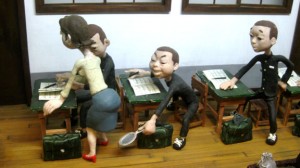
Diorama at Jeju Loveland

Jeju Love Land
20 km south of the city of Jeju-si
Open daily, 9 am – midnight (must be 18 or over)
www.jejuloveland.com
Tel
: +82 (64) 712-6988

Here at WoWasis, we’d guess that the number of museums we’ve visited in our lifetimes to certainly number in the hundreds, and maybe even the thousands. But none of them were as fun as South Korea’s Jeju Love Land, located a few kms south of the city of Jeju-si, on the island of Jeju. Yes, the museum is about sex, and it’s ribald. Nothing in this museum is taken seriously, from the déclassé sex toys in the museum shop (our favorite was a pen holder in which, when a pen is inserted into a couching man’s behind, he moans in pain, a favorite with the Japanese tourists who were visiting that day). The museum is clearly about sex as fun and sex as funny. There’s nothing sacred or politically correct here. But what surprised us was that much of the sculpture an art works are pretty damn good.

Jeju Museum of Art
20 km south of the city of Jeju-si
http://jmoa.jeju.go.kr/index.php/contents/information/viewing/openhours/kor
Tel: +82 (64) 710-4300

Right next door to Jeju Loveland is Jeju’s wonderful Museum of Art, located in a architecturally arresting building. The exhibits are compelling, the staff friendly, the museum relatively uncrowded. Two or three hours would be enough to see both Jeju Loveland and the Jeju Museum of Art, and they’re literally a 30 second walk from each other. Here’s a wonderful rule we found on the JMOA website: “Spectator banned:   Person who has possession of the goods the risk of fire, odors, or digusting.” No stinkers allowed, and we’re certainly in favor of that!

Spirited Garden
1534 Jeoji-ri, Hankyeong-myeon
Jeju-si, Jeju 690-947
Tel: (064) 772-3701
open 8:30 – sunset
www.spiritedgarden.com (includes a map)

In 1992, Mr. Sung Bum-young began creating this garden of bonsai trees out of a wasteland. Sung was a farmer who had a vision of what he considered beauty, and who managed, through hard work and determination, to bring it to fruition. He calls it the Bunjae Artpia, and through terraces, walkways, sunken vistas, he displays hundreds of meticulously bonsaied trees. There’s a tremendous amount of documentation throughout the park, both botanical and philosophical. But it’s well worth it, on several levels. It’s beautiful, for one. If you don’t know anything about bonsai, it’s educational (that’s two). But perhaps more importantly, it gives the visitor a reflection point. All of us are capable of having a passion that runs so deeply that we want to share it with the world. It’s not so easy to share, on such a grand level. But Mr. Sung did it, and his remarkable vision resulted in this, one of the highlights of Korea.
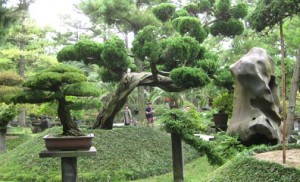
Bonsai and rock garden at Hallim Park

Hallim Park
300 Hallim Road, Hallim, Jeju
Tel: (064) 796-0001
www.hallimpark.co.kr

Like the Spirited Garden, Hallim Park represents the vision of one man, Song Bong-kyu, who acquired 80 acres of land and developed a recreational park on it. Unlike the Spirited Garden, it’s neither quiet nor philosophical in nature. What it is, is a microcosm of many of Jeju’s most interesting features, encompassing nine zoned theme parks: Palm Tree Avenue, Wild Grass & Flower Garden, Hyeopjae &  Ssangyong Caves, Jeju Stone & Bonsai Garden, Jae-Am Folk Village, Bird Garden, Jae-Am Stone Exhibition Hall, Water Garden, and Subtropical Botanic Garden. It can be seen in just under two hours by taking a walking loop through the park.  For us, the most interesting element to the park is its layout and development. We found the trinket shops and restaurants to feel somewhat out of place, but overall, came away feeling gratified that we experienced what was essentially a feat of creativity, built around the remarkable natural caves of Hyeopjae &  Ssangyong, 500 meters of which are open to the public, well-lit and easy to navigate, with a number of fascinating features.   If you don’t make it to Manjanggul Cave in Eastern Jeju, this is the one to see.

Jeju Art Park, 20 km west of Seoguipo City near the southern coast road, and 40 km south of Jeju City
Tel: (064) 794-9680

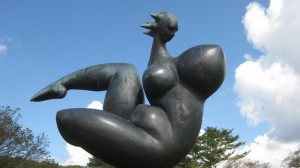
The Art Park has more than 160 art works by Korean sculptors, laid out over a large 430,000 square meter surface. The trail system is sophisticated yet easy to navigate, and the plethora of different styles means that the visitor will be exposed to visually stimulating views at virtually every turn.

Hallasan National Park
Tel: (064) 713-9953 (visitor center)
http://www.hallasan.go.kr/english/

At 1950 meters, Hallasan is the highest   peak in Korea, and divides the island of Jeju in half. There are a number of trails, two of which reach the crater lake summit.  These two take approximately 5 hours to reach the summit. There are emergency shelters along the way, as weather may turn at any moment. Crater hikes are recommended for experienced hikers. Visit the website for more details. 

Eastern Jeju:
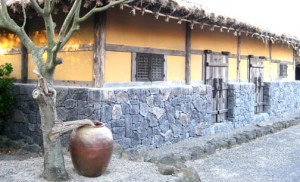
A relocated house at Jeju Folk Village

Jeju Folk Village
631-34, Minsokhaean-ro
Pyoseon, Jeju-Do
Tel: (064) 787-4501
There are a number of folk villages in Korea that feature authentic houses and varied cultural experiences. Some are actual working villages, others are recreated for the purpose of providing a historical perspective. Jeju Folk Village falls into the latter category. We here at WoWasis visited both classes of folk villages, but we felt a bit uncomfortable peering into people’s yards and homes in authentic villages, even though we were welcome to do it. On the other hand, recreated villages seemed a bit artificial at first, although relating to them as working museums eventually made the most sense.

Jeju Folk Village, located near the town of Pyoseon in southeastern Jeju, recreates 19th century Jeju life, and offers a fascinating view of the diversity of villages and lifestyles of the era. There are a total of 117 houses and facilities over 40 acres, including a Mountain Village, Hill-Country Village, Fishing Village, and Shamanism Village. Craftspeople recreate past working endeavors, and the extensive range of folk items on display includes 1,627 woodenware, 1,046 bamboo ware, 1,699 earthenware, 1,544 porcelain ware, and 921 ironware items.

Haenyo Museum
Near Sehwa, Jeju
Tel: (064) 782-9898
www.haenyeo.go.kr

Jeju’s female haenyeo divers utilize llittle more than a mask and a wetsuit, ply local waters in search of edible sea life. They learned their craft from their mothers and grandmothers, but no young girl today aspires to be a haenyeo diver. Today’s youngest divers are in their late 40s, and no one will take their places. From roughly 30,000 of them 50 years ago, today their number is estimated to be fewer than 3,000. A few km northwest of Ilchulbong,you’ll find the Haenyeo Museum, dedicated to the story of these divers, a “can’t miss.”

Manjanggul Cave
Tel: (064) 710-7907
open daily 9 am – 6 pm
http://jejuwnh.jeju.go.kr/contents/english.php?mid=020202

Walking through a lava tube, one can easily imagine being inside of the intestines of an enormous beast made of rock, with the advantages including that the beast is dead, and there’s no smell. Lava tubes are formed when hot rivers of lava surge through a channel, then depart, leaving an enormous empty tube, scoured on the sides by molten detritus, and with various rocky deposits left behind on the floor.  You can’t find them everywhere in the world, but there’s a spectacular one on Jeju that’s 7,416 meters long, well lit and marked, and one km of which is open to the public.  This enormous section of the cave reaches 30 meters high, and is 23 meters wide at its widest. It’s a UNESCO World Heritage site and features geological formations such as lava flowlines, stalactites, shelves, toes, and columns. This is a Jeju site not to miss, but bring a jacket and good shoes.
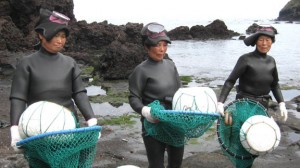
Haenyeo divers at Haenyeo House, Ilchulbong

Seongsang Ilchulbong and Hanyeo Divers exhibition
Eastern tip of Jeju

Climbing the mountain-crater of Ilchulbong is something that just about every visitor to Jeju does. The climb is a relatively easy 20 minute walk, and provides a view of nearby U-do island. What many visitors miss is the wonderful hanyeo divers’ exhibition at Hanyeo House, just east of Ilchulbong in the adjacent cove.  Hanyeo divers may not be around in a few years, so see them now, while you can.
 

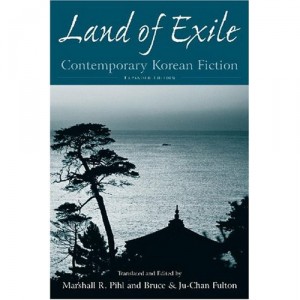
WoWasis book review: ‘Land of Exile: Contemporary Korean Fiction’

Written By: herbrunbridge - Dec• 01•12

If you’re going to delve into the genre of Korean fiction, the Expanded Edition of the compilation Land of Exile: Contemporary Korean Fiction (2007, ISBN 978-0-7656-1810-8), translated and edited by Marshall R. Pihl and Bruce and Ju-Chan Fulton, is a pretty good place to start. There are sixteen short stories in this book of 336 text pages, and they are as varied as the country itself. Their content spans immediate post-war Korea to modern times, and each story contains a brief introduction describing the author and something of the setting of the story.

There’s something for everyone here. Some stories touch on the uneasy political milieu of the post-Korean War south, and its impact on friends, families, and acquaintances.  The selections are so well-chosen that it’s tough to pick clear favorites, but two in particular stood out to us here at WoWasis. Hwang Sogyong’s ‘A Dream of Good Fortune’ is a riveting story delving with the daily lives of Korea’s dirt-poor, who live adjacent to sewers and railroad tracks. Here, the value of work is judged by what one brings home by cart, rather than by one’s title. Everyone’s station in life is rough.

Kim Hun’s ‘From Powder to Powder’ climbs into the mind of a cosmetics executive whose wife is being destroyed by cancer. The story is intricate, told alternately in first person and second person, the latter voice applying to a lover that doesn’t exist. Kim’s story becomes increasingly more compelling, whether submerged in the fine details of a body being killed by itself, tracing along uncomfortable familial issues, or balancing the business and personal worlds in times of crisis.

It helps to know a little Korean history while reading the first couple of chapters, but then again, the stories are timeless, and are common t any country experiencing a recent civil war. The book is highly recommended to readers wishing to gain insight into Korean culture, and those wishing to gain some knowledge of the richness of the Korean school of fiction. Buy this book now at the WoWasis eStore.