The sharper edge to traveling in Asia

Bangkok’s Nana Plaza sex emporium good for another 10 years now that master lease has been renewed

Written By: herbrunbridge - Jan• 08•13

To the relief of millions of punters worldwide, Bangkok’s Nana Entertainment Plaza has had its master lease renewed for another ten years. This three story atrium boasts dozens of go-go and beers bars, to go along with five ladyboy bars. In short, there’s something here for everyone. Prior to the signing of the lease, there had been some concern that the plaza, which occupies a valuable piece of real estate on Sukhumvit Soi 4, would be sold and a high-rise built in its place. This may eventually occur, but now cannot legally occur prior to the year 2023. 


Bangkok’s legendary Dave the Rave

WoWasis ran into Nana Plaza expert and blogger Dave the Rave, who gave us some of his own personal highlights of what has resulted from the new lease: 

1)      There are now new owners to several of the venues, including Angelwitch and DC-10.
2)      Owners are now upgrading their establishments to include new décor and better restrooms.
3)      The venerable Sexy Night, at 30 years old the longest Nana establishment operating under original management, remains totally unchanged. See an original Bangkok bar the way it was in 1983.
4)      Khun Toy, today’s finest Nana deejay, and who knows Vietnam-era rock better than anyone, continues to spin to the dancing gals at DC-10. 

Khun Toy, the best DJ in Nana Plaza, specializes in Vietnam-era rock and rock at the DC-10 bar

Bar fines (the price one pays for taking a lady out of a club) remain averaging 600 baht. Prices for short times (approximately one hour, but could be more, could be less, depending on the lady) vary by the lady, who sets her own prices, but are in the 1500-4000 baht range, although 4000 baht wouldn’t be considered by most punters to be excessive. 

Visitors who rebel at paying for the affections of ladies in the Nana area are reminded that the difference between paid sex and free sex is that free sex costs more. Ask any male resident of Bangkok, expat or native.
WoWasis travels transportation in Bangladesh

Written By: herbrunbridge - Jan• 07•13

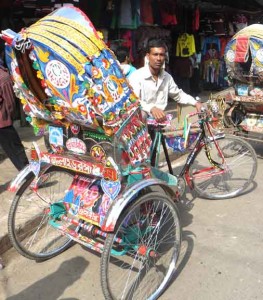
Transportation in Bangladesh consists chiefly of train, car & driver for hire, auto-rickshaw, and pedal-rickshaw. 

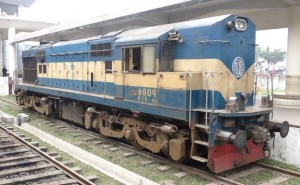
Train: Bangladesh’s train stations have virtually no signage in English, nor English-speaking information counters (exception: Rajshahi train station). Read the WoWasis post on how to deal with this. When you do get a first class ticket, the trains are relatively fast, and very inexpensive, by western standards. 

The sturdy diesel locomotives in Bangladesh pull everything, everywhere

Hired car & driver: This is an exceptional way to visit outlying historical areas. Expect to pay between $80 and $100 USD per day. You’ll also pay for your driver’s food and hotels room, if necessary. If you don’t read Bengali, don’t even think of driving, as there are essentially no road or street signs in English in the entire country. You can also hire a car & driver to take you around Dhaka, but traffic jams make this method an even toss up with auto-rickshaws and pedal-rickshaws, which are cheaper, and go just as slowly. 

This auto-rickshaw started beaming when he finally got a fare from WoWasis

Auto-rickshaw: also called a CNG (for compressed natural gas, which fuels it), these ubiquitous green three-wheeled conveyances have an enclosed cage, which you ride in, giving the whole thing an aura of a portable zoo in which you’re the animal. Like tuk-tuks everywhere, price is always open to negotiation. 

Pedal rickshaw: they’re everywhere, cheap (under $1 USD per mile), and in Dhaka, just about as fast as cars. Their drivers are extremely poor. We found the best technique for determining payment was to ask a Bangladeshi how much to pay. We’d bump it up by 30-50% at the end of the ride. 

You’ll notice we didn’t mention taxis. They’re never around, mainly congregating at train stations and airports. The auto-rickshaws and pedal-rickshaws, on the other hand, are everywhere.

WoWasis introduces the colorful street stall vendors of Bangladesh

Written By: herbrunbridge - Jan• 07•13

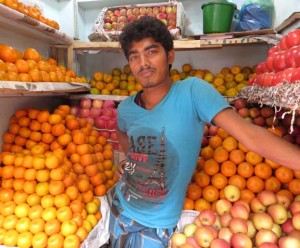
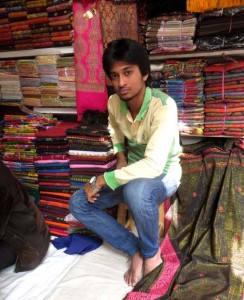
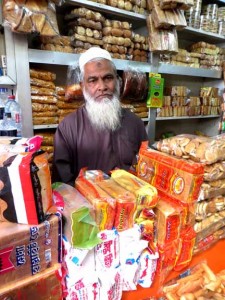
A poor country by economic standards, Bangladesh is rich in both the color and breadth of its internal commercial enterprises. It’s never more apparent than when visiting street stalls, with riots of color at every turn. It could be bread, fruit, textiles, or tools, but Bangladeshis have an eye for design and color as they present goods for sale.

Why WoWasis meets (and needs) the friendly people of Bangladesh

Written By: herbrunbridge - Jan• 06•13

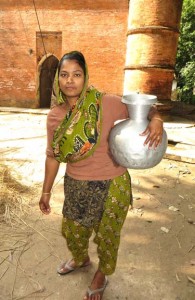
This friendly woman pointed us to an out-of-the-way historical site

One of the first things the seasoned Western traveler to Bangladesh will encounter is the lack of signage in English. To us here at WoWasis, it was most apparent beginning with the main train station in the country’s capital of Dhaka. There is zero signage in English and even the numbers are listed in Bengali. Which means good luck on finding the right ticket window, a discernible train schedule, the right platform, or the right train carriage. In addition, uniformed train personnel are nearly impossible to find. But there is a solution, which is exactly the solution you’ll need to every dilemma and question in the country. The solution is the friendly Bangladeshi people. 


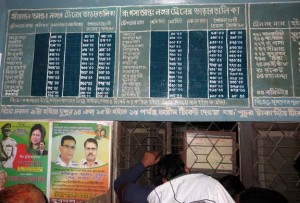
As with this schedule board in the Khulna depot, Bangladeshi train stations rarely have signage in English

Bengladeshis will always come to your aid, in big ways. We’ve had then lead us to the proper ticket windows, to our train cars, and even lend us sleeping bags on cold winter trains (neither trains nor hotels have heaters in Bangladesh). There is a bonus to being forced to rely on Bangladeshis: Western travelers are rare in Bangladesh, and for many locals, you will be the first visitor from your country (including the U.S.) that they’ll have ever met. They’ll always ask you what you think of their country. Be sure you tell them you love it, which shouldn’t be difficult, as the country is terrific. Bangladeshis are proud of their country, and absolutely beam when you tell them how much you’re enjoying yourself there. 

So the very real lack of Western signage has two immediate benefits: you’ll meet tons of warm, friendly Bangladeshis you never would have encountered had you been totally on your own. And you’ll have most of the country’s historical sites pretty much to yourself, no tour buses, screaming tour guides, or waiting lines. 

Oh, there’s a third benefit, too: the children. All over the countryside, small groups of elementary school-age children will follow you around, smiling and talking to you (yes, they’re learning English in elementary school). They’ll tag along, take you everywhere, and they don’t beg or panhandle (maybe occasionally one will ask for a pen). They’re not jaded by having seen thousands of foreigners and are sincerely welcoming. We guarantee that the kids of Bangladesh will be one of your happiest memories of the country. How often have you had the opportunity of creating a first impression of your own country to someone new? You can do it here, hourly. 

Bangladesh’s biggest asset is her people. Signage is awful and the travel infrastructure is always challenging, 24 x 7. So you’ll have a great opportunity to encounter some of the nicest people you’ll ever meet, who’ll take special pride in helping you out. The glass you initially thought was “half empty” is, as you’ll find, in reality “half full.” Lack of signage can be frustrating, but with a small change in attitude, it turns into a positive: you get to meet more people. 

Enjoy Bangladesh!

WoWasis book review: ‘The Ideal Man: The Tragedy of Jim Thompson’ by Joshua Kurlantzick

Written By: herbrunbridge - Jan• 06•13

Here at WoWasis, we believe that there are at least two schools of thought on how best to live the expatriate experience in Asia. One we call “ping-ponging,” bouncing back and forth between one’s mother country and Asia. Regarding Thailand, one advocate who lives part-time in the U.S. states, “I go to Thailand, and after 30 days, the Thais drive me nuts, so I return to the U.S. After 30 days, the Yanks drive me nuts, so I return to Thailand.” The other expat school stays in Asia, and rarely or never returns to his or her home country. That was Jim Thompson.

Author Joshua Kurlantzick is the latest writer to tackle Thompson, the legendary “silk king,” who disappeared in 1967 and has never been found. And the feeling, among people who knew him, that Thompson had lost perspective and “gone native,” is a theme that resonates throughout Kurlantzick’s The Ideal Man: The Tragedy of Jim Thompson and the American Way of War (2011, ISBN 978-0-470-08621-6. The author has done a fine job of interviewing people who knew Thompson (as Kurlantzick states, they’re passing away relatively quickly now), and has investigated U.S. government documents as well.

Thompson was an OSS operative who unsuccessfully fought his superiors on the subject of getting involved in the quagmire that was Vietnam. He was a friend of Ho Chi Minh, and argued that Ho’s relationship with Communism was based more on expediency than on philosophical values. Thompson’s decency as a human being is a big part of the story of this book, involving how he treated his silk workers, his advocacy for backing democratic politicians in Thailand (he lost this battle as well), and his anti-imperial perspective on the fortunes of Asian nations.

The 219 page book is a quick read, and the elements regarding his dinners, his silk factory, and his involvement with clandestine American operatives are fascinating.So is the ongoing sub-plot of Thai politics and political figures. The author has done his homework.

What is never resolved is what happened to Thompson on that fateful last day in Malaysia’s Cameron Highlands. It’s all conjecture, but based on the people to whom we’ve spoken, some of whom are quoted in this book, Kurlantzick has nailed it on the culprits, but not on the reason Thompson was probably liquidated. That story will have to wait for another book, which we don’t think with be written for at least a decade, and maybe longer.

Until then, you have this, and several other books and short stories revolving around Thompson. The tales of the scenes behind the U.S. involvement in Thailand and Southeast Asia are among the elements of this book that make it worth reading. Buy this book now at the WoWasis eStore.

A mad dash for university placement in Khulna, Bangladesh

Written By: herbrunbridge - Jan• 03•13

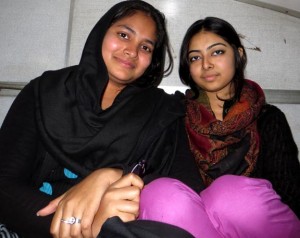
Two 19 year old students sit in an upper berth on a Bangladeshi train, thinking about tomorrow’s placement exam

The train from Rajshahi to Khulna, Bangladesh is jam packed with prospective students and their parents. The destination? Entrance Exam time at Khulna University. Khulna is far from the biggest university in Bangladesh, but it’s among the most desirable. “Khulna University is not political, which is why I want to go there,” one prospective student told us. “Other universities go on strike, and then there are session gaps, which mean it may take longer to get a degree. At Khulna, I can get it in four years.” 

Your WoWasis correspondent shared a train cabin with a government tax official, his wife, daughter, and her girlfriend, and three other prospective students. They all shared the same enthusiasm about tomorrow’s exams, although the chance of them all succeeding is poor. Of 4,500 yearly applicants, only 350 are chosen, vetted by this once-yearly exam. 

If selected, the tuition is affordable, 10,000 taka ($125 USD) per year. But other expenses do mount. Off-campus housing is 2,000 taka per month, food another 5,000, and general expenses another 3,000. That’s 10,000 taka per month, or $1,500 USD per year. Even for upper middle class Bangladeshi families, the expense can be a strain.  This expense can be lowered by staying in a campus dormitory, which costs only 3,000-5,000 taka per month, but there is a two-year waiting list. 

Bangladesh is an education-focused country, where even rural elementary school children learn English. Thousands of Bangladeshi teens take university exams every year, and each of the prospective students we talked to expressed a desire to graduate and continue building the country. But they also discussed the reality of leaving the country to accept employment in another country. According to the latest statistics from the United Nations Conference on trade and Development (UNCTAD), the top two corridors for skilled emigrants are Bangladesh-India (70,092 individuals per year) and Bangladesh-USA (41,920 per year). In fact, Bangladesh fills out 6 out of the top 14 slots, worldwide. The trend for Bangladeshis is on a growth curve: from 2002 to 2011, it increased 20%. 

For the young people on their way to the placement exam, the road seems to be laid out. Succeed in the exam, graduate, accept employment in another country, and send remittance payments home. Perhaps their future model will be similar to India’s, where they return home eventually to build their own businesses. But that’s in the future. Tomorrow, it’s all about the exam.


WoWasis makes a one-day visit to Puthia and the exceptional historical sites near Rajshahi and Bogra, Bangladesh

Written By: herbrunbridge - Jan• 03•13

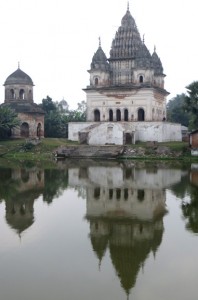
Shiva Temple in Puthia

In addition to being a great respite from the craziness of Dhaka, the city of Rajshahi, seven hours to the west by train, is close to a number of significant historical sites, which lie within the area of Rajshahi to the west, and Bogra to the east. To best see them, hire a car and driver from your hotel, and make a day out of it. Puthia is the most important of them, but you’ll also enjoy the rajbaris (old palaces) of Natore, the ruins of Mahasthangarh, and the Somapuri Vihara temple of Paharpur. The best restaurant in the area, incidentally, is just outside Bogra, at the Naz Garden Hotel, and highly recommended for a lunch stop. Assuming you leave in the early morning from Rajshahi, you’d take the following route. 

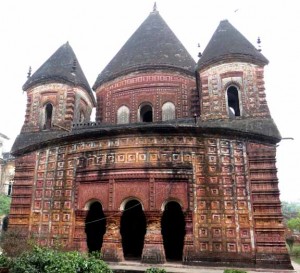
Puthia’s Govinda Temple

The city of Puthia is the site of several temples of historical importance, and shouldn’t be missed during your stay in Bangladesh. The first structure you’ll reach id the Shiva Temple, which sits pondside along the road. Here, ask to meet the caretaker, Mr. Bishwana. He’s a real character, posing as a dancer in front of any and all the structures at the Puthia site. He also has a passion for them all and will show you intricacies you’d probably miss on your own. The highlight of the site is usually listed as the Govinda Temple, with hundreds of red-hued terra cotta panels depicting scenes from the love affair of Krishna and Radha. It’s striking. But our favorite was the smaller, and to our eyes more intricate, Annika temple, with lovely terra cotta panels detailing apsara dancers. Mr. Bishwana has the keys to everything, and leaves no stone unturned in ensuring that you see everything.  

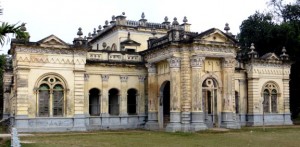
Natore’s Boro Torof rajbari

Next on your agenda is the town of Natore, where you’ll visit the Natore Rajbari, a fine complex of dilapidated palaces and houses that retain their charm and beauty despite their semi-ruined state. The main palace is called Boro Torof, built in the mid-1700s. At least one of the other buildings of note sits alongside a pond, and provides wonderful views from across the water.

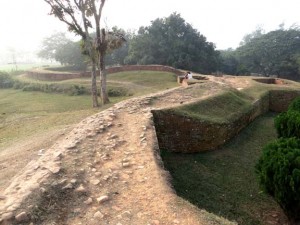
The citadel at masthangarh

Your third stop is the large archaeological site at Mahasthangarh, where you may walk the walls of the 2 square km citadel, in what remains of the oldest identified city in Bangladesh, dating from the 3rd century BCE. There is a small onsite museum. 

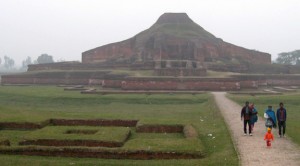
Somapuri Vihara, in Paharpur

The town of Paharpur lies approximately 50 km northwest of the city of Bogra, and here you’ll visit the amazing 60 foot high stupa of Somapuri Vihara, which now somewhat resembles an Egyptian stepped pyramid. The terracotta tiles surrounding the base are notable, and continue on the succeeding tier. There are a number of other structures on the site, including more than 170 monastic cells which enclose the courtyard. If you originally left on your day tour from Rajshahi, this will be your last stop, and you very well may reach it at dusk, where the structure just oozes atmosphere. A small museum is onsite.

Sharia follies continue in Indonesia’s Sumatra with proposed banning of face-forward female motorcycle riders

Written By: herbrunbridge - Jan• 03•13

Ignorance remains bliss in Indonesia’s Aceh province in Sumatra as the city of Lhokseumawe has proposed a  Sharia law that would ban female motorcycle passengers from riding face-forward. Deeming the position “improper,” according to the mayor, women now must ride side-saddle. Sumatra recently banned tight trousers on women, as reported in an article appearing in the January 3, 2013 issue of the Bangkok Post. Making this nutso law even weirder, women may drive motorcycles face-forward, providing that they’re dressed “in a Muslim way.” We are prompted to ask: Why not just import a bunch of camels, and ban women from riding motorcycles all together? After all, if we’re heading back to the Dark Ages, why not throw a little accelerant into it?

The proposed law must still pass muster with national authorities. Indonesian women’s groups are up in arms over the matter, citing everything from general motorcycle safety to discrimination issues.

Aceh has already implemented public whippings for alleged moral transgressions. As reported in the January 9, 2013 issue of the Bangkok Post, a public whipping was held in the capital city of Meulaboh on December 12, 2012, in which 16 people were whipped with rattan canes until they bled, for “indecent behavior.”

Bangkok traffic to get worse, fast, with new car-buying program now in force

Written By: herbrunbridge - Jan• 03•13

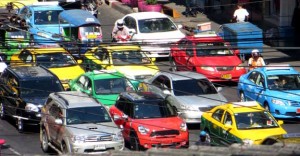
Bangkok ioing to get ws already home to some of Asia’s worst traffic jams. Now it’s get even crankier!

Thai Prime Minister Yingluck Shinawatra’s new first-time car buyer program, while solidifying future votes, will add an estimated 1.3 million vehicles to Thailand’s streets, much of it in already overcrowded Bangkok. It’s already being called a transportation nightmare, where gridlock slows incoming traffic to an average speed of 16.5 km per hour. A brainchild of Shinawatra’s Pheu Thai party, the program offers rebates of up to 100,000 baht ($3, 238, USD) to first-time car buyers who purchase an automobile with an engine displacement of 1500 cc or less. The program is expected to cost the Thai government more than 90 billion baht (approximately $3 million USD) in rebates. 

On top of that, five major high speed rail construction projects will cripple Bangkok’s streets over the next five years. In the final analysis, untold billions of baht will be spent on high speed rail projects intended to get people out of their cars, while 90 billion baht will be allocated to a program intended to get more people into automobiles. As the advertising slogan states, this is why it’s called “Amazing Thailand.”

WoWasis travel product review: Canon PowerShot SX 260 HS camera

Written By: herbrunbridge - Jan• 03•13

Here at WoWasis, we’ve raved for years about our tiny metal-body Canon SD 1100 camera. It’s never died, and has been through so much that all visible making have worn off. But we’ve changed cameras and kept the SD1100 as a spare that we carry in our luggage. Here’s why we did it, and are we happy we did! 

Canon’s new SX 260 HS went on sale, and we bought one. The selling feature was a much more powerful optical zoom (20x vs. 3x). The negatives were that it was slightly bigger (we always carry our camera in our front pants pocket) and the lack of optical viewfinder. It turns out that neither mattered. We’ve used the optical viewfinder less and less as the years went on. And while this camera is slightly bigger than the XXX, it still fits nicely in our trousers’ pocket. To keep the 5 leaf shuttle free of dirt and crud, and to protect the digital viewfinder/screen, we carry this camera inside a small drawstring-type cloth bag. 

In a two week period, we’ve taken 674 pictures and 8 movies with this camera. It wasn’t always in a dirt-free environment, either. Bangladesh, in particular, was rough going, but the new camera survived everything.            The 20x optical zoom we’ve used for lots of stuff, and we wouldn’t go without it, now. Movies are a snap, and you can use the zoom with it.  

The NB-6L battery is good for roughly 350 pictures, and we recommend buying a spare (about $50 USD) if you’re doing a field shoot. The only cumbersome element we’ve encountered is the pop-up flash, which keeps running into our left index finger and creating an error message. We’re still getting used that. This is a GPS camera, but we haven’t yet used that feature, having heard that it’s a bit of a memory hog. It’s nice to know it’s there, because conceivably we’ll use it in the future. 

The amazing part about this story is that we originally wanted to buy another XXX too keep in our luggage, but found that prices for that camera had skyrocketed. We were quoted $250 USD, even though the camera is no longer being made. We paid $199 USD for the SX 260 HS on sale, $50 cheaper and more feature-rich. 

Our rigorous field test has proven to us that the SX 260 HS is a winner to such an extent that when we went back to our SD 1100 (the 260’s battery had run out), we longed for the new camera. Even though we paid $199 in the US, it’s being sold for $350 in Bangkok, where we are today. So watch the sales and buy this camera. For its small size, it’s rugged, feature-laden, and a great buy at just about any price.