The sharper edge to traveling in Asia

WoWasis book review: Harold Stephens’ ‘The Voyages of the Schooner Third Sea’

Written By: herbrunbridge - Jan• 28•13

StephensThirdSeaBookEver thought about cashing it all in, grabbing a sailboat, and traveling in the South Seas? Writer Harold Stephens did just that, and chronicles the romance and challenges of doing so in his thrilling book The Voyages of the Schooner Third Sea (2012, ISBN 978-0-9786951-5-6).

Here at WoWasis, we’ve become real fans of the travel writing of Stephens, who has a knack for storytelling, and eye for the romance of the seas, and is a master profiler of the people he encounters. This book tells of Stephens’ building a ferro-concrete schooner, outfitting it in Thailand, and sailing all over the Pacific. Some of our favorite stories in the book concern people like island hermit Tom Neal, Cheyenne Brando (Marlon’s ill-fated daughter), and Pacific entrepreneur Emma Coe, just three of the unforgettable people the author describes.

The schooner Third Sea’s voyages were a mixture of beauty and challenges:

But it was more than the dreaded “white thing” that made the crew ill at ease. Peter Forte was at the helm with several crew sitting around him in the cockpit. They heard a slapping bang, and thought at first that one of the crew had thrown something overboard. But no one was about. When they heard the second bang they rushed to the port rail. I too rushed on deck when I heard the noise. To my ears it sounded like someone had thrown a plank on the deck. I looked over the side and there came a shock I would never have expected. An eight-foot shark was attacking the ship. We saw the shark back off, linger for a while, and then coming threshing through the water and strike the port side of the hull head-on. He did this several times, striking the hull with his full force. I actually thought he might hole us but he didn’t, thank goodness for a ferro-cement. He stayed with us for ten minutes and then swam off to the south.

We had to break the solemn mood. Robin succeeded by cooking a magnificent dinner—fish-potato cakes with banana flambé for desert, followed by rum punches with the last of our fresh fruit. We had an equally magnificent sunset that seemed to linger forever, while the crew sat along the rail and on the cabin top, listening to Beethoven’s “Emperor Concerto.” Later I noted the helmsman’s comment in the running log: “Colorful ending to an exciting day.” Beauty does follow beauty, and yet one tends to forget beauty. Upon a sailing ship, the sea and sky are infinite with beauty, and surprises. Those wonderful colors we see at dawn, as lovely as they are, they are beyond memory. They are fleeting moments of Joy, never to be duplicated. The world is the sailor’s imperishable painting.

We’ve never read a Stephens book that we didn’t love, and this 379 pager is no exception, filled with adventure and great writing. Available through www.wolfendenpublishing.com


Thai crime scams: international crooks find a home in Thailand, authorities classify them by ethnicity and crime type

Written By: herbrunbridge - Jan• 14•13

Thailand’s easy atmosphere has made it a home base for millions of tourists, but, according to Thai police, it’s also a haven for groups of international criminals. Amazingly, the police have mapped various ethnicities to certain types of crimes, according to an article appearing in the January 14, 2013 issue of the Bangkok Post. Here are the eleven classifications, as defined by Immigration Bureau chief Panu Kerdlappol: 

1)      Latin American from countries such as Mexico, Colombia, Peru, and Guatemala, who steal from elderly and female hotel guests, and rob homes and jewelry stores
2)      Africans, involved in the drug trade
3)      Iranians and Iraquis, involved n the drug trade, in particular crystal methamphetamine smuggling from Afghanistan
4)      South Asians, particularly active in Bangkok, involved in passport and document forgery, enabling their customers to travel illegally to Japan, Australia, Europe, and the U.S.
5)      Chinese, Taiwanese, and Hong Kong nationals, involved in telephone-based consumers scams
6)      Japanese and South Koreans, who extort protection money from Japanese and Korean businesses operating in Thailand
7)      Russians, who run prostitution rackets in tourist areas such as Pattaya
8)      Malaysian and Singapore nationals who forge credit cards
9)      National from Turkey, Bulgaria, and Romania, also involved in cedit card forgery
10)  Filipino, Vietnamese, and Indonesian nationals involved in crooked businesses and gambling ventures
11)  Europeans and Americans specializing in computer crimes involving advanced technologies (e.g. hacking and phishing scams) 

What’s particularly interesting to us here at WoWasis is how the Thai immigration and police authorities have mapped specific crimes to ethnicities. We know of one shady business operating not far from where we stay in Bangkok, run by a member of one of the above listed groups. If the police or immigration authorities ever investigate that business, the above list provides a pretty good road map for the focus area on which they’ll base their initial assumptions.

Medical tourism continues to boom in Asia, but do ensure a professional diagnosis before agreeing to a procedure

Written By: herbrunbridge - Jan• 14•13

Countries such as Thailand, India, South Korea, Malaysia, Singapore, Vietnam, and the Philippines are posting big numbers in terms of medical tourism, according to a story written by Peerapan Tungsuwan in the January 14, 2013 issue of the Bangkok Post. Worldwide, medical tourism accounts for an estimated $100 billion in revenue annually. While Asia’s share seems relatively low, at $8.5 billion, you’d never know it based on the hospitals, clinics, and care centers that have sprung up in major cities in the Asean region. Malaysia and Singapore in particular are experiencing significant growth in this sector annually, at 29% and 12%, respectively. 

What’s particularly interesting are the statistics relating to dollars spent per procedure in the U.S. vs. Asia, as provided by the US Medical Tourism Association. A heart bypass procedure costing $144,000 in the U.S. costs $5,200 in India, and $15,121 in Thailand. Spinal fusion, costing $100,000 in the U.S., costs $6,150 in Vietnam, $6,500 in India, and $9,091in Thailand. Overall, India seems the least expensive alternative to the U.S. in terms of Asian medicine, but Thailand, although more expensive than India, remains a choice for many due to the ease of getting around the country, as well as Thailand’s plethora of resorts. 

As a WoWasis cautionary note, a professional diagnosis of any medical issue is critical. Rumors are already circulating that one well-known hospital in Bangkok appears to be “procedure crazy,” and if true, it certainly wouldn’t be the only one. Healthcare in the U.S. is expensive, no doubt about it. But be sure you have a diagnosis you can rely on before jetting off to Asia.

WoWasis book review: ‘The Strange Disappearance of Jim Thompson’ by Harold Stephens

Written By: herbrunbridge - Jan• 14•13

Don’t let the title of the book fool you. There’s more here than just a story of the demise of the legendary silk king. Harold Stephens’ The Strange Disappearance of Jim Thompson and Stories of Other Expats in Southeast Asia (2003, ISBN 0-9642521-7-1), which originally was published in 1978 under the title Asian Portraits, is actually a compendium of stories relating to fourteen memorable expats, Thompson being the most notable. 

What’s apparent, in reading through these short anecdotal biographies, is how much the author loves people who have overcome adversity. Here at WoWasis, one of our favorite passages can be found on pages 145-146, detailing the brutal training regimen of American Samurai Jessie Takamiyama. Another fascinating portrait is that of belly dancer and serial entrepreneur Zaida Amara, with whom the author also had a love affair. Stephens’ taste for characters is catholic, and here you’ll find planters, deep sea treasure divers, hoteliers, and artists (Theo Meier, to be specific). 

And of course, there’s Thompson, who disappeared forever in 1967 while on a trip to Malaysia, and whose life has been the subject of speculation ever since. The author provides many interesting details about Thompson, enough that an intelligent reader can draw his or her conclusions regarding what probably happened to him. 

In much the same manner as Stephens’ other book of expat biographies, At Home in Asia, this one leaves the non-expat reader with a feeling of wanderlust as well as a vaguely uncomfortable notion that he or she might have done exactly what the subjects of this book did, in cashiering the staid life back home and following their dreams to Asia.

Easy to die in Thailand if you’re not a VIP… man denied an ambulance is proof

Written By: herbrunbridge - Jan• 14•13

In Bangkok, all of a sudden you have a stroke and an ambulance is called. You’re a photographer there to cover a news story. Everyone in the medical profession knows that it’s critical to get you to the hospital within an hour, before you begin to lose brain function that will soon be unrecoverable. You’re awake, so you know exactly what’s happening. You’re loaded in the ambulance, but it doesn’t go anywhere. It just sits there, not moving. Your splitting headache is killing you. Literally. Minute by minute. You say “Doc, I’m losing it. Help me.” But no one helps, and you lie there, your brain slowly hemorrhaging to death. Finally, after 30 minutes, your ambulance finally leaves for the hospital, your EMT crew relieved that another ambulance arrived to take its place. After all, an ambulance always has to be available at the Thai Parliament in case a politician needs an ambulance. But you’re only a photographer, and your life isn’t worth as much. Based on the law, you’ll wait until another ambulance arrives. In the meantime, if an MP (Minister of Parliament) needs and ambulance while the backup ambulance is on the way, you could be put out on the sidewalk. But the replacement ambulance wouldn’t take you either, as it would be there solely for the MPs. 

This isn’t fiction. It happened this week at the Thai parliament, where photographer Sakol Sandhiratne of The Nation newspaper suffered a stroke on January 10, and was delayed critical treatment for thirty minutes, while his ambulance waited for a replacement ambulance to arrive. The law states that Ministers of Parliament must have an ambulance available to them at all times. The story has captivated a nation, propelled by newspapers angered particularly because the victim was a member of the press. Sandhiratne is expected to live, but his brain function has yet to be determined. It could very well be that he’ll never be the same again. 

VIP treatment for the privileged is part of Thai life. Traffic coming to a halt on Sukhumvit to allow a fleet of cars carrying VIPS is relatively commonplace. But valuing the life of an MP over a photographer, considering that medical assistance was at hand but not given, has shocked the country. The Nation’s op-ed page had it right, in its headline of January 13, 2013: “The case of a news photographer being denied medical help at Parliament is a deeply disturbing indictment of an uncaring society.” In Thailand, Parliament makes the laws. The fact that it has made one elevating the lives of MPs over those of the common people doesn’t set an example for ethical fairness or — with the exception of royalty — the democratic tenet that opines that all are created equal. 

And what of the Hippocratic Oath supposedly taken by the medical professionals that denied help to an individual that was, essentially, dying?  It’s easy to die in Thailand. Fall off a building, get hit by a bus, or cover an event at Parliament. Today, several days after the event, Sandhiratne remains in critical condition, has not regained consciousness, and has been diagnosed as having a severe brain injury.

Welcome to Bangladesh: an introduction

Written By: herbrunbridge - Jan• 09•13

Welcome to Bangladesh! Here, braving the challenges of a country that doesn’t have much of a travel infrastructure for the westerner does have significant rewards. You’ll see things most people you know haven’t, like the wonderful historical temples and mosques outside of Rajshahi and Bagerhat, outside of Khulna. The Sundarbans National Park consists of the world’s largest mangrove forest. Friendly Bangladeshi people everywhere will help you get to your destination. Lots of them are university students who speak great English, too. The nation’s street stall vendors carry much of the color of Bangladesh. 

Transportation here has its highs and lows, but once you’ve gotten your train ticket and found your seat, you’re on a roll. Like any country, you’ll have a few downers, too. We’d be remiss if we didn’t warn you about Dhaka traffic and Bangladesh’s pollution and hygienic challenges 

Adventure travel is an apt description of what it’s like to travel in Bangladesh. Here, you’ve got most historical sites to yourself, often accompanied by some of the world’s most polite kids. Tour buses are absent for the most part. There’s a great argument for going to Bangladesh now, before the government wakes up and makes it easy.

Bangladesh pollution, air, land, and hygienic, still daunting to visitors

Written By: herbrunbridge - Jan• 09•13

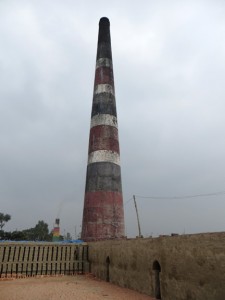
Brick factories are huge and noticeable polluters in bangladesh

You first notice it from the air, about 100 miles out from the capital of Dhaka’s Hazrat Shahjalal International Airport. The air below you has suddenly turned yellow, created by plumes of smoke coming from industrial chimneys that you later learn are from brick factories. In Dhaka city, despite the fact that many vehicles now run on CNG (compressed natural gas), the air smells nasty and there’s no blue sky. The developing nation of Bangladesh is wrestling with how to solve its pollution, garbage, and health and hygiene issues. It’s slowly moving in the right direction, but its plodding, small successes can frustrate the visitor. To wit: 

1)      Dhaka’s air is so polluted that it’s a pleasure leaving the city for the country.
2)      Plastic bags, empty cigarette packs, cans, bottles, you name it, they’re all thrown out of vehicle windows constantly. Garbage is everywhere, and public trash cans —in every locality — are pretty much non-existent.
3)      Western-style pedestal toilets are not the norm in public areas, leading to a hygienic nightmare. Let’s forget about the general filth of railway car and station restrooms for a second. In the departure area of Dhaka’s international airport, someone had taken a dump on the toilet seat. This is in the departure area! Everyone’s gone through security check and customs! Goodness knows how long it had been there, but what was obvious was that the last user had just climbed up on the seat and let it fly. Given the price of international air fares, this had to be done by a person with money. All restrooms in the international airport are filthy. How often are they cleaned? 

So here’s what we at WoWasis suggest when traveling to Bangladesh. Forget about western ideas of cleanliness. Bring baby wipes from your own country if you have to. Consider strongly that you may want to consider confining certain bathroom tasks to your hotel room bathroom only. You can’t do anything about air pollution, but the sooner you leave Dhaka, the happier you’ll be. 

For the Bangladeshi government, we’d say this: your international airport is what creates the first and last impressions many people have and take away from your country. The world isn’t going to be impressed that you’ve outlawed the sale of beer in your country. But it will be impressed when you’ve learned how to clean a restroom in your capital’s international airport departure area.

Thailand Corruption Watch: Thai civil servants hopelessly in debt, so watch your pockets

Written By: herbrunbridge - Jan• 09•13

We don’t know what she’s selling, but whatever it is, Thai civil servants are buying it

Westerners doing business in Thailand frequently complain about the bribes they have to pay for many government-related services. Thais pay them too, but there’s a two-tiered structure, and farang always pay more. It what will surprise no one, it was reported in the January 9, 2013 issue of the Bangkok Post that Thai civil servants are carrying a huge amount of personal debt. 22 times their monthly salary, as it turns out (another way of looking at it: they’d have to work 22 more months without spending anything, just to pay it off).

Geez, we ask here at WoWasis, how are those guys ever gonna pay it off?! Debt service was accelerated during the Thaksin Shinawatra years, as the Prime Minister declared personal debt good for the country. Going into personal debt was absolutely patriotic, he gushed.  Here are some daunting statistics, collected from interviews with 13,252 civil servants…

83% of civil servants are in debt, with an average debt of 1,111,425 baht ($36,416 USD) per household. The average civil service salary is 49,915 baht ($1,635 USD, or $19,620 USD per year). What do these folks do to get in debt? 55% is in home loans, 17% for car loans, 15% in personal loans, 6% for loans to invest in family businesses, and 4% in educational loans.

ThailandPromoBannerThailand is a consumerist country where conspicuous consumption, especially among the young, has taken hold. The concept of saving for a rainy day is anathema for many. So if you’re doing business in Thailand, pony up! Salaries are fixed, but the grease you pay to get something done is on a sliding fee scale that only goes up.

WoWasis visits Bagerhat’s exceptional historical temples and mosques near Khulna, Bangladesh

Written By: herbrunbridge - Jan• 08•13

Collecting the daily water at Ranabijoypur mosque

The city of Khulna, 12 hours south of Dhaka by train, is not only the gateway city to the Sundarbans National Park, but it’s also near to the town of Bagerhat, which hosts a number of wonderful historic masques and temples that you can see in less than one day,  by hiring a car and driver from Khulna. As a bonus, Khulna has a very nice old quarter in which to stroll, with old colonial houses is varying states of disrepair on virtually every block. It’s scenic, laid-back, and a fun walking town. But the Khulna highlight was, for us here at WoWasis, those historical temples and mosques of Baherhat. Rent a car and driver, go to Bagerhat, and here’s what you shouldn’t miss:

Shait Gumbad Mosque

Shait Gumbad Mosque, built in 1459, has been called the most significant historical mosque in Bangladesh, and it’s a beautiful brick and terra cotta structure. It boasts 77 domes, and its interior consists of whitewashed archways. It’s massive, and its towers have the banded decorations seen in traditional Tughlaq architecture. Right across the street from Shait Gumbad is the picturesque, one-domed Singar Mosque, set in a beautiful small garden.

Chunakhola Mosque

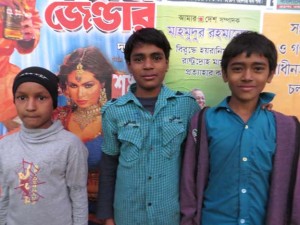
There are two other mosques within a short drive from Shait Gumbad. Our favorite, of all the ancient mosques of Bagerhat, was Chunakhola Mosque, located in a paddy field.  Your driver will have to take you to the small dirt access road. You then walk half a kilometer of so through a wonderful small village to the mosque, which suddenly appears in a clearing. Chances are, you’ll be the only one there, unless some local school children decide to accompany you to tag along, practice their English, and gather some boasting points that they’ll later use at school when telling about the westerner they met along the road. The mosque is stunning in its setting. Nearby to Chunakhola is the Bibi Begni Mosque, now shoehorned into a small site, but which has some intricate floral designs worth noting.

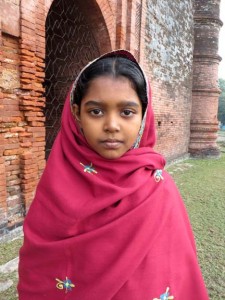
Friendly children always enjoy greeting visitors at ancient Zinda Pir Mosque

Two additional mosques are located adjacent to the Thakur Dighi pond, and are very much worth seeing. The Nine-Domed Mosque has a mihrab (prayer niche) inside that has wonderful floral reliefs. To enter, unfasten the metal door, remove your shoes, and remember to fasten the door again when you leave.  Short drive around the pond will take you to the Zinda Pir Mosque, located in a very pretty open setting.

While near the Thakur Dighi pond, you’ll want to visit the tomb of Khan Jahan Ali for historical reasons, but be warned: it’s a pilgrimage site, so expect to be panhandled by mendicants and mosque attendants.

The amazing Khodla Math temple

A km or so north of Khan Jahan Ali’s tomb, just off the main road, you’ll find the magnificent Ranabijoypur Mosque, with its 11 meter dome, the largest in Bangladesh. Gain, it’s in a small setting that you’ll probably have completely to yourself, with the exception of one or two neighborhood women who will collect water from the nearby well.

Your final stop with be to the one temple in the area, but you’ll have saved the best for last. The Khodla Math Temple is located 11 km from Bagerhat, in the village of Jatrapur. Its 20 meter high spire is filled with animal and human figures and geometrical and floral motis. Builit in the 17th century, this structure is a must-see, so be sure that your driver takes you there. Mr. Alam, the friendly caretaker, will want to show you a few of the motifs, including the elephant to the upper right of the entrance, and the apsaras (dancing women) on the left side of the temple’s outer wall.

WoWasis travels Bangladesh’s Sundarbans National Park, the world’s largest tiger-infested mangrove forest

Written By: herbrunbridge - Jan• 08•13

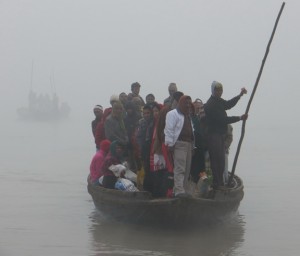
Fog creates ghost-like images in the early morning in the Sundarbans area

The world’s largest mangrove forest, actually. It’s amazing to many Westerners that people still get eaten by lions and tigers. We here at WoWasis remember when we were at Namibia’s Etosha National Park when it happened. A German visitor had slept on a bench outside a watering hole, protected by a barbed-wire fence. An old female lion managed to conquer the fence, and ate the visitor from the top down. What remained of his lower torso sat on the back end of a flatbed truck for a few hours until it was removed. When he was attacked, he let out a piercing scream, causing a woman to open the door of her rondavel to see what the commotion was all about. Seeing that he was being attacked by a lion and remembering that she’d heard lions were frightened by camera flashes, she grabbed her camera and started flashing away, to no avail. Her comment the next day was “what a terrible time to run out of film.” 

A friendly river family hangs out the wash and enjoys watching the boats pass by on the Pusur River in Bangladesh

Which brings us to the Sundarbans National Park in Bangladesh, the largest mangrove forest in the world. Here, three to four people get eaten by tigers every week. A good way to be eaten is to be a fisherman working in a small boat next to the waterline. Big cats watch for habits, and a tiger is good at waiting for prey that it knows will eventually be coming. Visitors can take boat tours of the Sundarbans lasting from one to three days, and its immediately noticeable how scared the guides are of tigers. On the ground at the Harbaria station, tiger footprints are everywhere. The visitor on a walk is always accompanied by a guard with a rifle, and will notice a bamboo grove every now and then that has been painted with red and white stripes. That’s a no-go area where tigers are known to be active at any and all hours. 

Huge tiger paw-prints show that this animal means business

The beauty of a Sundarbans visit lies mainly in enjoying watching the riverine life on the Pusur River. Your boat will pass by tiny fishing villages, friendly families and stevedores will wave at you. You’ll see mangroves as well as a number of other tree varieties, including the Sundri, which the forest is named after (Sundarbans literally means “beautiful sundri forest”). You’ll see a few birds, maybe some monkeys, but not a lot of wildlife variety. And you’ll pass by the entertainment town of Banisanta, where sex is sold by extremely young ladies for a few taka, and your tour boat probably won’t take you for a shore visit. 

This Sundri tree is surrunded by tiny mangrove shoots

You can tour the Sundarbans by boat for one or three days. We took the one day tour, as we just couldn’t see the value of staying 3 days in a mangrove forest when one would obviously do (tour companies couldn’t sell us on it, either). And remember, alcohol is illegal in Bangladesh, so forget about enjoying a mangrove forest sunset on deck while sipping a beer. 

A one-day boat tour will cost you roughly $120 USD for one person, with the price dropping per person if more people are involved. Book the tour from your hotel in the cities of Khulna or Mongla, from where your boat leaves.