The sharper edge to traveling in Asia

WoWasis travel clothing, accessories, and gadget reviews: why we field test

Written By: herbrunbridge - Jun• 05•11

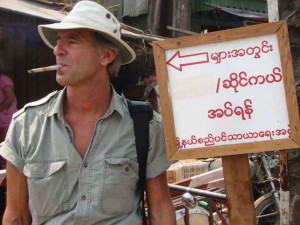
One of our field team testing shirts, hats, and cheroots in Burma

Here at the WoWasis Travel eStore, we like to rigorously test the items we promote. We wear them, use them, and beat the living hell out of them. We’ve had shirts shredded by African bush thorns, cameras sullied by Javanese volcanic dust, phones wrecked by falls. We even had a shirt destroyed by sulfuric acid fumes after we spent some time in a caldera in Greece (the whole thing came apart the next time it was washed). You name it, we’ve destroyed it. After cumulative decades of rough travel, we know what works, and what breaks.   

We’re always testing things in our travels, but some are tried and true, and we use them all the time, because they don’t fail. We’re testy. We loved a particular Pro-Camfis shirt, for instance, but it the fibers broke down too fast. We ended up going to a tailor in Bangkok, picked our own fabric, created a style, added zippers where we wanted them, and that’s what we travel with now, shirt-wise. You can’t buy that in stores or online, but we’ll report on stuff you can find. We bought it all with our own money, and we’re just like you. We want it to wear well in the field and be durable enough that we don’t have to keep spending for things that don’t work. Our Clothing Accessories Gadgets category in the blog is where you’ll find items that we’ve found pass the muster, and you can read our field test reports. You can buy many of these items in our eStore. If you’re always staying in 5 star hotels, you may not need goods that can take a beating. But if you’re in rigorous desert, jungle, or urban conditions, check out our posts.

WoWasis travel clothing review: Eagle Creek Money Belt

Written By: herbrunbridge - Jun• 05•11

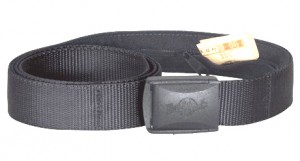
The best money belt in the business: looks cheap, and that's why it works

Here at WoWasis, we wuz robbed. But the Eagle Creek All-Terrain money belt saved all our money, because the robber never knew it was a money belt. That’s why we recommend it, and here’s the story. 

Savvy travelers that we are, we still got a date-rape drug snuck into our beer at an outdoor ad hoc bar in a major Asian city. Millions each year drink in these establishments, and almost all are honest. Not this one. We passed out, someone went through our pockets, and stole just about everything. But not the $300 USD we had tucked in our Eagle Creek money belt. The belt itself looks cheap, and that’s probably why it wasn’t touched. 

There are money belts and there are money belts. Some are just plain stupid, like the ones you wear around your neck (see story above for a good reason not to carry one). This one works because it looks like a standard variety inexpensive belt made out of webbing material, nothing a thief would ever care about. Its hidden zippered security pocket safely conceals currency, about 15 bills, which you fold in thirds, lengthwise. It will hold a photocopy of your passport, too. It’s so thin that it doesn’t look like it could hold any money at all. That’s another reason it works. 

It’s adjustable, with a quick release, slim cam-style buckle, and one size fits all. To size it, simply trim the leading edge to fit, then hold a match to the end to seal the cut. It’s extremely durable. We’ve used it for several years, and looks as good as new. This belt costs under $20 USD, and as our story attests, it’s the only one we’d carry. Highly recommended. Buy it now at the WoWasis estore, powered by Amazon.
WoWasis on Thai nightlife: Texas Lone Star in Bangkok closes for good

Written By: herbrunbridge - Jun• 04•11

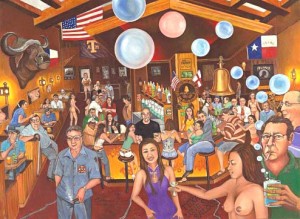
Texas Lone Starr Saloon, painting by Richard Diran*

Bangkok’s venerable Texas Lone Star Saloon closed its doors this week for good. A Washington Square institution since 1985, the bar actually had its beginnings in the late 1970s, when George Pipas opened the Texxan Bar on Patpong Road. The ‘Lone Star,’ as most people referred to it (it was actually spelled Lone Staar on the sign), was a legendary hangout for CIA and Special Forces types, war vets, and writers like Dean Barrett, Stephen Leather, and Chris Moore, who often held book signings there. For those mourning the loss of the bar as well as for those who never entered, Dean has placed a wonderful 6 minute video tribute of it on YouTube. 

If you’re in Bangkok long enough, you’ll end up having your own favorite bar. It will generally have bar girls, but not go-go dancers. It will be more of a comfortable, worn, slightly or mightily seedy joint where you can talk and drink with your friends. Most of the women working there will not be young. The music will be Vietnam-era and later rock and roll, never rap or techno. And eventually it will be torn down, like the Lone Star, so that a newer building will go up. And there goes the neighborhood. 

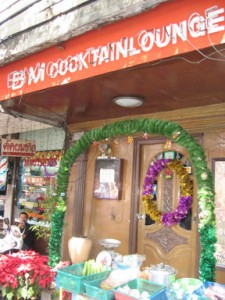
Here at WoWasis, our favorite was a joint on Sukhumvit called BM Cocktail (the sign read BM Cocktain, exactly the way Thais pronounce the word). We visited because we liked the name. The bartender was Chai, a Singaporean Chinese. Nui was its only waitress, who Chai referred to as “grandmother” to annoy her. Over the course of a few years, it became our hangout. We brought our friends here, drank and carried on, always at Chai’s bar, rather than in a booth. A few Japanese were always in the booths with the bar girls, and BM charged customers by the hour for conversing with them, so we were always the only Western folks in the place: only the Japanese will pay for conversations in Bangkok. 

One day, abruptly, the BM closed, the victim of another land sale. Bars like the BM never reopen. Chai left to work as one of several bartenders at a disco in the north of the city. Nui took a new job as a waitress at a restaurant on Soi Thonglor. We’ve stayed friends, but it will never be like it was at BM Cocktain. And that’s how it will be with the Lone Star. Everyone’s going to remain friends, they’ll share more drinks, continue to talk about the usual nonsense, and gather at other spots, none of which will have the veneer of the old bar. 

We often chide Westerners for always crowing about “the good old days” in Bangkok, and how today isn’t nearly as good as yesterday. “You should have been here 20 years ago,” is the standard lament. The closing of bars like BM and the Lone Star, though, contradicts the point. The good old days are actually today, where the bar you’re sitting in right now may suddenly close in the inexorable march Bangkok makes daily to tear down the old buildings and businesses in order to build high-rises. You’re living the good old days right now, and these are the times you’ll be reminiscing about in the not-too-distant future.

*The paiting at the beginning of this post was done by Richard Diran, a writer and painter living in Bangkok. You can purchase a copy of this painting, as well as others, at his website.

Bachelor in Bangkok: Khun Lee on short-times, long-times, and freebies

Written By: herbrunbridge - Jun• 04•11

To pay or not to pay, that is the question.  No, I am not misquoting Shakespeare but referring to the dilemma of being a womanizer in Bangkok.  Do you look for a regular girlfriend, or just pay for short term relationships?  Worse yet, do you pay a lady for short term love and then pay her a “salary” to be your constant companion?  Living in Bangkok means that you have so many choices when it comes to female companionship that it boggles the mind.  Herein lies the dilemma.  With so many choices it is necessary for the guy to know exactly what kind of life he really would lead if he could do it anyway he wants.  We men don’t have the best reputation for being introspective and understanding our inner most feelings.  In Paradise you can do it anyway you want.  You can have a regular girlfriend and do short time ladies on the side.  You can stay single and have a string of one night stands.  You can have several “special” arrangements with ladies and occasionally bring a new one into the picture just for the hell of it.  There are literally dozens of other combinations and possibilities and I must say many guys end up running around like a crazy man the first year or so in a total manic state.  We just aren’t used to being able to do anything that we want, at anytime we want, with anybody we want. 

The men who seem to get into the most trouble are the one’s who think they want to have fun, but deep inside they are really looking to be loved.  Obviously the ladies in the naughty nightlife are for fun, and the other 99% of the population you can explore looking for that special love.  Problem is, this group of guys take naughty gals for fun, then try to turn them into a “good girl” by buying her out of the bar (yes I know that is an awful way to put it but that’s what it is called here) and lavishing her with money and gifts.  It blows up in their faces nearly every time and then they blame Thailand for all of their problems.  It really is nauseating to hear one of these morons drone on and on in your local pub about how his special little go-go gal turned out to be nothing but a gold digger.  It is free entertainment but after hearing the same story (but with different characters) a few hundred times it really does get old.  I have a personal theory about this phenomenon that I call “modern day natural selection.”  I am sure you are all familiar with Darwin’s theory of natural selection that basically says the strongest animals survive and mate and produce offspring.  Well, in this modern day it is not how physically strong one is that determined success and failure in life but how intelligent or mentally strong.  These guys who send money to bargirls are at the bottom of the evolutionary ladder. 

We local lads do benefit a lot from these “sponsored” gals as they end up having plenty of money and almost unlimited free time.  My best English mate has really exploited this to his advantage better than anyone I know.  Flash (changing his name to protect the innocent) has a string of gals who used to work the streets and bars but now have sponsors and are often willing to sleep with him for free.  Fair enough as this is very common here.  One thing that is consistent with all the gals is that they need to have at least one guy in their life that they sleep with for fun and not for money.  More often than not this is a Thai guy, but it is becoming increasingly common for this to be a western guy.  So if you have a gal on salary, I guarantee that she has at least one guy (probably more) that she sees when she actually wants to have fun.  Makes perfect sense to me as the gal is working when she spends time with her sponsor, and certainly everyone needs to have some sort of social life outside of work.  Flash has a few very impressive freebies, but he has taken this fortuitous situation one step further.  He washes all of his clothes before they come over and stacks them up on the sofa.  Then the day after love making tells them that they are expected to do his ironing!  I can just see the gal’s eyes now when she walks into his place for some fun and frolic and spots the huge stack of un-ironed clothes.  “This guy is going to pound me all night and then in the morning when I am totally exhausted I will have to iron all his clothes! “ Cheeky bugger but I do love the guy. 

My favorite quote this week comes from a guy I met in Nana Plaza who travels the world selling medical devices.  While staring and drooling at one particularly sexy lass in Angel Witch, he said “there are entire countries that don’t have a single girl that good looking.”

Read Khun Lee’s other WoWasis columns for more advice on navigating the adult dating scene through the backstreets of Bangkok

WoWasis travel clothing review: EcoSox hiking socks

Written By: herbrunbridge - May• 31•11

Here at WoWasis, we’ve burned through many a pair of hiking socks. We’re not easy, either. We’re active in burning deserts, teeming jungles, and rubble-strewn urban streets and roadsides. Our socks have to be tough, have to wick away moisture, and provide a good deal of cushioning to avoid blistering. And they have to be affordable. 

We’ve been testing the Medium Hiker sock from a U.S.-based company called EcoSox, and we’re happy with the results. This sock is made primarily from viscose derived from bamboo (80%), along with Polyester (10%), Nylon (5%), Spandex (3%), and rubber (2%). These socks are tough, with a reinforced heel. They are, as their advertising suggests, cool in summer, warm in winter. 

It’s not uncommon for us to have to wear a pair over a 3-4 days period, and we’ve found that with the use of foot powder, they can go four days easily before they start to smell grungy. They air-dry quickly, and hold up well: we’ve used one pair more or less continuously for 5 months with repeated machine washings, and the synthetics keep these socks in good shape, still holding on the ankle, free of holes and other wear, and sturdy. 

Now for price. We originally saw EcoSox in a hiking store where they retailed for $15 USD, far too much to pay. You can buy them directly from the EcoSox online store for $6.00 USD, well worth it. In our road-test, these socks held up extraordinarily well in  arduous conditions, highly recommended at the $6 price point.

WoWasis book review: ‘Common Core: Thais and Americans’ by John Paul Fieg

Written By: herbrunbridge - May• 26•11

Westerners in Thailand who employ Thais know what a challenge that can be. And conversely, Thais working for Western expats often find relating to their direct reports is sometimes more difficult than the job itself. The beauty of John Paul Fieg’s A Common Core: Thais and Americans (1978, ISBN 0-933-662-80-7) is that it examines core values of both cultures, explains why they are often in conflict, and offers cogent business-world solutions in which neither culture is to blame. And amazingly, he does it in 112 pages. 

Fieg states that the essential problem is a different relationship each culture has with the concepts of Time and Authority. In dealing with the former, Westerners are often frustrated with the lack of planning evidenced by Thai workers (as a street example, how many Bangkok bar girls making $20,000 USD a year are saving anything for their futures?), but Thais, as Buddhists, see time as a continuum involving successive lives, and therefore have difficulty relating to overall western business objectives with a finite end-point. In terms of Authority, Western managers are easily frustrated with the concept of kreng jai, in which a Thai worker will refuse to divulge bad news to his or her director for fear of causing offense, even when the bad news is information critical to the success of the company. 

Fieg’s talent (as well as that of Elizabeth Morlock, who revised the book in 1989) lies in putting these issues in the context of history and culture. Over 100 Thais and Americans were interviewed during the writing of the book, and opinions of those interviewed are strong. Here at WoWasis, some of our favorite passages deal with the glacial pace of negotiations with Thais (p. 107), their emphasis on benevolent paternalism (p. 86), and the concept of personal time off during the work day. Consider this excerpt: 

     This very different approach to life was one of the hardest things for an American anthropologist working in Thailand to get used to- Once in the midst of an important interview, his Thai field assistant told him—with no forewarning—that he had to leave because he had to be in Bangkok in an hour and a half. He explained that he had promised a friend he would meet him at the movies and thus had to go. When asked why he had made a movie date during working hours, he answered, “Well, this was the only time my friend could go.” Several incidents of this kind with different assistants convinced the American that he and his Thai coworkers were clearly operating on different cultural wavelengths.
     With his lineal sense of time, the American had planned and scheduled his work. This was the day to conduct the interview. Tomorrow he would hand out a questionnaire. The next day he would go over the answers, etc. To waste a day, or even worse, several, would violate his deeply ingrained sense of the productive use of time. He had no doubt received a sizable grant to carry out his research. How could he justify just sitting there enjoying the shade of a coconut palm?
     To his Thai assistant, such thinking was clearly bizarre. What difference could it possibly make whether the interview was carried out today, tomorrow, or next week? The villagers are always going to be here; what’s the rush? My friend, on the other hand, can only go to the movie now; so it’s clear I have to go. To the American way of thinking, the Thai approach seems unpredictable and wasteful. In Thai terms, the American pattern precludes spontaneity andtakes the fun out of life. 

All-in-all, any Westerner doing business or wanting to do business with Thais should read this book. Many Westerners make the mistake of thinking that because Thais seem to be inevitably smiling, they aren’t as complex or intelligent as Westerners are. As the book cogently points out, that’s simply not true, and any Western manager that doesn’t make an honest attempt to understand the reasons underlying Thai behavior probably isn’t going to last long running a business operation in Thailand. There’s a whole lot of wisdom in these 112 pages. Highly recommended.

Why can’t bad-smelling foreigners smell themselves?

Written By: herbrunbridge - May• 24•11

The Good Manner: Advice on Thailand from WoWasis’ Pa Farang
This week’s dilemma: Bad-smelling foreigners can’t smell themselves 

Dear Pa Farang,

In a recent blog post, it seemed as though WoWasis ripped through the farang community, somehow saying that the majority of us smell bad.  What wasn’t said was that many deodorants and anti-perspirants have dangerous and/or irritating chemicals in them, and represent a health hazard.  I don’t use deodorants, but do wash every day, and have never had a complaint.  Deodorants are also expensive.  You owe it to your readers to mention the hazards of everyday deodorant use.
– BKK Vet

Dear Vet,

After a discussion with a friend last night, we concluded that one of the problems is that smelly people simply can’t smell themselves, through either a misfiring nose, or because they’ve become used to the smell.  The problem in such cases runs the gamut from general health to adherence to habit.

Pa Farang is not the expert on chemicals, but he does walk the streets, sometimes trailing behind some fairly odiferous western desperados.  In a discussion I had some years back, a young lady told me she eschewed deodorants, and used a rock instead, because she’d heard the chemicals in deodorants caused cancer.  Frankly, the rock wasn’t working, and I told her that while, to my knowledge, no one had ever died of armpit cancer, many die daily from exposure to BO.

In hot, humid Bangkok, BKK Vet, you’re probably not getting complaints because people can’t get near enough to you to hold a discussion.  I’ll refrain from suggesting you see a doctor for a nose test, but frankly, you may be used to your own smell.

It should be de rigueur for every farang to wash at least once (that’s minimum, by the way) daily, and use a good deodorant.  Arrid XX Unscented solid is surefire, if you’d accept a recommendation, battle tested through jungle & desert.

Your comment about the price of deodorants can be addressed accordingly: use a deodorant, and you slightly offend your pocketbook.  Don’t use one, and you strongly offend a nation.

Marayat dee,
– Pa Farang

Read Pa Farang’s other columns in WoWasis for more advice on relationships and cultural matters in Asia

WoWasis book review: ‘History of the Mongol Conquests’ by J.J. Saunders

Written By: herbrunbridge - May• 24•11

In this relatively short (191 pages) but powerful narrative, J.J. Saunders makes an effective argument that the series of Mongolian invasions of Europe and Asia, beginning in the early 1200s, was a major factor in shaping both European culture and Asian religions for centuries to come. The History of the Mongol Conquests (1971, ISBN 0-8122-1766-7) tells the story through a succession of Mongol rulers and potentates, beginning with Chingis (Genghis) Khan, and including Kubilai Khan, Timur (Tamerlane), and the Golden Horde. As the author notes, writing any such history can be a challenge, as extant historical material is written in several Asian languages. 

The book contains maps show conquest routes, stories of privations (entire populations were commonly killed for refusing to capitulate early enough), and other interesting data. We didn’t know, for instance, that Mongol arrows had a range of 200-300 yards. The endnotes are outstanding, proving a rich resource for scholars, and Saunders’ final thoughts make the book important reading for anyone wishing to understand Europe in the Renaissance and the Islamic dynamic as it exists today:

During the four centuries from 800 to 1200 Islam had enjoyed a
cultural predominance; the science and philosophy of the Greeks,
commonly filtered through a Syriac channel, had fertilized the
mind of the Muslim world and stimulated it to an impressive
creative activity, and Arabic acted as the lingua franca of scholar-
ship and letters over a wide segment of the globe from Spain to
Transoxiana. In medicine and mathematics, in history and
geography, in logic and philology, in music and astronomy, in
physics and chemistry, the men of many races who wrote in
Arabic enriched mankind by extending the horizons of know-
ledge and improving the techniques of inquiry, as for instance
by the use of the so-called Arabic numerals. The brilliant culture
of Islam shone the more brightly by contrast with the stagnant
scientists and commentators were introduced into the West to
inspire the intellectual awakening which culminated in the
Renaissance. But with the death of Ibn Rushd (Averroes), the last
great philosopher of Islam, in 1198, the primacy of Arabic-Muslim
culture may be said to have come to an end. The invasions, first of
the Turks and then of the Mongols, and the long and bitter
struggle against Isma’ilianism, had forced the Muslim orthodox
to close their ranks, systematize their theology, cease to tolerate
freedom of speculation, and discourage intellectual effort not
directly related to the furthering of religious piety. In the new
schools or madras, a product of the Seljuk age, little was taught
save the Koran and theology; the professors were exponents of an
unbending scholasticism, and al-Ghazzali, the Aquinas of Islam,
conducted a lifelong campaign against a ‘philosophy’ which he
considered no better than atheism. In the post-Mongol age theo-
logy won a resounding victory; free scientific inquiry was virtually
suppressed, and Islam shut itself up in its past. 

This passage is typical of the thought-provoking analysis found in every chapter of the book, recommended for anyone wishing to know more about this important, but still little known and understood age. Buy it now at the WoWasis estore, powered by Amazon.
Toilet Trucks in Bangkok: business is good when business is crappy

Written By: herbrunbridge - May• 22•11

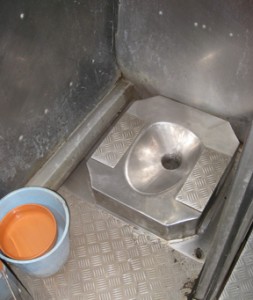
Welcome aboard! Thai mobile toilets ready for visitors.

Need to go when you’re on the go? Then Bangkok Municipal Administration’s fleet of 31 toilet trucks can help. These aging green mobile giants sport four toilets and six urinals, and are used as public conveniences during protest activities and public events. Each truck contains 2,000 litres of water, enough for 500 flushes. Detritus is pumped out periodically via tanker trucks.

Think your job is bad? Bangkok’s toilet truck workers make 150 baht ($5 USD) per day, have to put up with bad smells, premature depletion of water due to people washing their clothes in the truck, and customer complaints when the water runs out (they try to replenish it every two hours). All currently operating toilet trucks are more than 20 years old, and plans are being made by Bangkok’s Environmental Office, which has allocated 20 million baht to add four brand new trucks to the aging fleet.  

Aluminum stalls are optimized for bleach-washing, and water buckets are always available for good cleaning.

We here at WoWasis note that Thailand is one of the world’s cleanest countries, hygienically speaking, as virtually every bathroom in major cities has a toilet hose, a device which keeps users meticulously clean. We’ve yet to see these trucks in any other country, and although they aren’t perfect, they are an ever-present element whenever a mass protest takes place in the City of Angels.

WoWasis Book review: Timothy Hallinan’s ‘Queen of Patpong’

Written By: herbrunbridge - May• 15•11

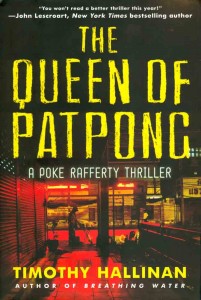
How does one really judge the entertainment value of a book? Timothy Hallinan’s  book in the Bangkok Fiction genre, The Queen of Patpong (2010, ISBN 978-0-06-167226-2), caused us here at WoWasis to ask, and here’s why. We finished this 312 page book, the latest update in the ongoing saga of travel writer Poke Rafferty and his family, in two nights. At a published price of $24.99, that’s $12.50 a night for two evenings worth of entertainment. Less than a movie and popcorn, less than most bottles of cabernet, less than a baseball game. Of course we could have taken longer to read it, but it was damned enthralling that we couldn’t put it down. 

Readers of Hallinan’s previous novels will not be shocked that his family is again in peril, this time from a shadowy westerner from his wife Rose’s bargirl past. What Hallinan brings to this book is the story of Rose’s personal history, from growing up in a poor Thai Isaan village to getting sold as a virgin into a bar on Bangkok’s Patpong Road. In telling that tale, he introduces our favorite character in the book, Nana, an older village girl who finagles Rose’s surreptitious and sudden train ride to Bangkok. We won’t reveal the nuances of this remarkably rich element of the plot here, but what we found exceptional was the dialogue between the experienced-beyond-her-years Nana, and the shy village girl Rose. Many previous Bangkok Fiction novels dealing with similar thematic material tell a story considerably like this one, but none we’ve read have the richness of dialogue in the interplay of what is essentially a sales situation, where Nana sells the reluctant teen on the value of going to Bangkok. Hallinan takes 20 pages to do it, and it’s a masterpiece in the art of objection-handling. 

Here’s an excerpt from that dialogue. Kwan is Rose’s village name, and here Nana works on convincing her that by going with her, rather than the people to whom Kwan’s father would be selling her, Kwan will have at least some control over her life:

” … I’m not going.”

“You’re even thicker than I was afraid you’d be.” Nana takes a long, angry drag that turns the coal on her cigarette a brilliant, hellish red.

Kwan looks away from it, letting the darkness soothe her eyes. “You haven’t asked the important question.”

“What is it? What’s the important question?”

“What happens if you don’t go with me. And don’t talk to me about your wonderful teacher. She can’t do anything.”

Kwan lifts her feet again and puts them on the bench, her long legs folded vertically in front of her, knees as high as her chin. She puts her hands, fingers spread, on top of the familiar curve of her bent knees.

Nothing there comforts her. Her knees feel like they belong to someone else. “What happens?”

Nana looks down at the cigarette in her hand and then drops it into the dust. She shifts the blanket a little, making sure Kwan is covered, and slides closer, so that Kwan can feel the other girl’s body warmth and smell something sweet and flowery on her loose, thin clothes.

Nana sighs. “Day after tomorrow, on your way home from school, three men will grab you. They’ll wait until you’re walking alone. They’ll cover your mouth with tape and put these tight things on your wrists that will hold them behind your back. They might do that to your feet, too. They’ll throw you into the back of a car and drive you to Bangkok. One man will drive. Two will sit in back. They’ll touch you any way they want to, but they won’t do anything that would cost their bosses the money they’re going to make from selling you as a virgin. But they can think of plenty of things to do without that. By the time you get to Bangkok, you’ll feel like filth.”

“My father wouldn’t do that to me.”

Nana doesn’t say anything- Kwan closes her eyes and listens to thefrogs as they sing the songs she’s heard her entire life. She feels a tear slide down her cheek. She says, “Then what?”

“You’ll be taken to a house. It’ll be dirty, and it’ll have windows that don’t open. Some of the rooms will have bars on the windows.”

“Bars?”

“What do you think this is about? You think you’re going to work in a flower shop? You’re going to be in some filthy, rat-filled cement house in Bangkok with bars on the windows and a lock on the door. You’re going to get put into a room with a bed in it and a bucket to pee in, and you’re going to stay in that room for months without ever going out. You’ll get fucked, you’ll rest, you’ll get fucked again. They’ll bring you some food, and then you’ll get fucked again. At night you’ll sleep in the same bed you fucked in all day, with the sheets still dirty from all those men, and whenever a new man comes, no matter what time it is, they’ll wake you up and you’ll have to fuck him. Doesn’t matter if he’s fat, filthy, drunk, mean, ugly, smelly, toothless, diseased. Doesn’t matter if he wants to slap you around. You’ll fuck him. Every day, seven days a week, all year long. For two or three years, until you’ve paid back the sixty thousand baht they paid your father, and they’ll cheat you on that. They’ll charge you rent for the room they lock you in, they’ll charge you for sheets and towels, for food. Whatever it costs them, they’ll charge three times as much. Until you’ve paid back every baht of the sixty thousand, plus interest.”

Tough dialogue, but one that probably occurs in some village in Isaan every day. Selling their daughters is one way many parents get money to pay off gambling debts, provide ongoing income, you name it. Hallinan’s characters are solid and realistic. His descriptions of individuals, scenes, and plot are compelling. While all the characters in this novel are interesting, Nana’s, for our money, was the most thought-provoking, a persona not often met in the West, but pervasive in Thailand. All in all, worthy reading for students of Thai culture and great mystery writing alike. Buy it now at the WoWasis estore, powered by Amazon.