The sharper edge to traveling in Asia

Apple unlocks the iPhone 4 for international travelers

Written By: herbrunbridge - Jun• 27•11

Part of the reason we here at WoWasis carry the cheap but reliable Nokia 1280 phone is that it’s cheap and reliable. It also is feature-poor. It does, however, work in every Asian country because it uses a SIM (Subscriber Identification Module) card, which you insert into the phone. You buy a different SIM card for each country, and it contains your phone number (it will also store your personal phone numbers and settings). But many people prefer to use an Apple i{hone, just like they use at home. 

Up until now, the Apple iPhone 4 had to be unlocked through a “hack” in order for it to be able to use a SIM. Don’t replace the SIM, and you might end up paying hundreds of dollars per month in “roaming” charges. Apple has now begun to sell unlocked phones that will take overseas SIMs without the hack. They’re not cheap, but you may end up saving money anyway by avoiding expensive roaming charges. If you’re in the U.S., you can buy the iPhone 4 on an AT&T or Verizon contract for two years and it’s considerably less, but just think: when you’re traveling, the monthly bill keeps coming, so if you do a lot of traveling, you’re not much ahead. 

For now, the price point isn’t going to woo us away from our durable, reliable Nokia. But if you have a few bucks to burn, Apple does now offer this new option. Buy the unlocked iPhone 4 now at below list price at the WoWasis estore.

WoWasis book review: Leon Wolff’s ‘Little Brown Brother: How the United States Purchased and Pacified the Philippines’

Written By: herbrunbridge - Jun• 27•11

There are two very good reasons Leon Wolff won the Parkman Prize for history literature for his landmark book Little Brown Brother: How the United States Purchased and Pacified the Philippine Islands at the Century’s Turn (1960, ISBN 1-58288-209-6). First of all, it’s a compelling book. And second, there remains a dearth of literature pertaining to U.S. involvement in the Philippines. 

In the WoWasis review of Sterling Seagrave’s The Marcos Dynasty, we discussed the frustration of finding books in English in the Philippines regarding the history of that country. There’s very little for the traveler to pick up while there, and it doesn’t get much better when you return to your home country. While Seagrave’s book does a great job of explaining the Marcos era, Wolff’s book is the one we’d recommend for events in the early 20th century, where a U.S. – fueled Manifest Destiny philosophy first succeeded in in “liberating” the Philippines from Spain and then proceeded to take over the country. The price? 200,000 civilians dead of pestilence or disease, 16,000 Filipino rebels killed, 4,234 Americans buried in the Philippines, 2,818 wounded. It cost the U.S. $600 million in 1900 money. 

Wolff describes how the U.S. public was goaded by religion, politicians, and newspapers into backing the war effort, and discusses the aspirations of Emilio Aguinaldo, who made a vain attempt to form a government with U.S. backing. He discusses the battles, personalities, strengths and failures of numerous parties in the struggle for control of the Philippines. In doing so, it goes a long way to explaining why a percentage of the citizenry of the Philippines will always have a distrust of the Yanks, even though they’ll always be happy to take their money. Buy it now at the WoWasis estore, powered by Amazon.

WoWasis travel field test review: the incredible Plantronics .Audio 480 USB headset

Written By: herbrunbridge - Jun• 27•11

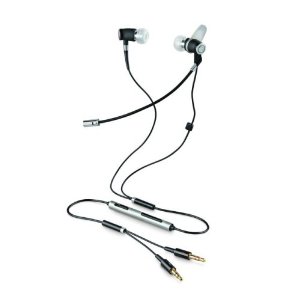
Here at WoWasis, we tend to use stereo headphones a lot, for either Skype calls from around the globe, or listening to language instruction CDs. And you know how much we love miniaturization. We want everything small, durable, and light. That’s why we fell in love with our (soon to be discontinued) Plantronics .Audio 480 USB headset.

This incredible piece of engineering has a 5 inch boom mic, stereo earbuds with great sound, and comes in a nice leather pouch, only 5.5”x1.5”x1”. It has a USB dongle as well as standard male plugs. In its pouch, the entire product weighs just 2.2 ounces! It’s the one we carry around the world, and the sturdy pouch keeps it from the pounding that we always give our stuff. It will be replaced in August 2011 by Plantronics’ Blackwire 435, but we recommend you get the 480 while you still can. We’ll review the new one when it’s available, but we love our 480 so much, we’re not giving it up! Buy it now at the WoWasis estore, powered by Amazon.

WoWasis book review: Ted Jordan Meredith’s Pocket Guide to Bamboos

Written By: herbrunbridge - Jun• 27•11

Here at WoWasis, we have quite a bit of bamboo planted in our immediate environs. And frankly, we’ve been wrestling a lot with the variety known as Bambusa oldhamii, also known as Oldham’s Bamboo. The problem with this variety is that it weeps an acidic liquid that etches car windows and paint and is not removable. Experts we’ve talked to claim the secretions are from aphids, but it’s not the case. So we’re going to plant another variety instead. Which is where Ted Jordan Meredith’s Timber Press Guide to Bamboos (2009, ISBN 978-0-88192-936-2) comes in. 

This handy book describes more than 300 species and varieties, with loads of pictures, growing and pruning tips, and importantly, great info on pachymorph (clumping) and leptomorph (running) rhizomes. Containing and thinning bamboo is a key to making it work for you, and you’ll want to be careful, as Meredith attests, to planting running bamboo anywhere where you’ve got neighbors nearby. We love Meredith’s book, although it doesn’t describe oldhamii’s secretion problem. But it does give us a number of other choices, and we think we’ll set up a test planting of another variety first, before propagating. This useful book is a wonderful addition to any amateur or professional botanist’s or gardener’s library. Buy it now at the WoWasis estore, powered by Amazon.

WoWasis travel field test review: Defcon netbook & laptop computer cable lock

Written By: herbrunbridge - Jun• 26•11

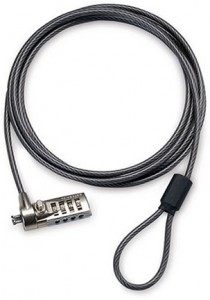
Here at WoWasis, we’re writing our travel stories pretty much non-stop, especially while we’re on the go. Our trusty netbook computer is always in our hotel room, and the first thing we do is lock it to some unmovable structure with our Targus Defcon computer cable lock. One day, our hotel room was burgled, and they got everything but our computer, because it was locked with our Defcon. 

Here’s what makes it so great. It’s got 10,000 user-settable combinations, with 6.5 feet (2 meters) of cut-resistant, galvanized steel cable to attach your notebook computer to any secure object. Simply loop the lock around a desk or chair, window bars, air-conditioner, you name it. Then, insert it into your notebook’s lock slot and set the combination. Notebook thefts are generally crimes of opportunity, and in our experience, thieves want to grab and run, and not wrestle with a computer that’s locked down. 

We’ve made a simple modification to our lock that you may need to do too. The Defcon wiggled back and forth a little too much at the lock interface, so we bought a simple zinc hardware store washer, attached it to the locking mechanism with double-stick tape, and it worked like a charm. It’s already saved our computer from being stolen, and it can save yours, too. Buy it now at the WoWasis estore, powered by Amazon.

WoWasis travel field test review: Tumi Alpha Frequent Traveler 22″ Zippered Expandable Carry-On

Written By: herbrunbridge - Jun• 24•11

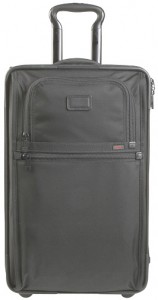
We here at WoWasis have been carrying the Tumi Alpha Frequent Traveler 22″ Zippered Expandable Carry-On all over the world now for over a decade. This roller bag has sturdy wheels that handle the terrible sidewalks of Bangkok, fits into every overhead bin except for those on small commuter airlines, and is exceptionally tough. How tough? On many trips, we put all the books we’ve bought into it, which makes it extremely heavy. It gets slammed and tossed by airline personnel, but nevertheless arrives home looking just about as good as the day we bought it. It’s got a bunch of hidden pockets, a suit section. 

In addition to all our clothes and toiletries, our Tumi bag gets stuffed with our collapsible Eagle Creek duffel and our teeny Ultra-Sil miniaturized day pack, and these three pieces of luggage handle every situation we’re in. The Tumi handles it all, is portable and durable (we sent ours to Tumi for rubber corner repair about 5 years ago, and the replacement corners still look like new. ) 

Our beat is the tropics, and with the ever-present heat and humidity, we didn’t want the discomfort of carrying a backpack. Instead, we use our Tumi for transportation to and from hotels, airports, train and bus stations. Out on the street, we put our Ultra-Sil in a pocket, and unfold it if we need a backpack. So if durability, high-quality, comfort, and efficiency are important, we recommend the Tumi. Measures 22″ x 14″ x 9″.  Buy it now at the WoWasis estore.

WoWasis travel clothing field test review: The tough and versatile Timberland 30003 Men’s 3-Eye Classic Lug shoe

Written By: herbrunbridge - Jun• 18•11

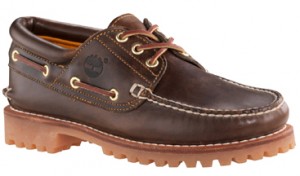
Here at WoWasis, we think no one’s harder on shoes than we are. We tear them up while climbing over volcanic pumice. We beat the hell out of them on the terrible so-called sidewalks of Bangkok and Phnom Penh. We totally stress the upper part of the shoe above the heel because we constantly slip them off going into Buddhist temples, and never retie them. We want them to last forever, so need to ensure that they can be re-soled with Vibram-like soles if ever we wish. The one shoe that has stood the test of time and our torture test is the mighty Timberland 30003 Men’s 3-Eye Classic Lug.

In the past, we used Timberland’s 32026 model, which at first glance looks similar to the model 30003, but found that the soles wore out too quickly, squeaked like crazy, and couldn’t be replaced. Nice shoe, but only the upper was durable. We were replacing them all the time. Not so with the 30003, which has a better sole construction all around. We’ve been on one pair of 30003s for two years now, and haven’t had to replace the soles yet. And when we need to, we can do it on a Bangkok street corner for 10 bucks. We consider the shoe a real bargain because it lasts forever.

Here are WoWasis’ qualifications for the shoe we need for tough and versatile world travel. The shoe needs to:

  • Be easy to break in: no blisters, please
  • Have a serrated, non-slip, long wear sole
  • Have a durable, tough-leather outer
  • Be easy to slip on and off without retying
  • Breathe comfortably in tropical climates
  • Shine well, so we can wear them to parties
  • Be easily resoleable with Vibram-type soles

The slip-on characteristic is really important if you’re at Buddhist sites. You’ll be taking your shoes off and putting them back on constantly to go into temples and shrines, so you’ve really got to have a durable rear upper, which is going to take a beating. You’ll scuff your shoes a lot climbing over and through ruins, so you’ll need a tough outer, and it’s really nice when you can hire a kid to shine them up when you have to go to a party at night.

The mighty Timberland 30003 takes a beating, looks great, and you can wear it anywhere. Buy them now at the WoWasis estore.

Is hard pinching really a form of love?

Written By: herbrunbridge - Jun• 18•11

The Good Manner: Advice on Thailand from WoWasis’ Pa Farang
This week’s dilemma: Is hard pinching really a form of love? 

Dear Pa Farang,
My face is sore (again) from my Thai wife’s latest onslaught, which involves pinching my cheeks strongly.  This nonsense started after her sister arrived for a visit with her new baby girl.  As soon as my wife saw the baby, she pinched her cheeks, said “man-Kee-ow,” and the baby squealed in delight.  Then, her sister did the same thing to me, which made them both break out in giggle fits.  Now my wife has picked up the habit of doing it night and day, leaving me with more or less a constant facial bruise.  Telling her to stop makes her pull the long face, and she tells me I’m being “mai sanuk.”  For the next few minutes, she broods, and I assume she’s gotten the hint not to do it anymore.  Next day she’s back at it again.  How can I keep my face and sanity intact, and my wife happy at the same time? 

–  Khun William

 Dear KW,

You are the unwilling victim of “man-Kee-ow”, an affectionate type of pinching which takes up two forms.  The first iteration occurs when adults playfully pinch young children as a way of telling them how cute they are.  The pinch is accompanied by saying “man-Kee-ow”, which has no literal translation into English, but means something like “How cute!” 

The second form of “man-Kee-ow” pinching is what you’re experiencing now.  This occurs between lovers and husbands and wives.  It also means you’re cute, but there’s also an element of “sadeet nit-noy” (a little bit Sadist), in that the result is painful for you, and your wife enjoys it. 

The fact that your wife gets upset when you ask her to stop tells me that she may have a romantically aggressive personality, and she may feel that you’re frustrating her need to communicate with you romantically in this way.  If that’s the case, she may ultimately wish to take her aggressiveness to a higher level, while you two are engaged in amorous activities.  

Have a talk with your wife when you’re not upset.   Instead of focusing on pinching, ask her how she feels about your marital relations.  Somewhere in the conversation, I’d ask her if she enjoys “man-Kee-ow”.  ft she says “it make me exciting!”, then you’ll have to accept the fact that even if you manage to get her to stop, she may eventually find another substitute activity that may damage your pleasure even more.  “Man-Kee-ow” may be indicative of a primal element within her being that has been unleashed.  If so, consider merit-making at a local wat, as a means of regaining your calm demeanor, essential for maintaining a harmonious household.  Please take heart in the fact that there are many men who wish they could walk in your shoes, as glossy magazines attest. 

Marayat dee, 
– Pa Farang 

Read Pa Farang’s other columns in WoWasis for more advice on relationships and cultural matters in Asia

WoWasis travel clothing field test review: Teva Terra waterproof travel sandals

Written By: herbrunbridge - Jun• 17•11

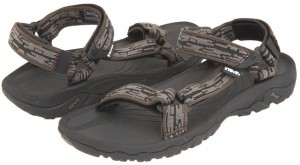
The ultra-durable, amphibious Teva Terra travel sandals

There came a time when we here at WoWasis just refused to buy any more travel sandals-zoris-flip-flops. At a few dollars a pair, it wasn’t like we couldn’t afford replacing them. It was the hassle. Our flip-flops had been torn apart by coral, toe straps pulled out by overuse, rubber molding destroyed by chemicals and sea water. The worse was when we got a bacterial infection because our rubber sandals became a home to microscopic varmints. We were tired of replacing flip-flops every trip. So we laid out $50 USD, and bought some really durable Teva Pterodactyls. That was 10 years ago. Since then, we’ve used them everywhere. They’re our snorkeling sea-water shoes. We take them to swimming pools, saunas, hot tubs, jungle hikes, cavern treks. And they look and perform pretty much like the day we bought them. 

Teva has slightly changed the sole pattern, but the Teva Terras are essentially the Pterodactyls. They’ll still prevent you from slipping on nasty rocks, stop your feet from being torn apart by coral, and become the one sea-land foot product that you’ll pack in your luggage that will do everything shoes won’t do (raining like hell outside in the tropics? Change to your Terras). And if you think the anti-microbial claim is nonsense, we used both Teva and another brand on a trip to Thailand’s Andaman Sea, using both every day. The other brand gave us a fungus, Teva didn’t. 

The damn things never wear out, so the initial cost, when amortized over a few years, is actually cheap. If you’re like us at WoWasis, you like durable travel gear that doesn’t have to be replaced. Tevas are our choice for amphibious foot gear, and we seriously doubt, regardless of the punishment you put them through, that they’ll ever need replacing your Teva Terras in your lifetime.  Buy it now at the WoWasis estore, powered by Amazon. Here are the specs:

  • Hook and loop closure for a snug and secure fit.
  • Nylon shank for torsional rigidity and stability.
    Encapsulated Shock Pad in the heel for shock absorption.
  • The Hurricane XLT’s contoured drop-in EVA footbed cradles and supports your foot while providing all day comfort.
  • Microban® zinc technology that fights the growth of odor causing bacteria and fungus. Built in anti-microbial product protection provides continuous odor control that won’t wash off or wear away.
  • Rugged outsole provides grip and traction.
  • Weight : 9 oz.

WoWasis travel gear review: a suppository escape kit you can’t be without

Written By: herbrunbridge - Jun• 16•11

This suppository kit contains an amazing array of tools

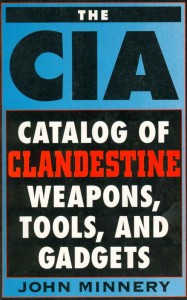
There are suppository escape kits and suppository escape kits. Here at the WoWasis Spycraft store, we’ve sold out of our complete supply of this item, and are looking for new suppliers (see below). Our little escape gizmo is essentially a “get out of jail free” card that was perfected by the French resistance during World War II. You’ve got to be a tough hombre to carry one of these, and today, we’d imagine that people who are concerned about being kidnapped in nations where that kind of thing is common are among its strongest advocates. The MK 1 suppository kit is detailed in Minnery’s The CIA Catalog Of Clandestine Weapons, Tools, And Gadgets (1990, ISBN 0-942637-69-0), and although it doesn’t include a small tube of lubricant, as some of the others do, it nevertheless contains an impressive toolkit, making it de rigueur for home handymen and fixit specialists the world over. Here’s what author John Minnery has to say about it:

E&E Suppository MK I
An attempt was made during World War II to provide a complete escape tool kit housed in a rubber capsule that could be carried internally if necessary. Pushed inside the anus, it could be held in place by the anal sphincter and would obviously pass all but the most intimate of searches. [This hiding place is nothing new; it has been used by prisoners and smugglers for centuries for stowing contraband. Prisoners use “Le plan,” as it is called in Europe, to secrete cash or illicit drugs inside custom-made aluminum or brass tubes with threaded caps. Daggers, and even guns, can be made to fit this profile as well.)
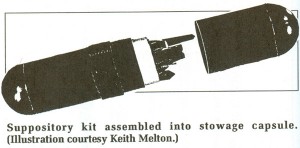
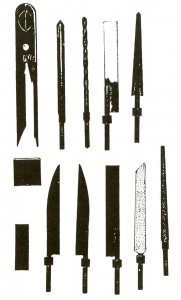
This kit contains a set of saw, file, and knife blades, as well as a drill and reamers. There is also a wire cutter with screwdriver and pry bar. With such an array of hardware, a prisoner could conceivably free himself or herself from shackles, make a key, disassemble a lock or door from its hinges, cut a barbed-wire fence, saw through a panel or bamboo floor, attack a guard, and even steal a vehicle. There are myriad options.

This compact kit is waterproof, of course, and while it would generally be carried in a pocket as a wallet, on operations in which one is in danger of being captured, it is stored where intended. Once one becomes acquainted with the item, it is not uncomfortable to carry; in some cases, it is a great comfort to know that it is always close at hand.

the-bum-gun-bidet-sprayersModern search techniques and the popular x-ray scanners and metal detectors will uncover this device, but these do not come into play in a preliminary search, which is the time that the device may still be used. Psychologically, the prisoner may be down for being caught, but the most opportune time for escape is in the early stages of capture during transfers, while waiting in holding cells, during breaks between interrogations,
and so on. The usefulness of this device depends upon the sophistication of the country of operation.
Your WoWasis field test team is frankly too skittish to give it a rigorous field test, especially after a heavy day of eating Thai meals with super-potent chilis (we’d hate to have to “go fishing” if we were inadvertently careless). There is at least one comprehensive posting on the internet detailing its use and history. We are actively looking for a new supplier, our previous one having gone out of business. If you supply a suppository kit similar to this, please respond to this post. We’ll request a sample, and if it passes muster, will add it to our eStore.