The sharper edge to traveling in Asia

WoWasis Book review: Timothy Hallinan’s ‘The Fear Artist’

Written By: herbrunbridge - May• 14•12

In his latest book, The Fear Artist (2012, ISBN 978-1-61695-112-2), veteran Bangkok Fiction writer Timothy Hallinan sure knows how to make a reader feel that he or she is in Bangkok: 

The soi itself is almost as featureless as the stucco wall: a thin seam of asphalt too narrow for two cars, framed by a sidewalk of tilting, badly set paving stones that are interrupted every now and then by one of those peculiarly Bangkok trees, wizened, largely leaf-free little spindles that look like they’d be more comfortable bent over a walker. Trees that look like they’ve got a cough.

Man, we here at WoWasis were dripping wet and looking for a bar as soon as we read that passage, stumbling over badly-laid sidewalk pavers, low-bridging under eyebrow-level power lines, and dodging crotch-high fireplugs (our personal favorite). The book is the latest in the ongoing saga of travel writer Poke Rafferty and his family, ex- bar girl Rose, and adopted daughter Miaow. But unlike the other books, wife and daughter, ensconced upcountry, don’t make an appearance, leaving Rafferty on his own. The great news is two other exceptional characters appear. One is his American half-sister. The other is the distressed child of the book’s villain. And it all takes place in sunny, bucolic Bangkok.

The villain, Murphy, is classic Hallinan, an out-of-control and lethal product of the Vietnam war machine, consumed with killing anyone still alive who would be able to report his heinous war crimes, along with any ancillary persons who happen to be nearby. And the stage is set when Rafferty, out for an innocent excursion to buy paint for his absent daughter’s bedroom, runs full-blast into a murder. 

The plot moves forward at surging pace, and has its expected Hallinan twists: good guys look like bad guys, women are innocently lethal, the police are alternately criminal, helpful, inefficient, and befuddlingly bureaucratic. A delicious aspect of Hallinan’s writing is that no one is to be trusted, including tried-and-true friends. As experienced Thailand-watchers know, money and power grease all gates in the Land of Smiles. 

Hallinan’s younger half-Chinese half-sister, Ming-Li, an intelligent but streetwise American in Bangkok, is a surprise protagonist here. And clearly, this young woman, who grew up in the U.S. in the home of a father/Spook, has some opinions about her same-age American contemporaries, as she defends her outlook to Rafferty: 

“I’ve seen the alternatives. Hanging around with girls just like me, picking on girls who aren’t just like me, buying ugly clothes with famous names to appeal to boys who talk through their noses and think tattoos are really daring. Whoa, dude, take your life in your hands, light a cigarette. Hey, man, let’s rebel by refusing to learn anything. Let’s be dull, stupid, ordinary kids who are looking forward to being dull, stupid, ordinary adults. No thanks, and with change. And by the way, I don’t see you living in some plaid-shirt American town and flashing your junk at Builders Emporium all weekend.”

Hallinan has her character nailed down well, and she becomes an essential element in the book’s outcome. As does the “wild-child” daughter of Murphy. By the end, we’ve got at least one other compelling member of Rafferty’s family to deal with. The book ends with a climactic scene of destruction, but one that leaves the reader wondering if everything is as neatly wrapped up as it seems. There seems to be a morsel of thread left hanging there, and one suspects that it may be pulled out a little further in Hallinan’s next book. 

Readers of Hallinan’s earlier Rafferty books will welcome this one. And those new to Hallinan’s writing will experience a roller-coaster ride of intrigue into the bowels of one of the world’s most fascinating, enigmatic, and — for those who stumble into the wrong situation — deadly cities. Buy this book at the WoWasis eStore.

Bachelor in Bangkok: Khun Lee on jealousy and relationships

Written By: herbrunbridge - May• 10•12

I just had 2 friends from England visit Bangkok and there were some magical moments during their stay that will certainly become local legend.  One particular evening stands out in my mind as it is a perfect illustration of how different one’s priorities become after living in Paradise as long as I have. There is a decent restaurant near my party area that has 2 girls who wear sexy tight uniforms that sport the name of the beer company that they represent. I have a fancy for the Leo Beer girl, who I must say looks really hot in her short, tight silky outfit.  Naturally I wandered in to the restaurant and had a couple of meals and managed to get her phone number followed by a couple of nights of partying on the town and energetic love making back at my place.  In my mind it was just innocent fun (as with any girl) but I must admit it wasn’t cheap.  Both nights out we went to pricy discos and I was set back a decent chunk of change.  It was still cheaper and more fun than paying for sex with a professional, but I certainly don’t like to spend that kind of money on a regular basis.  No problem in my scheme of things as certainly after 2 or 3 expensive dates we will just be eating som tom (papaya salad) on the street and going straight back to my place for sex in the future.  

Well, I had temporarily forgotten that I had introduced this lass to my 2 horny English mates(what was I thinking?), and to my shock and amusement one of them (Paul) ended up going out with her to some of her favorite discos and of course back to his place for some horizontal mambo.  He was very sheepish the day he confessed to me the events of that night, thinking that I would be angry or jealous that he had done one of my favorite gals.  I have evolved way past that novice stage of jealousy and possession in my life as an international playboy.   Actually, I thought it was great that a guy on a short holiday managed to have sex with such a hot gal for free when most of the visitors have to settle for the pay for play gals.  He begrudgingly recanted the sordid events of his midnight orgy and it was all good fun and all of us laughed until we had tears rolling down our cheeks.  I told him I wasn’t possessive with my gals and as far as I was concerned the more the merrier!  If you can’t share some of your favorite shag bunnies with your best mates you have got your priorities all screwed up in my humble opinion.  He had forgotten to use protection as they were both blind drunk, and I told him that just a few days earlier I had done the same with her so from this day forward we were officially blood brothers.  

Nothing about the story bothered me until his mate Ian asked him how he managed all of that when he had left the hotel room with only 1 thousand baht ($30) in his pocket?  Paul said that the Leo beer gal had paid for her own drinks. That little slut!  When I was out with her she NEVER paid for anything and both nights were very expensive for this poor little horn dog.  Now, I don’t give a shit if she wants to f**k one of my mates, but he nailed her without having to buy her drinks?  I don’t blame my horny mate Paul as he was just seizing an opportunity as any red blooded man would, but I will never talk to that cheap little Leo beer slut again.  Paul and Ian we miss you guys here!! 

I was watching a situation comedy from the USA the other night, and witnessed a perfect enactment of why guys should never get married or for that matter ever commit to just one woman.  A happy couple were out on the town and as usual the woman managed to turn the pleasant conversation into one of those “we have to bring the relationship to the next level” talks (OK, now I have to put 20 baht into the pot at Londoner for saying the “R” word).  Anyway, the gal told the guy that he needed to stop seeing other women and devote himself entirely to her.  This guy was a real playboy, and had dozens of gorgeous sexual partners and was more than a bit reticent to acquiesce to her request.  The gal was a professional ballet dancer.  She says that both of them need to make the sacrifice of not sleeping with other partners.  He stared at her and asked “do you want to sleep with other guys?”  Her answer was “of course not!”  He exclaimed “then YOU are not giving up anything!”  I couldn’t have said it better myself.  

My mates like to joke with me about how much younger than myself all of my gals tend to be.  I must admit I like them a bit on the young side.  There is an old joke that when an old guy looks at a young gal his friends say “she’s young enough to be your daughter.”  My mates always say that my girls are young enough to be my grand-daughter.  The other day I was chatting up a very hot gal who ended up being 27 years old.  I just can’t get excited about a dinosaur of that age so I turned and made a hasty exit.  I told my best mate “now SHE was old enough to be my daughter.”  Yuck. 

Read Khun Lee’s other WoWasis columns for more advice on navigating the adult dating scene through the backstreets of Bangkok

WoWasis book review: ‘Trigger Men’ snipercraft by Hans Halberstadt

Written By: herbrunbridge - Apr• 28•12

On May 13, 2010, WoWasis reported: “Major General Khattiya Sawasdipol, a rogue military officer familiarly known as Seh Daeng, had been shot in the head near the main protest area at Siam Square, as a result of sniper fire, and is reported to be in critical condition.” Seh Daeng was the de facto military leader of the Red Shirts and died soon after the incident, effectively taking the wind out of the sales of the huge protest that involved bombings and burnings, and shut-down of much of Bangkok’s business district. 

From newspapers to the folks on the street, everyone was asking “How did they get him?” The nearest high-rise wasn’t exactly close. Moments before, Seh Daeng was talking to a reporter who briefly stepped away. As author Hans Halberstadt might tell you, that’s all it took. 

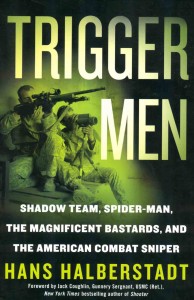
Halberstadt’s Trigger Men: Shadow Team, Spider-Man, the Magnificent Bastards, and the American Combat Sniper (2008, ISBN-10: 0-312-35456-8) doesn’t take place in Bangkok, but it’s a virtual bible of the sniper’s craft. The protagonists are in the armed forces of the U.S., in action in Iraq. Here, the author discusses favored weaponry, including the explosive .50cal M107 Barrett rifle, in-theatre operations, and tactics. His discussion of wind, drop, and other factors influencing the shot introduces the physics of arms, ammunition, and weather. 

The anecdotal stories told by the snipers themselves make for great reading, and are sobering. Individuals in this line of work have to make instantaneous target decisions: if they’re wrong, an innocent person dies; if they’re right, they’ve saved the lives of their buddies, and probably some civilians as well. This is deadly stuff: Canadian Carlos Hathcock made a confirmed kill at 2,286 meters, as detailed in the book. That’s over two kilometers! 

This isn’t the kind of book that’s found on the top of most people’s “to read” list, but every time a situation like that of She Daeng’s killing hits the papers, a whole lot of folks suddenly wish they knew more about snipers. And Halberstadt’s book is the one to read. Buy it now at the WoWasis eStore.

WoWasis book review: ‘Monuments of Civilization: Ancient Cambodia’

Written By: herbrunbridge - Apr• 25•12

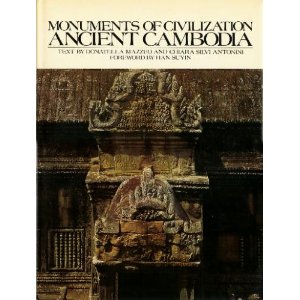
The large-format (13”x10”) Monuments of Civilization: Ancient Cambodia (1978, ISBN 0-448-02026-2) by Donatella Mazzeo and Chiara Silvi Antonini was actually first published in 1972, and remains a magnificent book, detailing the pre-Angkorean, Classic Angkorean, and Late Angkorean periods. The photographs are lavish, the text informative, and the diagrams readable, in this 192 page, 100 photograph book. It should be a staple of any Cambodian bookshelf.

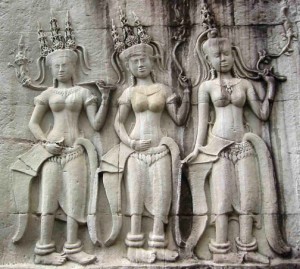
It’s thorough, too, especially in terms of public projects led by kings such as Jayavarman VII, (1181 – ca. 1218)) who built massive reservoirs, 102 hospitals, and numerous “houses with a fire’ (numbering 121 in his reign), where travelers could spend the night. We here at WoWasis were particularly impressed with the bas-relief devatas, or female divinities, adorning the outer wall of the northeast pavilion, and the book explains their headdress, sampot (skirt), and their three historical classification.

Devatas at Angkor Wat (WoWasis photo)

Where the book really shines is in the strikingly composed color photographs. They are marvelous, in landscape, architecture, and art. Better than those you will find in books sold at the site itself. Amazing enough that the reader wants to know who took them. And therein lies the enigma of the book. Not one single photographer is given credit. Why? Publisher squabbles? Fight with an editor? Failed personal relationship with one of the authors? What we’ll say is this: this is the only photography-heavy book we’ve ever encountered with a photographer’s credit (perhaps there was more than one?) At any rate, the authors owe us an explanation.

Photography credits aside, this is a book worth having. And it’s available on the internet for all low as $3 USD.

WoWasis book review: Nihal DeSilva’s ‘The Giniralla Conspiracy,’ Sri Lanka

Written By: herbrunbridge - Apr• 20•12

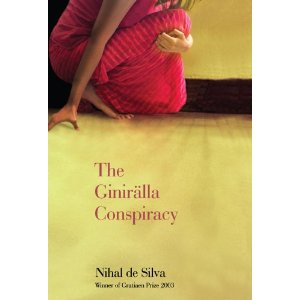
The Giniralla Conspiracy  (2005, ISBN 978-955-1266-02-8), was Sri Lankan novelist Nihal DeSilva’s third and final completed book hHe was killed by a landmine while in his mid-50s, making for a short, but stellar literary career). Like his two previous books, The Far-Spent Day, and the Gratiaen Prize-winning The Road from Elephant Pass, it is based on political intrigue specific to Sri Lanaka, but endemic to much of the world.

In the sense that he based much of his tale on the history of the Janatha Vimukthi Peramuna (JVP) student Marxist movement, it’s a book of historical fiction. What initially fascinated us here at WoWasis is the rhetoric and physical coercion used to confront first-year university students, who are bullied by upperclassmen (there are no female leaders) and a sympathetic school administration to join the movement. Eventually, the leader of the more moderate school union is murdered. Sujatha, a girl from a poor village, is the protagonist who wants to change Sri Lanka’s political fortunes, but is increasingly distressed at the violent acts consuming the country, perpetrated by her newfound colleagues. She leaves the movement, becomes a reporter, and her fortunes turn worse.

Eventually, she discovers that the Marxist student leader has visited Cambodia, and has set up a massive Sri Lankan secret prison that will contain the residents of Colombo, who will be forced to march in similar fashion to the deadly Khmer-Rouge-led emigration from Phnom Penh. She is eventually imprisoned there.

Sujatha has her own ghosts, deriving from a series of early tragedies in her youth, and driving her sense of independence. As in De Silva’s other books, there is romance here, strained and tortured by the events of the book. Romance, danger, and intrigue drive this book, surrounded by an intelligent, logical plotline that is complex, yet easy to follow.

De Silva didn’t live long enough to complete his fourth book. His death represents a Sri Lankan literary tragedy that is compounded by the fact that unexploded ordinance killed him in a national park (Wilpattu) that felt like home enough for him to stage action there in each of his books. His three books are all worth reading, and Giniralla is a noble back-end to an all-too-short literary career.  Buy it here at the WoWasis eStore.

How to avoid excessive phone charges when traveling in Asia

Written By: herbrunbridge - Apr• 08•12

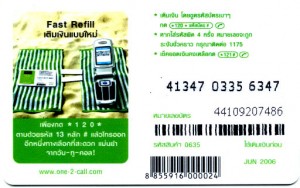
Phone top-off cards are available everywhere in Asia

Western travelers to Asia have been given an unwelcome shock upon returning home and opening their phone bills. They’ve been billed hundreds, if not thousands of dollars and euros for roaming charges associated with using their phones to call internationally. Our recommendation is to buy an inexpensive mobile phone like the Nokia 1280 (which costs approximately $23 USD in Asian countries), buy an inexpensive SIM card at the same shop, and buy minutes as you wish, using top-off cards. When we call home from Thailand, for example, we pay 7 cents USD per minute. In Sri Lanka, it’s even cheaper. 

You can buy inexpensive new mobile phones and SIM cards on virtually every street corner in Asia, and most small stores and convenience shops sell top-off cards, where you buy minutes, dial a number, and top off your phone. An added plus to buying an inexpensive phone for Asia-only use (the dual-band phone you buy in Asia operates at both the 900 MHz and 1800 MHz spectrum, which means it will not work in the Americas) is that it’s not as vulnerable to thieves as more expensive phones. 

If you prefer to use the phone you bought from home, you might want to turn off your data service or data roaming feature to avoid excessive charges. If it’s activated, you may be charged even if you don’t actually use it. One recent incident involved a traveler being charged $1800 USD (yes, $1800!) for three days of roaming charges, and he never used the service. After complaining to his provider, it “generously” cut the bill in half. That’s $900 for three days of something he never used. 

Overall, we here at WoWasis prefer to make our lives simpler in Asia by using an inexpensive Asian mobile phone. When we want to access the internet, we go to an internet shop. They’re everywhere in Asia. In over a decade, we’ve saved a heck of a lot of money by doing it this way, and we’ve got better ways to spend our money than by giving it to our phone service provider at home. Essentially, we have a phone we use in Asia, and another we use at home. In every Asian country, we buy a new SIM, get a new number, and enjoy the convenience and cost savings. When we return home, we just pack our Asian phone away for the next trip.

WoWasis book review: ‘The Snakehead’: of smuggling Chinese nationals into the U.S.

Written By: herbrunbridge - Apr• 01•12

WoWasis has already reported on the AAMP (Asian Apartment Massage Parlor) scene in the western U.S. In that environment, based on our interviews, it would appear that most of the women involved in the trade view the United States as a quick way to make great money, and a way-stop on their way back home. Whether returning to China to buy a home, start a business, or be close to their families, permanent residence in the U.S. is not a goal. 

For thousands of Chinese nationals that have been illegally smuggled into the U.S through New York City’s Chinatown, that isn’t the case. For them, the U.S. is indeed the “Gold Mountain.” And investigative author Patrick Radden Keefe details the whole operation beautifully in The Snakehead: An Epic Tale of the Chinatown Underworld and the American Dream (2009, ISBN 978-0-385-52130-7). Keefe begins by giving a history of the Chinese in the United States, but the story actually revolves around Sister Ping (Cheng Chui Ping), a master smuggler who ultimately and somewhat surprisingly comes across as a sympathetic figure, and who is currently incarcerated in a decades-long prison sentence.

There’s intrigue, horrific deaths, and great investigative reporting here. The Chinese detailed in the story are Fujianese, eager to escape an unfavorable economic situation at home. In 1993, the era in which much of this story takes place, they agreed to pay roughly $18,000 USD for the transit, $2,000 upfront, the rest due 72 hours upon delivery to the U.S. The latter amount they borrowed from friends and relatives in the U.S., and most paid the entire sum back in 2 years (the figure in 2009 had reportedly increased to $70,000 USD).

Many other players appear in the book: Chinese-American gangs, INS officials, and anti-abortion groups (who favored bringing Fujianese to the U.S. when they understood that Chinese laws limited size of families would cause females to undergo unwanted abortions in their own country). 

There’s also a wonderful passage discussing the corruption of Thai airport official in Bangkok:

During the years immediately following Tiananmen, snakeheads had relied on a great deal of official corruption at the international airport in Bangkok. Thailand is extravagantly corrupt even by the standards of Southeast Asia, and the snakeheads had no trouble finding officials at the airport who would turn a blind eye to travel documents that were obviously phony. The situation was somewhat comical: you could walk into the departures hall at Bangkok Airport and see eight ticket windows without any line at all and a long line of Chinese travelers waiting patiently at the ninth, where the official was on the take. By 1992, U.S. authorities were encountering so many fraudulent documents on incoming flights ‘from Thailand that they dispatched additional personnel to Bangkok to monitor their counterparts. American officials would perform “operation disrupts,” monitoring the Thai ticket-takers to make sure no fake passports were getting through and obliging the attendants to shuffle stations every twenty minutes so that snakeheads could not simply count on sending their customers to a designated window. American document experts worked alongside the Thais, examining any passport or visa that didn’t look legitimate.

Until that point Bangkok had been a kind of gateway to America; if you could make it from China to Bangkok, you could make it to the United States. People undertook long journeys to reach the city, and would wait in fetid safe houses in Bangkok’s Chinatown until they were able to board an airplane. But when authorities cracked down at the airport, a bottleneck developed. Many snakeheads had gone to great lengths to get people to Bangkok. The business was a pipeline, and there were always customers at different stages of the route. With the .bottleneck suddenly clogged, the safe houses in Bangkok started filling up with people, sometimes as many as thirty, crammed into small spaces, waiting for their flight out. The solution was boats.

For anyone desiring to better understand international human smuggling operations, U.S. INS practices, the Chinese dynamic in the U.S., Chinese gangs, and just plain old political intrigue, this well-written and researched book is for you. We couldn’t put it down. Buy this book now at the WoWasis eStore.

Bachelor in Bangkok: Khun Lee on errant condoms, guiltless sexual faux pas, and Valentine’s Day

Written By: herbrunbridge - Apr• 01•12

Bachelor in Bangkok: Khun Lee on guiltless sexual faux pas 

I think I just screwed up (again) so badly that I have brought another new meaning to the term “poor salesmanship.”  Casablanca is my all-time favorite movie and every time I commit one of my infamous screw ups with women I always think about the scene in that movie when Bogart’s old flame tries to talk him into giving her these valuable documents by asking him to do it “for the good times we had in Paris.”  Well, she ripped his heart out inParis so he just casually says “I wouldn’t bring upParis if I were you, its poor salesmanship.”  I think Khun Lee can top that one.  I have a super hot flight attendant that I have been pursuing for quite some time but with limited luck in the horizontal mambo department.  Recently she seemed to be weakening and finally began to see the incredible mistake she has committed by not recognizing what a truly extraordinary person I really am.  All of you readers can stop laughing now. Anyway, I managed to get her back to my lair and things were really heating up. We ended up on my bed and I had most of her clothes off and all of mine off when suddenly she jumped up and ran into the bathroom shrieking the whole way.  At first I thought she was in shock at the size of my manhood, but as it turns out she had looked up from her horizontal position and seen something horrible.  I looked up at the ceiling above the bed and to my shock and horror a used condom was dangling from the ceiling fan.  Just then I remembered that earlier that day I was fooling around with one of my favorite little tarts and had performed my usual ritual of jerking off the condom just before climax in order to finish on her face.  Certainly this is standard practice among most normal guys, my problem was that in my passion I had just tossed it in the air and the damn thing stuck to the ceiling fan!  So after several weeks of trying to convince my hot flight attendant that I wasn’t just another horny farang guy who just wants to party and have anonymous sex with multiple partners, I did just the opposite and showed her that her initial assumptions about me were spot on. After 30 minutes of crying in the bathroom, she finally came out and allowed me to escort her downstairs and into a taxi.  The little bitch hasn’t even returned my phone calls since that day.  Man is that poor salesmanship or what? 

The other day I was sitting at my favorite beer bar in front of the Nana Hotel and heard an incredibly loud and bizarre shrieking sound.  Realizing that my flight attendant wouldn’t be caught dead in that neighborhood, I asked my mate what he thought had caused that un-earthly noise.  He responded that it sounded like one of the elephants that the Thai mahouts ride around the area as tourist attractions.  I pondered this for a moment and then came up with a theory of my own.  Recently a McDonald’s restaurant opened just around the corner, so my theory was that it must have been an American female tourist who was just told that the limit for Big Macs is 5 per customer. 

In a recent column I told you lovely readers about my Sunderland, England mate who has ladies over for free sex, pounds them all night and then asks them to iron his shirts in the morning.  Just as I thought he could not possibly become more spoiled, I have to stand corrected.  Now his attitude is that the gals must come over at the appropriate time, the free sex has to be superb, and they have to VOLUNTEER to do his ironing in the morning.  He was recently complaining that he had to ask one of his gals to do the ironing, and as they should do it without being asked, she may be crossed off of his to do list.  Yes mate, you are spoiled beyond recognition.  Just try telling that story to anyone trapped back in loveless, sexless, passionless farangland.  When I challenged him on the frivolity of this course of action, he stated that he had put the ironing board and all his wrinkled shirts out in the middle of the room for all to see so how could that cheeky little thing not volunteer to do the ironing without being asked?  Maybe he does have a valid complaint after all.  

I just love Valentine’s Day in paradise.  Back in my poor, lost home country ofUSAall the prices for flowers, cards etc. get jacked up around 300% the week before the big day comes.   Then all the guys go walking around grabbing their hind quarters feeling like they had just been to the proctologist. Here inThailand, just the opposite is true.  Yesterday I went to Central shopping center in Pinklao (part of Bangkok near the river) and there were dozens of vendors selling specialized lover’s gifts.  They had such a variety of gifts to choose from at such low prices that I managed to buy for my top 7 gals (I try to limit myself to 7 really serious relationships at a time) for a totals outlay of US $65.  Heaven couldn’t possibly be this good.

Read Khun Lee’s other WoWasis columns for more advice on navigating the adult dating scene through the backstreets of Bangkok.

Grey Man: yet another Sex Trafficking NGO found to be falsifying data

Written By: herbrunbridge - Mar• 26•12

The Sydney Morning Herald has reported that yet another non-governmental organized charity (NGO) is under investigation for deceptive practices regarding the fake rescue of tribal females from non-existent sexual predators. Former Australian army commando Sean McBride abruptly resigned from Grey Man, the NGO he founded, after Thailand’s Department of Special Investigation determined that 21 hill tribe children from a village in northern Chiang Rai province were not rescued from prostitution as the charity claimed on its website along with appeals for funds. The Department is further investigating claims that the children had never left their homes, had continued to attend school and had suffered as a result of the publicity. 

As first reported by WoWasis in May, 2010, it appears that NGOs involved in investigating sex trafficking have found a bottomless gold mine of funding sources, leading critics to question to what extent the financial success of these organizations is based on alleged sex crime accusations that may be ultimately found to be meritless.

WoWasis book review: Nihal DeSilva’s ‘The Far Spent Day,’ Sri Lanka

Written By: herbrunbridge - Mar• 26•12

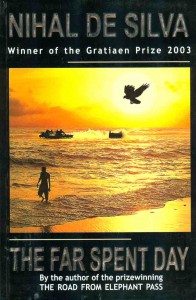
Nihal DeSilva was a formidable novelist, a master of plot and character development who was killed by a landmine while in his mid-50s, only three books into a literary career that promised to propel him into the firament of notable writers of political intrigue. The Far-Spent Day (2004, ISBN 978-955-8095-74-4), like his previous book, the Gratiaen Prize-winning The Road from Elephant Pass, won the prestigious, evidences wonderful character development and a compelling plot.

The Far-Spent Day is the story of a small Sri Lankan shopkeeper who runs afoul of “influential people” running the political system in Sri Lanka. Along the way, he picks up the alliance of a female reporter. As the tale unfolds, they are clearly in over their heads, as they encounter all sorts of miseries, from murder to child prostitution. The bad guys here aren’t playing around, which is why, we suppose, we couldn’t put the book down. Precipitous plots twists are the name of the game here, and they occur on virtually every page. And although the story resolves well, it doesn’t necessarily end in the manner that the reader may wish. For a novel, it’s a great dose of reality.

Along the way, we’re treated to the work of DeSilva the wordsmith, who infuses the book with his superb writing on nature whenever he can:

They followed the gravel road as it swung across a small bridge and then continued  in an easterly direction beyond the Research Station. The thick canopy of the forest stretched across the road in its quest for sunlight and gave them some respite from the early afternoon sun. This was an area that had been selectively logged when a brain dead government had given a Canadian company permission to extract timber for supply to a local plywood factory, A storm of public protests had halted the project but the affected areas had produced a regenerated forest, slightly different in character to the virgin rain forest.

On account of the thinner vegetation, it was easier to spot birds there. That’s where they ran into a feeding flock. The forest that seemed to be dozing quietly in the mid-afternoon heat suddenly burst into life. A feeding flock of birds is a unique feature of the Sinharaja Flocks of birds, many different species, were moving through the forest in an orderly way, feeding noisily as they went.

Ravi tried co identity them. Orange-billed Babblers were in mid canopy, chirping lustily. He saw Black Bulbuls, Yellow-naped Woodpeckers, an Azure Flycatcher and a couple of Crested Drongos flitting about. A Laughing Thrush was rooting in the leaf mould on the forest floor. Then he caught a, glimpse of the rare and wonderful Red-faced Malkoha in the upper canopy.

Ravi explained how the flocks fed at different levels of the forest, and helped each other. The birds feeding on the forest floor picked up any succulent tit-bit that was dislodged by the birds feeding above them. Insects the ground feeders disturbed when they foraged on the forest floor were picked up by the birds feeding in the trees above.

The Drongos were warrior-bandits. Two or three of these jet-black •ds kept watch, faithfully guarding the feeding flock against predators. But the feeders had to pay a price. If one of them unearthed a particularly succulent grub or moth, one of the Drongos would execute a power dive to snatch it away from the finder. Species by species, the birds crossed the road over their heads and moved away into the forest, their incessant twittering gradually fading away. Then the forest was quiet again, except for the droning of the Cicadas.

The book takes place in Sri Lanka, but it’s not really about Sri Lanka. Instead, it reveals a tale that can be told on a daily basis in virtually any country in Asia, where there’s very little black and white in terms of truth, but rather a series of grays. The book will appeal to old and new Asia hands, and everyone just loving a great, fast-paced story.  It’s also a bittersweet reminder of the fleeting nature of human life, in this particular case, of a writer taken away from us before he had fully finished his fourth (and final) novel. The book is a sobering reminder of what great writer he was, and how much he left unfinished in his career as an author. Buy it here at the WoWasis eStore.