The sharper edge to traveling in Asia

WoWasis book review: ‘Education of a Travel Writer’ by Harold Stephens

Written By: herbrunbridge - Feb• 26•13

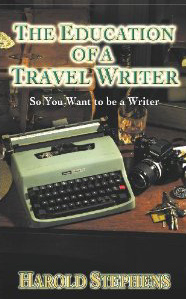
StephensTravelWriterAmong veteran travelers, there probably aren’t too many of us who haven’t, at least for one small moment, entertained the possibility of being travel writers. It’s tempting. We see lots worthy of writing about, and many of us keep notes, in notebooks, in the back of travel guides, or in electronic devices we carry with us. It’s the fodder for seemingly millions of blogs. Veteran travel and adventurer writer Harold Stephens taps into this yearning with his fascinating and well-written The Education of a Travel Writer: So You Want to Be a Writer (2009, ISBN: 0-9786951-2-7).

Stephens is a compelling storyteller whose books are engaging. He knows what he’s talking about, and doesn’t gloss over anything. Two important elements in the book are his emphasis on doing the right amount historical research to frame the writing, and the fact that a writer must always be writing, compulsively. Another interesting aspect is how he combats writing fatigue by writing several stories simultaneously.

Of the many fascinating passages in the book, here are two:

I find myself a writer twenty-four hours a day, even when I am sleeping. I wake in the middle of the night with new plots racing around in my head. Sometimes I have to get up and write them down. If I don’t, the next morning I am angry with myself. I can’t remember what they were. How could I let them go? They were brilliant. When I am riding in a car, walking down the street, sitting in a barber chair, my mind is not my own. I am writing. I find 1 have to describe the world around me in words, the expression on that woman’s face sitting across from me on the bus. The conversation I hear, I try to find words to express the accent, the tone of voice. Then there are the sounds. A train rumbling over tracks. A woman with shoes with wooden heels walking on a hard surface floor. My mind is never my own. As I am always writing, I am always in a daze. How do I capture it all? It becomes a challenge. My mind is constantly at work — sketching, painting, drawing — all day long, all night long, even in my sleep. That is what writing is about.

When it comes to pitfalls, travel writing creates them, and often they are unavoidable. To get published we must adhere to the rules, and that means writing what editors want. The idea of good travel writing, of course, is to promote travel. Fine. But what happens when I am visiting a place I don’t like? My solution is to write about only those places that I like and favor, and then I don’t have to fabricate and write lies. Critics often accuse me of only writing nice things about a destination and it is true. What they don’t know is that I don’t write about those places I dislike.

We think Stephens has a point. It’s much more fun to write about places you love, and travelers never run out of wonderful places. This is a terrific book written by a writer whose written more than thirty books and countless travel magazine articles. Highly recommended. Buy it now at the WoWasis eStore.


WoWasis travel product review: ArridXX Unscented deodorant, indefatigable in hot steamy climates

Written By: herbrunbridge - Feb• 22•13

ArridXXUnscented1Here at WoWasis, we just can’t stand being stinky, especially when traveling in the hot hot tropics. And there are a number of reasons ArridXX Unscented can’t be beat. The best we’ve ever used is Byly, a Spanish product that generally can’t be found anywhere but Spain. It’s beloved by mountain climbers, because one application lasts for days. The problem is, you can’t find it anywhere else. But ArridXX Unscented is a very close second. Here’s why:

ArridXX Unscented carries no perfume. And when a deodorant is mixed with perfume, it’s a disaster after a couple of hours of tropical heat, when it becomes a mixture of body odor (BO) and perfume. A couple of real losers in this category are Secret and Mennen Speed Stick. We swear the manufacturers know this, because very soon you have to wash up again, and apply it all over again. So you use a lot of it in one day. And they sell more deodorant, because you use it up so fast.

ArridXX Unscented is a solid, so it doesn’t run. One application lasts a whole day, and we’ve gone for 3 days on one application on arduous occasions, and it holds up really well. ArridXX is also sold in scented versions, and they’re all inferior. We’ve also tested ArridXX Regular, and it’s an inferior product.

AsiaPromoBannerWe’ve been traveling with ArridXX Unscented for two decades, and it’s unbeatable. We’ve used it successfully in Deserts like California’s Death Valley and teeming jungles on several continents. Because you use less of it, it isn’t stocked by many stores that sell the other ArridXX varieties, which makes us wonder if it’s going to be discontinued. Our recommendation? Buy it now. It’s incredible in the tropics, and keeps you fresh and BO-free all day, and for longer periods when an emergency hits.

WoWasis book review: ‘The Vets’ … Hong Kong and Bangkok intrigue by Stephen Leather

Written By: herbrunbridge - Feb• 19•13

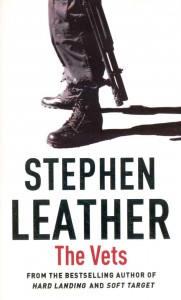
LeatherVetsBookBritish novelist Stephen Leather has written an amazing body of fiction books centering on Southeast Asia. In The Vets (1993, ISBN 978-0-340-59770-5), he includes Hong Kong in the mix, in a fast-paced thriller that displays his knowledge of HK prior to its takeover by the Chinese as well as his understanding of the powerful mainland forces that would one day hold force. Two fascinating story lines come together here, US veterans with nothing to lose coming together to create a heist, and a Chinese playboy fronting an even more spectacular crime. Leather’s insight into the machinations of the Chinese political/business/military amalgamation is reminiscent of Paul Theroux’s Kowloon Tong, which in fact was written several years later. As this review is being written, the New York Times has blown the lid off a major hacking operation run by China’s military. Leather’s novel explains quite well how China’s political, military, and business interests work together to create success, wealth, and mayhem. The book is twenty years old, yet the underpinnings that make the tale work so well really haven’t changed all that much. The book is timeless, and well worth a read.

Like Leather’s other books, this is a long one, at 564 pages, but reads quickly. The author’s descriptive powers are formidable. Here at WoWasis, our favorite passage reveals details of the kind of bar many of us have stumbled into in at least one point in our Asian sojourns:

The entrance to the bar was a hole in the wall guarded by a frumpy Chinese woman of indeterminate age wearing a jet black wig which seemed to have slipped on her head. She had on thick black mascara and too-red lipstick which overlapped the edge of her lips and gave her a clown-like smile. “Welcome to Red Lips,” she said in accented English.

“You have got to be joking,” grinned Lewis. “You have really got to be joking.” He stood with his hands on his hips and looked around the bar, with its scratched and stained tables, dimly lit cubicles and smoke-stained ceiling, and at the women in ill-fitting evening dresses, none of whom could have been under fifty years old. The Rolling Stones were on the jukebox. “Paint it Black.” It was the same record that had been playing in the bar Tyler had taken them to in Bangkok, and Lehman took it as a good omen. The record was scratched and the sound was down low enough so that they could hear the conversation from the only booth that was occupied in the bar, where two Australians with bottles of Fosters lager were arguing over who got the best deal on their cameras. They looked up almost guiltily as they became aware of the new arrivals, as if they were ashamed of being caught in such a dive. They were accompanied at the table by two women who must have been in their sixties, one with grey frizzy hair and a face that was criss-crossed with wrinkles and the other with hair so black that it could only have been dyed. They were listening attentively to the Australians and sipping from small glasses. From where he was standing Lehman could see that one of the women, the one with grey hair, had her hand on her tourist’s thigh where a gnarled nail slowly scratched the material of his jeans. Lehman felt he could hear the coarse scratching sound all the way across the bar.

“Sit here, sit here,” said an emaciated woman in a purple dress speckled with silver threads which draped around her thin frame as if it were still on a hanger. She fastened her bony fingers around Lehman’s forearm and it felt like the touch of a skeleton. Her eyes were deep-set and there were thick lines around either side of her mouth as if it were set amid two fleshy parentheses- When her lips drew back in a parody of a smile, they revealed that the two front teeth at the top of her mouth were gold. “Sit, sit,” she repeated and Lehman felt the talons tighten on his arm. A chubby woman with shoulder-length hair wearing a scarlet dress with a high neck and puffed-up sleeves attached herself to Carmody’s arm and began edging him towards a booth like a collie founding up a stray sheep.

“What the hell is this place?” asked Lewis. “Like the lady said, it’s the Red Lips Bar,” replied Lehman. “It was one of the R&R hangouts during the war, but this one never changed. They never decorated and they claim that it’s the original bargirls still working here. The skeleton on his arm nodded enthusiastically. “Yes, yes. Same bar. Red Lips never change. You American, yes? I think I remember you, GI. What your name?”

No, we’re not going to reveal what occurred in that bar, nor the ultimate outcome of the book. It’s well worth the read, and kept us fascinated from beginning to end. The book has wide-ranging appeal, from vets, to armchair adventurers, to observers of the Asian scene. Highly recommended. Buy The Vets here at the WoWasis eStore.

WoWasis book review: ‘Missing in Rangoon’ by Christopher G. Moore

Written By: herbrunbridge - Feb• 18•13

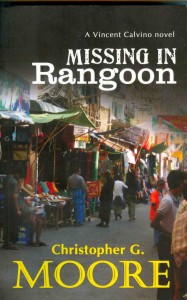
MooreRangoonBookVeteran Bangkok-based novelist Christopher G. Moore’s book, Missing in Rangoon (2013, ISBN 978-616-7503-17-2), is the latest in his detective Vincent Calvino series. We here at WoWasis loved the plot, and the book has passages with some of the best writing we’ve seen from this prolific novelist.

The story is delicious. Calvino gets a missing person’s case that takes him to Myanmar (Burma), drugs are involved, and the plot takes several wonderful twists that keep the reader mesmerized. His counterpart, Colonel Pratt of the Royal Thai Police is along for the ride nominally incognito as a jazz musician. Jazz figures prominently in the story-line. We loved the ending, which underscores the author’s understanding of how life really works in both Burma and Thailand, where the tale eventually resolves.

In our opinion, some of the best writing in the book concerns the labyrinthine Burmese legal system and its courts. On pages 148-156, Moore conducts a tour de force of court proceedings with an eye for detail that’s remarkably descriptive and enchanting. Moore’s own background as a lawyer undoubtedly helps, but one still has to communicate it for the reader. Here’s just a taste:

A calendar was nailed above the half-partition that separated the courtroom from the one next door. There was no clock. One of the guards found a key on a thick ring of keys and unlocked Wai Wan’s handcuffs. He was the first to testify. He walked to a platform and stepped up, facing the judge, but still much lower than where the judge sat. He swore an oath to tell the truth. He swore by placing his hand on a lacquered palm leaf with Buddhist scriptures written in Sanskrit and wrapped in a red cloth. He swore to the Buddha to tell the truth. During the swearing the feathery beating sound of bird wings nearly drowned out Wai Wan’s voice. No one paid any attention to the far wall, where at the top a row of windows with torn wire mesh had become a nesting place for birds. As Wai Wan swore his oath, pigeons fluttered and cooed, flying in and out from the courtyard side.

The ex-hanging judge slipped on his official white hat, a gaung baung, casting him in the role of the good guy in the drama. The junior lawyers and the Crown counsel wore pink versions. The hats were frayed and yellowed around the rim, as if they’d been handed down for generations without ever being laundered.

In terms of honing the book to a sharper edge, we’d like to see a little more refinement in terms of jazz jargon. Jazz has an argot unto itself, not always verbal. A finger pointed to the head means let’s go back to the top, four fingers raised means “trade fours,” in which musicians trade solos over four bars of music, just to cover some non-verbal stuff. In verbal terms, jazz musicians and aficionados don’t refer to the “saxophone,’ as Moore’s characters do, but instead refer to the variety they play in one word only, usually tenor, alto, soprano, or bari (baritone). “Did you bring your tenor?” sums it up. Also, jazzmen playing these instruments refer to the “keys” on their horns, not “buttons” (page 98). A Brooklyn detective and a Thai reedman playing jazz would know this. A baseball reference also needs work: mangers, not coaches, pull pitchers from the game (page 162), something that a hard-boiled Yankee fan-detective from Brooklyn wouldn’t miss. Moore, who spent much of his life in Canada, gets a bit of a hall pass, but Calvino is, after all, his protagonist. And Calvino is a hard-boiled Brooklynite.

We found some of Moore’s similes forced: “the super-fan who’d been super-glued to him before like a bandage on a hairy leg” for one. At times we wish he’d drop the many hard-boiled similes and just let the story and characters run a bit more.

But back to the good stuff, and there’s plenty here. The death scene on pages 310-317 is a wonderfully written amalgam encompassing the Thai and Burmese underworlds, which we won’t quote because we don’t want to divulge the ending. It’s well worth waiting for. It’s Moore at his best, and displays his knowledge of how Southeast Asia really works, in terms of unofficial channels.

As old Asia hands, we enjoyed the book, and especially recommend it for travelers to Thailand that are curious as to what’s going on under the surface. Read Bangkok’s daily English newspapers, and you’ll find references to all sorts of things that are beyond the ken of many westerners. Sometimes, especially with crime reporting, they don’t seem to make much sense. Reading a book like Missing in Rangoon will open up a whole new world of knowledge that will help the reader to understand the element in the story that the newspaper — and reporter — dared not reveal. Buy Missing in Rangoon here at the WoWasis eStore.

WoWasis book review: ‘The Solitary Man,’ Golden Triangle adventure by Stephen Leather

Written By: herbrunbridge - Feb• 18•13

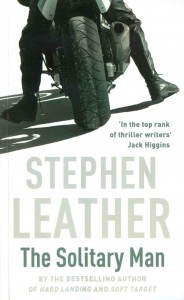
LeatherSolitaryManWe’d imagine that comparatively few of our WoWasis readers have served time in their nation’s prisons. Fewer have served in overseas prisons. And fewer still in the legendarily filthy prisons of Thailand. And that’s why so many people just love to read about them. From shit-encrusted holes in the floor that serve as toilets to the ever-present cockroaches, Thai prisons remain a nightmare. Author Stephen Leather’s The Solitary Man (1997, ISBN 978-0340-62837-9) puts you right inside.

Chris Hutchinson didn’t plan on spending much time there, actually. He was placed there by strong-arm elements that needed his expertise to spring a man out of prison. He couldn’t refuse: someone he loved was going to die if he didn’t agree to do it. Sound far-fetched? Plots such as these never are, in the novels of Stephen Leather. He never leaves dangled strings, leaking plots, or “wet” endings. Which makes book such as this one, at 567 pages, a joy to read. It’s a book that builds momentum with every page.

Hutchinson’s dilemma is touched by the DEA, the Thai court and prison system, Golden Triangle drug enterprises, and the Hong Kong mafia, just to name several. Many characters are memorable, from his African cell-mate to his beautiful, connected, intelligent, and loyal girlfriend, who, as the story progresses, knows less about him with every page. Even his relationship with her is a shadow.

Leather’s emphasis on verisimilitude is ever-present. Every element in the story is corroborated by countless tales in Thai newspapers, but the author’s gift is being able to furnish a beginning and an end to which newspaper readers are rarely privy. He’s a novelist that thinks like a newspaperman, which he was for a number of years, before becoming a successful novelist. He throws enough teasers in The Solitary Man that the thinking reader is never bored, but it’s tough to stay ahead of him. The twists in this story have too many turns to make them predictable. Highly recommended.  Buy it here at the WoWasis eStore.

WoWasis book review: ‘The Chinaman,’ Vietnam and IRA adventure by Stephen Leather

Written By: herbrunbridge - Feb• 13•13

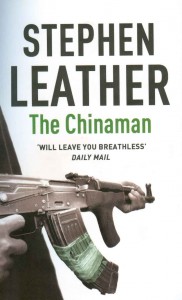
LeatherChinamanOne of the goodest bad guys in the annals of fiction would have to be Nguyen Ngoc Minh, the protagonist of author Stephen Leather’s The Chinaman (1992, ISBN 978-0340-58025-7). And right, he’s not Chinese, but rather a former Vietnamese military man that ended up in England, running a Chinese food take-out business. Life was good for Minh, his wife, and teen-age daughter until an IRA bomb in London dramatically changed the landscape, leading to warfare pitting one Vietnamese veteran against seemingly the entire Irish Republican Army.

As is the case with Leather’s other novels, the premise isn’t that far-fetched. There aree no holes in this script. Nguyen’s aware that he stands out, particularly in Northern Ireland, where much of the action takes place. His jungle skills are essential to his operations in Irish rural areas, as he infiltrates secret lairs of the IRA and Sinn Fein, its political arm. Leather’s a master of character development, his compelling male characters buffeted by the desires of a couple of intriguing femmes fatales. As the old calypso song by the Duke of Iron goes, “man smart, woman smarter.”

Some of Leather’s best writing concerns Nguyen’s jungle craft in farmlands, displaying the author’s pinpoint accuracy on guerilla fighting and bomb-making details. Not to be overlooked in his fascinating insight into the IRA, especially as it relates to the possibility of a rogue element working without the knowledge of its leadership.

This 400 page thriller can (and will, we predict) be read in a weekend. It’s a difficult to lay aside for a few moments, as its characters beckon the reader to finish this enchanting and intellectually stimulating tale. Highly recommended.  Buy it here at the WoWasis eStore.

WoWasis book review: ‘The Tunnel Rats,’ Vietnam terror by Stephen Leather

Written By: herbrunbridge - Feb• 10•13

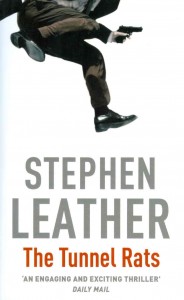
LeatherTunnelRatsbVietnam’s Cu Chi tunnels were a particularly nasty element in the Vietnam war. Built by the Viet Cong, they went for miles underground, and there were nasty things living in there, aside from Viet Cong soldiers, including rats, massive spiders, and stinging mites that lived in the tree roots. Novelist Stephen Leather has managed to capture the terror of what it was like to operate in the tunnels in his 500 page thriller The Tunnel Rats (1997, ISBN 978-0-340-68954-7). The author built his writing chops as a journalist and began writing books full-time in 1992. As of today, he’s written 26 novels. Though Tunnel Rats was one of his first, it’s got all the hallmarks of his later books: a twisted, intellectually stimulating plot, memorable characters, and a notion for locale and history that means he’s done his homework.

The story begins in London, where a war vet is found tortured to death in an abandoned railway tunnel. Conflict immediately comes into play between two competing police forces, and the dead man’s wife eventually looms as a significant player in the story. After the FBI becomes involved, the action shifts to Vietnam.

Leather is his most masterful in the 128 pages involving his characters’ actions in the tunnels. It’s claustrophobic, damp, fraught with punji sticks and spring-loaded spears, and in one nasty place, giant spiders. It’s also multi-level, again indicative of Leather’s emphasis on verisimilitude and frightening imagery. Being lost underground is a fear we’d guess most readers will fear as they read these pages.

Today, you can take a tour through the Cu Chi tunnels. We here at WoWasis have. But if you can’t (or won’t) The Tunnel Rats will take you there and provide you with a delicious crawl through armchair terror that will stay with you days after you’ve read the book. Highly recommended.

WoWasis visits the Irish Rover bookstore in Chiang Mai, Thailand

Written By: herbrunbridge - Feb• 01•13

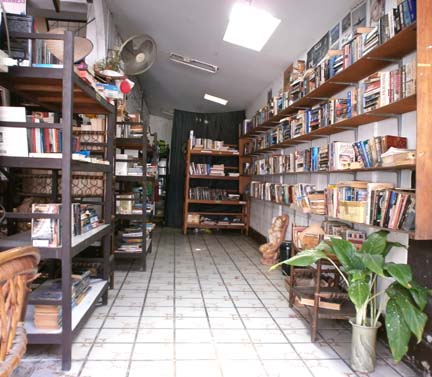
Here at WoWasis, we just love used bookstores. OLYMPUS DIGITAL CAMERAAnd here’s a great one we discovered in Chiang Mai, Thailand. It’s called the Irish Rover Bookstore and Café, and sure enough the personable proprietor, John McCoy, is Irish. Here’s what he has to say about his bookstore:

“There are many Chinese tourists here this year. In fact there are as many Asian tourists as Caucasian which must indicate a shift in things. I’ve had many Chinese coming into my shop as besides the books we have a cafe serving fresh fruit juices/shakes, fresh coconuts, local teas and coffee and also now BBQ.

OLYMPUS DIGITAL CAMERA“It’s always been mainly a bookshop, and when I started here back in 1997 there were just two of us here in Chiangmai, me here at Irish Rover and Richard over at Lost Bookshop. Richard became a good friend of mine and would occasionally come here for a fruit shake and I would go to his shop for an afternoon tea, Richard unfortunately died recently and his shop was taken over by another bookshop. There are now so many used bookshops in Chiangmai, the changes here over the last 15 years would take a lot of describing.

“What I have liked most about running the bookshop/cafe is the variety of people I meet, and of course the variety of books and trading and discussing books. I probably don’t have so many books as some of the newer stores that seem to have an endless supply, but because I get all of my books by trading with individuals or from the odd yard sale here from foreigners returning home, I would say my collection is more interesting.

I also have local writers here occasionally, including Sean Bunzick who lives locally, and James G. Cullinane (Biography: Arses & Elbows), C.Woww (Losing the Plot, set in Bangkok), Michael La Rocca (Rising from the Ashes, set in Chiangmai), and Jim Goodman who has written about and taken the most beautiful photos of local hill tribe people both here and in Yunnan, China.”

Location:  The Irish Rover is on Soi 6, behind Somphet Market, a colorful vegetable and fruit market, and is a place to relax and have a drink and meet people, while browsing the books. A big part of the fun is meeting John McCoy.

WoWasis book review: Stephen Leather’s ‘Live Fire’

Written By: herbrunbridge - Jan• 30•13

LeatherLiveFireIf you’re a Brit and love adventure fiction, you’ve probably read Stephen Leather. If you’re a Yank, you probably haven’t. Fact is, Leather sells tons of books in the UK. He’s written more than thirty novels, sold nearly three million books in all, and did get some U.S. traction with his eBook The Basement, which rose to the top of the charts. As his thriller Live Fire (2009, ISBN 978-0-340-92175-3) proves, the fact that he’s not a household name in the U.S. isn’t because he can’t write. It’s a terrific book.

It’s another in his series of books with agent Dan Shepherd as the protagonist. The action takes place in Pattaya, Thailand, Cambodia, the UK, and Holland, and involves two plots, one involving a Thailand-based group of British bank robbers, the other a Muslim conspiracy to commit a major terrorist act. These plots finally connect toward the end of this 470 page book.

If you’re a Yank, like those of us here at WoWasis, it takes a few pages to get used to the British jargon. But if you’re a Yank expat living in, or a traveler visiting Thailand, you’re used to it: it’s spoken by your British friends. Dan Shepherd is an interesting and somewhat complex character. He has neither close romantic involvements with women nor a good relationship with his teen-age son. The kind of work he does doesn’t permit either.

Leather works up some fairly good character portrayals in Live Fire. The international arms dealers are right out of Soldier of Fortune magazine. Many of us have been exposed to Russian mafia types like Sergei. One of the bank robbers is gay, but not ostracized by his heterosexual mates for being so. And in a surprising twist at the end of the book, one of the robbers shows an uncharacteristic bit of humanity. One suspects that Mickey Moore will eventually appear in a future Leather novel. We’d like to see him again.

The book flows so well that 470 pages passes quite quickly, with lots of action, good dialogue, and a plot that moves with a good deal of momentum. It’s a good book for an international air flight, reading fast enough that you may finish it before landing. Good characters, a compelling plot, and great dialogue represent an entertainment value better than most movie choices on planes these days. Highly recommended for those who like international intrigue and adventure. Buy it here at the WoWasis eStore.

WoWasis introduces author Harold Stephens’ people of Southeast Asia

Written By: herbrunbridge - Jan• 28•13

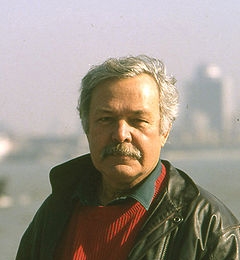
harold_stephensHarold Stephens knows Southeast Asia about as well as any author we’ve read. He knows it by sea as well as by land, and has written two books based on the fascinating people he’s met in Asia over the years, At Home in Asia: Expatriates in Southeast Asia and Their Stories, and The Strange Disappearance of Jim Thompson and Stories of Other Expats in Southeast Asia. What makes his profiles exceptional is that “Steve” Stephens clearly loves people, especially those who are living their dreams.

We at WoWasis are providing a list of those people he’s profiled in each of these books, alphabetically, and with the book referenced in which he profiled them. We’re convinced future historians and writers on Asian topics will one day want to discover more about these fascinating people. But before we get to the list, here’s what Stephens has to say about them, in general:

Given the chance, we all like to travel, to go beyond the sea, to visit foreign places. And oftentimes when we do travel, we try to imagine what it would be like to live there. How would it be to live in Singapore, the busiest seaport in the East, or maybe Bangkok, with its palaces and thousands of temples. And what about Kathmandu, high in the Himalayas, or Bali, where artists and poets go to live. Now that’s a place we have all dreamed about. And how many other such places are there whose names ring with romance? Can you picture your own Thai house, made of polished teak, with a high sloping roof and carved eaves and lintels, with tiny brass bells that tinkle in the breeze? Or perhaps a Malay house overlooking the Malacca Strait with a pandanas roof to keep it cool. And can you imagine having your own boat and diving beneath the sea for sunken treasure, or hacking through primeval jungle in search of lost cities? Or perhaps owning a plane and flying around Southeast Asia as simply as one takes to the freeways back home in Los Angeles?

There are people who live this way and do these things, people who have gone beyond the sea and taken up residence in foreign lands. These are the people I would like to tell you about.

And here they are:

BARBARA ADAMS: Every Woman’s Dream (At Home in Asia)

ZIENA AMARA: Travels with a belly dancer (The Strange Disappearance of Jim Thompson and Stories of Other Expats in Southeast Asia)

DELLA BUTCHER: Singapore s Grand Dame of the Arts (At Home in Asia)

LISA CHOEGYAL: At Home in the Himalayas (At Home in Asia)

ROBIN DANNHORN: Breaking Barriers (At Home in Asia)

JOHN EVERINGHAM: From Laos with Love (At Home in Asia)

COLONEL L.T. FIRBANKS: A tale from the British Raj (The Strange Disappearance of Jim Thompson and Stories of Other Expats in Southeast Asia)

AXEL GOERLACH: The General Managers (At Home in Asia)

BILL HEINECKE: Call to Adventure (At Home in Asia)

HOMER HICKS: The old man from Zamboanga (The Strange Disappearance of Jim Thompson and Stories of Other Expats in Southeast Asia)

HANS HOEFER: From Rugs to Riches (At Home in Asia)

BRIAN AND ZAHARA HUGHES: The expatriate and the princess (The Strange Disappearance of Jim Thompson and Stories of Other Expats in Southeast Asia)

JEFF AND ROBIN: Two sailors who may be kings (The Strange Disappearance of Jim Thompson and Stories of Other Expats in Southeast Asia)

TRISTAN JONES: Sailor Extraordinaire (At Home in Asia)

BORIS LISSANEVITCH of Kathmandu: A kingdom of his own (The Strange Disappearance of Jim Thompson and Stories of Other Expats in Southeast Asia)

INGER LISSONEVITCH: Mrs. Boris of Kathmandu (At Home in Asia)

BILL MATHERS: Treasures Beneath the Sea (At Home in Asia)

THEO MEIER: The private world of a South Seas painter (The Strange Disappearance of Jim Thompson and Stories of Other Expats in Southeast Asia)

R.V. PERKINS: The last of the great planters (The Strange Disappearance of Jim Thompson and Stories of Other Expats in Southeast Asia)

KURT ROLFES: The happy life of Tuan Kurt (The Strange Disappearance of Jim Thompson and Stories of Other Expats in Southeast Asia)

FRANS SCHUTZMAN:  The General Managers (At Home in Asia)

FRANS SCHUTZMAN: Twenty years at the Raffles and Manila hotels (The Strange Disappearance of Jim Thompson and Stories of Other Expats in Southeast Asia)

HAN SNEL: Life Among the Gods (At Home in Asia)

CONNIE STRICKLAND: Lady doctor from the jungles (The Strange Disappearance of Jim Thompson and Stories of Other Expats in Southeast Asia)

JESSIE TAKAMIYAMA: The kid from Hawaii who became a sumo wrestler (The Strange Disappearance of Jim Thompson and Stories of Other Expats in Southeast Asia)

JIM THOMPSON: The strange disappearance of the Thai silk king (The Strange Disappearance of Jim Thompson and Stories of Other Expats in Southeast Asia)

DOUG TIFFANY: Treasures beneath Southeast Asian seas (The Strange Disappearance of Jim Thompson and Stories of Other Expats in Southeast Asia)

KAREL VAN WOLFEREN: Mightier Than the Sword (At Home in Asia)

KURT WACHTVEITL: The General Managers (At Home in Asia)