The sharper edge to traveling in Asia

WoWasis visits the Hida Folk Village (Hida No Sato) in Takayama, Japan

Written By: herbrunbridge - Jul• 13•13

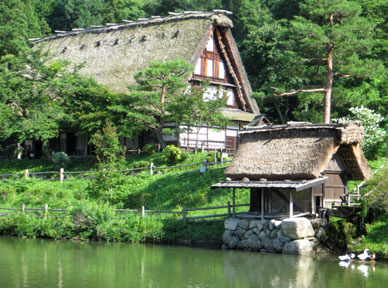
Noshioka house and mill

Noshioka house and mill

The hillside and lake-situated Hida Folk Village historical park in the city of Takayama, Japan, isn’t to be missed, and is worth a visit if you’re anywhere close to Takayama. Opened in 1971, the site consists of more than thirty buildings from the Hida area, moved here to preserve them from destruction. Architectural styles include Gassho-style thatched , and shingle-roofs. There are a number of displays of traditional Hida crafts in several of the houses, including our favorite, the wood-carrying sleds found in Hozumi’s house.  Also on the site are artisans working on traditional crafts such as wood carving and lacquerware.
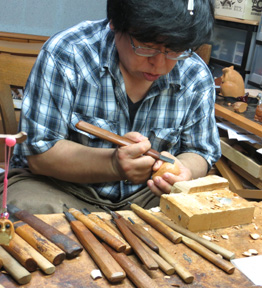
A woodcarver displays his craft at Hida Folk Village

A woodcarver displays his craft at Hida Folk Village

The grounds are magnificently laid out, with wonderful sightlines around every corner. A sign is posted outside of each house, describing in English the type of person who lived in the house (merchant, framer, etc.), what daily life was like for the inhabitants, and highlighting important architectural features.

The main site is concentrated around Goami Pond, and plan on about 1.5 hours to see everything. There is an adjacent site a few meters down the road which contains an additional house and the Museum of Mountain Life (ask for a map and direcions to the Museum at the main ticket window, as getting to the adjacent site is confusing).
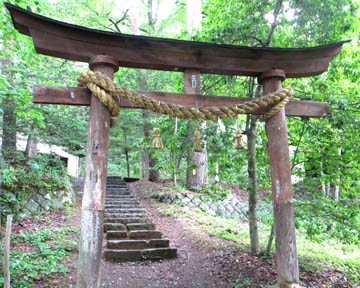
An ancient torii gate marks the path to a shrine

An ancient torii gate marks the path to a shrine

The Hida Folk Village is essential for visitors wishing to get to know more about traditional Japanese architectural styles. It’s easily visited by bus from the bus station right next to the train station. For 900 yen, you can buy a ticket that will get you entry into the park along with a round-trip bus ticket.

Hida Folk Village (Hida No Sato)
1-590 Kamiokamoto-machi, Takayama-city, Gifu 506-0055
Phone: +81-(0)577-34-4711
Open daily: 8:30-5:00

www.hida.jp/hidanosato
GPS: N36°07’56’’  E137°14’05’’
Not optimized for westerners: an afternoon wasted in Kibune, Kyoto, Japan

Written By: herbrunbridge - Jul• 13•13

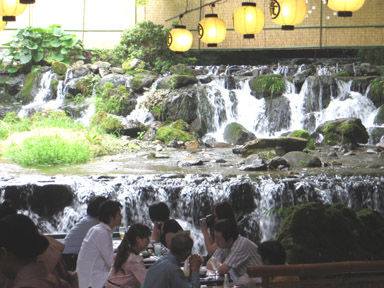
Lunching next to the river in Kibune will just have to remain a fantasy for western visitors

Lunching next to the river in Kibune will just have to remain a fantasy for western visitors

The tiny mountain village of Kibune, a half-hour north of Kyoto, Japan, sounds great in the guidebooks. It sits next to a mountain stream, and people eat at restaurants that consist of platforms nestled next to the steam.  The traditional dish is cold noodles dipped in a local sauce. Sounds wonderful and idyllic, doesn’t it? That’s not what we here at WoWasis discovered.

It’s a half-hour walk uphill from the train station, and you’ll find it a disappointing destination when you arrive. For starters, if you really do want to eat noodles on a river platform, you’ve got three choices. They all get booked in advance by tour buses. We arrived at 12:15, and were told there’d be a 4 hour wait! There was nothing else to do in Kibune, which is a small collection of restaurants on both sides of a road next to the river. We gave up the idea of noodles and were willing to settle for any other kind of lunch, but we did want to eat next to the river. Those options all consisted of prix fixe lunches at $52-$100 USD. A few coffee/snack places are on the other side of the road and not next to the river, but why travel to Kibune when we could have a coffee snack in Kyoto and not have to take a 20 minute train and then walk a half-hour uphill to get it?

Banner_Asia00A warning to westerners, then. Don’t bother going there if you don’t speak Japanese. No one there does. It sure would have been nice if someone had recommended a reasonably-priced place to eat, but no one spoke English at any of the five places we tried. They kept pointing to other restaurants, again, all with fixed-price lunch menus from $52-$100. We were the only westerners there, and figure that the westerners who recommend this place in guidebooks (are you listening, Lonely Planet?) were obviously accompanied by Japanese people, who probably got them bus reservations, cuts in line, or maybe a free lunch.

There are places the Japanese like to keep for themselves. Kibune may very well be one of these. It’s not optimized for western tourism, the food’s expensive, the hike in is long and nasty. For the westerner who speaks no Japanese, visit only if you’re in for an afternoon of masochism.

Gaining weight leads to bigger penis size, Thai Health Department suggests

Written By: herbrunbridge - Jul• 13•13

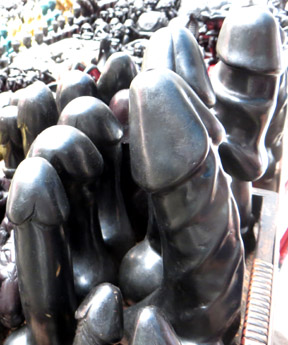
BKKstreetPenises1cLeave it to the Thais to finally find a natural solution to what men have been seeking for millennia: bigger cocks! According to a front page story in the July 13, 2013 Bangkok Post, the Thai government is now buying larger condoms to dole out to men under the age of 30. The Post quotes Dr. Pornthep Siriwanarangsun, director-general of the Disease Prevention and Control Department, who says the Ministry of Public Heath will buy more condoms with a circumference of 54mm, and fewer in the 52mm and 49mm sizes. The reason? “More Thai men are now over 170cm tall and exceed 70kg in weight.” We here at WoWasis weren’t aware that penis size is directly attributable to weight, but if that’s the case, look for Thai men to go on a campaign to eat more robustly, regardless of whether they consider themselves well-endowed or not. It wouldn’t surprise us if many Thai women responsible for the family cooking will up the caloric content of their man’s meals in search of a new element to sexual play.

ThailandThe Thai government distributes 40 million condoms annually through a number of different programs. We’d guess that the bigger condoms will go first, as we can’t imagine a man in the distribution line saying “I’ll take a small.”

The incredible mechanical puppets of the Karakuri Museum in Takayama, Japan

Written By: herbrunbridge - Jul• 12•13

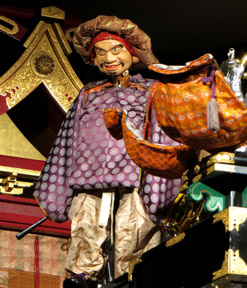
KarakuriPuppet1cPuppet- making has been a tradition in Japan for centuries, but we here at WoWasis admit that we were unprepared for the technical wizardry inherent in Karakuri puppets, the centerpieces of Takayam’s Karakuri Museum. Their history begins in Edo (now Tokyo) in 1617, where a watch repairman conceptualized that cogs and wheels found in timepieces could be utilized to make automated puppets.
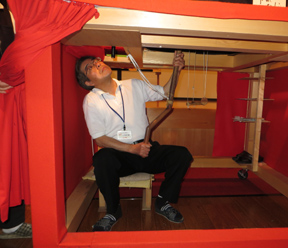
At the museum, the puppeteer is unveiled

At the museum, the puppeteer is unveiled

The first maker of Karakuri Dolls was called Shobei Tamaya (automated doll maker), and the dolls in today’s Karakuri Museum were made by the 7th and 8th Shobei Tamaya. Every 20 minutes or so, a puppet show is begun at the museum. Several puppets perform, as an aerialist, a walker on piers, and as a tea server, just to name three. The tea server’s mechanism involves an on-off switch that is activated when a tea cup is placed on a saucer in the puppet’s hands. The puppet moves forward on its own until the cup is lifted off, at which point it stops. When the cup is replaced, the puppet turns in a circle, returning immediately back to where it started.

There’s a Karakuri video of the tea server on YouTube that is amazing, but it obviously can’t replace seeing these puppets live. When you’re in Takayama, Japan, this museum is a “can’t miss.”

Karakuri Museum
Shishi-Kaikan 53-1
Sakura-Mach,  Takayama, Japan
Tel: (0577) 32-0881
Open daily April 1-October 31: 8:30 am – 6:30 pm
November 1 – March 31: 8:30 am – 5:00 pm
GPS: N36°08’51’’  E137°15’37’’

Thai Prime Minister Yingluck Shinawatra: Best legs in the business?

Written By: herbrunbridge - Jul• 11•13

Courtesy Bangkok Post

Courtesy Bangkok Post

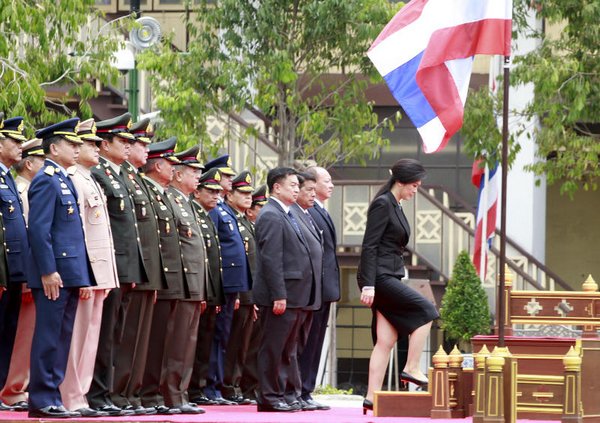
Thai Prime Minister Yingluck Shinawatra apparently has a leg up on her fellow world leaders, based on a front page photo by the Bangkok Post’s Thanarak Khoonton in the July 12, 2013 issue. In the photo, the Prime Minister reveals a shapely leg as she steps up on the dais to review an armed forces guard of honor. Judging by the man in the suit in the foreground, we’re not the only ones that noticed, either. Thailand obviously continues to set the world standard in femininity. Other governments please take note.

WoWasis product review: The incredible INAX “toilet shower” seat, now available worldwide

Written By: herbrunbridge - Jul• 09•13

The INAX replacement seat bolts right onto the existing pedestal

The INAX replacement seat bolts right onto the existing pedestal

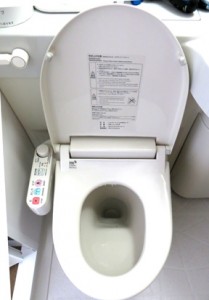
It probably started with us because we here at WoWasis hated the squat toilets that are traditional in most of the world. They’re messy and barbaric. We discovered Thai toilet hoses in 2002, reported on them, and even plumbed one into our house bathroom in our own country. But we weren’t prepared to be thoroughly spoiled by the INAX Toilet Shower we encountered in Japan, retrofitted onto the existing pedestal toilets in hotels and B&Bs. And we are so totally enthused by them that we’ll probably retrofit one of them at our own home.

Here’s what you’ll love, just for starters (INAX has several models, all with minor variations).

1) There are at least two nozzles, one for “shower,” the other “bidet.” We use them both.
2) Nozzles are self-cleaning after each use.
3) Adjust the seat temperature if you’re in the cold season.
4) The lid doesn’t slam down, it floats down.
5) A smell-suction device keeps the bathroom smelling nice.

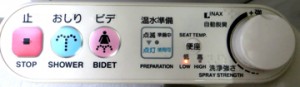
The controls are so easy, even Stevie Wonder could use them

The controls are so easy, even Stevie Wonder could use them

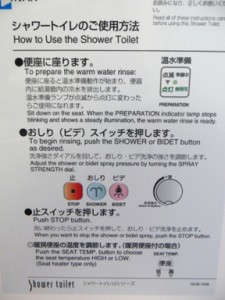
It’s so easy to use. After you finish your business, just hit the “bidet” or “shower” button and you’ll get a straight or pulsating warm jet of water (you choose). Wriggle your butt slightly to center the jet in the right spot (we’re all anatomically different, after all). Use another button, if you like, we always loved to experiment with water.

Use can even post these instructions within reading distance when friends pp over just to use your new toilet

You can even post these instructions within reading distance when friends pop over just to use your new toilet

Amazingly, this device is so accurate that water never jets out in front of you to spill on the floor. It’s pretty much foolproof, hygienically. It does require an electrical power source, and in most older bathrooms, there’s not one nearby, so the cost of an electrician will have to be added to the price of the seat, which could be between $700-$1000 USD, depending on the model and where you buy it.

Amortized over a year, that’s less than three bucks a day US, and the first time you use it, you’ll wonder how you spent a lifetime without it.

The best of Takayama Japan: Gomi Teruichi’s Showa Museum

Written By: herbrunbridge - Jul• 09•13

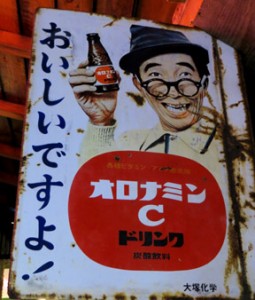
ShowaBeerAd1cThe Takayama Showa Museum is not only one of the best things in Takayama, in our opinion here at WoWasis, it’s most of the most remarkable museums in the world. Showa refers to the period of Japanese history (1926-1987) following the Taisho era (1912-1925), and preceding the Heisei era (1988-today).
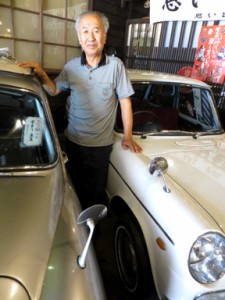
Founder Teruichi Gomi

Founder Teruichi Gomi

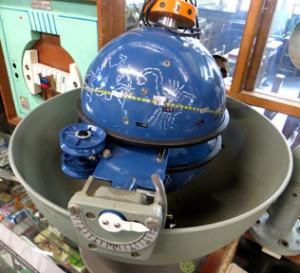
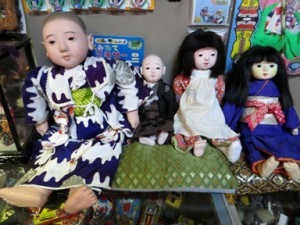
Virtually everyone who has owned and loved a Japanese product will enjoy this museum. It was founded as a labor of love by Gomi Teruichi, who was born in 1944. The museum showcases consumer technology of the era, and is divided up into twenty period rooms, including an appliance store, a toy store, an elementary school classroom, and a place for period automobiles. It’s a history of how the Japanese invented themselves into an economic power. Not everything worked: there is a Bridgestone bicycle powered by a tiny engine affixed to the rear frame. When the engine turns, it causes a hard rubber disc to engage with the rear wheel rim. Education was a big thing in Japan, as witnessed by a bowl-like device that when plugged in, allows a classroom to become a planetarium. There are vintage Japanese radios, cameras, movie posters and monster toys. The are cute dolls for girls and tin Shinkansen (bullet train) toys for boys. An eye chart from an optometrist’s office has figures in Japanese, with a color-deficiency chart built right in. The advertising posters are studies in ebullience.

Planetarium-in-a-bowl

Planetarium-in-a-bowl

The museum encapsulates Japan’s economic resurgence after World War II and its race to consumerism. We like the city of Takayama anyway, but we’re tempted to say it’s worth a visit solely to visit this museum. We spent an hour here, but could easily have stayed half a day.

There’s the Showa-Kan Museum in Tokyo that deals with the same era. We haven’t been there, but online data indicates that it focuses a lot on deprivation. On the other hand, the Takayama Showa museum is a celebration, with its twenty stores and shops reveling  in a wild optimism that took over a country and influenced much of the world, as inventiveness, miniaturization, and cost-control resulted in a new way of live for much of the post-1950 world.

ShowaDolls1cTakayama Showa Museum
6 Shimoichinomachi (3rd building north of Yasugawa intersecton)
Takayama City, Gifu Prefecture, Japan
Tel: 0577-33-7836
Open daily 9 am – 5 pm
GPS: N36°08’38’’  E137°15’36’’

Why we just LOVE the Spa-Hotel Alpina in Takayama, Japan

Written By: herbrunbridge - Jul• 08•13
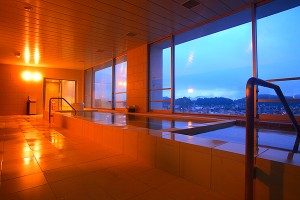
AlpinaSpaNight

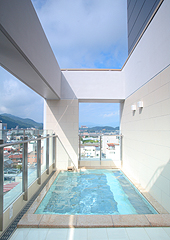
The onsen bath on the 9th floor

We don’t write about hotels very often. We here at WoWasis don’t get complimentary rooms, we pay for our own. So when we take the time to write about a hotel, it’s gotta be good. If you’re ever in the beautiful historical city of Takayama, Japan, a bit northeast of Kyoto, then you’ve got to stay at the Spa-Hotel Alpina. Here’s what you get for your $75 USD:

Looks great by day, too

Looks great by day, too

1)A simple, clean room with free LAN connection and a cool Japanese “toilet shower”
2) A breakfast
3) An incredible onsen (Japanese hot spring-type bath) on the top floor, where you can get a  180 degree view of the city while you’re soaking.
4) Great location: 3 minutes walk from the train station, 5 minutes walk to most major sites.
5) A really friendly staff.

Frankly, it’s the 9th floor bath that got us. It’s got three hot pools, all overlooking the city. One has undulating tiles, so you can soak as if you were on a chaise longue. Another pool is outside, so you can feel the cool evening air with your upper body, while keeping the rest of you nice and hot below water.

You can book it online, but you’ll probably pay more (around $100 USD) than if you called by phone ($75 USD). We happen to think it’s a bargain at $100 anyway.

Spa-Hotel Alpina
5-41, Nadamachi, Takayama-city, Gifu 506-0021
Phone: +81-(0)577-33-0033 Fax: +81-(0)577-35-3600
http://www.spa-hotel-alpina.com/english/index.html

WoWasis travel product review: the SunDog indestructible book cover

Written By: herbrunbridge - Jul• 06•13

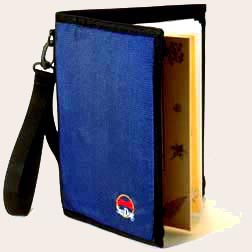
SunDogbookcoverDid you ever use a product that was so good and yet so simple that you used it for years and just didn’t think about how good it was?  That’s why we here at WoWasis are writing about the book covers from SunDog that we’ve been using for years.
What’s a book cover? It’s a slinky portfolio-type device that allows you to slip front and back covers of the book you’re reading into it. The book cover protects the book, and we’ve been using it for years on every guidebook we’ve taken overseas. We save our guidebooks because of all the notes we put in them, but like to covers to look pristine when they’re on our bookshelf at home. SunDog’s covers appear to be waterproof (we’ve never tested that), has a zippered front inside pocket for stashing stuff, a sewn-in bookmark (we use that a lot!), and best of all, we’ve had ours for more than 20 years, not a single stitch unwoven, not a single tear, nothin’!

ChinaWe originally bought three of them (different sizes) at Barnes & Noble.  We wish we could tell you where you could buy one, but SunDog’s website isn’t any help. So we’ll just say that the SunDog book cover is an exceptional product that you’ll use over and over again, and will probably outlast you. If it doesn’t, they have a lifetime warranty. This is a hell of a product!

http://www.sundog.com/product/deluxebookcover.shtml

The best bath in Japan? Maybe it’s Kyoto’s Funaoka Onsen

Written By: herbrunbridge - Jul• 05•13
Funoaka Onsen, Kyoto, Japan

Funoaka Onsen, Kyoto, Japan

Here at WoWasis, we’re clean freaks, or can’t you tell? We’ve reported on Thai toilet hoses, soapy massages, Bangkok Korean scrubs, you name it, we just wanna be clean. It turns out that the Japanese, like the Thais and Koreans, are water people, and they revere their public baths, which they call onsen.

And there’s one in Kyoto, called Funaoka Onsen, that’s off-the-scale good. And for 410 yen (about $4 USD), it can’t be beat. They’ve got both men’s and women’s sides of the house. Each side has a variety of hot baths, water jets, sauna, cypress wood tub, cold bath, tepid bath, and something they call “electric bath,” which apparently sends a low-velocity current through you. We spent an hour there, with Japanese men that shaved, washed, bathed, brushed their teeth, abluted like crazy, and we  were welcomed.

Banner_Asia00Here’s what you do: Japanese bath etiquette:

If you’re dirty, you’ll go to the sit-down stations and soap and shower off. Japanese baths are for soaking, not cleaning. Once you’re squeaky clean, choose one of those large tubs, and climb in. Yeah, you’re supposed to use the small towel you brought with you as a fig leaf, but forget about it. Here, no one cares about naked, it’s all about clean.  If you’re a first-timer, we recommend that you try all the baths. Dip your toe in to test the temperature, and immerse yourself in your favorite. Veteran Japanese bath goers like to take one of those plastic buckets that are all over the place, scoop out some water from the baths they’re about to go in, then drench themselves head to foot outside of the bath before they go in.

What to bring:

You can bring as little as a small towel, which is used for scrubbing as well as drying yourself, when wrung out. But you’d better shower first before you get there. If not bring soap and shampoo and clean off at the sitting stations. We brought deodorant and foot cream, so headed back out on the street clean as a whistle, and smelling great.

Many neighborhoods in Japan have onsen, so ask your hotel where the nearest one is. Bring a small towel from your hotel, and plan on 1-2 hours. This is an experience you won’t forget. And if you live in a western country, you may very well leave the onsen wondering where we westerners went wrong, in the hygienic department.

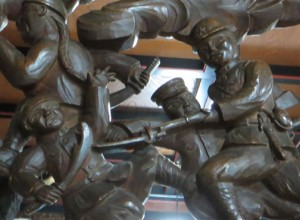
Bayoneting at the onsen

Bayoneting at the onsen

What to see:

In the changing rooms, there are elaborate carvings showing the Japanese conquest of Manchuria. Some people are offended by the violence, in particular the bayoneting scene. We are placing it on this page so you can enjoy your hot bath and not worry about it. If it indeed bothers you, please visit our report on Iris Chang’s book and funeral.

Funaoka Onsen
82-1 Minami-Funaoka-cho-Murasakino, Kita-Ku
Tel: (075) 441-3735
Open 3 pm – 1 am, Mon-Sat
8 am – 1 am Sundays, holidays
GPS address:    N35°02’13’’  E135°44’40’’

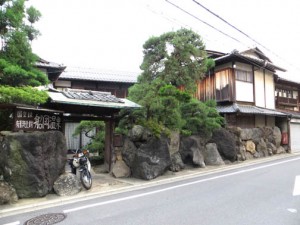
One way to get there: Take the 206 bus west from Kitaoji bus Terminal, . When it turns south, get off at the Senbon Kuramaguchi stop. At the next street south, turn left and walk 500 or so meters. Look for the big house with lots of rocks in front.