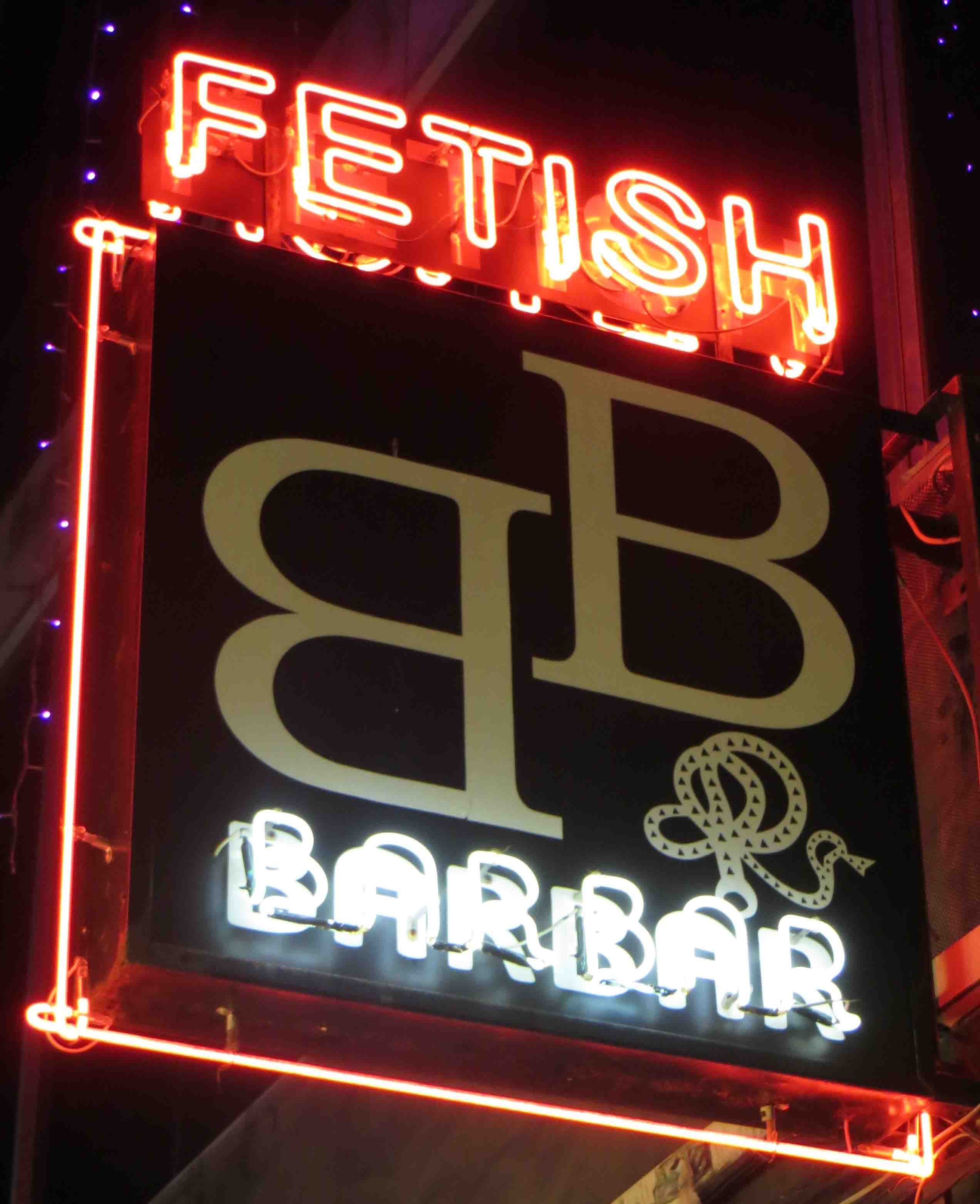
 Note: We here at WoWasis field all sorts of questions about Asia. Many of them are about entertainment options and Bangkok always heads the list. We’ve gotten several queries recently about fetish and S&M activities in Bangkok, so we thought we’d go right to the source by interviewing Barbara, who manages BarBar, a noted fetish bar in Bangkok.
Q: When did you originally open your bar, and what services did you provide that you felt were lacking in Bangkok?
The concept was first established in 2003, our doors in Patpong opened in 2006 and we just celebrated our 7th year anniversary. Unbelievable but true, at that time there was nothing happening in Bangkok in regards to BDSM and Fetish, besides two professional houses of domination, but no club, nothing for visitors who were looking for adult entertainment beyond gogo bars.
We were looking to do something different, more intimate, more exclusive, but also more explicit, creating a quiet haven for ladies & gents to relax without hassle, but in an arranged club protected environment.
Q: How many service providers work in the club, and how are they categorized (mistress, slave, etc).
There are always more then 20 ladies at the club, really talented and well experienced Mistresses and devoted Slaves. Some slavegirls also switch to the lighter forms of domination, mostly foot-fetish related
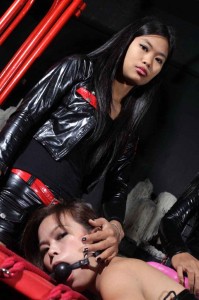 Q: Your customers run from being interested tourists to fetish veterans. For a new patron or couple just curious about S&M fetishes, describe what experiences await them and how you make the bar comfortable for those who are curious, but have little experience in the fetish world.
Our club caters to both the well versed fetish and BDSM enthusiast and the novice, or those who are just curious and want to experience a more mysterious and exciting night on the darker side. It is very easy, the dress code is black shirt, or fetish gear. You pay an entrance fee of 900 baht, and that includes one free drink of your choice, anything from Gold Label on the rocks, a cocktail or a glass of water. We don’t do discounts, in order to keep the clientele selected, and ensure a certain standard.
After you chose your drink you are free to explore the club area, sit at the bar or in one of the more private corners. The Mistresses and Slaves in waiting are constantly performing small shows and acts, where you can watch, mingle with the ladies, and even interact in the show as you wish. There is no time limit, and nobody will harass you for more drinks or to buy lady drinks, etc.
If you found what you have seen inspiring, then you can ask one or two or more Mistresses or Slaves to come and sit with you, start some more private play, or just hang out and enjoy the scenery of the club and the action that is ongoing around you. Our Mistresses and Slaves are very well experienced to make it a smooth and gentle intro into the world of fetish, so newcomers constantly have a great first time experience at BarBar.
Q: How about for veteran fetishists. What can they expect, and how are limits established?
It’s all about using the “safe word.” Only the safe word is the limit, and we want to emphasize that we don’t allow drugs or activities involving minors. Safe, Sane, and Consensual are the words we use, in common with other fetish clubs around the world. In terms of variety, we cater to the full range, from boot foot and leg-fetish, bondage, wax and pins, spanking whipping, flogging, and botanically speaking, we have a superb selection of locally grown canes.
In terms of equipment, we have huge selection of toys, restraints, costumes, devices for full body suspension, metal cages, crosses, benches, and we take pride in the fact that we are among the best equipped facilities in Southeast Asia. Our ladies are professional in conduct, and we have had not a single issue regarding the safety of a client or lady within the past 7 years, and we are sure to keep it that way.
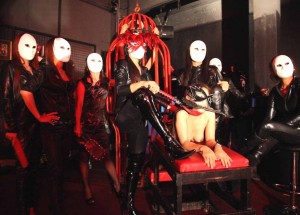 Q: Describe your pricing structure. What is covered in the admission price, and what charges are extra?
All activity within the club area is covered in your drinks price, 900 baht for the first drink, 300 baht for every following order. Bottles of spirit are sold at 7000 baht. If you wish to reward the ladies that you have been chatting or playing with, you may offer a drink for them at 250 baht flat-rate. Private sessions in our in-house dungeons are priced at 3,500 baht for 90 minutes, all inclusive.
Basically, for somewhat between 4000-5000 baht, you can get an unforgettable evening, if you are looking for a great night, with a friend or your partner. Compare that with what you get for this amount in some show or go-go bars, and you will most likely to return to BarBar. If you want to have a private session, including the entrance fee and your drink you get 2 to three hours of fun, a nice warm up and that private climax for just over 4000 baht.
Q: So let’s go back to that inexperienced but curious customer or couple. What do they do when they enter the bar? Maybe they don’t want to participate, but just watch. Later that evening, they may decide to participate in a fetish activity. Who can they talk to in the bar for guidance and friendly advice?
It’s so easy. Just ask our mamasan or any of the more senior ladies, as our ladies love to introduce the fetish world to newcomers. You’ll find the atmosphere very protective, you’re never forced to participate or do anything. You can be guided gently into this lifestyle and can go as far as you want, and nobody is pushing or forcing you in any way. This is especially true for single ladies or couples, as our ladies enjoy very much having the chance to meet, interact and play with curious single ladies and couples.
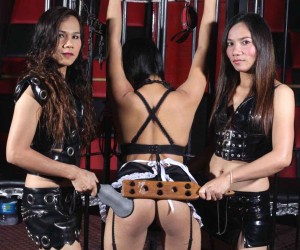 Q: On a recent evening, we noticed that many customers enjoyed taking on the slave role with the mistresses, but no customer seemed to want to take on a more dominant role. Do you serve fetish requests for dominant men as well?
Yes we do, for the more severe play, we recommend to take one of our Mistresses to join the first session with your Slave, as our Mistresses are experienced in play with each respective slave and are able to provide some guidance in the “get to know each other” phase.
Q: Finally, you refer to BarBar as a Fetish bar. How would you characterize a fetish bar versus an S& M bar? In short, what services do you NOT provide?
To us “Fetish” covers the entire spectrum, including but not limited to Bondage, Domination and Sado- Masochism. We have had some clients that would like to feminized, others have wished to be smashed in the face with a pie, and a few other things that have little to do with Domination, Leather and the Cane. But of course we also cater to the traditional aspects of fetishes, such as corporal punishment, shibari, and “whips and chains.”
Q: What days are you open, what hours, and what’s the best time to arrive?
We open everyday at 18:00 and close early mornings. However I recommend our guests to arrive before 21:00, as at that time the ladies are fresh and the biggest selection is available. Later on, we tend to get busy. We’re always fun, always ready to meet you, so come any time!
BarBar
Patpong 2
Bangkok, Thailand
BTS: Take BTS to Sala Daeng station, take exit 1. Walk two block to Patpong 2, BarBar is 50 meters up the road, on the right side of the street.
 “One thing for sure. I never want to be an old ladyboy.”
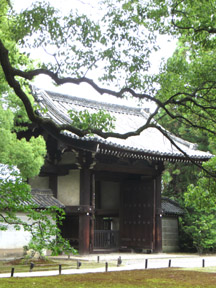 Blink, and you’ll miss it. But you shouldn’t. On the famed
 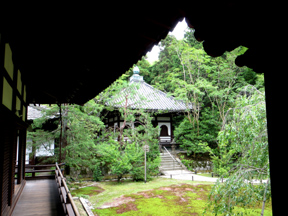 Sho-ren-in Temple
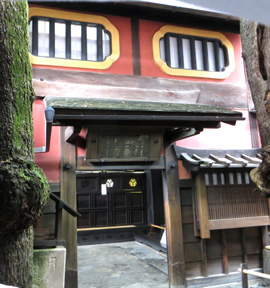 Sumiya is a wonderful, ancient traditional restaurant and entertainment venue, originally built in 1641, that’s now a museum of sorts, primarily involved in the architectural preservation of the building and interior. It’s considered to be the finest example of Edo-period ageya (restaurant and entertainment venue) architecture in urban Japan. Here is where lavish meals were served to wealthy patrons, where geisha and taiyu (premiere geisha) performed tea ceremonies, sang, and danced.
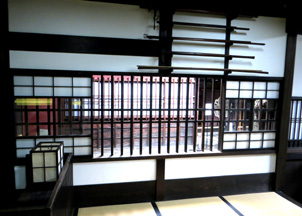 Sumiya is where leading politicians, writers, and artists of their times would gather for meals, entertainment, and conviviality. The house was ownerd and operated by the Nakagawa family for 13 generations, beginning in 1641. In 1952, it was designated by the government of Japan as a National Cultural Treasure.
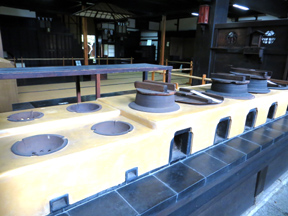 Today, it is an outstanding example of urban architecture and design. Visitors are typically only allowed to see the first floor. The second floor rwquires an additional fee of 800 yen, tours must be arranged in advance, and are only given in Japanese. In addition, no photos are allowed to be taken upstairs. A visit to the lower floor, however, is worthwhile. The building is magnificent, and it’s enough off the beaten tourist track in Kyoto that you’ll probably have it all to yourself.
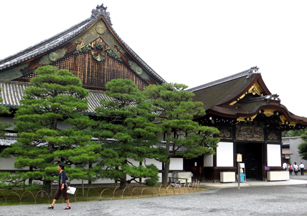
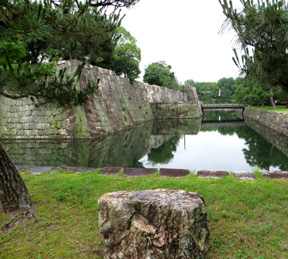
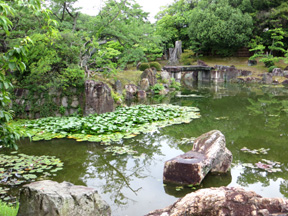
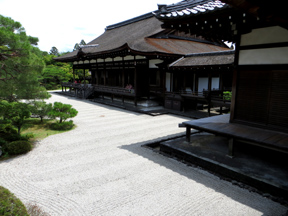 The Ninna-ji Temple was founded in 888 ACE. Also known as the Old Imperal Palace, Ninna-ji is the headquarters of the Omuro School of the Shingon sect of Buddhism.The Omuro School of Flower Arrangement is also housed in the temple. The temple complex is striking, with a number of architecturally arresting buildings, including an imposing pagaoda. A walk around the temple grounds is delightful, and there are comparatively few visitors here.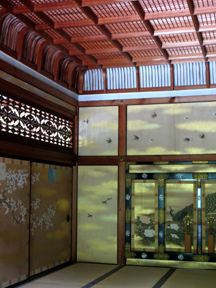
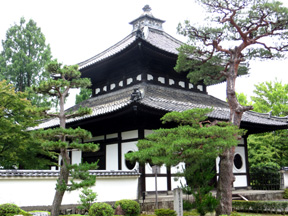 Tofuku-ji Temple with its well-known garden is southeast of Kyoto’s center, and is well worth the visit, both for its renowned garden, but also for the fact that there are relatively few visitors here, and the serenity can be welcome after braving crowds at Kyoto’s better known sites. It’s also close to the Fumisjhi Inari Shrine, and not too far from
 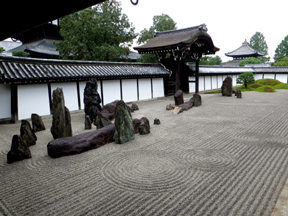 Tofuku-ji’s gardens are the highlight here. The Hojo (abbott’s hall) was rebuilt in 1890, and the Hasso garden dates from 1939, designed by Shigemori Mirei. It is the only temple in Japan in which the garden encompasses all four sides of the temple. The garden, comprising stones, trees, and raked gravel, is deeply symbolic, representing islands, scared mountains, and constellations.
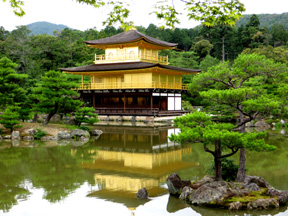 Although it’s full of visitors and can get crowded, there’s no doubt as to the beauty of the scene of Kyoto’s golden Kinkaku-ji Pavilion overlooking the lake. It’s one of the finest views in Japan. Originally built in 1397 ACE, the temple was burned in 1950 by an obsessed monk, so what you’re seeing today is an exact reconstruction, built in 1955. You can take a pleasant walk around the pavilion, but there are better gardens in Kyoto. This is a can’t- miss, though, if only for the beauty of the pavilion itself.
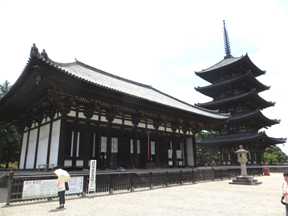 These days, Japan is restoring seemingly dozens of historical shrines and temples. The process included shrouding the building in a huge, unsightly shed for periods of up to five years. While we here at

