The sharper edge to traveling in Asia

Why a balding, smoking, middle-aged white guy may be the new sex symbol in Japan

Written By: herbrunbridge - Jul• 02•13
"Daddy" chic is back!

“Daddy” chic is back!

You can quote us here at WoWasis: Japan is different. Waaay different. By western standards, middle-aged white guys aren’t worth much, sexually or commercially. Ask yourself: how many older western guys are spokespersons, or models, or mage logos for anything hip? Can’t name one? Neither can we. Receding hairlines aren’t very popular: guys are paying big money to try to recover lost hair. And moustaches are even worse. Add smoking, and you’ve probably defined a figure that most western women would find repugnant, so much so, in fact, that no American company would even think of using such a figure to sell anything other than death insurance or old folks homes. “Daddy” is only chic in the gay world. 

That’s why we love the Japanese. The Suntory group created a fictitious character to be the logo for their brand of caffeine-laden coffee drinks. He’s got a moustache, a receding hairline, smokes a pipe, and his name is “Boss.” He’s made “Daddy” hip. 

And Boss gets around. He’s on T-shirts, and sometimes he’s modified to be completely bald, with a gnarly scar down his cheek as well. He’s on coffee vending machines every other corner, it seems. In Thailand, this guy would be a punter, albeit a stately one. In America, he’d be a non-entity. But in Japan, he’s Boss. And don’t forget it!

See Kyoto’s temples by city bus, optimized for western visitors

Written By: herbrunbridge - Jul• 01•13

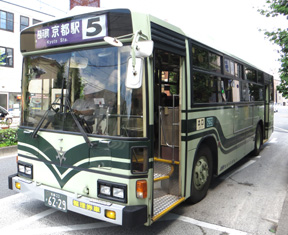
KyotoCityBus1cWe’ll have to admit it, we here at WoWasis aren’t much for using city buses to get around. In most cities, we’ll take the subway, taxis, hire a car and driver for a day, we might even take a bicycle. Typically, city buses can be challenging for those not speaking the language. But Kyoto, Japan’s city buses are different. Really different. They’re easy, inexpensive, go everywhere and they have a map optimized for Western visitors. For touring Kyoto, they’re the best. Here’s how they work. 

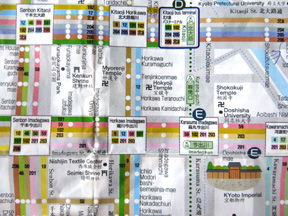
KyotoBusMap1c1)      First of all, get yourself a copy or two of the green ‘Bus Navi,’ the city bus travel map available at the airport, train station, and tourist info centers. Fold it up and keep it in your pocket.
2)      Bus fare is 220 yen, but a full-day pass costs only 500 yen, and you can buy it from the bus driver. When you exit the bus after your first ride, just insert it in the card reader slot next to the driver and it will automatically stamp the date on it.
3)      Each bus stop is named using the Western alphabet, and has an easy-to-read schedule with the buses it serves as well as arrival times.
4)      The bus map is a gem of graphic design. Each city bus stop lists the buses it serves, and color-coded lines with bus numbers radiate from each stop. In seconds, you can find where you are, pick your destination, and choose your route and bus.
5)      A number of well-visited tourist locations are listed on the map as well adjacent to their respective stops. 

KyotoBusDayPass1cIn short, this efficient, effective bus system has been optimized for Westerners. Map in hand, it takes only a couple of rides to fully understand the system. Kyoto also has a two-line subway system, but for the most part, you’ll find yourself using (and enjoying) city bus travel in Kyoto.

See Kyoto’s eastern temples in a half-day walk in the southern Higashiyama district

Written By: herbrunbridge - Jun• 30•13
KiyoMizu Temple

Kiyomizu Temple

Kyoto’s Buddhist temples and Shinto shrines are spread all over this fairly large city, and using the bus system is something visitors get used to doing quite quickly, unless they want to run up considerable taxi bills.

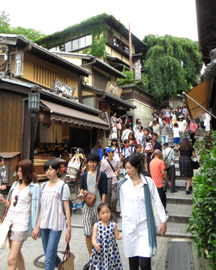
On weekends, hundreds of girls in kimono walk along Ninen-zaka

On weekends, hundreds of girls in kimono walk along Ninen-zaka

For us here at WoWasis, therefore, a half-day north to south walk along Kyoto’s eastern perimeter in the southern Higashiyama district was not only a relatively easy way to see temples, but it introduced us to some great neighborhoods, too. Obviously you can begin the walk from either direction, but we’ll describe it from south to north, beginning at the Kiyomzu-michi bus stop. You can arrive at this bus stop via bus lines 100, 202, 206, or 207. From there, go south for half a block, then walk up the hill heading east, bear right at the fork in the road, go up Chawan-zaka (Teapot Lane), a street with dozens of tourist trinket shops. Soon, you’ll see the pagoda of the Kiyomizu-dera temple. All of Kyoto’s historical temples charge an entrance fee, and in this case it’s 300 yen. We don’t think it’s worth 300 yen, nor is it worth 100 yen to go underground, visit “the womb” in darkness, and see a rock. With dozens of trinket shops inside, Kiyomizu Temple gets our vote for Kyoto’s biggest tourist ripoff. Its most interesting buildings are encountered before the ticket booth, so enjoy them, take some pictures, and leave with your hard-earned yen intact.

Descending Ninen-zaka Street

Descending Ninen-zaka Street

After visiting Kyomizu-dera, walk back down the hill for a few meters, then turn right at Sannen-zaka, which will begin yur tour of a number of beautiful streets with old houses that have been turned into interesting shops. Like much of Kyoto, there isn’t much in the way of street signs, but this walk is famous among Japanese locals and visitors, so just follow people, as they’re doing the same thing you are. Sannen-zaka will curve to the left, and shortly after the curve, turn right down a flight of steps to Ninen-zaka, another beautiful small street. On your walk, you’ll be tempted to go down other small streets, and it’s well worth doing so, as there are some beautiful old buildings there. On the weekends, dozens of girls in kimonos are touring these streets as well, adding to the traditional atmosphere that makes this walk a memorable one.

At the end of Ninen-zaka, zig zag left then right and continue north. A few meters down, make a left onto Ishibei-koji, a magnificent street made of tooled stone, then return to Ninen-zaka north, where you’ll pass the Kodai-ji shrine and enter Maruyama-koen park. After a drink break in the park, continue north to the Chion-in and Shoren-in temples, adjacent to each other. The Shoren-in temple was our favorite in Kyoto, with few crowds and a quiet atmosphere.

To end your walk, descend south on the busy Sanjo-dori street and you’ll arrive at the Higashiyama Sanjo bus stop, where you can pick up buses 5, 12, 46, 100, 201, 202, 203, or 206.

WoWasis Book review: ‘Tears of Autumn’ Vietnam spy fiction by Charles McCarry

Written By: herbrunbridge - Jun• 26•13

Here at WoWasis, we love reading old books that we missed the first time around, especially when we discover something that we really shouldn’t have missed. We’ll bet you missed Charles McCarry’s thriller The Tears of Autumn (1974, ISBN 13-978-1-58567-890-7), too. That’s right, it was written in 1974, at which point many of the readers of this blog weren’t even born. The book is worth reading for its interesting supposition as to the reason behind the assassination of President Kennedy, but also for its explanation of some of the fine points of spycraft. Some very interesting elements of Vietnamese culture are thrown in as well. And the regime of Ngo Dinh Diem figures prominently in the book as well.

The author reveals fascinating information on the structure of Vietnamese familial lineage, beginning with the toc, consisting of all persons, male and female, who can claim a common ancestry five generations in the past and three generations in the future. In the mix are also chi, men in a direct line from eldest son to eldest son, and phai, men who descend from younger sons. As a result, Vietnamese families have a sense of future generations, as well as the past. McCarry’s got interesting points involving death rituals as well. There are two pages — 144 to 146 in our copy — beginning with the laying of bananas on the chest of the deceased to confuse the appetite of the Celestial Dog. 

Superior novelists fill the minds of readers with historical and cultural details particular to the lives of those involved in the story, and McCarry’s got his chops together in several different areas. Although the story is essentially about the killing of JFK, the action takes place in Vietnam, Africa, and Europe, as well as the U.S. Protagonist Paul Christopher is a recently-retired spy using the vocation of a writer as a cover. Although there are lots of deaths in the book, it surprised us that Christopher didn’t ever directly kill anyone in the book, even though he shot someone with birdshot and did a few other nasty things, like threaten to shoot a syringe full of leprosy culture into someone else. No matter, Christopher’s acquaintances manage to accomplish enough nasty stuff to keep readers wide awake. 

So why read a book based on an event that occurred 50 ago and was written 40 years ago? It’s a timelessly compelling and well-written story, bringing alive a historically important era in which a beloved president was killed and a largely unpopular war launched. The twists of plot, nefarious figures, and cultural nuances drive the action forward, and perhaps most importantly, the writer sums up all the discoveries in a tight chapter at the end of the book. This is a critical element in a book with as much going on as this one has, and is a welcome contrast to a another book we just read that left us as confused at the end as we were at the beginning. Not so here. 

This book is highly recommended for lovers of adventure, spycraft, delicious characters, and tight writing. Buy it here at the WoWasis eStore.

WoWasis book review: ‘Bangkok Dragons, Cape Cod Tears’ by Randall Peffer

Written By: herbrunbridge - Jun• 20•13

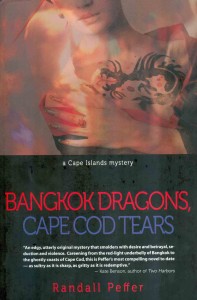
BangkokDragonsPefferFrom our catbird seat here at WoWasis, it’s pretty clear that novelist Randall Peffer, in his Bangkok Dragons, Cape Cod Tears (2009, ISBN 978-1-60648-038-0), knows a few disparate worlds. The transgender world features prominently here, both in Bangkok and Cape Cod, as does the Portuguese fishing community of the Cape. Melding these worlds with police and the criminal underground into a cogent novel, though, is tricky, and by the time the book ended, we were scratching our heads as much as we were after the first chapter.

This is a follow-on book to Peffer’s two earlier books in the ‘Cape Cod Islands Mystery’ series, and many references are made through flashbacks, a chore for the reader unfamiliar with the others. The story revolves around a Portuguese-American’s love for a mixed-race Viet-American transgender girl who is heavily involved in the Bangkok scene. A previous romance of hers involves a stolen gem, which brings police on two continents as well as the underworld into the fray. Peffer is at his best in moving the action forward, but his dialogue, especially concerning Tuki, the transgender protagonist, isn’t always believable. One example is Tuki’s quote “That wench had Sunny kill Prem?” We’ll give you five pounds of satay if you can find an English-speaking Thai that uses the word “wench.” The names of some of the characters are bizarre as well. Prem’s father is Thaksin Kittikachorn. Melding the names of two recent Thai strongmen (Thaksin Shinawatra and Thanom Kittikachorn) just seems a little too precious to us. Yes, Thai names can be a bit challenging for western novelists, but we would have liked a bit more creativity here. These issues may seem like nitpicks, but we found them grating.

ATthailandIn terms of what we found compelling about the book, first and foremost was the use of a transgender individual as a main character. Thailand is full of transgender folks, for the most part well-integrated into Thai life and culture. Many westerners have had relationships with them (not always knowing that the lover in question was transgender, of course), and protagonist Michael DeCastro’s often uncomfortable realization and understanding of this element is realistic. He’s not the first, and won’t be the last. And the author certainly knows his Cape Cod culture, from the fishing boats to Provincetown’s gay bars.

Gay and /or transgender protagonists are not common elements in Bangkok Fiction, and we’re happy that Peffer has taken the plunge. He has, as of now, written six novels in this series. In terms of reading the others, we’d hope that Peffer relies less on flashbacks, gets a little more polished on dialogue, and spins a tighter tale with fewer loose ends. When writing books in serial form, each novel must stand on its own. We’d have liked this one to have a more concrete ending, instead of serving as a way-station between novels two and four. Buy this book here at the WoWasis eStore.

WoWasis Vietnam book review: Nelson DeMille’s ‘Word of Honor’

Written By: herbrunbridge - Jun• 16•13

WordOfHonorDeMilleIf you’re a U.S. citizen, when you visit Vietnam, you may be pleasantly surprised at the lack of animosity. After all, the Yanks tore up the country and killed a lot of people. Just how badly things go haywire under combat conditions in Vietnam is a story that sets the table for Nelson DeMille’s epic novel Word of Honor (1985, ISBN 13-978-0-446-30158-9). The underlying story is that of a massacre of civilians and NVA wounded at a hospital. Years after the war ended, the untold story is revealed in a book, setting in motion the court martial trial of the American commanding officer.

This 738 page book is a thriller from beginning to end, as individual honor, betrayal, and immorality are laid bare in the courtroom. The author himself was a lieutenant that served in Vietnam, and we here at WoWasis can’t figure out how anyone who hadn’t served in combat conditions could have expressed the chaos in the heat of conflict so well. But where DeMille’s writing really shines is in his reporting of the courtroom scenes, which kept us on the edge of our seat for several nights as we raced to reach the final chapters. DeMille’s great at dialogue and describing individual relationships, in particular between protagonist Ben Tyson and his attorney, and Tyson and several female figures, including his wife.

This is a remarkable piece of writing, and has global appeal. It’s a must-read in particular for people interested in legal situations, Vietnam, and war crimes. Highly recommended. Buy this book now at the WoWasis eStore.

WoWasis GPS product review: Magellan RoadMate 5265T-LMB vs Garmin Nuvi 1350 LMT

Written By: herbrunbridge - Jun• 07•13

Magellan RoadMate 5265T-LMB

Magellan RoadMate 5265T-LMB

For several years now, we’ve been using the Garmin Nuvi 1350 LMT GPS navigator, but read a sterling review of the Magellan RoadMate 5265T-LMB, which seemed to be for us, an upgrade. Perhaps its most notable feature was its ability to show points of interest on the actual display itself, so we could make turns based on easy-to-identify gas stations, stores, etc., so we wouldn’t have to hunt for street signs. Its 5 inch display was bigger, too, so we ordered one. Here’s how it stacks up with the Garmin.

The Magellan’s display isn’t lit as well as Garmin’s, so it’s more difficult to see when sunlight hits the screen. Although Garmin’s screen is smaller, Garmin makes better use of the screen. Garmin allows us to show current direction, current speed, elevation, and time simultaneously, right next to the map, whereas Magellan allows you to see only one of those elements on-screen at a time. You can touch the Magellan screen to get any of these elements individually, but it’s cumbersome to do so while driving, and must be done by reading small print, rather than by an icon.

A disadvantage of the Garmin is that you have to toggle through four screens to find points of interest, like gas stations and ATMs, meaning you really have to pull over, unless you have a co-pilot. That gets you a street address, but you must go through an additional two screens to actually get a map that will guide you there. The Magellan, allows you to program them in on the map, which is the advantage of having a larger screen.

The Magellan has the added advantage of having traffic warnings on-screen, and picked one up right around the corner from us the first time we used it. The Garmin also has traffic warnings, but to enable that feature, you must accept on-screen advertising. The Magellan features Red Light and Fixed Speed camera alerts, the Garmin does not. If you drive in an urban environment, this feature alone could save you the price you paid for the Magellan unit.

Both the Garmin and the Magellan include free lifetime maps, but with the Garmin, you must register the product online within 60 days or you lose the free lifetime map feature. The Garmin comes pre-loaded with maps for the lower 48 states, Hawaii and Puerto Rico. The Magellan includes all that, and Alaska as well. The Garmin unit has world map capability via a separate purchase of its WorldMap CD. We here at WoWasis have used the WorldMap in Asia, and have found it to be virtually worthless in Southeast Asian countries. We’ve not yet tested it in Europe. Based on Magellan’s website, it appears that international maps are not available for the 5265T-LMB unit.

In terms of pricing, the Garmin unit can be found on the web for $135 USD and the Magellan unit for $170 USD.

Which unit is best for you? The Magellan’s larger screen and on-screen points of interest are a plus, but sunlight creates a problem. The Garmin has an easy-to read screen with speed, time, direction, and distance on-screen, but points of interest are not resident on the screen, and require several clicks. Travelers to European countries may find benefit in the Garmin’s capability to download international maps. If you have a Blue Tooth mobile phone, the Magellan interfaces with it, the Garmin doesn’t. Overall, the Magellan has more bells & whistles, but again, if the sun hits the screen and you have the audio turned off or can’t hear it, then the unit doesn’t do much good. We’ll continue using both, but for our money, the Garmin’s a better value, considering its price point.

Buy the Garmin Nuvi 1350 LMT here at the WoWasis eStore.

WoWasis book review: ‘Lacquerware Journeys’ Burmese Lacquerware by Than Htun (Dedaye)

Written By: herbrunbridge - Jun• 05•13


LacquerwareJourneysBookThere has been a resurgence of interest in Burmese lacquer ware concomitant to the large numbers of travelers now visiting the country of Myanmar. Sylvia Fraser-Lu’s landmark book Burmese Lacquerware is in its second edition, but ordering it internationally is financially problematic, going for more than $100 USD on the internet, while available for $45 USD if purchased in Bangkok. As good as Lu’s book is, it’s not nearly as graphically interesting, nor as informative as Than Htun (Dedaye)’s Lacquerware Journeys: The Untold Story of Burmese Lacquer (2013, ISBN 978-616-7339-23-8). This extraordinarily handsome 277 page book is comprehensively illustrated with loads of photos, many of which contain extreme close-ups of lacquerware art in color.

Than Htun’s passion for the art form is driven by a natural curiosity that has sent him to many parts of Burma looking for examples and collectors. He’s a good writer, too, and although the text is voluminous, it goes at a good clip. We here at WoWasis are lacquerware collectors ourselves, and this book sent us back to looking at our own collection with a finer eye to detail. We now see both flaws and beauty where we hadn’t appreciated them before, and the book will allow us to make more informed future purchases. Part of the beauty for the reader is that Burmese lacquerware is still affordable in both Thailand and Burma.

The book is comprehensive, covering the history of lacquerware as well as the intricacies of lacquer production, well-illustrated with photographs. He meticulously describes how objects are colored and incised. He then describes pieces themselves, including hsun-ok and betel boxes, among the most ubiquitous manifestations of the art form, dividing them into fourteen geographical areas, categorized into Lower Myanmar, Upper Myanmar, the Shan States, and Rakhine. There’s also a glossary, bibliography, and index. It’s a world-class book.

We would have liked to have seen more information on large gilded lacquerware puppets, but it’s hard to find fault with the book. In truth, virtually every type of lacquerware, be it hsun-ok, betel box, nat, or puppet, is deserving of a book in itself. Without a doubt, this book, though, is the place to start, and should be considered an integral part of the library of anyone interested in the art and culture of Burma. Buy it here at the WoWasis eStore.

Bachelor in Bangkok: Khun Lee on expensive, worthless American dating services

Written By: herbrunbridge - Jun• 05•13

BachBKKLKee1cLiving in Paradise one tends to become extremely spoiled when it comes to women, sex and just about anything that has to do with life’s pleasures.  I must admit that although I tell people every day that I am the luckiest guy on the planet, every once in a while I need to be reminded in a harsh and somewhat brutal way of just how fortunate I am to have escaped the passionless existence of the West for the hot, sultry life in the exotic East.

I was chatting online with an old friend the other day that happens to live in my native city of Washington, D.C.  He is quite similar to me, late 40’s, tall, slim and has a good job and enjoys socializing.  He proceeds to tell me about a dating service he joined that requires an upfront payment of $4,000 (yes that’s 140,000 baht!) but guarantees him 4 lunch dates with different ladies or he gets his money back.  Now, I have to stop right here and say that if this man lived here in Bangkok he would be quite a stud.  I dare to say he would have to beat the women off with a stick.  However, things have gotten so ridiculous back in farangland that he hasn’t had a date for 4 years, and hasn’t had sex for 7 years.  After making sure he hadn’t said 7 days instead of 7 years (who the hell could go more than a week without sex and not kill himself?), I inquired about the details of this dating service’s package.  For this incredible sum of money they set him up with 4 women, and he proceeds to have a one hour lunch date with each one.  That is it! That is all he gets.

But it is even worse than that.  One of the women he joined for lunch couldn’t stomach spending even an hour with him and made a flimsy excuse and sauntered off.  When he informed the dating service, they said she would not count as 1 of his 4 dates and they would still guarantee the 4 lunch dates or his money back.  So he returns to the service’s office to view videos of possible dates and selects a few prospective ladies for lunch meetings.  When the manager of the service looked at my friend’s selections, he says “this is why you are having such bad luck.  You are being WAY too picky.  He proceeds to tell my friend that 1 of his selections, a lady 40 years old who has 3 children and a double chin, is out of his league and he should select another lady who is closer to his own age and level of attractiveness. Whaaaaaat the fu*k?  Now I truly understand the emotions behind “The Pattaya Flying Club,” the enormous number of men in Thailand (most of whom spent their days in Pattaya) who run completely out of money and assets, so throw themselves from the roof of a tall building because meeting their Maker is preferable to returning to the absolute hell that is farangland.

thailadies290x200One doesn’t need to travel all the way around the world from Paradise in order to meet stuck up women with bad attitudes.  I have many mates who work in rich Asian countries or cities such as Singapore, Taiwan and Hong Kong.  Money is the ultimate corruptor, and as most men have figured out by now, once women are surrounded by money they become total bitches.  My mates have told me countless times that the women in these rich Asian cities are just as bad as farang women (especially if they have the Chinese influence) but until recently I wasn’t sure whether or not I believed it.  Last week I was enjoying a few cold beers and pleasant conversation in one of my favorite haunts when 3 Chinese looking gals walked in and sat down.  Needless to say, the Thai manager was salivating over these gals (they really were not that hot) because of the Thai addiction to white skin.  I introduced myself to the ladies (who were from Hong Kong)  in order to give my Thai manager friend an excuse to chat them up, and as the conversation progressed I decided to ask them what kind of men they normally are interested in meeting.  In unison, the 3 ladies shouted “rich” and “lots of money” much to my amazement.  I can honestly say that in 8 years of living in Thailand, not one Thai lady has ever told me that she was specifically looking for a rich man.  For that matter, I think my poor friends do even better with Thai ladies than my rich friends do. 

Man oh man do I love Thailand.

Read Khun Lee’s other WoWasis columns for more advice on navigating the adult dating scene through the backstreets of Bangkok

WoWasis sex book review: ‘She Comes First’ by Ian Kerner

Written By: herbrunbridge - May• 31•13

SheComesFirstBookWriting a book on oral sex techniques to be performed on women is a pretty serious undertaking. As Ian Kerner, Ph.D., the author of She Comes First: the Thinking Man’s Guide to Pleasuring a Woman (2010, ISBN 978-0-06-053826-2) unveils, there’s a lot of there there. There’s a lot to like about this book, provided the reader can get beyond the numerous puns that made us here at WoWasis gag more or less consistently while reading the book. We wish Kerner would have left out that form of juvenilia.

His basic premise is spot-on, namely a good lover of women ensures that she experiences orgasm before he (or she) does. The book is primarily written for men who know little or nothing about the female sex organs, and the author provides a very good anatomical explanation of what they look like and how they function. His descriptions of tongue play are fairly complete, and his discussion of the value of timing is quite good.

Every woman is different, as the author notes, and soon, after the anatomy lesson, Kerner launches into the descriptions of a ridiculously high number of tongue gymnastics. To keep track, he ends the book with a six stage template that can be copied by the buyer, and upon which he or she can note preferred positions for tongue, fingers, and hand.

Veteran punters generally know this stuff, but there are one or two essentials the author has left out (one will remain our secret). For one, we couldn’t find any mention of the importance of keeping your upper lip closed over your teeth. If you don’t, a serious pelvic buck could send her screaming, and not in the right way. We like the fact that he mentioned the importance of good hygiene, thus we hope that millions of North American women will buy this book and adhere to its precept of cleanliness. We wish the author had spent a little more time on the subject of hair as odor-collector. If the author had recommended a clean shave, he might have mentioned Gillette’s Venus razor, loved by thousands of women and their lovers.

If you’re a lover that already has your women climbing the walls, you probably don’t need this book, or the anatomy lesson. Too, you can peruse it at the library. On the other hand, if pleasing women first is news to you, the book’s a good read, and you can just ignore the bad puns. And remember what we said about covering your teeth.  Buy this book now at the WoWasis eStore.