The sharper edge to traveling in Asia

WoWasis book review: ‘The Terra Cotta Army’ by John Man

Written By: herbrunbridge - May• 27•13

TerraCottaArmyBookThe discovery in 1974 of some 7,000 Chinese terra cotta warriors and horses from the First Emperor’s reign circa 200 BCE is one of the outstanding archaeological finds on th twentieth century. Several of these statutes have been on tour of U.S. museums, most recently at San Francisco’s Asian Art Museum.

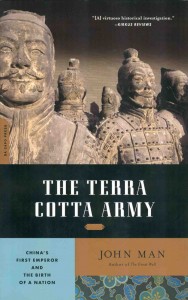
John Man’s landmark book, ‘The Terra Cotta Army: China’s First Emperor and the birth of a Nation (2008, ISBN 978-0-306-81744-1) is a comprehensive 288 page book containing 32 pages of photographs that encompasses the excitement of the find as well as the historical information needed to put it in perspective.

Man is an exceptional writer with a keen sense of curiosity and a writing style that unfolds the story magnificently. There’s much drama herein, from the machinations of historical Chinese warring factions to the politics surrounding the discovery of the statues and the involvement of the Chinese government. He has a wonderful chapter on the subject of the restoration process as well, as it’s a significant element in the story. By the end of the book, we’ll bet that most readers will seriously consider buying an airline ticket to see the statures in situ. As an example of Man’s considerable writing talents, consider his take on heavy-metal poisoning:

The taking of elixirs was a dangerous business, justified only by the supposed rewards. To experiment not only with gold and mercury – the favourites – but also with arsenic, lead, copper and tin was to poison oneself. Here, too, experience was no match for optimism. To quote a sixth-century text that ticks off an array of metal-poisoning symptoms:


After taking an elixir, if your face and body itch as though insects were crawling over them, if your hands and feet swell dropsically, if you cannot stand the smell of food and bring it up after you have eaten it, if you feel as though you were going to be sick most of the time, if you experience weakness in your four limbs, if you have to go often to the latrine, or if your head or stomach violently ache – do not be alarmed or disturbed. All these effects are merely proofs that the elixir you are taking is successfully dispelling your latent disorders.

 

ChinaThe theory behind these practices, wildly eccentric though they sound to outsiders (and sounded back then Confucians), was mainstream among Daoists for centuries. The elixirs were supposed to somehow rarefy or aetherialize the body (an idea that may have derived from the trance-inducing ‘magic mushroom’ potions taken by Siberian shamans and ancient Indian mystics), the purpose being generate a new self that was immortal though still physical. Adepts took elixirs during life to prevent decay after death. Indeed, arsenic has precisely this effect, presumably because it poisons not only the victim but also the bacteria that cause decay. Death thus becomes a doorway to immortality.  The corpse of the successful adept would remain incorruptible and emerge like a butterfly from a chrysalis to dwell with immortals.

This book is a must-read for Chinese history enthusiasts as well as those interested in this most fascinating archaeological discovery. Buy it here at the WoWasis eStore.
WoWasis book review: ‘Myanmar Buddha: The Image and Its History’ by Somkiart Lopetcharat

Written By: herbrunbridge - May• 27•13

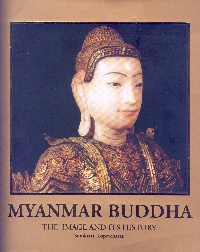
MyanmarBuddhaBookThis very fine and comprehensive book on Burmese Buddha images is generally available only in Southeast Asia, so we here at WoWasis would advise putting it on your shopping list for your next trip. Somkiart Lopetcharat’s Myanmar Buddha: The Image and Its History (2007, ISBN 978-974-09-6065-2) carries a suggested retail price of $85 USD, and for collectors, researchers, and historians, it’s worth it. This handsome book is 503 pages long and has hundreds of color pictures of Buddha statues, in marble, wood, metal, and papier-mâché, dating from the pre-Christian era to the twentieth century. It also contains a chapter on Nat images, and an additional one on other items, such as hsun-ok lacquerware.

The book contains a comprehensive history of Myanmar, covering its kings and eras, and the separate kingdoms of Mon, Arakan, Tai Yai. The images are keyed to kingdoms, eras, and localities. The main fault with this book is a small one, as several of the pictures are fuzzy, a registration problem that should have been corrected in the proofs. We would have liked to have seen more on the carving and construction of these images, as well. Burmese Buddha images are among the most stunning in Southeast Asia, and for now, this is the go-to book for understanding the breadth of the art form.

WoWasis banned book review: ‘Thailand Unhinged: the Death of Thai-Style Democracy’ by Federico Ferrara

Written By: herbrunbridge - May• 18•13

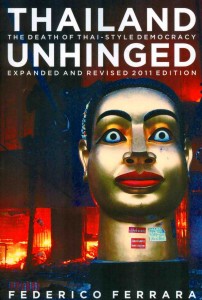
FerraraUnhingedThis book has been banned in Thailand, and it’s easy to see why. It takes on the ruling class, the monarchy, and to a certain extent, denigrates the Thai people as well. With his Thailand Unhinged: the Death of Thai-Style Democracy (2011, ISBN 978-979-3780-84-9), author Federico Ferrara notes in his foreword that he’d self-censored his earlier edition in order to avoid being arrested and thrown in jail while traveling in Thailand. This is a genuine concern, in light of Thailand’s draconian lèse-majesté laws. He goes on to note that with the new edition, he pulls no punches, and states that he’s essentially given up his freedom to travel to Thailand.

He makes a number of salient points in this 180 page book. In addition to the aforementioned laws, he excoriates both the recent Thaksin and Abhiset regimes, discusses their relationships to the ruling classes, and issues a call for expanded democracy. He also provides insight into the Thammasat University slaughter of 1976 as well as the Red Shirt demonstrations of 2010.

We here at WoWasis, though, have a real problem with his Chapter 4, Thailand For Sale, which is simplistic on many levels and so vituperative and embittered in its anger that the objective reader may very well question his analysis in other chapters. Quoting Ferrara:

Soi 4, just off Sukhumvit Road, has all the gloss and silky smoothness of a chunk of pulsating, raw flesh. The uniquely Thai blend of fermenting piss, rotting compost, exhaust fumes, and burnt-out cooking oils is only rendered more asphyxiating by the cheap incense smoldering by the ubiquitous makeshift shrine. Steam rises from the roadside food- stalls that cramp the narrow, potholed sidewalk; it is with difficulty that it finally dissipates into the thick, damp air. A bewildering lineup of dead animals on a stick lie on display on pushcarts, alongside tropical fruit whose freshness has long evaporated on the foggy plexiglass shielding it from the flies and the dust. Whole roasted chickens sit on bare tables next to fake eyelashes and make-up, flanked by rows of size-zerotank-tops and lingerie. Typically most transfixing to new- comers and repeat offenders alike, however, is the repugnant assortment of deep-fried crickets, roaches, locusts, and other bugs sold here by the bagful.

Nana Entertainment Plaza – in much of the country, the “entertainment” serves as a euphemism for anything designed to end in ejaculation – is a disheveled three-story bazaar of cascading go-go bars, glaring red neons, and mildewy rooms rented out by the romp. Acts of unutterable depravity are committed or tentatively agreed upon here. Menseeped through the bowels of every first world society all the way down here to feast on a banquet of oriental game. Barely post-pubescent, bronze-skinned metrosexuals join limp septuagenarians carrying lifetime supplies of indispensable hard-on pills. Veteran sex fiends wear as decorations from previous, valiant campaigns t-shirts acquired in places as far flung as Cambodia, the Philippines, Brazil, Costa Rica, the Dominican Republic. Most belong to the thick sludge of balding middle-aged men, tourist and expatriate alike, flaunting their trademark deformity – guts swollen from a lifetime of the old lady’s home-cooking and an eternity spent lounging in the slothful comfort of a livingroom couch.

Ferrara doesn’t care much for the women, either: “a twenty-something Thai hooker — a true Siamese cat eager to suck cocks no matter how puny, wrinkled, or flaccid…And the erotic shows… where ugly women use mangled vaginas to smoke cigarettes, play the trumpet, or shoot darts into balloons fifteen feet away…”

Ferrara’s writings on these subjects descend into unfactual, acerbic rants that make us question his powers of observation as well as his cultural understanding of Thailand. For one thing, Soi 4 doesn’t smell like urine. Ever. There are restrooms in every one of the dozens of bars that line the street. The “repugnant assortment” of bugs is a staple of Isaan cuisine, and doesn’t include cockroaches, called “meng sab” in Thai. They’re actually water bugs, “meng da.” And Thais are famous for liking their meat on a stick. We wonder if the author has ever eaten satay. We further ask what “unutterable depravity” Ferrara alleges to have seen in Nana Plaza; we haven’t witnessed any. There are lots of go-go dancers and lady boys, maybe that’s what he means. Perhaps the act of watching bikini-clad dancers is his definition of depravity. He doesn’t like “balding middle-aged men,” either.  Maybe he’ll become one himself one day. In terms of “ugly women” with “mangled vaginas,” did he really get close enough to examine one? Or is he hiding a degree in Gynecology that wasn’t divulged in his book bio?

Even though there’s lots of thought-provoking political material in the book, we think it’s best that Ferrara doesn’t return to Thailand. He apparently doesn’t like the food, the women, fellow expats, or much of anything else. He’ll be happier elsewhere. For another banned book that we think offers a more scholarly perspective on Thai politics and the Monarchy, we’d instead  recommend Paul Handley’s The King Never Smiles.

Perhaps Ferrara’s bitterness will subside with age, and he’ll write yet another revision. Chapter 4 isn’t necessary, and detracts from the political analysis that forms the major part of the book. For now, you’ll have to settle for the second edition. Buy it here at the WoWasis eStore.
WoWasis book review: ‘A Golden Age’: Bangladeshi fiction from Tahmina Anam

Written By: herbrunbridge - May• 17•13

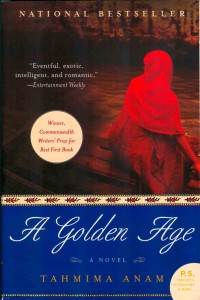
AnamGoldenAgeThe Bangladeshi War of Independence of 1971 forms the backdrop of a plethora of novels from that country, and Tahmina Anam’s A Golden Age (2007, ISBN 978-0-06-14787-1) is no exception. The book won a Commonwealth Writer’s Prize for Best First Book. It’s a coming of age tale, involving the evolution of a mother from a housewife into a revolutionary.

In essence, Rehana Haque, a widow with two young adult children, is at first cajoled into allowing a house on her property to be used for storing illicit arms. The story morphs into one of increasing involvement, most poignantly involving her caretaking of a revolutionary officer. Rehana’s focus is in trying her best to keep her revolutionary children out of harm’s way, ever more challenging as the battle comes closer to her home.

Like many first novels, this one is somewhat autobiographical. The Harper Perennial paperback edition of this book includes an insightful 12 page postscript, consisting of an interview with the author, who states:

 When I first sat down to write A Golden Age,
I imagined a war novel on an epic scale. I
imagined battle scenes, political rallies, and
the grand sweep of history. But after having
interviewed more than a hundred survivors
of the Bangladesh War for Independence,

I realized it was the very small details that
always stayed in my mind-the guerilla
fighters who exchanged shirts before they
went
into battle, the women who sewed their best
silk saris into blankets for the refugees. I
realized I wanted to write a novel about how
ordinary people are transformed by war, and
once I discovered this, I turned to the story of

my maternal grandmother, Musleha Islam,
and how she became a revolutionary.

The tale is a fascinating one, a terrific war story concerning the vicissitudes of family life in an unconventional war zone. Buy it here at the WoWasis eStore.
WoWasis banned book review: ‘Lajja (Shame)’: Bangladeshi fiction from Taslima Nasrin

Written By: herbrunbridge - May• 09•13

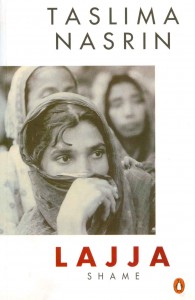
LajjaNasrinGiven that the nation of Bangladesh changed from a secular state to an Islamic country via a constitutional amendment, it’s easy to see why this book has been banned. Taslima Nasrin’s Lajja (Shame) (1993, ISBN 978-014-024-0511) is a strong indictment of the Islamic movement that made pariahs of its Hindu population. This is historical novel that chronicles the privations against the Hindu minority that forced many of them to flee to India from the nation of their birth.

At times, the novel borders on the didactic, with many pages of documented murders, rapes, temple burnings, and land incursions. In its defense, it constitutes, in essence, a Bangladeshi genocide of a minority population.

The story is of an atheist family of Hindu extraction, buffeted by the winds of Islamic persecution. The son is something of an intellectual ne’er do well who continually pontificates and ultimately spins out of control when his sister is kidnapped by a young Islamic mob, which also destroys the family possessions. Western readers who feel that the injustice deserves retribution will be frustrated, as the philosophy of the family is peaceful co-existence, a continuing frustration in the face of violent and seemingly random oppression. The scene that stuck longest with us involved a young Muslim prostitute, a victim of temporary anger, whose suffering only increased the angst of the perpetrator.

Visitors to Bangladesh today can easily be confused when reading a history of the country. It was originally founded as a secular nation. The events promulgating the change to an Islamic nation, as well as its aftermath, are sobering, and this is the book to read for those interested in how it occurred and how it changed the social dynamic of the country. The author, a critic of religious fundamentalism, was forced to leave her country shortly after the book was written.

Freedom of the press is a western construct that is still anathema to many Asian nations, and Bangladesh is no exception. Today, twenty years after this book originally appeared, it remains a powerful treatise, and essential reading for those interested in the ramifications of the formation of a religion-based government as its effects on marginalized peoples. Buy it here at the WoWasis eStore.

WoWasis book review: ‘Galpa: Short Stories by Women from Bangladesh’

Written By: herbrunbridge - May• 09•13

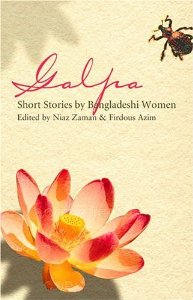
GalpaBookBangladesh can boast a number of exceptional women writers, and Galpa: Short Stories by Women from Bangladesh (2012, ISBN 984-32-2931-2), edited by Firdous Azim and Niaz Zaman, contains short stories written by 27 of them. As with any collection of this size (273 pages), the work can sometimes be spotty, but the editors noted the importance of populating the book with a representative sample, and thus, meets one of its goals.

The always intriguing Selina Hossein makes her appearance her with Motijan’s Daughters, a wonderful story of a young wife who succeeds in overcoming her nasty mother-in-law’s machinations. The final scene, involving a public embarrassment, is a poignant example of kharmic retribution. Dilara Hashem’s The Immersion delves into the mind of a developmentally disabled man, in which most of the action is seen from the perspective of the man himself. In addition to being a compelling and off-beat story about a troubled child, Parag Chowdhury’s Why Does Durgati Weep? features an exceptional translation by Shabnam Nadiya, who has a notable talent for using American idioms.

All in all, we here at WoWasis would have liked the collection to be stronger in terms of plot and character development. Several of the stories involve dreams, a vehicle used successfully by Rokeya Hossein in her landmark story Sultana’s Dream, but not as compelling when delivered by the other authors in this anthology. The book is recommended for those wishing to gain a perspective on contemporary fiction by female Bangladeshi writers. Buy it here at the WoWasis eStore.  
Stories in this anthology include:

Shaheen Akhtar, The Makeup Box

Sonia Nishat Amin, Under the Lemon Tree

Purabi Basu. Radha Will Not Cook Today

Parag Chowdhury. Why Does Durgati Weep?
Audity Falguni, Wildflower

Shamim Hamid, The Party

Dilara Hashem. The Immersion

Rokeya Sakhawat Hossein, Sultana’s Dream
Selina Hossain. Motijan’s Daughters
Naheed Husain, The Deal

NasreenJahan, Different

Helena Khan Projection

M. Faterna Khanarn, Chamely

Rabeya Kharun, Obsession

Razia Mahbub, Troubles

Nuzhat Amin Mannan, The Wardrobe

Makbula Manzoor, On the Road

Dilara Mesbah. The Ballad ofNihar Banu

Shabnam Nadiya, AJourney into Night

Jharna Das Purakayastha, Barbecue

Jharna Rahman, Arshinagar

Papree Rahman, The Rainbow Bird of Slumber and Dreams

Rizia Rahman. What Price Honour?

Nayan Rahman. Bon Voyage

Syeda Farida Rahman. Roots

Khaleda Salahuddin, Relief Camp

Niaz Zaman. The Daily Woman

WoWasis crime review: Airport Baggage Theft Scam, the Booster Bag

Written By: herbrunbridge - May• 06•13

Drop your attention for one moment, and your bag is gone

Drop your attention for one moment, and your bag is gone

Here at WoWasis, we’re pretty careful about scams in general, and one of our favorites is the booster bag, which is a device that, when placed over your own bag sitting on the ground, allows the perpetrator to carry off your bag before you know it. The perp is usually well-dressed, the last person you’d suspect. There’s a wonderful video showing how the scam operates, take a look.

A remedy? We always recommend that you attached a long strap to your bag so that you can quickly tie it to your chair or your wrist if you have to do something else with your hands, or briefly lose your attention.

WoWasis book review: ‘Killing the Water,’ Bangladeshi stories by Mahmud Rahman

Written By: herbrunbridge - Apr• 30•13

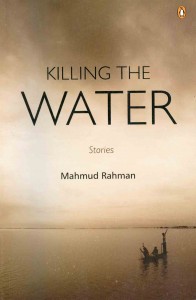
KillingWaterRahmanBangladeshi writer Mahmud Rahman knows his Boston. And Providence and Oakland as well. He’s lived in all three places, got a writing degree from Oakland’s Mills College, and in his book Killing the Water (2010, ISBN 978-014-306-5036), he explores the somewhat murky, yet romantic and fascinating world of a Bangladeshi trying to make his way in the United States. He writes about Bangladesh too, in this book, but we found his US-based stories to be the most compelling and universally interesting.

Here at WoWasis, we know our Orange Line, the subway in Boston that runs through Roxbury. We actually drove a taxi in that area as well. Rahman’s story Orange Line is a fascinating and nearly morbid tale of a dark-skinned person caught among some idiot toughs from Southie, and he nearly dies, until rescued at Dudley Station. Rahman has a deft touch with romantic themes. His Yuralda investigates the dynamic between the protagonist and a Dominican laundress, while Smoke Signals climbs into a delicate relationship fractured by a real or perceived slight.

Our favorite story was Postcards from a Stranger, a tale told through a series of postcards, written to a woman who misplaced a book. Until the end of the tale, there is no response, but the writer manages to detail the fine points of a relationship taking place on a trip through the United States. The ending is surprising and well-crafted.

Rahman’s a very good writer, at his best in this book when unveiling the feelings of an immigrant trying to navigate foreign customs in a new country. His characters interact with African-Americans, Dominicans, and other South Asians. His notion for suspense keeps the reader riveted until the final page of the story, making this 200 page book a solid read.

WoWasis book review: ‘New Age Short Stories,’ Bangladeshi fiction edited by Niaz Zaman

Written By: herbrunbridge - Apr• 30•13

NewAgeShortStoriesNiaz Zaman is a formidable editor. In her collection New Age Short Stories (2006, ISBN 984-8715-02-9), she’s compiled twenty-seven stories over 237 pages. Nearly all of them are top-notch, and they all are compelling. These aren’t ‘New Age’ in the western sense: New Age is the name of the Bangladeshi newspaper that originally printed these stories.

Here at WoWasis, we found it difficult to pick favorites, but here are several. We’ve always loved Selina Hossein’s writing, and here she offers The World of Love and Labour, a get-even story told about an 18 year old girl who her parents have agreed to trade for some property. We loved Syed Badrul Ahsan’s A Woman Named Mrinmoyee, which describes the protagonist’s love for and marriage to a corpulent, poor woman with nothing to offer, in the way of a dowry or education. It flies in the face of the traditional Bengali belief system as it relates to society and marriage. Another favorite was Deena Forkan’s Grand Finale, describing the entry and exit of a mystery woman into the life of a well-respected older man.

One of the more complex stories was Najmul Alam’s The Wife. Here, a poor rickshaw driver is married to a beautiful woman he has never loved. He continues a relationship with an old lover in a tale fraught with questions regarding relationship built of social convenience and necessity rather than desire, love, or even like.

One hallmark of this book is the emphasis on strong female characters, not surprising considering Zaman’s past collections of stories. This isn’t necessarily a woman’s book, though. Men will find lots to enjoy here, too, especially the manner in which the male figures in the book relate — or don’t relate — to these women. The collection is so strong that the reader wants to know more about the writers, and Zaman has anticipated this by including a one paragraph biography of each of them.

Writers in this volume include: Humayun Ahmed, Kazi Anis Ahmed, Syed Badrul Ahsan, Shaheen Akhtar, Najmul Alam, Marisa Anaman, Deena Forkan, Parag Chowdhury, Tulip Chowdhury, Selina Hossain, M. Zafar Iqbal, Syed Manzoorul Islam,  Nasreen Khundker, Makbula Manzoor, Imdadul Haq Milon, Maithilee Mitra, Manal Mohamed, Shabnam Nadiya, Farhana Haque Rahman, Rezaur Rahman, Husne Ara Shahed, Syed Waliullah, and Niaz Zaman.  

WoWasis book review: ‘Short Takes: Stories from Bangladesh’ by Tanvir Malik

Written By: herbrunbridge - Apr• 28•13

ShortTakesMalikLike a cranky Bangladeshi locomotive, author Tanvir Malik’s Short Takes: Stories from Bangladesh (2010, ISBN 978-93-80154-40-4) takes a while to get started and gain momentum. Here at WoWasis, we found that this collection of eighteen stories over 136 pages doesn’t get its sea legs until the fourth story, Veil Over Eyes, takes hold on page 23. And from there on, the book has a number of compelling stories.

Veil Over Eyes is a magnificent story revolving around a man’s fetishizing over women in burkhas. He becomes increasingly attracted to the forbidden, enthusing over women plucked eyebrows and eye makeup. He’s somewhat confused, as his branch of Islam promotes covering a woman as a means of removing male interest in her. Finally, he goes to the mosque, seeking an explanation of his confusion from the imam, who’s flabbergasted. “This is not a place to crack jokes,” says the holy man, incredulous.

Perhaps the most poignant tale is Murky Motive, regarding a religious figure turned politician, who manufactures a tragedy to gain sympathy and political clout.

Overall, Malik’s book gives the reader a real sense of Bangladesh, and especially the traffic, heat, noise, and confusion of the capital of Dhaka. The book is also an important reminder that in Islamic countries like Bangladesh, there are writers like Tanvir Malik, unafraid to expose religious charlatans and hypocrisies. Buy the book here at the WoWasis eStore.