The sharper edge to traveling in Asia

Top 5 travel sites in Laos

Written By: herbrunbridge - Apr• 30•10

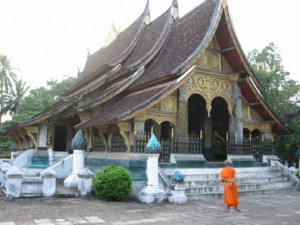
Tour Luang Prabang or tour Vientiane now! The ancient kingdom of Lan Xang is transforming itself into a country that has increasing amenities for the traveler, yet boasts delights that are still relatively untraveled.  Although increasingly popular, the royal capital of Luang Prabang remains one of the most beautiful towns in Southeast Asia, and an absolute must on any itinerary.   You’ll probably be passing through Vientiane, with its noteworthy temples and grand monument of PhaThat Luang.   

In the south, the ancient temple of Wat Phu Champasak is a majestic secret due to the dearth (thankfully) of organized tours, while the legendary Plain of Jars, in the north, bekons thousands of visitors year round. 

Laos Top 5 

1) Luang Prabang is one of Southeast Asia’s most beautiful towns, a hillside oasis with over thirty temples to visit in a serene setting. 

2) Vientiane’s traditions meld traditional Lao with colonial French, allowing you to have a baguette and coffee before seeing Buddhist temples, then finishing your day with superior French cuisine at a terrific price.

3)  Wat Phu Champasak, near the charming town of Pakse, requires a bit of ingenuity in getting there, but the reward, a wonderful temple just about to yourself, is well worth it. 

4)  The Plain of Jars, near Phonsavan, host a dozen or so sites containing hundreds dozens of mammoth stone jars of unknown origin, the largest of which weighs an estimated ton. 

5) Vang Vieng is a town located in the midst of a scernic Karst area, with dozens of caves to visit and explore. 

Getting to Laos by air is through the Wattay International Airport in Vientiane, or the Luang Prabang International airport.  International carriers are increasingly adding Laotian cities to their itineraries.  In-country, Lao Aviation flights connect most cities of note.  Laotian roads are not up to international standards, although superior to those of neighboring Cambodia.  

Rental cars are available in Laos, but relatively expensive (generally in excess of $100 per day) due the poor condition of the roads.  Locally, tuk-tuks and pedicabs are the norm, and motorbikes can be rented for roughly $10 USD per day.
Spas in Laos: Discovering Laos’ Extraordinary Health Experiences

Written By: herbrunbridge - Apr• 29•10

Laos has been a bit slow on the spa uptake, with fewer choices than neighboring Cambodia.  Spas are beginning to appear, limited at this time to Day Spas in Vientiane and Resort/Hotel Spas in Luang Prabang. Here’s what we’ve found: 

Resort/hotel spas in Luang Prabang
Angsana Spa at Maison Souvannaphoum Hotel
Rue Chao Fa Ngum
+856 71 254 609
Offering massage and body therapy, other spa services.

Day Spas in Vientiane
Papaya Spa
facing Xieng Veh temple, on the banks of the Mekong River
Ban Sithan Neua,Vientiane
+ 856  21 216 550 or mobile-phone: (020) 561 0565
Open 9am to 9pm
www.papayaspa.com

Papaya Spa Lane Xang
Lane Xang Avenue, Opposite the French Centre de Langues, CCCL and next to the Ministry of Tourism
Open 9am to 9pm
+856  21 219626 or mobile-phone: (020) 020 50 03 601
www.papayaspa.com/papayaspa-lanexang.htm

6 things to consider when selecting a breast augmentation provider

Written By: herbrunbridge - Apr• 28•10

Cosmetic surgery is a large part of the medical tourism scene in Bangkok, and breast augmentation surgery is an increasingly popular reason for coming to Thailand. Here are some things to consider as you select a procedure and surgeon that works for you.

• Will the doctor remove the implants free of charge if you have serious problems? What if you want them removed but the doctor doesn’t? Will the services of the nurses, anesthesiologist, and other costs also be covered?

• Is there a paid warranty on the implants, and what exactly is included in that warranty? What isn’t included?

• Does the surgeon have operating privileges in an accredited hospital in case something goes wrong?

• If your doctor shows photographs of patients, are they his or her own patients?

• Ask to speak to a patient who had implants for at least seven to 10 years.

• Ask to see photographs of how his or her patients looked a few years later and ask to see photos of what they would look like if there were complications.

• Ask for written information about the risks, and read that information at least one week before surgery, so you have time to ask questions or gather more information.

Troops enter Bangkok under cover as crackdown begins

Written By: herbrunbridge - Apr• 28•10

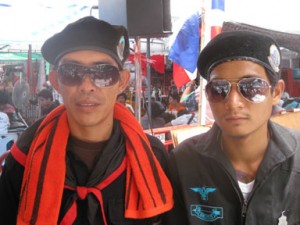
Red shirt guards beneath Siam Square BTS station

The rumored Thai military crackdown against red-shirted UDD dissidents began this afternoon in a pitched battle north of Victory Monument and south of Don Muang airport. Reportedly, Thai troops are using live rounds, and Red shirt UDD fighters have commandeered gas stations and fuel trucks.

Earlier today, troop numbers in Bangkok were surreptitiously increased by deploying them from outlying areas into Bangkok via small, unmarked minivans.  This tactic was a result of red-shirt UDD protesters’ success in blocking troop movements via standard transportation such as train and truck convoys. An estimated hundreds of Thai military personnel were added this morning to the forces in Bangkok. Rumors increasingly persist that a crackdown will occur this afternoon or early this evening.

From the BTS Chitlom to BTS Sala Daeng station, thousands of protesters, mostly Isaan people, have gathered to form what is essentially an Isaan village below the skytrain tracks. Many observers seem to be in agreement that the Isaan protesters, many of whom are women and children, will be used essentially as human shields by the red shirts. One theory suggests that this tactic to sacrifice unprotected people on their own side is indeed a planned one, and intended to engender national and world opinion against the current Thai government, when pictures of dead protesters would be distributed by the world press.

A major thunderstorm is gathering dark clouds over Bangkok’s Ratchaprasong intersection at the moment, accompanying the firefight to the north.

A memorable day in Thailand’s Khao Yai National Park

Written By: shanecorbin - Apr• 27•10

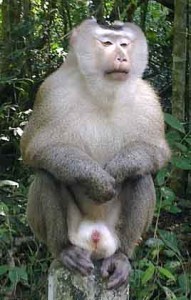
This friendly Macaque insisted on receiving a park fee

Just over 200 km east of Bangkok and spanning over four provinces is Thailand’s Khao Yai National Park. Khao Yai became Thailand’s first National Park in the fall of 1962 and is part of the larger Dong Phayayen forest complex. At more than 2,165 square km, Khao Yai is the third largest National Park world wide. A UNESCO World Heritage Site, Khao Yai’s diversity of flora and fauna, and the seemingly endless network of trails and campgrounds, offer a nice change from the hustle and bustle of Bangkok. Entrance fees for the park range from 40 baht to 400 baht, depending on whether or not you’re Thai. The information center proved most helpful to us in explaining where we would find camping, rented tents and sleeping bags, and even making an appointment for us to meet a guide the following day for an afternoon of trekking.

Before our trek began, our guide pointed out what we should be aware of on the trail including the necessity for pants and long sleeves to keep out any unwanted hitchhikers such as leeches and ticks, and the importance of not approaching the wide variety of wildlife. He then humored us with stories of the dozens of stubborn tourists he has had to rescue, who insist on hiking alone. Our suggestion is to hire a guide and save yourself the grief. Our guide was very knowledgeable, and knew a great deal about the vegetation of the jungle. As we passed Scarlet Orchids and Wild Galanga root, he was quick to point them out. Further down the trail we were caught in a very heavy tropical rain. The weather is a bit cooler here in Khao Yai, but you should prepare for the unexpected.

Although we decided to camp, there are several resorts and guest houses just outside the park, and bungalows and houses can be rented within the park as well. Restaurants and concessions are plentiful in Khao Yai, as are showers for those who choose to rough it. The presence of wildlife is a constant here. Several signs along the roads read ”Cobra Crossing”, and “Beware of Elephants”. We were greeted by a friendly Macaque while driving down the main road, who once he had established that we were no threat, decided to bring the whole family out and stare at the humans. We also encountered Wild pigs, deer, and porcupine while sleeping in our tents. We stayed for two nights, but all agreed that we could have spent several more days. With White Water rafting,Bike rental’s, Night safari’s, Waterfall’s and Bird watching, a one or two day trip simply won’t do.

Bangkok by night: a Chao Phraya dinner cruise aboard the exotic Wan Fah

Written By: herbrunbridge - Apr• 26•10

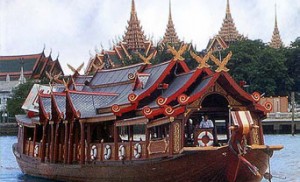
The Wan Fah motors past Thai history

Although several companies offer dinner cruises on the Chao Phraya river, none quite match up to the Wan Fah experience.  The Wan Fah is a beautifully appointed teak boat, with traditional Thai decorative elements. The experience is intimate, as she seats only 120 persons.  The meals are extraordinarily good, and the diner may choose between traditional Thai, or seafood fare. 

Cruising between the River City pier and the Rama XIII bridge, diners get wonderful views of Wat Arun, and are regaled by classical Thai music played on the kim (a hammered zither), and wonderful classical Thai dancers performing historical Thai dances in magnificent costumes.  In keeping with the mood, we found our fellow diners to be respectful of the musicians and dancers, and the overall experience was memorable, as orchestrated by manager Khun Rungroj, who ensured that meals were served hot, timely, and respectfully, in view of the performance schedule. 

Prices range from 950-1200 baht, the cruise lasts from 7-9 pm, and reservations may be made at your hotel.  Wan Fah will pick you up from your hotel, and return you.
Wan Fah Cruise, Tel: (02) 639-0704, between 10:30 am – 9:00  pm

In praise of the Thai Toilet Hose (what’s that thing attached to my toilet, and how do I use it?)

Written By: herbrunbridge - Apr• 26•10

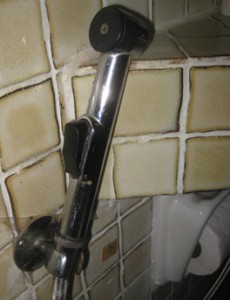
Thai toilet hose in holster position

First time travelers to Thailand are soon confronted with an element of plumbing not generally associated with western toilets: the Thai bathroom hose (“fahk bua”).  Used to the western convention of toilet paper, travelers tend to eschew this remarkable device, which, in fact, keeps one cleaner after ablutions than does t.p. (Thais generally use paper only for drying.)  The problem, apart from its unfamiliarity, is lack of instruction as to how the hose is used.  Thais, ever cognizant of decorum, won’t tell you.  But we will.

Why it works
Logic is the reason.  Simply, a good jetstream of water does the job better than paper, and the additional use of soap makes one cleaner.  And many westerners have now, after falling in love with the hose, bought them in Thailand, taken them to their own countries, and plumbed them into their own bathrooms. They generally agree that the use of toilet paper to clean oneself is barbaric.

the-bum-gun-bidet-sprayers


How it works
It will take you a maximum of three sessions to get the technique down pat, and we predict you’ll eventually adopt it as your preference.  You’ll need only two items at hand to do the job:
– soap, within easy reach
– a towel (or paper) for drying

ThailandPromoBannerTake these steps in the following order (we’re assuming the hose is located on your right.  Reverse everything below if it’s on your left):
1)      Flush the organic material
2)      If you’re a man, rise forward, lifting your rear off the back of the seat, direct the hose to your nether regions, and hose the entire area at random.  If you’re a woman, lean backward, hold the hose slightly in front of the area to be washed, then direct the jet stream over all areas, washing the detritus up and backward. Gravity and continued directed water will wash the effluvium into the bowl.
3)      Continue holding the hose in your right hand, but stop the water flow.  Grab the soap with your left hand, and rising forward, soap all areas.
4)      If you’re a man, lean forward slightly, and, hose in right hand and soap in left, direct the hose slightly under you, aim the jet to both your personal areas, and to the soap in your left hand as well. Fire away. This produces the final cleaning action on both your bottom, and your left hand and soap as well. If you’re a woman, repeat the same procedure, but instead, lean backward, and direct the water stream toward the rear of the toilet bowl.
5)       Replace the clean soap in its receptacle, and use the towel to dry off.

You’re now cleaner than you’ve ever been in a western country, on par with the Thais!

Other Thai bathroom essentials
Away from big cities, you’ll find squat toilets to be fairly ubiquitous, and in most bathrooms you’ll find a water spigot, a cistern, and a plastic cup or small bucket.  Toilet paper is virtually non-existent.  The idea here is to wash yourself with water from the plastic cup (remember to bring your own soap, as it’s not always provided), and when the cup of bucket is empty, fill it from the cistern of spigot.  Outside, you’ll generally find a sink with soap.

Especially in bars, the single bathroom is unisex.  When using the urinal in men’s bathrooms in bars, it’s not uncommon to find yourself getting a shoulder massage from the attendant.  Be assured, it’s not a gay pickup routine.  He’ll also offer you a clean, warm hot towel, and you’ll be expected to leave a small tip, as that’s his pay for keeping the restroom clean.

No doubt about it, Thai restrooms are the cleanest and funnest in the universe!

Top 3 Things to see in Ubon Ratchathani, Thailand

Written By: herbrunbridge - Apr• 26•10

Wat Thung Si Meuang

It’s doubtful that you’ll come to the Isaan city of Ubon intentionally, unless you have relatives here, or you’ll be traveling to Laos through the Chong Mek border station, as I was.  If you do happen to be here, you’ll find a pleasant, clean city with several interesting places worth stopping to see. How did I come to spend a few hours here? I was in transit to a nearby temple, and flew through Ubon. My return flight was delayed 4 hours. At the Air Asia ticket window, the attendant informs me that the flight’s been delayed to 3 pm, no other carriers available.  I’ve got 5 hours dead time in Ubon.  There’s a museum in Ubon, but not a cab to be seen, so I walk over to the Air Asia counter again, and ask how I can get a cab. The friendly ticket agent says “that’s OK, I’ll take you”, and unbelievably, she takes me to the museum!  It turns out that Khun Sirithip is the station manager, and was giving me great customer service to make up for my inconvenience.  She mentioned that her station got a nasty complaint from a farang last month, which of course caused the whole team to lose some face.  I told her I’d be happy to write a complimentary email to her boss, and I’d blog about it, too, as she took the extra step to provide exceptional hospitality and service. 

Ubon Ratchathani Top 3: 

Ubon Ratchathani National Museum
Khuanthani Road near Chayangkhul Road
Tel: (045) 255-071
Open Wed-Sun 9 am – 4 pm
GPS: N15°13.645’ E104°51.460’ (go around to north entrance)
Here, in the lovely old city hall, is the home to a nice collection of prehistoric items, sculptures from the Dvaravati and Angkor cultures, and a number of ethnographic items and textiles.

Wat Thung Si Meuang
Thanon Luang
GPS: N15°13.797’  E104°51.683’
The focal point of this wat is the beautiful old library, built on stilts and sitting in a pond to prevent ground termites.  Inside the tiny library are 150 year-old jataka murals.

Wat Phra That Nong
Off Chayangkhul Road, 3 km north of downtown
From the main road, turn left at GPS N15°15.755’  E104°50.728’
Wat is at GPS N15°15.779’  E104°50.420’
Our choice for the best in Ubon, this beautiful wat is derived from the Mahabodhi stupa in Bodhgaya, Bihar, India.  This pyramidal structure hosts a number of exceptional bas reliefs, in a beautiful village-like setting.

Ban Phiphithaphan, Bangkok’s exceptional hidden retro Museum

Written By: herbrunbridge - Apr• 26•10

Bangkok's best (and only) Retro museum

For those willing to spend 200 baht taxi fare and travel a few kilometers west of the Pin Klao bridge, one of Bangkok’s more fascinating museums awaits.  Founders Anake and Wanna Nawigamune have here compiled a lifetime’s worth of everyday objects found —until the last decade or so —  in homes, barbershops, candy stores, and various other establishments.  Not old enough to be considered antiques, they are now gone, forgotten items that will have perceived value in 50 years, but throwaway items today. 

This non-profit museum, open only on weekends and staffed by 12 volunteer, is a neighborhood gem.  Displays are set up in recreated shops, filled with old objects, including cans, signs, furniture, and appliances.  In the barbershop, you’ll see old barbering tools, chairs, and tonics.  The schoolroom comes complete with a switch used on the hands of those perceived to be idle at study.  The old toy store is chock full of ancient toys that used to be ubiquitous, and have now vanished.  

Here, you can actually touch and hold many of the objects, as the museum is fundamentally interactive.  You’ll also get to meet Wanna, who during the week is deputy head of the Literature Department at Kasetsart University, and her husband Asake, who has authored numerous books on Thai art, culture, and history.

Ban Phiphithaphan (House of Museums)
Soi Khlong Pho 2, Sala Thammasop
(take Boromrat Chonnanee elevated highway to Phutthamonthon Road)
Tel: 01-257-4508
Open: Saturday and Sunday, 10 am – 5 pm

GPS: N13°47.841’  E100°23.499’

Bangkok Silom standoff continues as Crime Detection Division investigates grenade death

Written By: herbrunbridge - Apr• 25•10

Dr. Porntip Rojanasunan, director of Thailand's Central Institute of Forensic Science at Sala Daeng grenade blast site, with an undentified member of the press

Amidst discussions for a possible end to the Silom standoff, UDD red shirts’ barriers were raised even higher, Thai troops bivouacked at the Sala Daeng BTS skytrain station, and the Central Institute of Forensic Science’s director Dr. Porntip Rojanasunan paid a visit to the building where an M79 grenade killed a protester earlier in the week.

Events at Silom have not only closed the grenade-damaged Sala Daeng station, but have caused the entire BTS skytrain system to close at 7 pm, five hours earlier than its usual closing time of midnight. Many businesses near the intersection of Silom and Rama IV have been closed, and concertina wire has been set up on sidewalks to protect no-go areas. A general tension seems to be gripping the red shirts security people manning the perimeter of the barricade, who are armed with automatic weapons, and routinely conduct searches of passers by.

Yesterday, Dr. Porntip Rojanasunan, a member of the special committee investigating the deadly protests of April 10, inspected the damage at the building housing the Au Bon Pain bakery where one “multicolored” protester was killed in Thursday’s grenade attack.

The bone of contention between the red shirts and the government remains the potential date that the House will be dissolved. It is unfathomable to many that commerce in two significant business areas in Bangkok is essentially shut down, traffic in these areas has been ground to a halt, and BTS skytrain hours have been curtailed. While many state the belief that this can’t continue for much longer, the memory of the shutting down of Suvarnabhumi airport by protesters for weeks last year remains a strong one, and the reality of a long-term impasse appears more of a possibility as each day passes.

Military and government officials today issued a warning that a major scale military move was a possibility.