The sharper edge to traveling in Asia

Angeles City: Nightlife capital of the Philippines

Written By: herbrunbridge - May• 03•10

Two of Angeles' most notorius bar girls shop for alluring clothes prior to making their nightly rounds

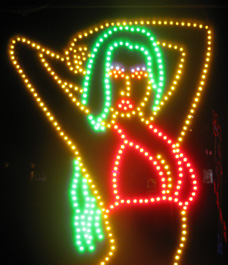
50 miles north of Manila is Angeles City, known primarily as the Philippines’ gogo bar headquarters. Here, along the 4 block stretch of Fields Avenue, you’ll find dozens of bars with dancing girls, most of whom are available for companionship.

Compared to the nightlife in Bangkok, Angeles clubs don’t offer as wide a range of anatomical options, provider-wise, but the girls are generally friendly and engaging. But also by comparison, drinks are cheaper (95 peso – $1USD beers, or 150 lady drinks), meaning that bar-hopping here is more cost-effective: grab a couple of sips and you can leave, and it costs very little to visit much of the street, and not be totally inebriated at the end of your evening.

Two of the friendliest bars we found were Voodoo and Angelwitch, both run by Derek Hewitt, who also runs the Kokomo Hotel. Derek gives his guests a few rules of survival here, and they’re worth noting. For the most part, they’re appropriate for any adult district in any part of the world, as well:

1  Carry just a little more money than you intend to spend.
2  Carry plenty of small bills for paying trikes and goods from Sari Sari shops.
3  Never give to beggars not even 1 peso, we all did, we all find it hard not to, BUT YOU WILL REGRET IT, IF YOU DO.
a)  It identifies you as a tourist and gullible, not only to the beggar but everyone in the street.
b)  You might be followed and pestered by the beggar for MORE.
c)   These are not poor people – ALL the money is handed over to the minders.
4  NEVER BUY FROM STREET VENDORS, don’t even ask the price of anything, don’t stop if you are approached, don’t let them touch you.
5  NEVER TAKE A RIDE IN A TRIKE, when the driver approaches YOU, even if he knows your name or says he knows you or it’s free. Pick your own trike from a rank and insist on NO BACK RIDERS.
6  NEVER EVER play cards or any other game with the locals – IT’S A CON!7  In Angeles, NEVER befriend a girl on the street or in public areas. She can get you into more trouble than you can imagine. Similarly NEVER allow a girl to bring a friend to your room she may be underage, if they are working the street it means they CAN’T get a license to work in the bars, why?
8  You are very safe in Fields Avenue, all the way up to Alaska Bar and down to Walk About Bar, also on the side street next to Kokomo’s and the right turn called Real Street and next to any of the big hotels in the area. Use a trike from the rank to travel outside these areas till you get familiar with the City.
9  Check your bar bill in all bars for extra drinks being added and the addition of the bill when you’re leaving.

$30,000 Pedophilia NGO scam: if allegations are true, who’s watching the Watchers?

Written By: herbrunbridge - May• 03•10

Concomitant to the meritorious work being done by international Non-governmental Organizations (NGOs) in rooting out pedophilia, allegations are surfacing that innocent Western male travelers in Cambodia are being unfairly accused of having sex with minors, with uncomfortable and dangerous legal consequences.  If the allegations are true, this may prove to be an elaborate extortion scheme that no victim is willing to expose. At the heart of the scam, it is claimed, is the manner in which NGOs gather evidence to begin the prosecution process against foreigners, namely the use of paid informants, including  motorcycle taxi drivers.  In other instances, it is alleged, teams of survey-takers, purporting to be from tourism organizations, collect data on individuals, including the names of their hotels, prompting later visits by police.  One NGO openly states their investigators ” go undercover as drivers, English teachers or even craftsmen.”

While the investigative methods of NGOs remain somewhat of an in-house secret, it is alleged that informants are paid commissions for each “lead,” and are encouraged to report each day to an NGO contact, who will log the data for subsequent payments of commissions. Informants would therefore accrue the most profit by providing increasing  numbers of names, relatively easy to obtain from hotel personnel at the original point of pick-up, in the case of a taxi driver, or survey location, if done outside a hotel. 

The purported extortion scam is alleged to work like this: After a target individual has been initially identified, he is then followed and photographed on visits to establishments offering sexual companionship with those above the age of consent. 

The taxi driver or survey-taker next provides the name and photograph to the NGO. The NGO then gives the name of the individual to the police, who visit the innocent alleged “perpetrator” and demand a financial payment in order to avoid arrest for allegedly having sex with an underage female. This amount has generally been reported to be $30,000 USD. In this fashion, the taxi driver and police official both make a profit from the extortion racket, while the NGO adds yet another spurious statistic to its list of Western males having sex with underage girls. NGOs use such statistics to solicit additional funding from Western sources. Everybody in this story accrues a financial gain except the victim. If he doesn’t pay up, he is threatened with arrest as a pedophile as well as notification to his own government for potential prosecution in his own country. 

An additional issue arises when the individual seeking sexual favors does so with an individual of legal age, but who appears —to the eyes of Western police officials —to be younger, based on a photograph of the alleged underage female. Local police can use this additional “evidence” to their advantage by threatening to turn the male victim over to his own Embassy, for prosecution in his own country. In this manner, names and photographs can easily be used by local police to “shake down” the innocent victim for a bribe, even though the police know that no crime against children has been committed.  If unwilling to pay the bribe, the victim could, in theory, be reported to the government of his nation of origin as a suspected or known pedophile, with accompanying photographic evidence to “prove” the suspicion, and the imprimatur of an international NGO to confirm the suspicion. 

Today, an individual unjustly accused of sexually molesting children is all too often presumed guilty until proven innocent, and the costs associated with defending himself legally are significant.  Victims of nefarious “stings” are rarely willing to call attention to themselves by complaining to the local or international Press.  

Critics of the use of paid informants to provide unreliable data on alleged perpetrators of crimes often refer to the excesses of the days in the 1950s when Senator Joseph McCarthy rode roughshod over civil liberties to root out alleged Communists in the United States.  In that era, thousands of innocent victims were harassed and persecuted.  With today’s reliance on databases, dishonest information and shaky allegations may stay in one’s international police files in perpetuity. 

The overwhelming majority of people in all nations condemn sexual abuse of children, and NGOs have certainly done their part in bringing attention to the problem.  In bringing perpetrators to justice, though, it’s important to ensure the rights of the innocent.  If justice is the goal, the rights of all must be respected.  Reliance on word of paid informants is always suspect, overburdens prosecutorial systems, and greases the chain of bribery.  Is there any substance to these allegations of NGO and Police dishonesty?  If so, perhaps it’s time to take a better look at how NGOs go about collecting and storing information on individuals loosely suspected of abusing children,  and sharing the information with local, national, and international police agencies.  In moving forward to help eradicate the crime of sexual abuse of children, we must ensure that the innocent aren’t being thrown in with the guilty. 

Tell us your story 

Have you been unjustly accused of pedophilia by an NGO?  We’d like to hear your story. If you’ve been harassed or persecuted by a Non-Governmental Organization in the course of seeking sexual relations with a non-minor, we’d like to know about it.  Please provide the name of the NGO, places, dates, and approximate times if possible, and tell us what happened.  If you’d be willing to go public with your name, please tell us that as well.

Update: see our post on a legal follow-on to this subject.

Philippine bar economics: How much does an Angeles bar girl make?

Written By: herbrunbridge - May• 03•10

In general Angeles girls are paid in 3 ways: salaries, barfines, and lady drinks. While each bar could be slightly different, here are some basics: 

Taking a lady out of the bar for companionship for 1,300-1,500 pesos (roughly $30 USD) for a short-time tour, paid directly to the club. Of this amount, approximately half goes to the girl, so additional tips paid directly to the entertainment provider are appreciated, and commonly are the100 to 200 peso range, or might include a meal. 

Lady drinks are 150 pesos, and the lady gets 50 pesos of that. For salaries, dancers get 160-190 pesos per day, waitresses 120. 

So let’s say a lady has a decent day of one bar fine, 6 lady drinks, plus her salary. That would amount to 1,100 pesos, or $24.66 USD. Let’s say she works 25 days a month. At a full run rate, that would be $493 USD per month. There aren’t that many ladies averaging one barfine a day, so it would be a pretty good guess that all girls make somewhere between $200 to $500 USD per month. And that’s why even small tips are always appreciated.

Girls are paid for their bar drinks at the end of every shift, and salaries and barfine fees are paid once a week.

In terms of expenses, each girl pays a yearly license fee of 1,000 pesos. She gets a pap smear once per week, regulated by the government through the club, which costs her 70 pesos per week.

Chocolates and sex in Angeles City

Written By: herbrunbridge - May• 02•10

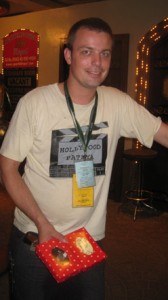
Do sex and chocolates go together? They must, because David Bogaert has been successfully hawking his white chocolate treats in the gogo clubs of Angeles City’s Field Boulevard now for three years. 

Selling items not particular to the sex industry is not completely unfamiliar in Asian nightlife venues (Bangkok’s raving evangelist Brother Tony comes immediately to mind), but David works particularly hard at selling his chocolates club to club, often for 12 hours each day, carrying two baskets of treats ranging from chocolate mango to chocolate strawberry. 

David’s Belgian Fantasy Chocolates was begun three years ago after his manufacturing job fell apart in the recession. He employs two full-time confection makers, has no website, does no mail order, and seems to have a great time handing out samples and meeting new people in this bare-bones venture, Bogaert’s answer to the recessionary nosedive from his far-flung post in the Philippines.

Budget Rent a Car hell in Manila: why is no one minding the shop?

Written By: herbrunbridge - May• 02•10

When is a rental car not a rental car? When it doesn’t exist! I had booked a rental car from Budget Rent a Car for a car at the Manila airport at 7 pm tonight through Travelocity, with a Budget confirmation number and everything. When I arrived at 6:30, there was no one at the counter showing both Budget and Hertz signs, except the Hertz representative. I explained that I’d booked and prepaid for a Budget car, so he called the Budget number I’d been given when I reserved the car. The Budget rep (wherever he or she was) texted back that my car would be ready tomorrow, contrary to our agreement. 

What the hell happened to my reservation tonight? I have a hotel reservation 40 miles north of Manila, so can’t stay in Manila tonight. The Hertz rep didn’t have any cars, but nicely put me in a cab for the bus station, so I’m taking the bus to my destination tonight. I’ll figure out how to get a car tomorrow. Memo to Budget: staff your counter, and deliver a car when promised. 

So here’s how to get from the Manila airport to Angeles City, when your rental company botches your reservation and you have no other rental options. You can take a taxi for approximately 4,000 pesos ($88 USD), or take a bus, much cheaper, as follows:

1)      Take taxi (480 pesos, $10 USD) to bus station.
2)      Take 5 Star bus to the town of Dau (132 pesos, $3 USD)
3)      From Dau, take moto-tricycle to Angeles (130 pesos, $3USD) 

Cars are available for rental in Angeles, too. If your first stop in the Philippines is Angeles, renting a car in Angeles may be a better alternative anyway, since you can avoid the traffic nightmare inherent in departing metro Manila when you’re at the wheel.

Update on the UDD red shirt hospital raid: Is Thailand now ready for martial law?

Written By: herbrunbridge - Apr• 30•10

UDD Red shirts man their own illegal checkpoint under the Chitlom BTS skytrain station

With UDD redshirts commandeering military trains, setting up checkpoints on expressways, and conducting armed searches in hospitals, people are beginning to ask if a state of anarchy can be far behind? And if it is, will full martial law be the only effective way to stop it.

This past week, United Front for Democracy (UDD) red shirts, believing that Chulalongkorn Hospital was being used to house and hide Thai military personnel, conducted a “search” of the hospital. The end result was the evacuation of critically ill patients, closing of outpatient services, and the cancellation of all surgical procedures.

The Thai army has advocated and taken a “hands off” approach, believing that in attempting to slow supply chains to the protesters, the red shirt protest will eventually wane and die. Instead, the UDD repeatedly tests the army by staging new protests with impunity, taking over additional targets, and generally making life miserable for people in Bangkok.

The Thai army’s philosophy of appeasement is reminiscent of British PM Neville Chamberlain’s concessions to the Hitler juggernaut. For Bangkokians in particular, there appears to be no end in sight to the siege inexorably taking hold of their city.

Some experts now strongly believe the army will never proactively oust the protesters from their nests. Transportation on the BTS sky train and MRT underground will continue to shut down early. Roads will be potentially threatened, as will hospitals, and other essential public services. Eventually, whether it be days or weeks, the dam will finally burst when a few soldiers are killed, and martial law will be invoked as a response. Until then, the Thai army’s appeasement tactics appear to be only delaying the seemingly inevitable.

Nut’s Story: How much can a Bangkok bargirl make and spend?

Written By: herbrunbridge - Apr• 30•10

Nut is a hostess outside a bar on Bangkok’s Soi Cowboy, where she makes 7,000 baht (roughly $200 USD) per week. Dancers there make 10,000 baht per week. Nut left her previous club on Sukhumvit Soi 4, where she made 1,500 baht as a hostess. She’s 32 years old, and has been in the business since the age of 24. She’s made (and lost) a small fortune. 

“When I was 25, I was stupid,” she says. “I once had one million baht ($32,000) USD in the bank, but lost 800,000 ($25,000) of it gambling in one hand of cards.” How did Nut amass a bank account of a million baht by the age of 25? Most of it was paid by her sponsor of the time, a western man in his mid 50s she met at the bar in which she worked. “He bought me a house, a Mercedes, and my boobs, and he gave me $30,000 baht a month for four years” (that’s $48,000 USD, in cash). 

Nut’s story is not atypical for many of the thousands of young women who work in Thailand’s bar industry. Nut’s father is an Isaan farmer who still lives in the house Nut’s sponsor bought her. The objective of Nut and her colleagues is to meet a nice western man that will support them and their families. But many like Nut, unaccustomed to the sudden lavish spending of sponsors, drink and gamble most of it away. The concept of planning for a time they’ll no longer be young and beautiful doesn’t occur to them. If they don’t eventually land a relationship with a man who “take care,” many will end up working the streets as freelancers, returning to home upcountry when they are older women. 

Nut has plans that this will not happen to her. “Now, I’m smart. I went to the beach with a new sponsor who paid me 4,000 baht a day for 20 days ($2,500 USD). I’m going to move in with him next month. He’ll pay me less when I’, but he’s sending me to hairdressing school until I graduate. When I do, he’ll buy me my own shop, and we’ll live in the apartment upstairs.”  

Nut’s an example of a Bangkok bar girl that blew through an exorbitant amount of money, but learned enough from it that, at the age of 32, she realizes she may have only one more shot at making her financial future comfortable. “I lost my old sponsor because I got drunk and went with another man, and he saw it. Then he left. Then I was drinking too much and lost all my money. Now I don’t drink any more. My sponsor now is a good man, but he’s too old, 55 years old. It doesn’t matter. He has a good heart and is taking care of me. I don’t drink, and I not go with another man.”

Shopping for Antiquities in Phuket

Written By: herbrunbridge - Apr• 30•10

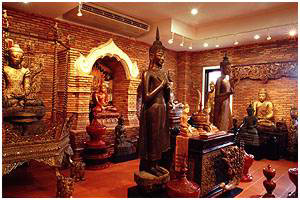
Palace of Art, Phuket

Given its significant number of yearly visitors, it’s not really surprising that Thailand’s island of Phuket has a number of good stores dealing in antiquities.  As is the case  in the rest of Thailand, much of the best that you’ll find in these shops in Burmese in origin.

With the exception of the Soul of Asia shop in Phuket, and Chan Antiques on the 402 Bypass road, all shops below are within 10 or 15 minutes of each other, near the junctions of highways 4030 and 4025.

Chan’s Antique House, 99/42 Moo 5, Chalermprakiat R.9 (Bypass Road), Tambon Rassada, Phuket. Tel: (076) 261-1416. Chan’s offers a very good selection of sculptures, crafts, and decorative antiquities. The first room upon entering houses reproductions; the best of their collection is in the rear. Chan’s is not the easiest place to find, as Route 9 is also called 402 Bypass (which differs from 402, which runs more or less parallel to the east. Chan’s can be found on the northwest side of this busy highway.
www.chans-antique.com  GPS: N07°55.572’  E098°22.327’

Heritage Collection, 382/45 Phuket Laguna Road, Cherngtalaay, Thalang, Phuket.  Tel: (076) 325-818.  This large store has antiquities and reproductions, but we weren’t all that happy with the repairs on some of the pieces.  Worth a visit, but caveat emptor.GPS:  N07°59.787’  E098°18.249’

Palace of Art, 103/3 Moo 4, Srisoonthon Road, Talang, Phuket.  Tel: (076) 273-533. Palace bills itself as having “the best Fine Art & Décor objects in the country”, and its claim may be warranted.  This beautiful collection, housed in a state-of-the-art villa, is as close to a museum as an antiquities venue could be, certainly the best in Phuket. www.thaiart.com 

Siam Arts Collection, 382/5 Mu-1 Srisoonthon Road, Talang, Phuket. Tel: (076) 325-207.  This small shop, near the Laguna Resort turn-off, has an exceptional collection of Burmese antiquities.  Owner Thida is friendly, knowledgeable, and Burmese. 
GPS:  N07°59.651’  E098°18.346’

Sivalla, Plaza Surin, 5/50 Moo 3, Cherntalay, Phuket.  Tel: (076) 271-546.  Sivalla has a nice collection of antiquities and jewelry, but the diffident owner impatiently drummed his fingers, waiting for us to leave, while loudly playing French pop music.  Worth a visit, but see Soul of Asia next door while you’re there in the Plaza.
GPS: N07°58.584’  E098°56.062’

Soul of Asia, Plaza Surin, 5/50 Moo 3, Cherntalay, and 37, 39 Rasada Road, Phuket.  Tel: (076) 211-122.  Soul of Asia has three shops (one in Phuket town), but we liked the friendly atmosphere and good collection at Plaza Surin best.  The charming manager there took great pains to explain differences in Thai, Burmese, and Lao Buddha sculptures.
www.phuketdir.com/soulofasia
GPS: N07°58.584’  E098°56.062’

Touring the untraveled Wat Phu Champasak in Western Laos

Written By: herbrunbridge - Apr• 30•10

The temple of Wat Phu Champasak is located on an unspoiled hillside setting, and its original structures date from approximately the 7th century ACE. Arranged on three levels, Champasak’s upper-level sanctuary provides a stunning view of the countryside, including the remaining baray (pond). Wat Phu Champasak boasts wonderful lintel carvings, bas-relief apsaras (dancers), and is in a state of semi-decay, devoid of over-restoration. A great element in the overall beauty of this temple is that it’s relatively untraveled, and you won’t see hoards of tourists there anytime soon. In fact, we had it all to ourselves. Your visit begins by traveling to the town of Pakse. 

To get to Pakse:
From Laos, there are daily flights from Vientiane, via Savannakhet, to Pakse, a pleasant border town 50 km from Wat Phu Champasak. 

From Thailand, fly to Ubon Ratchathani.   The Chong Mek border station is 95 km from the airport, and you can hire a taxi straight to the post for 900 baht (on our return, we jumped on the Chong Mek-Bangkok bus—there are two daily — and paid 50 baht to Ubon).  After paying $30 USD for a Lao visa-on-arrival, a Lao taxi will take you to the town of Pakse for approximately $5 USD. 

To get to Wat Champhusak:
Wat Phu Champasak is 50 km from Pakse. In Pakse, you can find a tour that will charge you approximately $30 USD to visit the Wat. You can also take one of the roughly scheduled local buses from Pakse’s New Market (approximately 1.5 hours, at $2 USD).  As return buses to Pakse are irregularly scheduled, we decided to make the trip by motorbike, which we hired ourselves for $10 USD. 

Directions by motorbike from Pakse to Wat Phu Champasak:  Follow Road 13 south out of Pakse approximately 8km, then turn right at the sign saying “Khong Island 120” (GPS N15°06.911’  E105°52.370’).  Continue for approximately 22km at the Wat Phu Champasak sign, at GPS N14°55.739’  E105°56.208’. Several kilometers later, you’ll arrive at the Muang ferry crossing at the Mekong. After crossing, turn left at the main road, and continue to Wat Phu Champasak’s main gate at GPS N14°50.837’  E105°49.234’

WoWasis Recommended books on Laos: The Lao Bookshelf

Written By: herbrunbridge - Apr• 30•10

Laos is as under-reported in literature as it is in the Press, so there are relatively few books particular to the country, compared to those pertaining to its neighbors in Thailand and Vietnam.  Here are a few that we at WoWasis recommend as worthy of your attention. 

Non-Fiction
Kay Danes’ prose is a bit twisted at times, but her travails as a Western businesswoman unjustly accused of embezzlement in Laos are the stuff of terror.  Their business essentially stolen by Lao government officials, Danes and her husband spent nearly a year in Phonthong prison.  They were lucky to get out alive, and their story is chronicled in Deliver Us from Evil (2001, ISBN 1-74095-025-9).  The book is a must-read for any Western person considering engaging in a business relationship with a Southeast Asian partner in-country. 

In 2002, Paul Conroy followed with the behind-the-scenes story that sent Kay and Kerry Danes on the road to ruin in 10 Months in Laos: a Vast Web of Intrigue, Missing Millions, and Murder (ISBN 1-86350-385-4).  The whole thing develops as a confidence scheme run out of Australia, with tendrils reaching into Laos and Cambodia.  Conroy’s got all the financial numbers down pat, to the extent that some accounting background might be necessary to grasp this intricate web of deception. 

American Brett Dakin spent the better part of a year in Laos, working for the government tourist agency.  He describes his life and acquaintances in Vientiane in Another Quiet American (2003, ISBN 974-8303-68-3).   To us, his stories offer a pastiche, but seem a bit incomplete.  The most poignant part of the book deals with his brief, uneasy relationship with “Kee”, a Lao bargirl (toward the end of the book, Dakin ‘fesses up that he was “repelled, rather than stimulated by the difficulties of pursuing relationships with Lao women.”) 

 In Air America: From World War II to Vietnam (1979, ISBN 974-8303-51-9), Christopher Robbins unfolds the story of the CIA’s secret airline, from the early days of Claire Chennault’s Flying Tigers, to the later times of “Pops” Buell and pilot Les Strouse.   Much of the action takes place in Laos. 

Fiction
Col Cotterill’s third novel, Pool and its Role in Asian Communism (2005, ISBN 974-8303-76-4) focuses — yet again — on child trafficking.  The passion for the issue is clearly close to the author’s heart, having served in more than one NGO specializing in child abuse.  That said, the similarity to Cotterill’s previous book (Evil in the Land Without) in terms of subject matter leaves the reader wishing for a different type of criminal to provide some necessary variation. Much of the action here takes place in Laos during America’s Vietnam years, and Cotterill weaves various historical figures into this tale.  As other critics have noted, Cotterill places perhaps too much emphasis on the improbable for the book to be truly memorable. In our opinion, his strong suit is dialogue and humor, with believability running behind.