The sharper edge to traveling in Asia

Top Ten Hazards to Avoid in Bangkok

Written By: herbrunbridge - Apr• 25•10


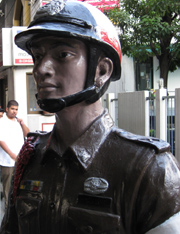
Be as observant as this policeman when you walk the streets of Bangkok

Sure you’re a veteran traveler, but even longtime expats get nailed by ten common hazards that are particular to Bangkok.  Be aware of the following, and live a long life…

1)  Being “wired” takes on a whole new meaning in Bangkok, where heap big power lines, fluorescent tubes, and incandescent bulbs are commonly strung low enough to tangle the hair and smash the foreheads of anyone over one meter in height. 

2) Khlong Saen Saep water taxisYes, they’re efficient; just keep your mouth closed and your arms covered as you glide over the waters of Bangkok’s intestines. 

3)  We’ve been to the desert floor on a summer’s day in California’s Death Valley, but never have we been in anything as hot as an enclosed Bangkok telephone booth on a scorcher.  The “hot box” was a common torture in the old Ayuttahaya era.  Live it today while dialing a call in Bangkok! 

4) Think a green “walk” signal means you can safely cross the street?  Think again.  Traffic routinely cuts through crosswalks, allowing you to practice those forgotten dance steps from finishing school… 

5)  Everyone knows that Bangkok’s sidewalks are for motorcycles, not pedestrians.  Keep your eyes peeled at all times for oncoming motored traffic while on a sidewalk.

6) A little bacteria with your piercing, ma’am?  Get a body piercing  done down on the corner curb, where airborne particulates dance the night away, with nary a water spigot nor clean towel in sight. 

7) For those who think Bangkok just isn’t noisy enough, how about the arrival of these ear-splitting mega-street blasters, bombarding your ears with commercials 24 by 7.  Nearby bus stops and shopping zones provide a constant stream of victims. 

8)  Not the doggie to pet!  Mangy soi dogs abound in Bangkok, eating late-night leftovers from food vendors, then more or less lounge around and lick, scratch, and shift position as the sun changes.  An estimated 12% of all dogs in Thailand have been exposed to rabies, including pups.  Keep your hands to yourselves, and exercise your petting fetish with the pooch you know at home.

9)  Stationary sidewalk hazards range from Bangkok’s knee-level red fireplugs, always placed squarely in the middle of a sidewalk, to the “uplifting patterns” of her sidewalks.  Stray pieces of construction rebar, ankle high and embedded in cement, provide another joy on Asia’s finest slalom course. 

10) Moving sidewalk obstructions include grazing elephants, but backpackers carrying two tons of household goods seem to be everyone’s favorite.  For additional fun, add a guitar and hand-drum to the mix, providing that extra girth that is especially welcome in narrow sidewalk stalls.

Remembering the wild sexual world of writer Cleo Odzer

Written By: herbrunbridge - Apr• 25•10

Comparatively few WOWasis women readers browse Thai bookstores in search of books relating to Thai adult-themed nightlife, but those who do are often surprised to find a well-researched book on the life encountered on Patpong Road, expat writer Cleo Odzer’s Patpong Sisters (ISBN 1-55970-372-5).  Odzer held a Ph.D. in anthropology, and spent three years living the life of the district, interviewing girls, bar owners, and customers.  She got involved personally, too, and her book tells the tale of her tempestuous relationship with a Thai man, involved on the periphery of the bar scene.

What sets her apart from many women writing on the scene is that she was an adventurer and wrote from experience, rather than an armchair.  She was quick to realize the power that bar girls held over their own lives, and wrote of their autonomy, drawing the ire of many western women in the process.  Ironically, she was also reviled by a good number of western men.

The story of how the book came to be written is fascinating as well.  After shopping around her manuscript to several publishers, it was finally taken by former Grove Press publisher Barney Rosset for his Blue Moon publishing company.  He described the manuscript as a long-winded treatise on the relationship with her Thai boyfriend, and he asked to see her dissertation on Bangkok nightlife.  He melded the two, and Patpong Sisters is the result.  The book remains controversial, and is a fascinating and unconventional look at the scene.

Cleo wrote a follow-on book, Goa Freaks (1995, ISBN 1-56201-059-X), a chronicle of her free-spirited earlier days in the early-to-mid 1970s.  Her life was legendary.  Born in 1951, she modeled for a short time in Europe, was involved in an iconoclastic record album Alan Lorber’s The Groupies, reportedly was engaged to rock star Keith Emerson,  became a heroin addict and petty thief in India, temporarily dried out, and obtained three university degrees in New York in the 1980s.  She covered the Patpong scene after receiving one of her degrees, returned to New York and got involved in the internet world, and suddenly pulled up stakes and moved back to Goa, probably some time in 1998.  She was never able to shake her own ghosts, and died in Goa in 2001, of complications arising from her lifestyle.  In her own way, she was a remarkable women who bucked trends, broke rules, was brave and self-effacing enough to cast herself in a less-than-glamorous light, and was unafraid to write about it.   She was a vibrant, if challenging, tortured soul who left us too early; her future writings would have undoubtedly been as iconoclastic as the books she left behind. Cleo’s  website is still alive on the web.

Welcome to Japan Oasis!

Written By: docreineger - Apr• 23•10

This section of the WoWasis Travel Blog features all your travel experiences and thoughts about Japan

WoWasis book review: Boye De Mente’s ‘Women of the Orient’

Written By: herbrunbridge - Apr• 23•10

Many men have loved exotic women from the Orient, but few have written as passionately on the subject as adventurer Boye De Mente, in his small but encyclopedic Women of the Orient (1995, ISBN 0-8048-1880-0).  Here, he chronicles the habits, looks, and proclivities of women from six Asian countries, China (Hong Kong & Taiwan), Japan, Korea, the Philippines, Thailand, and Vietnam.   A former resident of Japan, he waxes poetic about the tonsorial aspects of the Japanese woman, how she relates to men, and her physical characteristics as well.  De Mente classifies men who love women as alternately girl watchers, girl chasers, information gatherers, field reporters, and lotharios, but the reader quickly finds that these are all embodied in the author, who is a consummate researcher on the subject.

Perhaps his most revealing chapter is on the Vietnamese woman, and he write most passionately on the traditional ao dai garment, devoting nearly three pages to its appeal for men.  Practically everything in this subchapter is quotable, for example “Just a slightly above average Vietnamese girl in an ao dai is more provocative than a Miss World beauty queen would be accepting her crown in the nude.”  The book is out of print, but well worth seeking out in used bookstores.  It’s a classic.

Some of our favorite passages can be found on the following pages:
p. 18, the beauty of long black hair
p. 33, on clever women
p. 45, mogaku, the Japanese way of describing pubic hair
p. 49, on western women, compared with Asian women
p. 130, the world outlook of Thai women
p. 139, the beauty of Vietnamese women
p. 143-44, treatise on the Vietnamese ao dai dress… wow!
p. 147-148, sidesaddle girls, and a diminutive Filipina singer

Morlam music: an Isaan pastiche of city and country

Written By: herbrunbridge - Apr• 23•10

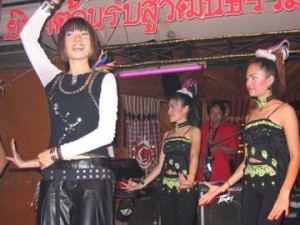
Jintara Poonlarb live at Bankok's Tawan Daeng

Morlam music, an infectious, riotous urban music originally from the Isaan northeast, is one of the predominant Thai musical genres you’ll find in Bangkok today. With its raging organ ostinados, high-flying guitar riffs, and rap-like vocal phrasing, morlam can be heard in street stalls, Thai bars, and taxi radios and VCD (video CD) players. A live  morlam show may include dancers, up to dozens in number, sporting plumed headdresses, sarongs, tennis shoes, you name it, just as long as it’s festive. 

Often referred to as “Thai country music”, along with its close cousin “lukthung,” you can hear morlam live at venues such as Tawan Daeng, and all stalls selling Thai music will have morlam CDs and VCDs (labeled “karaoke”) for sale, featuring morlam stars such as Jintara Poonlarb, Banyen Rakkaen, Doakfah Phetpuphan, and  Rojaná Sarakham.  

About the music
Morlam music is also referred to as “mor-lam”, “moh-lam”, “moh-lum”, and similar spellings, as the English transliteration from Thai and Lao is inexact.  Originating in the Isaan country of northeastern Thailand, its primary instruments originally were the khaen, a multi-reed, multi-pipe mouth organ, and the phin, a stringed instrument similar to the western guitar. These were often accompanied by the sor, a bowed string instrument, a hand drum, and a circular panpipe called the wood. Today, these instruments are augmented and/or replaced by electronic keyboards, electric bass, and a western-style drum-set. The keyboard is set up to resemble the sound of the 1960’s Farfisa combo organ. The name morlam derives from two words in the Isaan dialect, “mor”, meaning expert, and “lam” meaning song. The Isaan dialect is not understood by most Thais speaking central Thai, the primary dialect in Bangkok, the north, and south, even though the written script is the same. The Isaan dialect spoken in northeastern Thailand and Lao are essentially the same language, and in fact, “morlam” exists in Laos as well, under the name “lamlao”. Although much morlam is sung in Thai, a significant amount is sung in Isaan (Lao).
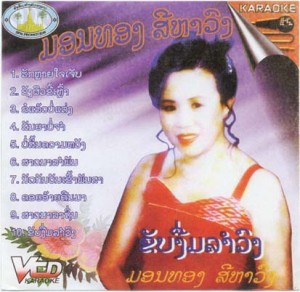
Lamlao singer Monthong Sihavong

Morlam music, at its best, is fast-paced, being driven by a continual flurry of 16th notes from the khaen, booming bass, surging organ swells, and drums relying heavily on backbeat. Morlam singers are accompanied by dancers, who might either be dressed in traditional Thai costume, mod disco garb, or a stylized combination of both.  It is not uncommon for stage dancers at morlam shows to wear bikinis, which some Western observers believe indicates an encroachment of Western culture on the East.  Not so.  Bas reliefs of scantily-clad temple dancers can be found throughout Southeast Asia, and the tradition is centuries old.

There are four main components to the Morlam song vocal styles:  1)  “Talk“, in which a singer recites non-sung words, generally to slow musical accompaniment; 2) “Gern“, an introductory slow sung section that lasts approximately sixty seconds, most often accompanied by khaen; “Lam“, a rap-like chorus, which differs from western rap in being melody-based, and generally only one chorus long; “Pleng“, which is the non-lam part of the song, and also means “song” in Thai.  Often, the words “o-la-nor” (“o fate”) occur as a beginning to the “gern” section. A common and significant vocal inflection often ends a chorus, consisting of several repeated, non-word vocal inflections, sounding like “o-ey, o-ey, o-ey”.

Morlam and the Isaan culture
As much as it is a music, morlam is also a social force unifying the Isaan people of northeast Thailand, many of whom find their way to Bangkok to find fortune, far from the villages, many of which are wrought with poverty, hunger, and meager economic opportunity. Isaan workers, most of whom have at best an elementary school education, become Bangkok’s construction laborers, street vendors, cleaners, and bar girls. They are ostracized from upscale Bangkok society due to their lack of higher education, language, and skin color, which is darker than that of Sino-Thais. To a large extent, the lyrics of morlam songs tell their own story, making references to village life, village people they miss, lost loves, and exploitation by elements of city culture. Morlam music can be found in numerous karaoke bars in Bangkok where, for a few baht, Isaan people can play a video CD of a favorite morlam performer. The video CD, based on the MPEG1 format, is the preferred choice for hundreds of thousands of morlam fans, many of whom cannot afford televisions, as it allows them to experience their favorite stars on stage, in a venue close to work or home.

Non-Isaan Thais often express embarrassment at the popularity of morlam with Westerners, in much the same way that many mainstream-society people in the U.S. felt about early 1900s New Orleans jazz, which was heard primarily in bordellos. Lao people, on the other hand, generally love the music, which they’ll often claim as being originally Lao.If possible, obtain the VCD versions of morlam CDs, which show the pageantry, the musicians, and acted sequences depicting the lyrics. Some of the more popular morlam singers also sing other forms of popular Thai music. These would include Jintara Poonlarb and Siriporn Umpaipong. On the other hand, singers such as Banyen Rakkaen and Rochana Sarakham tend to sing morlam almost exclusively. Overall, the best way to buy morlam is to buy something you enjoy hearing as you’re walking by a music stall.

Banyen Rakkaen

Morlam recommendations

For more information on Isaan culture, consider reading the work of Isaan novelist Pira Sudham, whose books ‘Monsoon County’ (ISBN 974-89067-3-6), ‘People of Esarn’ (an alternate spelling of “Isaan”, ISBN 974-89123-4-5) and ‘The Force of Karma’ (ISBN 974-90079-1-3) are written in the original English.  For more on Sudham, visit: www.pirasudham.com
Power and Politics in Thailand: a few notes on governmental organization and hierarchy

Written By: herbrunbridge - Apr• 23•10

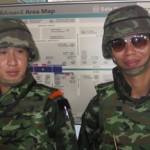
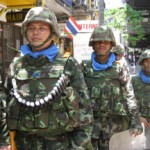
Soldiers at Sala Daeng BTS station, shortly before a grenade attack, May, 2010

One of the most vexing challenges for the Westerner in the East is to understand how decisions are made within the Thai political structure.

The Kingdom of Thailand has been independent since 1238 ACE, and is considered the only country in Southeast Asia never colonized by an imperialist power. It became a constitutional monarchy in 1932. King Bhumibol Adulyadej has ruled since 1946. Although the King has no formal political power as defined by this system, his opinion is revered by individuals, politicians, and the military. In times of national crisis, both the King and Queen Sirikit have provided counsel that has been adhered to by military, legislative, and judicial powers.

Thailand has a lower house (House of Representatives) of 500 individuals elected to four-year terms, responsible for making legislative changes. The upper house (Senate) has 200 members, elected for six-year terms, and is responsible for changes in the constitution. Anyone running for election must have at least a Bachelor’s degree. The Prime Minister is elected to a six-year term. Judges of the Supreme Court are selected by the King. Voting in all elections is compulsory for all citizens of Thailand.

The country is divided into 76 provinces, each of which is led by a Governor, appointed to a four-year term by the Ministry of the Interior. Provinces are divided into Districts, each of which is led by the District Officer (also appointed by the Ministry), who directly reports to the Provincial Governor. Districts are further divided into Sub-districts, Tambon (groups of villages), and Moo Baan (towns). The ‘kamnan,’ who governs a tambon, and ‘puu yai baan’ the headman who controls a village, are elected by popular vote. It has been common practice in elections for kamnan and poo-yai-baan for votes to be paid for, in cash. Government officials at the District level and higher are often referred to in newspapers by the title “Than,” and their wives by “Than Puying.” Retired military personnel serving in civilian government posts are referred to by their titles, such as “Pol Gen” (Police General).

Large municipalities with over 50,000 people are called ‘nakhorn’, whle typically towns with 10,000 to 50,000 people are called ‘muang.’ A provincial capital is called ‘amphur muang,’ commonly abbreviated in addresses as ‘A. Muang.’ Mayors of cities are elected by popular vote. Bangkok is actually considered a province itself, and therefore is run by a Governor, who is elected to a four-year term by popular vote, rather than appointed by the Ministry of the Interior, as are the Provincial Governors.

Pay, Ranking, and Levels of Authority

In the Thai government, the largest political units are the Ministries, divided first into Departments, then Divisions, then Sections. In the civil service, title, pay grades, and responsibility are indicative of a class structure in which one is expected to rise according to a formal schedule. Civil service is divided into five classes, each consisting of three grades. There are four salary steps in each grade, and each civil servant is expected to rise one step within the grade each year.

In the Ministry of Education, for example, the highest class, known as the Special Class, contains most of the top officials. Below that are Division Chiefs in Class One, Section Chiefs and officials in Class Two, and Classes Three and Four comprise non-specialized clerks, which include most village schoolteachers. Typically, only college graduates are able to gain entry into Class Three, and are referred to as ‘ajarn, when they teach at university level.’ The word ‘khru’ often refers to a teacher in Class Four (‘khru yai’ refers to a headmaster). Incidentally, all students are provided with free education for 12 years, and the system is divided into two parts, Primary 1-6, and Secondary 1-6.

Bombs fly on Silom as Bangkok Skytrain station becomes target for terror

Written By: herbrunbridge - Apr• 22•10

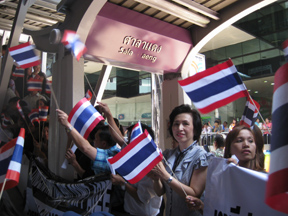
Multicolored protestors at Bangkok's Sala Daeng skytrain station a few hours before the grenades hit

M79 rocket grenades exploded in and near the Sala Daeng skytrain station last night, killing 3 and injuring dozens. The target was the “multicolored” group of protestors demonstrating against the red-shirted United Front for Democracy against Dictatorship’s (UDD) group at Bangkok’s Ratchaprasong intersection. UDD leaders have denied the attacks originated from their ranks, although it is believed that the grenades were launched from Lumpini Park, where many of the red-shirts have assembled.

Police have reportedly arrested some suspects, but it is increasingly suspected that a number of security agencies have been compromised by red-shirt members in their ranks, who may be surreptitiously feeding intelligence to sources within the red-shirt movement.

The red-shirts have been active in other parts of the country as well, engaged in stopping a Thai army train in Khon Kaen on its way to southern Thailand. The red-shirts allowed the train to proceed only after becoming convinced that the train was not headed to Bangkok for the purpose of troop and materiel reinforcements. The red-shirts reportedly are traveling on the train, allegedly to ensure that the train is not routed to Bangkok.,

For now, it’s clearly a situation of “watch and wait” in Thailand, especially at Bangkok’s Ratchaprasong intersection, as all factions, police, military, red-shirts and multicoloreds,  ponder their next moves.

Bangkok Hotel closures provoke more worry for beleaguered Thai tourism industry

Written By: docreineger - Apr• 21•10

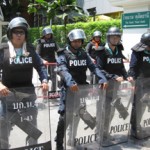
Bangkok Police Tac Squad guards entrance to Dusit Thani Hotel

The downtick of Thailand’s tourism business that started with the yellow-shirted People’s Alliance for Democracy’s (PAD) closing of Bangkok’s Suvarnabhumi Airport in 2008 has continued unabated with the red-shirted United Front for Democracy against Dictatorship’s (UDD) protest at Bangkok’s Ratchaprasong intersection in 2010.

The Bangkok Post reported on April 21 that the InterContinental Bangkok and Holiday Inn Bangkok have temporarily decided to close. The Grand Hyatt Erawan and Four Seasons Hotel are no longer accepting new guests. It’s estimated that millions of baht per day are being lost by hotels in the area. Air traffic numbers are down as well, with over 100 charter tourism flights to Thailand cancelled in the last several weeks alone.

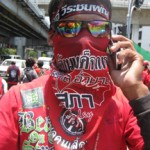
Many UDD redshirt protestors disguise themselves to thwart Thai police and military cameras

Foreign governments’ travel warnings regarding visits to Thailand are increasingly common, as sporadic threats, such as recent bomb attacks on various branches of Bangkok Bank, continue to be reported.

As was the case at Suvarnabhumi, a party atmosphere is in evidence at the Red Shirt camp at Ratchaprasong. Unsubstantiated rumors persist that protesters have been bused to Ratchaprasong for figures ranging from 500 baht to 1000 baht per person per day. While the protesting and partying continues, Thailand’s tourism market continues to drop, affecting not only the hotel industry, but all ancillary businesses as well.

Two large questions loom. How much worse will this get? And when this has run its course, how long will it take for Thailand to regain her reputation as a safe destination with easy access for world travelers?

Bangkok Taxi Cockpit: a drive to distraction?

Written By: docreineger - Apr• 20•10

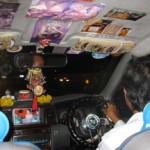
Why should a taxi driver watch the road, when he can "look TV" instead!

Check out the cockpit of the taxi meter I just took from Suvarnabhumi Airport in Bangkok.  He’s got a morlam vcd player going all the time so he can watch TV while he drives (it was a neat Siriporn morlam live show, too). His visors are loaded with other VCDs so he can select others while on the road. Lots of Buddhist stuff on the dashboard, windows, even the headliner! Like many a Bangkok taxi, this one’s a mobile shrine and entertainment center on the move!

Red Shirts play a waiting game in Bangkok

Written By: docreineger - Apr• 20•10

Thai military "locked & loaded"

An uneasy rest formed at the corner of Silom and Rama IV roads in Bangkok, as several thousand Red Shirts, supporters of the deposed Prime Minister Thaksin Shinawatra, were faced down by soldiers and police, armed with tear gas and live ammunition. As police and military lined the southern side of Silom between Rama IV and Convent Road, Red Shirts were confined to an area within Lumpini Park, waiting for their next move.

Even in tough times, a pretty girl is always ready to fire off a quick salute

In the early afternoon, several thousand government supporters — sans yellow shirts — began demonstrating near the police lines on southern Silom.

Although the Thaksin supporters had vowed to march down Silom, they held off, as the military had made a statement earlier that they would not allow the Red Shirts to ossify Silom Road.

Who are the Red Shirts? Some, like political pundit Sirikul Bunnag, as quoted in the April 20 issue of the Bangkok Post, argue that there are four discrete factions: Thaksin and his supporters, Radical Leftists (including Maoists), the country poor, and soldiers who have crossed over into the pro-Thaksin camp, looking to achieve higher rank with the return of a Thaksin-oriented government.

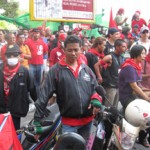
Red Shirts await the next call to action

Soldiers, who are carrying live rounds consisting of bullets, shotgun shells, and tear gas, are largely made up of country people themselves (none of the soldiers I interviewed spoke English), and it remains to be seen how willing they will be to fire upon their own people, what ever their political persuasion.

On the other hand, action could be escalated through the intervention of the Yellow Shirts, who have vowed that they will do something to unblock the situation if the police and military won’t. As of now, it’s a standoff, as Bangkok waits warily for the next step.