The sharper edge to traveling in Asia

The Ambarawa Locomotive Railway Museum in Central Java

Written By: herbrunbridge - May• 23•10

This open air train museum can easily be visited by WoWasis travelers visiting the nearly Indonesian sites of Borobudur and Gedung Songo in Central Java. The museum is housed in the Ambarawa train station, built in 1873. In addition to viewing the locomotives, vistors can take a 20 km excursion (try to book in advance, see phone number below). The museum’s unofficial website offers the following description of the museum: 

The museum was established in the 1970s primarily to preserve a wide selection of the steam locomotives which were then coming to the end of their useful lives on the 3ft 6in (1067mm) gauge railways of the Indonesian State Railway (the then Perusahaan Negara Kereta-Api, PNKA). These are parked in the open air next to the original station, originally a transhipment point between the 4ft 8½in gauge branch from Kedungjati to the north-east and the 3ft 6in gauge line onward towards Yogyakarta via Magelang to the south. It is still possible to see that the two sides of the station were built to accommodate different size trains. 

Ambarawa is located 30 km south of the provincial capital of Semarang, and 75 km north of Yogjakarta. A great way to see it is to arrange a tour from your hotel with private car that will take you to Borobudur, Gedong Songo, and the Museum, which can be accomplished in one day. 

Museum Kereta Api Ambarawa (Ambarawa Railway Museum)
Jalan Setasiun no. 1, Ambarawa. Phone 0298 – 91035
www.internationalsteam.co.uk/ambarawa/museum.htm
GPS S07°15.914’  E110°24.116′

Bangkok’s Central World burns: were protesters paid to commit arson?

Written By: herbrunbridge - May• 20•10

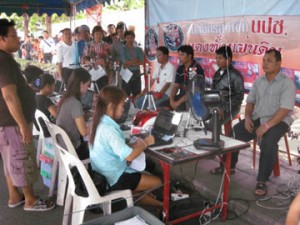
April 27, 2010: hundreds wait in line at Red Shirt registration table

That’s a mighty sobering video of the burning of Central World, Asia’s second largest shopping complex. Especially interesting is the cheering of the red shirts as Central World burns at 2:35 into the video, applauding no doubt the hundreds, maybe thousands of jobs lost at the center to middle and lower middle class workers who won’t see a paycheck for awhile.

The disturbing idea that many, if not most, of the protesters were paid (500 to 1000 baht per day is the figure we’ve heard from many sources) is underscored by the registration table that was located in the protest zone under the BTS Ratchadamri station, at which protesters filled out a form, were entered into a database, had their pictures taken, and received an identification card. The question persists: was this registration procedure initiated to prevent protesters from getting paid more than once per day?

The red shirts were no doubt infiltrated by Thai military Special Forces, and the military continuously took camera shots by day and through night vision cameras of hundreds of protesters. It is believed these photos will enable Thai authorities to identify those who committed felonies, including arson.

But three very important questions remain: who’s got that database, for what purpose was it established, and who took on the responsibility for paying for the hardware, software, infrastructure, and, as has been suggested, disbursal of daily funds to protesters?

Bangkok Profiles: the Irrepressible Dave the Rave, Bangkok’s nightlife guru

Written By: herbrunbridge - May• 20•10

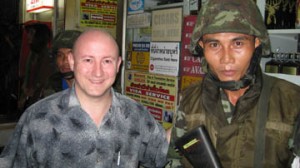
At 4 am, at Soi Nana, observing protests

Spend enough time in Bangkok’s nightspots, and you’re sure to run into Dave the Rave. Living in Bangkok since 1988, Dave is a former Muay Thai boxer who fell in love with the country, eventually began managing bars, and now hosts a popular Bangkok nightlife entertainment website, now one of the most visited in Thailand. He regularly updates it with information relating to nightlife as well as the occasional political emergencies that affect Thailand’s capital city. 

About his early days in Thailand, Dave writes “I was 25 years old when I first visited Thailand in 1988.  I was sponsored by a company in my home town in England to live and train at a Muay Thai Camp in Thailand. It was Sityodtong Payakaroon Muay Thai Camp in Naklua village near Pattaya.  I lived and trained at Sityodtong for four months.   I have the honour of training with Former World Muay Thai and Boxing Champion Samart Payakaroon. Samart was a legend in Thailand and we became friends and training partners. In 1984 I become World Kickboxing Champion by defeating the USA Superteam. Life is tough on a Muay Thai Camp, but being a World Champion I was used to tough training. At my fittest I could road run 10 miles in under 60 minutes and then, complete 5 more hours training on top of that.  Nowadays, I struggle to dash to the bar for last orders!” 

We first met Dave at a book signing, and found that he was a big fan of the WoWasis article on the emerging literary genre of Bangkok Fiction. Dave’s enthusiasm about just about everything is infectious, as we were reminded the other evening when we ran into him during a Thai military operation in front of Bangkok’s JW Marriott Hotel. Even after a bomb exploded nearby, Dave enthusiastically followed troop movements, jumping animatedly into the action taking pictures and clearly enjoying being in the center of where the action was. Everyone from Marriott security to the Thai military was trying to persuade to go home to safety, but he wasn’t having any of it, reveling in the moment, and picking up news items. 

During his Muay Thai days, 1988

Dave is a veteran bar manager whose familiar haunts include Sukhumvit Soi 4 Nana and Soi Cowboy, and he can be found in those areas most nights. And within minutes of meeting him, you’ll understand how he picked up that moniker. He’s willing to share an opinion about most anything, including dancers and stage performers. Waxing eloquently on viewing a well-endowed stage performer recently, he raved “Will you look at that… they’re massive, simply massive!” Dave’s a fun, energetic guy who’s one of the thousands of expats that contribute to making Bangkok one of the world’s most unique cities.

WoWasis discovers Bali’s Top 6 museums

Written By: herbrunbridge - May• 20•10

Denpasar Provincial Museum

Most Balinese museums of note are right in the town of Ubud, a couple of others within short driving distance are well worth a visit, too. Bali has inspired artists for generations, including a number of exceptional expat painters active in the 20th century, such as Rudolf Bonnet, Arie Smit, and Walter Spies.

In Ubud

Museum Puri Lukisan
Yayasan Ratna Wartha, Ubud
Open 9 am – 5 pm daily
www.mpl-ubud.com
This exceptional museum started with a donation of paintings from Rudolf Bonnet, and was formally founded in 1956. Eventually the collection increased, donated by different artists themselves and collectors, and includes the work of Balinese artists such as Ida Bagus Gelgel, I Gusti Nyoman Lempad, Anak Agung Gde Sobrat, and I Gusti Made Deblog. The Dutch government supported the return of Bonnet in 1975, who was summoned to leave Bali in 1956, to complete the building of the museum. The museum’s collection highlights, through paintings and woodcarvings, the important developments of Balinese arts, focusing on the past two centuries. Its bookstore offers a wonderful selection of books on Balinese arts.

Agung Rai Museum of Art (ARMA)
Jl. Pengosekan, Ubud
Open 9 am – 6 pm daily
www.armamuseum.com
The permanent exhibition of paintings by Balinese, Indonesian and foreign artists is housed in a wonderfully landscaped setting. The paintings range from traditional to contemporary including  classical Kamasan paintings on tree bark, masterpieces by Batuan artists of the 1930’s and 1940’s, the only works to be seen on the island of Bali by the 19th century Javanese artist Raden Saleh Syarif Bustaman and German painter Walter Spies, works by Balinese masters such as I Gusti Nyoman Lempad, Ida Bagus Made, Anak Agung Gde Sobrat and I Gusti Made Deblong, and a number of other expat artists, including Willem Gerald Hofker, Rudolf Bonnet, Adrien-Jean Le Mayeur de Merpres and Willem Dooijwaard. The works of Walter Spies, an influential artist whose work is shown to great effect here in a room dedicated to his oeuvre, is not to be missed. The museum is located on the grounds of the ARMA Resort, where visitors may also book lodging.

IndonesiaPromoBannerNeka Art Museum
Raya Campuhan St.
Kedewatan Village, Ubud
Open Monday-Saturday: 9 am- 5 pm, Sunday: Noon – 5 pm
www.museumneka.com
The Neka Art Museum was opened in 1982 and is named after a Balinese teacher Suteja Neka who collected paintings as a means of artistic documentation. Nowadays the museum has a great selection of works from many famous Balinese artists and expats who have lived here and influenced local artists. This can’t miss museum features works by Balinese and expat artists such as Arie Smit, Rudolf Bonnet, Theo Meier, and I Wayan Atjin Tisna.  Do not fail to have lunch or dinner at the legendary Naughty Nuri’s across the street.

Blanco Renaissance Museum
Jl. Raya Campuhan, Ubud
Open 9 am – 5 pm daily
www.marioblancobali.com
This unique museum, featuring the works of Don Antonio and son Mario Blanco, is a sometimes odd, but always fascinating glimpse into the flamboyant world of this Catalan expat artist family. It’s housed in their centrally-located Ubud studio-home, and well worth a visit.

Other museums of note in Bali
Museum Seni Lukis Klasik Bali (Gunarsa Museum of Classical & Modern Art)
Located 5 km west of Semarapura (Klungkung)
Tel: 0366-22255
Open daily, 9 am – 4 pm
GPS: S08°33.248’  E115°23.209’
Dr. Nyoman Gunarsa, known primarily as a painter of Balinese dancers, founded this three-story museum, which includes his studio as well as many of his paintings, which though representational, combine elements of abstraction. A nice collection of traditional Balinese paintings are on exhibit, as are masks, wood carvings, and art in stone. The grounds themselves are striking as well.

Denpasar Provincial Museum (Museum Negeri Propinsi Bali)
Jalan Letkol Wisnu, Denpasar
Tel 361 22 2680
Open 8 am -3 pm daily
Denpasar’s ethnographic museum is worth a visit, and travelers landing at the airport often make a stop at the museum before heading to Ubud. Here you’ll find prehistoric art, shadow puppets, dance costumes and textiles, in a beautiful setting comprising several pavilions. Do call ahead, as hours tend to change depending on local variances.

WoWasis’ Indonesian Bookshelf: what to read before, during, and after your trip

Written By: herbrunbridge - May• 20•10

There are a great number of terrific books on Indonesia, and we here at WoWasis suggest you consider buying in your own country when possible, as books in Indonesia are expensive, even for paperbacks. The other side of the argument is that by buying in Indonesia, you support local bookstores. Here are a few books on Indonesia that we’ve found particularly fascinating. 

History, Culture, and Politics
John Coast, to a very large extent, introduced Balinese dancing to the West through a world tour he organized in the early 1950s. Dancing out of Bali (1953, ISBN 0-7946-0261-4) provides the fascinating story of talented but temperamental dancers and musicians, and the difficulties faced by a Westerner dealing with Indonesian politicians and local figures. 

Painter Miguel Covarrubias’ Island of Bali (1946, ISN 962-593-060-4) is an encyclopedic work of over 400 pages, detailing cultural and artistic elements of Bali, containing dozens of b&w photographs and several color plates. There have been several iterations of this book, including a coffee-table version with better reproductions of the photographs. 

If you suspect that there is a sexual underbelly to this fascinating nation, you’ll want to read Moammar Emka’s Jakarta Undercover series, which is in two discrete volumes. Volume 1, called simply Jakarta Undercover (2002, ISBN 10-981-05-3917-7) primarily covers high society venues and rich local playboys in Java. We preferred Jakarta Undercover II (2007, ISBN 978-981-05-9109-0), which has wonderful data on middle class sex haunts, current prices, and gay and ladyboy venues, both in Java and Bali. 

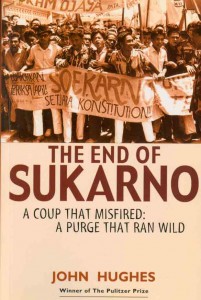
You won’t find a better book on the politics of Indonesia than John Hughes’ The End of Sukarno: a Coup that misfired, a Purge that Ran Wild (1967, ISBN 981-4068-95-9). Hughes’ tale of the aborted Communist coup reads like novel, and is essential for those wishing to gain a greater understanding of the personality of Sukarno, and the forces that drove the later Suharto régime. 

Most travelers to Bali find the art of the island fascinating, and overall, we found the most comprehensive book on the origins, painters, and schools of Balinese painting to be the large paperback called Museum Puri Lukisan, written by Jean Couteau, that you can only buy at the museum (1999, ISBN 979-95713-0-8). Here, you’ll find nice color representations of painting and sculpture, good historical information and photographs, and a section on wood carving as well. 

Indonesian Fiction
Jakarta Shadows (2002, ISBN 0 9535895 87) is a very interesting political thriller by Alan Brayne, in which the protagonist, an Western expat white collar worker, is caught between secretive elements in the reform movement and dark formal and quasi-police units. Brayne’s characters are fascinating, leaving the reader constantly guessing as to who the good guys and the bad guys are, and the book is a real page-turner.

Bali’s fun nightlife in Seminyak and Kuta

Written By: herbrunbridge - May• 20•10

Friendly servers in Seminyak's Bush Telegraph bar

Bali’s nightlife centers around the southern towns of Seminyak and Kuta. While Indonesia’s night scene may not rival that of Thailand or the Philippines, it’s worth a night out just to take a look. Nightlife here starts late, around 10 pm or so, and carries on until 3 in the morning. Don’t worry if your bar closes early. Just ask anyone for the name of another bar open late, and it won’t be more than a couple of kilometers away, maximum. Jump on a motorbike and join the fun. 

There’s a thriving gay scene, too, in bars like the Q Bar and Nirvana. And for a cold beer and a nice bar meal, we really like the Bush Telegraph.

Discovering two great spas on Indonesia’s island of Java

Written By: herbrunbridge - May• 20•10

Indonesia is the home of some magnificent spas, and some of the finest are to be found on the islands of Java and Bali. There are, we’d guess, approximately 1,000 spas of different types on the island of Bali alone.

On Java, one of the nicest we’ve discovered is the Losari Coffee Plantation & Resort, a beautiful resort spa located on a former coffee plantation, with enchanting guest rooms, all spa services, and internet access.

Losari Coffee Plantation Resort & Spa Jawa Tengah (Central Java)
Desa Losari, Magelang, Jawa Tengah (Central Java), Indonesia
+(62-298) 596333
   www.losaricoffeeplantation.com

Another wonderful Javanese day spa can be found in the city of Malang, at the lovely Hotel Tugu Malang. The hotel itself has beautiful architecture, a terrific restaurant, and a shop with some compelling locals crafts. The day spa offers all spa services.

Apsara Spa, Hotel Tugu Malang
Jalan Tugu 3, Malang, Java, Indonesia
Tel: (62-341) 363891
www.tuguhotels.com/malang/dining/apsara%20spa.html 

Know of any other great spas in Java? Respond to this post, and tell us about your favorites!

Should you visit a Sharia-based island in Indonesia?

Written By: herbrunbridge - May• 20•10

If you’re a Westerner, you’ll eventually be faced with an option of visiting an Indonesian island (or part of one) that has adopted a Sharia-based Islamic law code. You will find little or no alcohol being served, and if you break a law, you might find yourself formally judged on Quranic principles. 

While traveling in a Sharia-based, strict Islamic area may be exotic, you really must ask yourself if it might not be better supporting the more moderate areas of Indonesia instead. There is a cultural clash in Indonesia between strict and moderate Muslims, and the moderate ones are afraid that the strict Muslims are gaining in power. They most assuredly do not want to see their entire country under the Sharia code. Consider therefore where your tourist money goes, and act according to your conscience. 

Java, for example, is moderate, and many Muslims there feel uncomfortable adopting strict Sharia laws.  Much of Sumatra, in contrast, has gone Sharia. Have a great time in Indonesia, but remember that your tourist euros and dollars do cast ballots for philosophical principles as they’re being spent.

Are red shirts winning the Bangkok propaganda battle in international media? Where’s the critical analysis?

Written By: herbrunbridge - May• 15•10

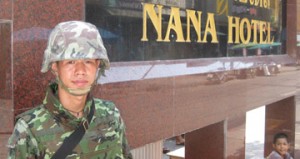
Thai military high alert now extends to the Nana Hotel on Bangkok's Sukhumvit Soi 4

Watching the international media coverage on CNN and BBC, it’s apparent that the redshirt side is winning the propaganda battle. As we reported several weeks ago, protesters fall into four main camps: Thaksin and his supporters, Radical Leftists (including Maoists), the country poor, and soldiers who have crossed over into the pro-Thaksin camp, looking to achieve higher rank with the return of a Thaksin-oriented government.

Based on their reports, the BBC and CNN appear to recognize only the country poor, while either ignoring, or being ignorant of the other factions. It has been commonly reported in Bangkok that the country poor are being paid 500-1000 baht ($15-$30 USD) to join the protest, yet those news organizations have elected not to inform their viewers that this possibility exists. In addition, these news organizations are reporting that red shirt protesters are resorting to sling shots and home-made rockets as red shirts’ only defense again the weapons of the Thai military, when in fact red shirts have caches of small arms such as AK-47, and had shouldered them at checkpoints until recently, when the international media arrived.

It appears as though the United Front for Democracy (UDD) red shirts have played the international media like a fiddle. The goal of the UDD team as far as international media is to portray the protest as the country poor battling for democratic principles against the “undemocratic elite” now ruling the country. The international press conveniently ignores the very real possibility of ex-PM Thaksin pulling the strings behind the scenes, while radical agitators in the group appear to be all too willing to sacrifice the country poor as cannon fodder once government troops get serious about a military solution.

Forgetting for a moment about some of the higher-end businesses such as hotels, there are thousands of vendors and shopkeepers, urban poor and middle class, whose businesses have suffered tremendously because of these protests. They have no income right now, an irony when compared to many of the protesters who are gladly receiving their daily 1,000 baht stipend. We talk to these small business owners every day, and what they say about the protests consists of some very strong language in terms of what they think the government should have done to clear the streets from Day 1. But the international media ignores their stories, as if these people didn’t exist. Instead, they interview an Isaan protester with a minimal education demanding “democracy.”

In terms of the international media, it is hoped that organizations such as CNN and the BBC will start doing a better job of reporting the entire picture, rather than parroting the proclamations of the red shirt leadership, if there is such as beast.

Angeles City bar girls aggressively post street prices to fight global warming

Written By: herbrunbridge - May• 14•10


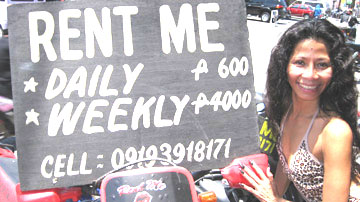
Renting her services on a daily or weekly rate will help fight global warming, says Angeles bar girl

In solidarity with thousands of world organizations, bar girls working the fabled strip in Angeles City, Philippines are making themselves available on the street with prices clearly posted. Available for daily or weekly rates, women working the bars are now available to passersby, who now don’t even have to walk into a bar. “Those clubs use lots of electricity for music, air conditioning, and lighting,” says one bar girl. “Thousands of us have banded together to lessen our global footprint. The customers’ haggling over prices has caused too much hot air in the clubs, increasing the power needed for the additional air conditioning. To solve the problem, we’re going green by putting our prices right on the street, in plain view. If greengrocers, lemonade stands, and gas stations can openly post prices, so should we.”

Asked if she would consider posting hourly rates as well, the comely lass we interviewed responded “We’re not doing this to make it easier for Cheap Charlies. If they’re looking for an hourly rate, tell them to put their banana into a parking meter instead. We’re going green, so have some respect.”

By some estimates, as many as 10,000 bar girls work the Angeles City bar strip. It would appear that if the rest of the world reflected a similar eco-consciousness, the dangers associated with global warming could be, in short order, merely a dim memory.