The sharper edge to traveling in Asia

Why is my expensive Thai hotel is ripping me off with a 10% dining-in service charge?

Written By: herbrunbridge - Aug• 11•13

pafaranghalo[1]The Good Manner: Advice on Thailand from WoWasis’ Pa Farang

This week’s scam unveiled: My expensive Thai hotel is ripping me off with a 10% dining-in service charge

Dear Pa Farang,

I routinely stay at one of the top Western hotels in Thailand, and eat frequently at its top restaurant.  Each time, a 10% “service charge” is added to my bill, and my server insists it doesn’t go to the wait staff, but instead is shared among all hotel staff.  Who really gets the money?

– Frequent Guest

Dear Frequent Guest,

It differs by hotel, and each has its way of doing things.  I’m not sure if “all hotel staff” are getting anything, but I’m quite positive your server gets none of it.  What follows is my educated guess…

Your retaurant is not owned by the hotel.  Instead, it pays rent to the hotel.  This could be a flat monthly fee, a percentage of net profit, or a percentage of gross receipts.  It could even be a combination of all three.  I suspect yours pays 10% of its gross receipts as rent.  A convenient way to pay the fee is to charge the customer a 10% surcharge, which means you, effectively pay the restaurant’s rent on top of what you pay for the meal.  Any “hotel staff” who asks where his or her “service fee” money is will probably be summarily sacked as a troublemaker. The staff are not ignorant, and will refuse to jeopardize their jobs by asking to actually receive the fees which are allegedly collected on their behalves.  You, on the other hand, are quite possibly on expense account, so you may not ask too many questions either.

ThailandPromoBannerFact is, you’re being dunned twice, once for the tip to your server, again to pay your restaurant’s rent.  If you want to ensure that your server does indeed get a tip, give him or her paper money by placing it in his or her hand. If you place the paper money tip on a plate or in a leather credit card envelope, it will either go directly to management, or be shared among all restaurant staff. That restaurant managers worked their way up through the system, and generally speaking, believe they deserve the tips left in plates and charge envelopes. After all, they were victims of this unfair systems once themselves.

If this situation angers you, vote with your feet and go elsewhere.  And yes, we consider 10% meal service fees a scam.

Avoid all scams, show the Good Manner, and have a great time in Thailand.

Marayat dee,
– Pa Farang

Read Pa Farang’s other columns in WoWasis for more advice on relationships and cultural matters in Asia

WoWasis Book review: ‘Bangkok Haunts’ Bangkok Fiction by John Burdett

Written By: herbrunbridge - Aug• 10•13

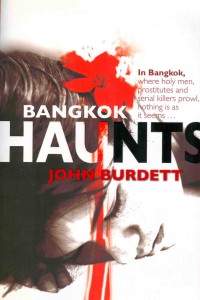
BurdettBangkokHauntsBangkok Haunts (2007, ISBN 9780-5930-5544-1) is the third in writer John Burdett’s Detective Sonchai series, in which Sonchai, a colorful character in the Bangkok Fiction genre,  attempts to get to the bottom of the death of an ex-lover, with other-worldly implications. Burdett’s protagonist, a Royal Thai Police detective operating in Bangkok’s District 8, offers up the tale in a first-person narrative, and his life is an amalgam of the crazy world that makes the city so compelling. His mother runs a nightlife bar, and Sonchai operates as a sometime-manager (prostitution, incidentally, is illegal in Thailand). Lek, Sonchai’s police assistant, is a man undergoing gender reassignment. We here at WoWasis appreciate the verisimilitude: It’s common knowledge that Bangkok police are heavily involved in the bar-girl industry. All clubs make payoffs to keep under the legal radar, and one police family-owned bar we know of was actually able to keep the lights on during a recent power outage that covered the entire block. It pays to know people on high (and low) places.

The tale here involves the investigation of a snuff film, and touches on the relationships among a powerful Thai business leader who operates above the law, the police, an international crime syndicate, a non-traditional monk with Cambodian Khmer Rouge links, and the FBI. Sonchai’s insistence on solving the crime is accelerated by the fact that he had a personal relationship with the murdered woman. Burdett introduces the reader to the Thai concept of gatdanyu, ( กตัญญู ) which holds those who have received favors to a lifelong responsibility to protect the interests of those bestowing the favors. Aside from being a riveting, well-written book, Burdett’s references to widely-seen but little-discussed aspects of Bangkok life, including aroma inhalers, motorcycle taxi jackets, and the ancient “elephant game” execution motif add fascinating elements to the story that will please those interested in Thai cultural elements.

From our perspective, the ending requires a suspension of skeptical, atheistic, and free-thought beliefs, and will appeal more to faith-based readers, those who believe in ghosts (virtually the entire Thai population), and Theravada Buddhists. Overall, Burdett’s a cerebral writer that his done his homework. His acknowledgements include a number of important books he cites that cover Thai politics and culture. This is a terrific crime novel that neatly wraps up another Thai saying, som nam naa (สมน้ำน่า  serves you right!).

WoWasis book review: Haruki Murakami’s Japanese novel ‘Norwegian Wood’

Written By: herbrunbridge - Aug• 08•13

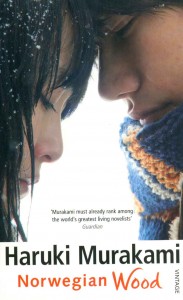
MurakamiNorwegianHaruki Murakami is Japan’s best-selling novelist, and he’s a master of description and psychology. Norwegian Wood (1987, ISBN 978-0-099-55454-7) is a masterfully told coming-of-age story in which a number of students attempt to find their way in a complex world, buffeted by personal relationships, hormonal onslaughts, and the complex factors involving transitioning from adolescence to adulthood.

Make no mistake, the characters are practically all emotional trainwrecks, but for us here at WoWasis, it was a bittersweet reading, as it caused us to reflect on our own actions when we were the age of the people who make up most of this narrative. We made many of the same mistakes, especially concerning relationships we’ve had with people that contributed little but sorrow to our lives, and yet, driven by youthful compulsions, were unable to avoid. As Murakami so skillfully writes, those relationships always seemed to have enough blue sky in them that the dark clouds were somehow always overlooked. Mature readers will no doubt look back on their own lives, happy that they’re no longer 20.

The young intellectual Watanabe is the protagonist, and the star-crossed Naoko is his major love interest. He journeys with her through her path to a sanitarium, waylaid along the way by Midori, a self-centered siren who alternately teases and professes her love for him, and Nagasawa, a worldly student on the fast-track to a career in international diplomacy. Plenty of other characters appear along the way, perhaps none as compelling as Reiko, an older woman who shares the room in the country retreat along with Naoko. Reiko’s story of being seduced by her female thirteen year old piano student is chilling.

Japan-290x200There are plenty of deaths in this tale, and seemingly, no one gets by unscathed. Except perhaps Reiko, who being a decade older than her friends, has, by the time the book ends, appears to be finding her own place in Murakami’s turbulent world. The songs she plays on her guitar include the title song of this book, and her musical acumen provide an arty vehicle through which the action progresses. She was our favorite character. The book is a masterpiece of psychological fiction, and we recommend it. Buy it now at the WoWasis eStore.

WoWasis book review: ‘Confessions of a Yakuza’ by Junichi Saga

Written By: herbrunbridge - Aug• 07•13

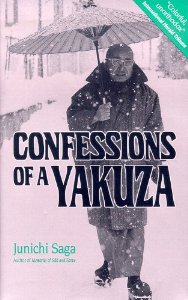
ConfessionsYakuzaAt one point, former Yakuza Ijichi Eiji came into physician-writer Junichi Saga’s world as a patient, and thus began a series of conversations than turned into the memoirs  that became the remarkable book Confessions of a Yakuza: a Life in Japan’s Underworld (1991, ISBN 978-4-7700-1948-6). The narratives detail the path taken by Eiji to become an underworld gambling boss. Along the way, we meet his colleagues, enemies, and women, and learn the code under which he lived.

Most of the action here occurs in pre-WWII Japan, although his tale of the looting of war stores after the allied takeover is interesting in itself. There are many memorable tales and elements discussed in the book. The pre-war flophouses where unfortunates eked out a meager existence; the ethics of gambling, police interrogation techniques, including the use of triangular sticks upon which the prisoner was forced to sit while weight was applied. The story about intimidating his future wife’s mother into giving her permission is outstanding, as are the several pages recounting how the evening’s gambling profits were divvied up among Yakuza bosses and their underlings. Particularly fascinating to us here at WoWasis was the story of how men would broker off their wives to brothels to gain money to gamble.

Japan-290x200The book holds special appeal to students of Yakuza, the underworld, and Japanese culture, but is highly recommended to anyone desirous of reading a fascinating tale of adventure centered on a world with which few are familiar.  Buy this book here at the WoWasis eStore!

WoWasis Book review: ‘38 Million Dollar Smile’ / ‘Bangkok Free Fall’ by Richard Stevenson

Written By: herbrunbridge - Aug• 04•13

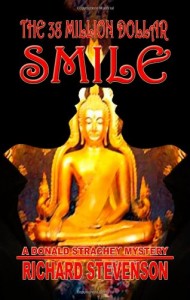
Stevenson38MillionLargeRichard Stevenson is the nom de plume of Richard Lipez, an American author best known for his series of novels involving the world of private eye Don Strachey. Here at WoWasis, we’re always looking at new twists on the Bangkok Fiction genre. The ‘bar girl meets western man’ theme has been covered in dozens of books, so Stevenson’s 38 Million Dollar Smile (2009, ISBN 978-981-08-6409-5) is a refreshing difference. In fact, there’s not a bar girl in this Bangkok-based novel. The main protagonists — like the author himself — are gay. And instead of the classic Bangkok target adult venues such as Nana Plaza or Soi Cowboy, they visit Dream Boys, a well-known gay boy show club on Soi Twilight, adjacent to Patpong Road. The book, incidentally, was also published under the title Bangkok Free Fall in 2010 for distribution in Asia.

The story involves a wealthy Eastern U.S. family and their wayward son, who seems ready to abscond with the family fortune and donate it to a somewhat shady Thai group that has promised to build a large Buddhist center near Suvarnabhumi airport. The family hires Strachey to visit Thailand, meet with the son and figure out what’s really going on. In standard Thai fashion, though, people are “committing suicide” by being thrown off high-rise buildings, some influential police figures are involved, and Strachey and his partner Timothy are imperiled virtually as soon as they arrive.

ThailandPromoBannerThe book is a fun read, with plenty of gay banter, lots of inside references to arty material (“It’s Chinatown, Jake”), a ladyboy associate, and a witty wisecracking Thai private eye, Rufus Pugh, our favorite character. The book will appeal to anyone willing to enjoy a departure from traditional Bangkok fiction. Much of the dialogue is reminiscent of what you’ll hear in drag shows in the United States, so be prepared for something really different, humor-wise. We found it ultimately to be an enchanting, wonderful take on Thai crime and culture. Buy 38 Million Dollar Smile now at the WoWasis eStore.

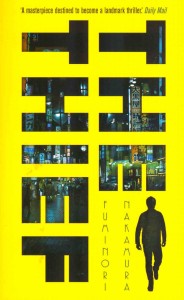
WoWasis book review: Fumitori Nakamura’s Japanese novel ‘The Thief’

Written By: herbrunbridge - Aug• 03•13

NakamuraThiefNishimura, the lifelong pickpocket in Fumitori Nakamura’s novel The Thief (2009, ISBN 978-1-47210-695-7) is the embodiment of nihilism, to such an extent that his name appears fewer than ten times in the book. He loves no one and compulsively plies his trade in return for the small amount of joy it gives him. The one person he ends up caring for, a young boy with a worthless mother, he befriends by first teaching him how to be a more effective shoplifter. Eventually he makes an attempt at moralizing to him, then creates a situation in which he can succeed in a foster home.

Nakamura’s terse style of writing is well-translated by Satoko Izumo and Stephen Coates, and many of the most compelling passages detail the sartorial aspects of the perfect shoplifter, from the prosperous-looking clothes to the secret pockets sewn into coats. The author leaves out nothing in terms of pickpocketing technique.

Japan-290x200Eventually, the protagonist falls into the omniscient clutches of Kizaki, a mastermind criminal, a political killer well-beyond the purvey of street-level Yakuza. Kizaki is the éminence grisewho determines Nishimura’s fate, which involves two elaborate schemes, and a wild Japanese sex club. In an interesting and somewhat subtle twist, a robbery is conducted by Japanese gangsters pretending they’re Chinese, right down to fake accents and disguised jackets laden with body odor. Could this be a cultural statement? After all, Japanese are known for their bathing habits. In Japan, do Chinese have a reputation for being hygienically not up to snuff?

The book is a masterpiece of crime fiction, and we recommend it. Buy it now at the WoWasis eStore.

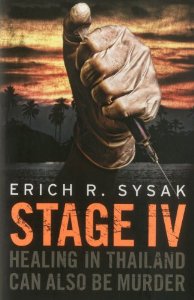
WoWasis Book review: ‘Stage IV’: cancer and death in Thailand by Erich Sysak

Written By: herbrunbridge - Aug• 02•13

SysakStageIVHere at WoWasis, we’re always looking at new twists on the Bangkok Fiction literary genre. The ‘bar girl meets western man’ theme has been covered in dozens of books, so Erich R. Sysak’s Stage IV (2011, ISBN 978-981-08-5435-5) really caught our eye. It’s not often a guy dying from cancer gets to be a book’s hero. And truly, Lawson Banks, Sysak’s protagonist, must set a record in fiction for most vomits, pusses (not ‘pussies’) bleeding sores, and cancer-related what-not, per 223 pages, the length of this book.

The action takes place primarily in the Thai seaside towns of Pattaya and Hua Hin, revolving around Banks, who has essentially come to Thailand because of its proximity to inexpensive drugs that will keep him alive, prohibitively expensive in the United States. His love interest is Benz, a Thai woman whose familial problem have come to involve a crooked Thai policeman, eventually ending up in her emptying Lawson’s bank account. Sysak does know his cancer, incidentally:  small details like PowerPorts embedded in the chest that prevent veins from being destroyed by noxious anti-cancer agents give him instant “cancer cred.”

The nastiest twist to the story involves a viatical settlement, a term used to describe a situation in which an insured who is terminally or chronically ill sells his or her existing life insurance policy to a third party for more than its cash surrender value, but less than its net death benefit. The original policy owner with a lump sum, while the third party becomes the new owner of the policy, pays the monthly premiums, and receives the full benefit of the policy when the insured dies.

ThailandPromoBannerIn this novel, Lawson has sold his policy, lived beyond his predicted two years, and as a result, the nefarious group that bought his policy determined it would be in its best financial interest to kill him. But he’d gone off the rails and disappeared, so they’d have to find him first.

Sysak delivers a whole range of bad guys, some interesting elements of Thai village culture, and a plot that moves well. It’s not a book without flaws, particularly in the manner in which the author handles flashbacks, which he moves in and out of without asterisk or subchapter breaks, and instead just continues the text with a new paragraph describing past action. This frustrating element of the book caused us to stop and re-read to ensure we doze off and miss something. A good editor would have caught and fixed it.

Nevertheless, Stage IV is a good read, and a pleasant break from much of the recent “bar girl and detective” fare that’s been distributed out of Southeast Asia. Buy Stage IV now at the WoWasis eStore.

Bachelor in Bangkok: Khun Lee on rude Western women and weak Western men

Written By: herbrunbridge - Jul• 31•13

BachBKKLKee1cI just returned from my twice a year pilgrimage to the gates of hell (United States) and the jet lag lingers on and on.  It’s amazing that I lived my first 43 years in the USA and I still feel like an outsider when I return to visit.  Let me tell you that those poor clueless bastards (I am referring to the men) there are being led around by the nose by the domineering women.  Never in my life have I seen so many weak, desperate, pathetic men.  I really am surprised any of them can even get an erection they are so lacking in masculinity and self-esteem. 

My friend Jim who I have known for 40 years was supposed to pick me up at the airport, but upon my arrival there was no one to greet me.  When I phoned him he was stuttering on the line and said something like “err my girlfriend doesn’t like it when I go places without her, and she isn’t here at the moment so I never left the house.”  What a pathetic wimp. He then went on to explain that if he ever does something to piss her off, he has to sleep on the couch for a week.  I told him to f*ck off in no uncertain terms and paid for the $70 taxi ride to my home.  Yes, both cars and fuel are cheaper in the USA than they are in Thailand, but a 15 mile taxi fare is $70 there and $7 in Bangkok.  Welcome home you schmuck is what I was thinking at the time. 

My first night in America I went to a small local bar with a friend who recently sold his software company to Microsoft and is so rich he doesn’t know what to do with all of his cash.  He started explaining to me that there was a really hot new bartender at this place and all the guys in his group had already been shot down in their attempts to get a date with her.  We proceed to grab a couple bar stools and when I look up an over-flowing glacier of a woman is oozing toward us from behind the bar.  Just as I was about to joke with my mate that this couldn’t possibly be the hottie that he was going on and on about but perhaps this monster has eaten her, his face lights up like a Christmas tree and he says “ Khun Nana let me introduce you to Debbie.  Debbie, this is Khun Nana.  He lives in Thailand, but when he is in town he will be hanging out here a lot.”  This beast looks at me with disdain and mumbles to my friend “Are you trying to introduce me to this person?  Listen it’s busy in here so what will you have?”  We give her our drink order and I turn to my friend and ask him why she was so rude to us, and his response was that he didn’t think she was being rude at all!  Yes dear readers, in my lovely hometown of Washington D.C. rich educated guys are chasing and being rejected by fat, rude water buffalos and the poor clueless bastards don’t even know that there is another world out there, a world filled with millions of beautiful, sexy, approachable women who are polite and cherish men.  Why do I ever leave Thailand?
ThailandPromoBannerWe local guys are often the recipients of the free entertainment that results from western men coming on holiday to Thailand and throwing all of their money at the local lasses.  Now it is not my intention to whine about all the free sex I get from gals who have idiots overseas sending them money, or to complain about all the laughs and chuckles I have watching these guys go down in flames.  However, some of these men are ruining their life by flushing needed money down the toilet so I would like to offer the following insights about giving lump sums of money to gals who you barely know:

1) No matter how much money you give a gal she will never like you any more for it. Either she likes you or she doesn’t and no amount of money will change that.

2) If you give her a reasonable sum of money and she asks for more, I guarantee that she doesn’t like or respect you at all.  Thai gals are very aware of the fact that repeated requests for money will be viewed as mercenary and selfish and they will not do it if they want a future with the guy.  If she repeatedly ask for money than she views you only as a customer.

3) You don’t need to “save” her. Believe it or not, most Thais are much happier than westerners and they have a good life here.  If she is working in the naughty nightlife industry then she is already making 3 to 10 times more than all of her non-working peers at home and she doesn’t need your charity.  Don’t think you are doing her a favor trying to move her to the west as 99.9% of Thais would much rather live in Thailand than any other country, and she will consider it a SACRIFICE moving to your country.

4) If you absolutely insist on giving money to some gal in spite of all of the evidence that it is a huge mistake, then do it the way a Thai guy would.  Bring her into your trust slowly.  Give her absolutely no money the first few months and then start to help her a little at a time as you see that she has genuine feelings for you.  If you throw money at her from day 1 then you will NEVER know if she actually cares for you or not. Also Thai women want a strong man for a partner and if you are stupid about throwing money around then she will view you as weak and good for nothing other than money. 

One thing I love about Thais is that unlike westerners, Thais can be very happy while earning little or no money.  I am reminded of a day I was having a beer in a small cocktail lounge in Bangkok a few years before I took the plunge and moved here permanently.  There were 5 gals working and 4 were quite young and one was clearly the oldest.  One of the gals asked me why I would give up a high paying job in the USA in order to move to a poor country like Thailand.  I was still pondering my reply when the oldest gal said “I know why.  Because in America everybody rich and nobody happy, but in Thailand nobody rich and almost everybody happy.”  Yes, that most certainly is the reason and I couldn’t have said it better myself.

Read Khun Lee’s other WoWasis columns for more advice on navigating the adult dating scene through the backstreets of Bangkok

Tourist complaints increase in Japan as Nikko’s historic sites are renovated

Written By: herbrunbridge - Jul• 31•13

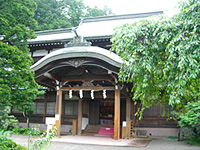
Toshogu Shrine

Toshogu Shrine

Japan is undergoing renovations of major historical buildings all over the country, but in the eyes of many visitors, it’s most apparent and frustrating in the city of Nikko, two hours north of Tokyo. Shrines and Temples of Nikko is a UNESCO World Heritage site consisting of two Shinto shrines and one Buddhist temple (Futarasan Shrine, Toshogu Shrine, Rinnoji Temple) and their surroundings, including 103 buildings, of which nine are classified as National Treasures, and 94 as Important Cultural Properties. Several of the most compelling structures in Nikko are undergoing various forms of renovation, which often involves enclosing an entire historical structure in a steel barn or other opaque coverings.  

In addition to the renovation frustrations, the popular 3-in-1 tourist ticket has been discontinued, meaning the three sites will now cost between 300 and 900 yen each, versus 1,000 yen for all three. A recent WoWasis trip to Japan revealed that Nikko seems to be at the top of many visitors’ complaint lists. While Japan deserves appreciation for keeping its most prized visitor sites in good repair, it does cause frustration for tourists, and Nikko’s most significant repairs won’t be finished for several years.

AsiaPromoBannerRenovation at the Yomeimon Gate at Toshugu Shrine, an iconic structure, began this past June, while at the main hall at Rinnoji Temple, pest work has just begun. This will lead to an expanded, overall repair initiative, now that entry restrictions are in place.   In addition, Futarasan Shrine will begin renovating its main hall in Spring, 2014. The work on all three sites is estimated to be finished in six years.

These repairs have brought a temporary end to the 3-for-1 ticket to these three sites, a ticket that has been in existence since the Meiji (1968-1912) era.  As was recently reported in the Yomiuri Shimbun, the two shrines recommended suspending the common ticket due to the fact that so many of the buildings on their sites are under renovation. The management of the shrines and the temple had reached a tentative agreement to collect their own separate ticket fees, with the Toshugo Shrine agreeing to help subsidize repairs in the other two sites. Management of Rinnoji Temple, however, has balked, as it was depending on revenue from the common ticket to pay for the lion’s share of its renovations. As the argument goes, if visitors have their choice as to which sites are now most worth seeing, they may very well ignore Rinnoji.

Thus, there is a two-pronged problem in Nikko. An increasing number of structures in these sites are being functionally lost to visitors for varying periods of time, and the attractive joint ticket has been abolished. It remains to be seen how ultimately this will affect funding for renovating these three important sites at Nikko, but tourist grumbling has already begun.  

WoWasis tours Tokyo by bicycle

Written By: herbrunbridge - Jul• 28•13

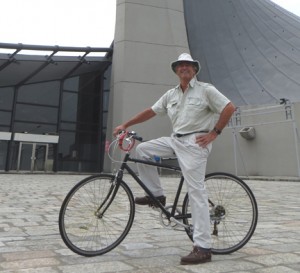
GBikeTokyoSmall BTo us here at WoWasis, it first the concept of seeing a lot of one of the world’s largest cities by bicycle in one day sounded absurd. Tokyo isn’t laid out on a grid pattern, so following a map and doing on your own is problematic, especially considering the constant traffic. But doing it alongside another bicyclist who knows the city, and it’s terrific! There are several companies offering bike tours of Tokyo (see below), but we went with our friend Lennie Mace, an expat artist who’s lived in Tokyo for years, has a passion for architecture, and travels by bicycle just about everywhere.

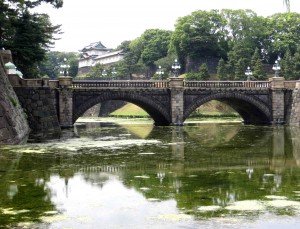
Tokyo's Imperial Palace

Tokyo’s Imperial Palace

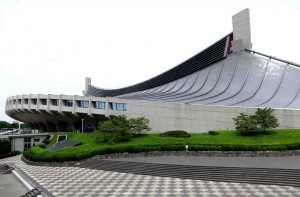
Over a six-hour day, we biked 20 kilometers. Beginning in Shinjuku, we first viewed the amazing Olympic architecture at the Yoyogi National Gymnasium, designed by architect Kenzo Tange, and built in 1964. Riding east, we stopped at the ancient Meiji-jingu Shrine, then biked to the Meiji Memorial Picture Gallery, a magnificent Taisho-era structure completed in 1925. The beautiful grounds of the Imperial Palace were next, where we de-biked and took a lovely walk. We next headed southeast to the Ginza district, and pedaled through to the legendary Tsukiji Fish Market. We arrived there in the early afternoon, well after the auctions and most commercial activity had taken place. This gave us an opportunity to bicycle through the building, something that wouldn’t have been possible earlier in the day.

Yoyogi National Gymnasium

Yoyogi National Gymnasium

After the market, we crossed the Nijubashi Bridge and over the Sumidagawa River, for a view of Tokyo Bay. We re-traced our ride through Ginza to stop briefly at the historical Diet building, then ended our day at the Hiejinja Shrine. The whole trip took six hours, allowing for numerous stop-offs at historical shrines, parks, and buildings, as well as an hour for lunch.

Traffic-wise, it was wonderful, as Tokyo drivers are used to bicycles, and getting around the city was easier than we could ever have imagined. Biking Tokyo made for a memorable day, and we recommend it. Here are two companies that offer Tokyo bicycle tours:

Tokyo Great Cycling Tour Office
1-3-2, Shinkawa, Chuo-ku, Tokyo, 104-0033
Tel +81-3-4590-2995 (International)

Tokyo Bicycle Tours
Tel: 080-3209-9996 (in Tokyo)

AsiaPromoBanner