The sharper edge to traveling in Asia

Visit a traditional longhouse in Sarawak, Borneo while you still can

Written By: herbrunbridge - Jun• 07•10

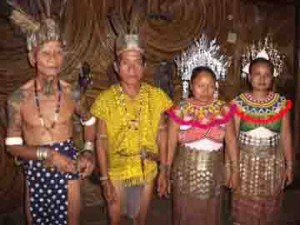
Serubah Chief Saong and friends

Visiting a Dayak Longhouse is, by everyone’s account, one of the highlights  of a visit to the state of Sarawak, Borneo. Some westerners, though, have an aversion to “roughing it,” and elect to go for a day visit, rather than an overnight stay.  This is a mistake for several reasons, the chief of which is that this simple way of traditional life will soon disappear as Dayak children will become inexorably immersed in mobile phones, computer games, and rap music.  The change hasn’t hit yet, but it will, just as it has in other traditional world cultures. Our recommendation?  Go with a guide, stay overnight, have a drink with your hosts. 

Go with a guide 

We once made the mistake once of visiting the Ana Rais Longhouse in Borneo without a guide.  This can easily be done, just drive up to the ticket booth, pay 20 Ringgit or so, and step on up.  You’ll be able to appreciate the architecture, true enough, but the people won’t be welcoming, as you’ve got no one to establish protocol for you.  It really is important, from a hospitality perspective, to follow protocol, meet the chief, bring a small gift or two for the village, and get introduced. 

A couple of months later, we hooked up with a guide who took us to Kampung Serubah, 100 miles or so east of Kuching, up the Lemanak River, at GPS N01°13.969’  E111°45.852’.  The Iban longhouse there, consisting of 24 apartments, is only 7 years old, but is a wooden structure built in the tradition.  Chief Saong, some 80 years of age, was a gracious host, and performed a traditional warrior dance along with his sword, which originally belonged to his grandfather, and had taken many heads.  Yes, heads taken in past raids are prominently displayed in the longhouse, but their sooty, aged appearance camouflages them a bit.  They remain a token of luck and tradition (see James Ritchie’s headhunting articles on headhunting ritual and curing techniques). 

We would not have been welcomed as well without our guide Anna, to be sure, and we feel a good guide is essential. 

Stay overnight 

So what will you miss if you leave before dark?  You’ll miss the remarkable quiet of the longhouse shutting down after a long day.  The working men come home in their boats, the women prepare dinner and corral the children, and the only sounds are human voices and maybe a distant generator.  When the generator shuts down, a few kerosene lamps warm up the night, and voices can be heard laughing, talking, arguing, as they have for generations.  The evening in traditional longhouses is a time to get together for good talk and cheer, and the old people are an essential part of the mix, as they reminisce.  Those of us from industrialized nations might have only read about this type of evening life in books, and our guess is that it will be gone in 10 years.  Experience it now, while you can. 

Have a drink with your hosts 

Longhouse people enjoy good cheer, and you’ll be treated to traditional dance and music.  If you’re fortunate, the elders will dance and sing for you, and they enjoy performing for guests who appreciate their traditions.  By arrangement, tour groups provide money to longhouse committees to keep up longhouse repairs, and help pay for longhouse events and rituals.  Your guide will stop at a store and ask you to buy simple food gifts like crackers, biscuits, and candy, and we found watching the in-longhouse distribution channel a fascinating thing in itself, as no one gets left out.  You will be offered a glass or two of rice wine, tasty and not overly strong.  Please consider drinking with your hosts as a matter of conviviality, and buy a bottle, too.  It’s only 5 ringgit or so, and you can then share as you pour for your hosts.  In doing so, you will have bridged the gap between onlooker and host, and will have a rich experience you’ll remember for months to come. 

In conclusion 

There are 4000 some-odd longhouses in Sarawak, Borneo, Malaysia.  Some are concrete, some are traditional wood.  We like the wooden ones, and we like staying overnight.  Bring a few simple toiletries, a rain poncho, and little else.  Food, water, and simple bedding will be provided for you.  Visit Malaysia Oasis’ Tours pages for some great Longhouse visiting options, including the tour we just described on the Lemanak River.

Arts, Crafts, and Cooking classes in Kuching, Malaysian Borneo

Written By: herbrunbridge - Jun• 07•10


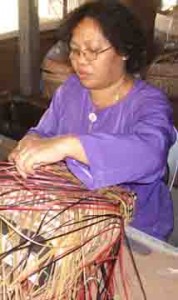
Weaving class at Sarakraf

A great way to enhance your stay in the city of Kuching, Sarawak is to take a cooking, crafts, painting, or traditional dancing class. 

These are affordable and taught by affable experts who speak English, and Melton Kais’ painting classes can even include a home stay on premises if you wish.  

Cooking, Crafts, Dancing, Chinese Calligraphy Classes 

Sarakraf Pavilion
Lot 78, Section 43, Jalan Tabuan
Tel: 082-258-771
www.sarakraf.com.my
GPS N01°32.590’ E110°21.256’
Sarakraf is one of the great experiences in Kuching.  Crafts classes are offered during the week, and dance classes on weekends.  Courses include ceramics, batik, bead work, and bamboo weaving.  Cooking classes are available upon request.  You may also buy crafts there as well. 


Painting and Drawing Classes
 

Galleria
Wesberly House
Lot 2812, Block 195, Rubber Road West
Tel: 082-429-361
www.wesberly.com.my
GPS  N01°33.090’ E110°19.816’
Melton Kais is a fine local painter and professor of art who provides painting classes twice a week.  He can also craft a curriculum for you for more intensive work, and you can even stay at the nicely-appointed Wesberly House above his gallery and studio.  This is a great way to “get away” in Kuching, and have a wonderful art experience as well.

Letter from Melaka: Malay nightlife and culture as viewed from Jim’s Cottage Pub

Written By: herbrunbridge - Jun• 07•10

Tiger Beer Girls Jennifer and Sandra

Jim’s Cottage Pub is at the eastern end of the city of Melaka (Malacca), Malaysia, way past all the points of interest to tourists.  Here, the barmaids are pretty much all past a certain age, wear miniskirts, drink and smoke with the customers, and don’t muck around with them.  It’s strictly old-world convivial, where no one’s got “attitude” (that tend to get waylaid east of the dateline, anyway.)  Walls are covered with black and white pictures of old western movie stars, but no one working there can identify many of the actors. Sharon, whose partner owns the bar, tells me that the original owner put them up, but when he died, the knowledge of who these folks were died with him. Still, the pictures stayed. 

Who’s Jim?  “He was the brother of the original owner, who gave him the money to start the pub.”  Why are beers so expensive in Malaysia ($3 a bottle, double the price of a beer in any other SE Asian country). “The country is Muslim, so they tax, tax, tax, cigarettes and beer, because they don’t want poor Muslims to spend their money that way.  Chinese people drink and smoke, so they tax.”  

She continues: “Muslims always have a lot of children, so very poor.  Don’t believe in birth control.  Chinese, have few children, always want the best for their children.”  So Sharon’s nailed overpopulation as the cause of many of the miseries in today’s world, from behind her little bar in Melaka.  There are 22 ethnic groups in Malaysia, but many consider themselves Chinese or Muslim, and that’s how the country socializes, and does business.  Jim’s has an unusual schedule, closed Saturday and Sunday nights.  “We’ve been open 18 years, the oldest bar in Melaka.  Two years ago we realized that Chinese people stay home with their families on Saturday, so no one came to the bar.  Since then, only open Monday through Friday.” 

Jennifer and Sandra, two Chinese Tiger Beer girls walk into the bar.  Their job is to encourage customers to drink their brand, pour their beers, and converse a bit.  They’re paid straight salary, and bring a time sheet into the bar, which is stamped by the management, confirming the amount of time spent at the bar.  After an hour or so, they’re off to another bar, in their matching Tiger Beer dresses.  Jennifer is 31, unmarried, no children.  She helps her mom in the family restaurant by day, then earns more at night, supporting the family, and obtaining some spending money.  On her way out, she leaves a Tiger Beer promotion: red money envelopes for the upcoming Chinese New Year, emblazoned with the Tiger Beer stamp.  “For good luck”, she says.  For us and for her. 

We’re happy to be in a Muslim country again, regardless of the beer prices. The basic friendliness and decency of the Muslim people is something we realize we’ve missed.  We’ll visit a historic mosque, and a caretaker will greet us. “Where you come from?”, but I sense he already knows.  “America, US”, we tell him.  There’s always a look of disbelief, that a Yank is coming to the mosque to enjoy its architecture and history.  Thousands of words are unspoken, but this is ground-floor diplomacy, as we both understand that regardless of what’s on the front pages of the world’s newspapers, we enjoy each other as individuals, regardless of politics and propaganda. 

In fact, Yanks aren’t coming to Malaysia at all, it seems. Aussies, tons of Brits, Scandinavians.  Malays tell me it’s because people in the U.S. are afraid of coming to a Muslim country.  Jennifer, the Tiger Beer girl:  “You know, we are not terrorists; we do not like terrorists, and Americans are welcome!  Maybe Americans think Malaysians are all poor, but we have modern cities like Kuala Lumpur.  They should come.”  

Everywhere, Malays have been encouraging us to invite all Americans to come to Malaysia.  They’re building a country that already has a pretty good tourist infrastructure, and a better-than-average transportation system. Small cities like Melaka and George Town are jewels.  We have to agree, though. Yanks are spooked about 9/11, and those who are aware of the turmoil in southern Thailand believe (rightly or wrongly) that those deadly and dramatic events are propelled by forces in northern Malaysia. 

What it all comes down to is that this is a very god time for westerners from any country to visit Malaysia. It’s cultured, beautiful, and full of friendly people willing to share their view of the world, and one, we think, that isn’t represented much by what’s generally seen on western television.

WoWasis Book review: Timothy Hallinan’s ‘The Fourth Watcher’

Written By: herbrunbridge - Jun• 07•10

Following up on his excellent novel A Nail Through the Heart, Timothy Hallinan’s The Fourth Watcher (2008, ISBN 978-0-06-125726-1) is a continuation of the ongoing saga of travel writer Poke Rafferty and his family, ex- bar girl Rose, and adopted daughter Miaow. 

Hallinan is rapidly becoming a fixture in the Bangkok Fiction genre, whose prosaic descriptions of the city of Bangkok are interwoven with a keen sense of drama and a good understanding of the underpinnings of Bangkok’s street powers structure. 

In Watcher, what begins as a relatively innocent game of cat-and-mouse, played with a cloak-and-dagger acquaintance, soon escalates into a dangerous game involving counterfeit money, abutting on international financial politics. Rafferty’s long-lost father is introduced, and his uneasy relationship with his long-absent parent is an ever-present element in the story. Non-traditional — from western eyes — relationships are a hallmark of Hallinan’s books, and again, Rafferty’s family and friends are imperiled by the ongoing series of events that continually escalate throughout the book. 

Hallinan tantalizes the reader with interesting characters, from Treasury agent Elson, who evolves from a nemesis to an ally, to Thai business owner Peachy, a gambling aficionado trying, with mixed success, to elevate her professional standing. 

As with the previous book, Watcher is a real page-turner, and we found ourselves delaying other important tasks to find the time to finish it to see how it would all play out. 

A couple of characters from Heart are missing, the street urchin Superman, and the memorable punter Getting Younger Man. We would enjoy seeing their return in future Hallinan novels, and word has it that the author already has plans for the latter’s involvement in a subsequent book. 

All in all, Watcher is a fast-paced book that we found to be a compelling read, and an excellent addition to any Bangkok Fiction library. Buy it now at the WoWasis estore, powered by Amazon.

Massage parlors for men in Vietnam: the good, the bad, and the ugly

Written By: herbrunbridge - Jun• 06•10

Vietnamese streetside massage shops offer everything from foot massage to manual stimulation, but do not offer full service, in sexual terms. Read on, as our handy guide will help you to navigate this labyrinth of services and to get what you’re paying for.

The good

Streetside stall massage shops typically offer body, face, and foot massage, at extremely reasonable rates.  For body massage, you’ll remove your shoes and shirt (if a man), and shoes only if a woman.  The massage is non-sexual, and pretty much the whole experience is in full view of passersby.  During your massage, you’ll be asked if you’d like to buy a facial, manicure, pedicure, or a haircut, at affordable prices.  Service is generally terrific, for these girls operating on commission only.

The bad & the ugly

Hotel-based massage parlors, and establishments dealing in massage only cater to males exclusively.  Here, you’ll pay an entry fee, typically 60,000 VND ($4 USD), which includes steam room, sauna, shower, and a one-hour body massage.  Three-star hotels and above charge different fees for Vietnamese than Westerners.  A typical hotel we know charges $15 USD on the rate card.  Flip the rate card over (if you’re savvy), and you’ll see the same service offered for 75,000 VND (equal to $5 USD).

It gets worse.  As a Westerner, you’ll be given the oldest masseuse in the establishment, because younger masseuses are reserved for Vietnamese men, who would complain if offered otherwise.  Your massage room will have a window on the door that allows management to monitor your masseuse.  Since many massage parlors are government-owned and controlled, girls are under threat to be fired if caught doing anything naughty.  You will get your 45 minute massage, after which your masseuse will ask you if you’d like “special service”.  She’ll quote you up to $30 USD for a hand-job.  Prices can usually be bargained to 100,000 VND (roughly $12 USD), but service is uniformly poor throughout the country.  This activity is illegal in Vietnam, and its practitioners rarely provide “service with a smile,” as they are constantly watching the window in the door  to see if they’re being spied upon.  To provide additional cover-up, they will place a large towel over their hands, and you.  Girls in this line of business are relatively unsophisticated, sexually, and they have mixed feelings about being in this line of work.

We’d suggest you opt out of any sexual peccadilloes, and finish your legitimate massage, without sexual services. Masseuses will expect a tip, and 50% of the entrance fee, where no sexual service is obtained, is considered fair.  Expect a grumpy face when you give your 50% tip, (plus or minus 30,000 VND, depending on entry fee), as you were expected to tip the going rate for sexual services.

Do take a look around as you exit to see if dodgy characters are following you. Occasionally, girls will phone their boyfriends loitering outside, telling them about the Westerners who didn’t live up to their financial “obligations.” If you notice nefarious persons, stick to well-lighted, well-traveled streets, and don’t telegraph the whereabouts of your hotel.

Our recommendation

In our opinion, sexual services in Vietnamese massage parlors are rip-offs. Do go for the massages, steam rooms, and saunas, which are relaxing and wonderful.  Stick to the published price sheet (remember to ask for the Vietnamese price sheet, when there is one), and have a great experience.  If you take the bait and go for the dubious “sexual services,” it’s a good bet that your experience won’t be a satisfactory one.

Terminology used in Vietnamese massage parlors 

Phòng thư giân = massage room
Phòng xông khô  = sauna room
Phòng xông hơi = steam room
Phòng thay đỗ = dressing room
Phòng tăm = shower room

A go-go girl’s path to success, regardless of what the guidebooks say

Written By: herbrunbridge - Jun• 06•10

Carmina works as a dancer in a bar in Angeles City, Philippines. Possessor of a deep, sultry voice, she was occupied as a performer-hostess at a men’s club overseas for more than 10 years, and made a very good living. Her specialty was singing jazz standards, and she can rattle off any Cole Porter tune at a moment’s notice. She left her adopted country because it was time to return home and start a business. Carmina doesn’t really need the money she makes at the bar. In fact, she lends money to other bar girls at 20% monthly interest, and makes a small fortune off that every month. Twenty to thirty girls borrow money from her every month, and, she pays her mamasan a monthly salary to collect the interest (paid on a daily basis, at 400 pesos per day). The arrangement she has is that the mamasan is responsible financially for all unpaid debts. 

So why is Carmina working in an Angeles bar? 

“I want to have my own bar, but want to find western boyfriend, maybe get married, maybe have baby, maybe start a business running my own bar,” she says. “I don’t like Philippine man, Western man better for me, so I think I meet one here.” So that’s what Carmina’s doing at a job she really doesn’t need. She’s looking for a husband and a business partner, and knows she’s got her best shot finding him at a bar in Angeles. Whereas other Western men she may meet outside of the clubs may judge her based on their own moral philosophies, men she meets in the bar won’t. Carmina’s got a plan and a launching pad, namely the bar at which she works on Field Avenue in Angeles. 

Carmina, if the irony hasn’t struck you, is the type of woman that is referred to in guide books such as Lonely Planet, as “exploited” (my 7th edition of LP’s Philippines guide mentions the “crooked police, politicians, and bar owners who make a living from exploiting sex workers”). In other words, the girls working these bars aren’t doing so of their own free will. Stories like Carmina’s convince me that Lonely Planet guide book writers don’t meet these women. Instead, they have pre-formed ideas, then fit Asian bar girls nicely into their categories. How could a woman sink so low as to sell sex in a bar, unless there was were some horrible man making her do it, they seem to ask. 

By contrast, last year, we attended a party given by a western woman who told us proudly that her wedding cost her and her husband-to-be $800,000 USD. OK, we’ll repeat that number. $800,000 USD. We asked her husband to confirm the figure, and he did. “It was sort of her idea, and I went along with it. After all, you only do it once,” he said, and it was said with a conspiratorial tone that indicated no expensive wedding, no marriage. 

We don’t have a moral problem with the western woman selling herself for nearly a million dollars any more than we have an issue with Carmina offering herself at a more attractive price point. Each of these women is trying to move on to the next step in her life in the way she so chooses. But let’s stop calling bar girls second class citizens, or thinking of them as not being intelligent enough to make their own decisions. Publications such as the Lonely Planet guide mentioned earlier perpetuate the myth that these women aren’t making their own career decisions. As abhorrent as it must be to the authors of these publications, perhaps they should walk into a bar, buy a girl a drink, and engage in a discussion. They might learn something. But of course they never will, because by buying a $2 USD drink, they feel they’ll be adding to the profit of the bar owner “exploiting” the people who work there. And so the ignorance of western travel guide writers on the subject of women who work in bars is perpetuated year after year. 

If travel writers wishing to investigate exploitation as it relates to bar girls want the real scoop, they should interview Carmina. They’re welcome to buy her a “lady drink” for her time, and she’ll even lend them some money at her customary 240% per annum rate.

Eating bugs in Thailand: Supplementing your daily caloric intake the upcountry way

Written By: herbrunbridge - Jun• 06•10

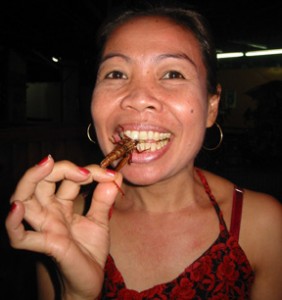
An Isaan lady gets up fron & personal with a cicada

Westerners visiting Thailand for the first time may quickly encounter a dramatic indicator that they’re no longer in the western world: the streetside bug cart. Loaded with trays filled with a number of delicious insect delights, these carts serve primarily Thai people who’ve emigrated to Bangkok from outlying provinces such as Isaan and the northern tribal areas, and who have made nutritious insects a part of their diet for generations.  

The good news, for those of you willing to try eating a bug or two, is that you’re already doing it!  It’s been estimated that, due to insects finding their way into processed food factories, the average westerner eats approximately a half pound of insects per year.  According to the allowable levels of insects parts in the processed foods regulated by the United States Food and Drug administration, tomato sauce can contain 30 fly eggs per 100 grams of weight, a can of mushrooms is allowed to contain 24 mites, and chocolate may have up to 60 insect fragments per 100 grams. 

The menu: what you’ll find on the bug cart 

Typically, all carts will offer some or all of the following foods. Also note that non-insect delicacies, such as baby frog, may be on the cart as well. Your order will be placed in a sandwich-sized plastic bag, dosed with a shake or two of pepper, and quick spray of soy sauce.  One shake of the bag, and it’s ready-to-eat. 

Ant mix:  ants mixed with vegetable and spices
Baby frog
Bamboo worm
Beetle (black)
Cicada
Cricket
Grasshopper
Mole Cricket
Scorpion (large, black)
Silkworm
Water Bug

 The business end

 Raising bugs can be good business for Thai farmers facing increasingly challenging environmental and financial concerns, namely the relative lack of irrigation water, and the significant costs associated with raising animals and crops, including fertilizers, pesticides, and feeds.  Bugs can be raised in close quarters, require no veterinary care, and have a high feed-to-meat ratio.

Exotic Fruits of Thailand: What’s this thing called, and how do I eat it?

Written By: herbrunbridge - Jun• 06•10

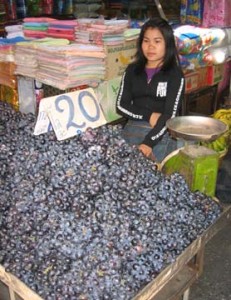
Bangkok fruit vendor

Westerners from even the more abundant agricultural nations will quickly become transfixed by the breadth of palate to be sampled in the fruits commonly found in Thailand.  Fruits here are categorized as either seasonal (e.g. durian, lychee, longan, mango, mangosteen) or year-round (banana, jackfruit, papaya, pineapple).  Here is your guide to the most common, encountered in virtually every Thai city and town. 

Custard-Apple (noi-naa), also known as “sugar apple”
Botanical name: Annona reticulata
Description: lumpy green skin
Taste:  sweet
How to peel and eat it:  pull the two halves apart with hands or knife, and eat fruit with a spoon
Available June through September 

Durian (thurian)
Botanical name: Bombaceae Durio zibethinus L./Murr
Description:  spiky and green, approximately the size of a human head
Taste:  sweet and custard-like
How to peel and eat it:  Peeling is best left to the experts.  It takes roughly ½ hour to open it and remove the sectional fruit.  Lots of stringy detritus, similar to what you’d find in a pumpkin.
Additional notes:  Called “the king of fruits,”  the durian carries a strong smell, and is indeed banned indoors at many Asian hotels and places of business.  The noted 19th century English traveler Sir Henry Yule referred to it as “the prince of fruits to those that like it, but the chief of abominations to all strangers and novices.”  Its flesh is considered to be an aphrodisiac.  There are many different varieties of durian, but experts consider Golden Pillow to be the most delicious (also, the most expensive).  Other common varieties include Frog, and Transvestite (two commingled, said to be exceptionally good).  Available May through August.

 Gaow-mankon
Description:  approximately six inches high, three inches across.  Shiny, rose-colored skin with yellow-green fleshy spines.  Fruit is white with black specs.
Taste:  Tangy, with hints of coconut
How to peel and eat it:  with knife, cut all the way through, in circular fashion, top-to-bottom, until you have two halves.  Cut again, so fruit is in quarters.  Peel skin off each quarter as you eat. 

Guava
Botanical name: Psidium guajava L.
Description:  Pear-shaped, 2 – 4 inches long.  The fruit is soft when ripe, and tangerine-orange in color
Taste: Tangy and fruity
How to peel and eat it:  Peel with a knife, cut into quarters.  You may also peel from the top, and take bites.  You will get juice on your hands, so eat in a place where you can wash up.
Available all year

Jackfruit (kanoon)
Botanical name: Artocarpus heterophylus Lamk.
Description: approximately the size of a human hand, grayish-green skin
Taste: sweet
How to peel and eat it:  peel with a knife, cut into sections
Available January-May

Lamut (sapodilla)
Botanical name: Manilkara zapota L.
Description: Round to egg-shape, two to four2 – 4 inches in diameter. The skin is brown, and fruit varies from yellow to brown.
Taste: Sweet, described as similar to brown sugar.
Available October through December. 

Longkong (la mai, or lang-sat)
Botanical name: Lansium domesticum Corr.
Description:  shiny, light tan-brown skin, approximately one inch in diameter.
Taste:  Tangy
How to peel and eat it:  Skin is very soft, peel it like an orange.  Inside fruit is white, in three sections.  Remove each section and chew-suck on it, being careful of the large seed in each section.
Available May-October 

Longon (dragon’s eye, lam yai)
Botanical name: Euphoria longana L.
Description:  Hard brown skin, approximately one inch in diameter.
Taste: Tangy, with the consistency of a cocktail onion
How to peel and eat it:  Peel hard skin as you would an orange.  Put white fruit in your mouth, and chew, being careful to avoid the one large seed inside.
Available May through August 

Lychee
Botanical name: Litchi chinensis Sonn.
Description: A leathery exterior, pinkish red in color, oval or nearly round, 1 to 1-1/2 inches in length.
Taste:  Sweet, juicy
How to peel and eat it:  Peel with fingers
Available April and May

Mango (ma-muang)
Botanical name: Mangifera indica L.
Description: slightly larger than a human hand, green skin, with orange fruit
Taste: sweet, tangy
How to peel and eat it:  quarter the skin with a knife, and peel.  The fruit is slightly stringy, and it’s a bit messy to eat, but well worth the effort.
Available March-June.

Mangosteen (mang-khut)
Botanical name: Garcinia mangostana L.
Description:  purple, 1-2 inches in diameter, with four bulbous green bulbs surrounding the stem.
Taste: Tangy
How to peel and eat it:  It may be split by pressing carefully against the middle of the fruit, rolling around its circumference.  Pull apart the two halves, and one half will contain the sectioned white fruit.  Put each section into your mouth and suck. Some sections will contain a large seed, which you will spit out.
Notes: mangosteens will easily stain everything, so wash your fingers before you touch your clothes.
Available April through September.

Orange (som)
Botanical name: Citrus sinensis Osb.
Description:  yellow-green, approximately the size of a tangerine
Taste:  sweet, tangerine-like
How to peel and eat it:  use fingers, eat in sections
Notes. Tangerines (som khiao wan) are also commonly found.
Available all year

Papaya (malakaw)
Botanical name: Carica papaya L
Description: Pear-shaped fruit, weighs roughly one pound, with yellow skin.  The fruit is orange or pinkish, depending on variety, with small black seeds clustered in the center.  Papaya is the main ingredient of som tam salad.
Taste: Sweet, juicy, slightly toward cantaloupe
Available all year

Rambutan (ngor)
Botanical name: Nephelium lappaceum L.
Description: When ripe, it is red, with soft spikes, approximately 1 to 1.5 inches in circumference..  Unripened fruit is yellow, and hard when you squeeze it. 
Taste: sweet
How to peel and eat it:  Cut with a knife along its circumference.  Pull the two halves apart, which will expose the egg-like shape of the fruit in one half.  Eat it right out of the half, and peel off the remaining skin as you eat.
Available May through September.

Men’s rooms TV ads: more noise pollution in Bangkok?

Written By: herbrunbridge - Jun• 06•10

Bangkok, already one of the world’s noisiest cities, might be in the process of getting louder. U.S.-educated entrepreneur Palin Lojanagosin intends to start putting ads in washrooms on television monitors.  These will not only be placed above sinks, but above the toilet stalls themselves.  All of us have come to grips with the notion that print advertising is pervasive, but many are questioning the sanity of blasting verbal information all over the place, from BTS stations, to cinemas, to the sidewalks themselves (witness the monstrous television on Ratchadamri outside of the Central World complex, which can be heard one block away, even with heavy traffic). 

Construction in Bangkok has sheathed the city in hard, reflective surfaces that radiate street noise, ditto for interior spaces, such as shopping complexes.  It’s become increasingly more difficult to engage in a mobile telephone conversation in shopping centers, as introducing ear-shattering live music has become commonplace.  Washrooms have always been something of a safe haven from ear pollution, and we’re concerned that silent television ads will not be the final stop.  In our opinion, adding boisterous sound to washroom TV ads cannot be far away, taking away yet another place where we thought we could get some peace and quiet.

Buying property: Own your own piece of Thailand? It can be done, but with caveats

Written By: herbrunbridge - Jun• 05•10

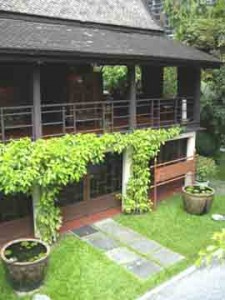
Suan Pakkad House is now a museum, but you can still find ways to get one of your own

(Note: Also read WoWasis post about construction scams in Thailand) Many Westerners who fall in love with Thailand have expressed a desire to own property there.  Although the process is probably more complicated than in your own country, it is doable, as thousands can attest.   Here are some of the basics, and remember to consult a lawyer when considering any property transaction in Thailand. 

What properties can a foreigner own? 

A farang may own the following types of properties:
1)  a condominium, in a complex where over 50% of the units are owned by Thais
2)  a house as a structure, having no interest on the land on which it sits
3)  one rai (or less) of land, provided at least 40 million baht is brought into the country, and permission is obtained from the Minister of the Interior. 

Acquiring a condominium 

In terms of a condominium purchase, price must be paid in full through payment to a Thai bank, in a process known as Tor Tor Sam.  For the payment, you need to open new account in a Thai bank and transfer the money in your own currency directly to that bank.  You will need to list the purpose of the transfer, e.g. “To purchase a condo in Bangkok.”

You will need to show the bank your passport, as well as a marriage certificate (if any).  The bank with then issue a Certificate of Transference, which will be part of the recording process at the Land Department. 

Mortgages are not available to individual foreigners, but are available to foreigners married to Thais. Mortgages are also available to Thai companies (see below) where the principal is under age 60.  Upon purchase, the owner will receive a certificate of ownership, detailing the percentage of rights over common areas.  It will also list the floor area of the condo in square meters, the percentage of common property acquired through ownership, which also represents the voter interest in the homeowners association.  

If your offer is accepted, a contract is drawn up, and you’ll be asked for a non-refundable “earnest money” down payment, typically 10% of the purchase price.  The contract will stipulate when the remainder must be paid, typically in 30-45 days. 

Before buying, be sure to determine the following: 

1)   Monthly maintenance costs. Get the amount in writing, on the contract, as well as  a line-item breakdown of how they’re disbursed.  It is unfortunately common that you’ll be charged for garbage disposal, street lighting, and pool use, even though it’s not stipulated in the contract.  Ask about everything.  How much have all maintenance costs risen in the past two years?

2)   Management company.  How many other condominium complexes do they own?  How long have they managed yours?  Arrange to visit one of their other managed properties, to see how the future of your building could play out.

3)   Is your project unfinished?  If so, there’s some degree of risk, as they could be over-mortgaged, or run out of funds to finish the job right.

4)   What percentage of units in a newer building have been sold?  If it’s only a few, they’ll all be paying more in monthly fees than if the complex is fully bought-out. 

Condominium prices in Bangkok

 As in other parts of the world, prices vary on location.  Along the desirable Sukhumvit central area, prices as of today are in the 45,000-80,000 baht-per-square meter range.  Recent construction (within the last 2-10 years) can be a good investment, due to better grade construction materials used in that era.  For better resale value, consider at least a 2 bedroom, 2 bath configuration. 

Monthly management fees typically run 30 baht per square meter.  If you’ll be renting out the property, figure on paying 7% of the monthly rental to your Thai rental management company. 

If you wish to buy property in your Thai wife’s name

 Your Thai wife may buy property in her name, but only if she guarantees that the money was hers originally, with no foreign claim on the money.  You (the farang husband) will be asked to provide a legal document stating that the money belonged to your wife prior to marriage. 

Some additional ways to own a house, with land 

1)   Form a Thai company, then buy the house and land. The Thai company must be primarily owned by Thai nationals, with the exact figure set by municipalities.  Figures between 51% and 61% are common.  For a limited company, shareholders must amount to at least seven individuals, and the director may be a foreigner.  In the event of the foreigner owning 39%, let’s say, the remaining six shares may be equally divided, meaning the foreign director is nominally in charge of deciding who lives in the house.

Caveat emptor: if the director is out of the country, the shareholders may hold a meeting, declare the director missing, then vote in a new (Thai) director, leaving the old director (you) out in the cold. There is a workaround, involving preferred and normal shares.  Getting the advice of a good attorney is recommended for this and all transactions involving ownership of property in Thailand.

2)   Have a Thai friend buy the house and land, then lease it to you (many foreigners do this based on a 30-year lease) 

Taxes 

There are two tax structures that you’ll need to be aware of, taxes due upon sale of property, and ongoing property taxes.   

Taxes due upon sale of property 

In Bangkok, three types of taxes are due upon sale of property, Witholding Tax, Transfer Fee, and BusinessFee/Stamp Fee Tax. 

1)   Withholding tax is is determined by a complex formula, but typically is between 1% and 1.5% of the sale price,  typically borne by the seller.

2)   The Transfer Fee is 2% of the appraised value, determined by the Lands Department, and is typically shared 50-50 by seller and buyer.

3)   If property is held fewer than five years,  a Business Tax of 3.3% is applied.  If over five years, a Stamp Fee tax of ½% of the selling price is paid, typically shared 50-50 by seller and buyer.

Ongoing property taxes

Two types exist in Thailand, Land Tax, and Structures Use Tax. 

1)      Land tax is levied on land ownership, and consists of a few baht per rai each year.  It is rarely collected, but may be eventually collected after multiple years. Anecdotal evidence suggests the amount to be negotiable.

2)      Structures Use Tax is applied to property being rented, at the annual rate of 12.5% of gross rentals.  This amount is often collected directly from the company you’ve hired to manage your property and collect your rent. 

Building your dream home

 If you’re determined to build rather than buy, and you’ve got the land, start with hiring an architect who understands both materials and the culture and needs of the workers who’ll be building it.  There are loads of good materials in Thailand, but even more shoddy ones (like our toilet seat, which cracked in half on the first “sitting”).  Always insist on top-ranked fixtures, and ask your architect how he’ll guarantee that best quality concrete will be used.  Work with the architect to select a builder who understands the concept of durability and quality, and that, as a farang, you’ll be checking the work constantly, and will insist on keeping to schedule

It is a wise precaution to hire a building engineer who will visit the site every week, and make inspections to ensure the work is up to snuff.  You absolutely must specify what you want the engineer to check, and how often he or she should do it.  If you need a weekly written report, with recommendations, put it in print.  Verbal contracts do not hold up in Thai courts! 

Insist that both the engineer and the architect be licensed, which gives you added protection, as if there is an issue, the licensing body may assist you before the matter ends up in court.  Finally, resist paying up-front fees, and adopt a “pay-as-you-go” formula, with both the builder and the engineer.  If you meet resistance, it could be wise to get your lawyer, who may be more persuasive, and savvy to local custom, involved. 

Choosing a lawyer

 T’would be folly to engage in a real estate transaction without the advice of a lawyer.  When choosing a lawyer, ask the following: 

1)   Ask if the lawyer has a conflict of interest, i.e, does he or she also represent the party from whom you are buying the property?

2)   Does he or she have a lawyer permit?  If this cannot be produced, call (02) 629-1430, x 100 or 107, and ask if the lawyer is registered.

3)   Be clear about describing the task you’d like the lawyer to do, then ask the amount of the fee for the service.  Typically, three different courts can be involved in property matters, and you should be charged for only one.

4)   Make a contract with your attorney, spelling out the service required, and fees.  Ask for a copy in your own language.  Any disputes with the lawyer will of course, be adjudicated based on the Thai-language original.

5)   If engaged in a dispute with the individual or company from which you’ve bought property, turn over all pertinent documents to your lawyer, and ask for a receipt.  This will allow your attorney to act on your behalf in timely fashion.

6)   Follow up on the case.  The squeaky wheel gets the grease.  Ensure that your lawyer is one his or her toes.

7)   Don’t miss your court date.  If you do, a default judgment could be entered against you.

Land measurements in Thailand

 Land is measured in talang wah, ngarn, and rai.
1 talang wah = 4 square meters
100 talang wah = 1 ngarn = 400 square meters
4 ngarn = 1 rai = 1600 square meters
2.529 rai = 1 acre 

Does all this seem a bit complex?  It needn’t be, if you adhere to the above advice, secure a good lawyer, and insist on quality above all.