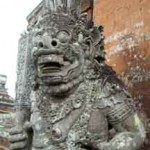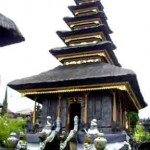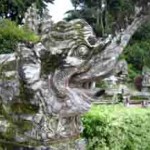
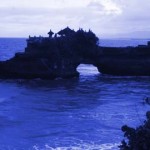
Located 25km southwest of Ubud, on the southern coast of Bali, Pura Tanah Lot is probably the most photographed temple in Bali. Although extensively renovated, it’s in a lovely spot, but best enjoyed in the early morning before the tour buses arrive. We especially enjoyed having a drink at the Sunset Terrace, located a few steps east of the temple, where we could take in the view in a relaxed setting. Pura Tanah Lot is located at GPS: S08°37.220’ E115°05.236’
Pura Taman Ayun temple in Bali, Indonesia
Located 10km southwest of Ubud, Pura Taman Ayun is a picturesque orange-walled temple surrounded by sculptures and a moat, a wonderful respite from the heat, and a refreshing walk through well-kept gardens. Although originally built in 1634, it was tastefully renovated in 1937. Located at GPS: S08°32.626’ E115°10.329’
Pura Besakih temple near Bangli, Bali, Indonesia
The 23 temples that make up Pura Besakih comprise Bali’s most important temple complex. The most important temple is Pura Penataran Agung, a six-level temple that is off limits to non-believers. All other temples are accessible. Beware of the touts that continually badger you, and enjoy your walk. You do not need them to guide you to anything. You should be able to take in the entire complex in two hours of fewer. Pura Besakih is located 18 km northeast of Bangli at GPS: S08°22.496’ E115°27.050’
Pura Kehen & Pura Dalem temples near Bangli, Bali, Indonesia
In and near the quiet city of Bangli in east Bali, you’ll find two wonderful temples, worth a visit.
Pura Kehen is considered to be one of the most the nicer temples in east Bali, and serves as the state temple. Located right in Bangli, it rises from a hill has a nicely carved entrance, and several interesting small temples inside, with stacked roofs similar to those at Pura Besakih, to the northeast. Located at GPS: S08°26.522’ E115°21.594’
Pura Dalem Penunggekan, which sits along a small but well-traveled road, is famous for its “panels of death,” featuring splendid carvings depicting what will happen in the afterlife to those transgressing in this one. The genital mutilation carvings are noteworthy, and of the “don’t try this at home” variety. Located 8 km south of Bangli at GPS: S08°27.934’ E115°21.246’
Steve Rosse’s short story of Phuket: Two for the Road
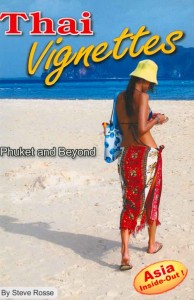
Here at WoWasis, we think Steve Rosse’s short story Two for the Road is one of the most poigant we’ve read on life in Thailand (see Steve’s bio at the bottom of this article. ) The story is reprinted from the book Thai Vignettes, published in book or ebook format from Bangkok Book House
Two For The Road
Eduardo went home from Phuket today in Royal Orchid Class. Ooy went home in a cheap brass urn.
Eduardo’s leg stuck out into the aisle in a hip-to-toe plaster cast which would annoy the flight attendants all the way from Bangkok to Rome. He also had a broken collarbone, a dislocated elbow and a hairline fracture in his left orbit, the ring of bone that contains the eyeball. He had two stainless steel pins in his femur which would set off airport metal detectors for the rest of his life. Ooy was eight ounces of ash and a few chips of bone.
Eduardo’s summer vacation cost him 75,000 baht for plane tickets and hotel accommodation. The vacation cost Eduardo’s father 50,000 baht for the lawyer, 50,000 baht for the police, 50,000 baht to repair the front end of the parked pick-up truck that Eduardo hit head-on at 60 kph, and 20,000 baht for Ooy’s funeral. He paid 50,000 baht to Ooy’s family, and 200,000 baht for the 450 cc motorcycle Eduardo had wrecked. Eduardo’s vacation had cost Ooy her life, and nobody concerned questioned that a two-year-old motorcycle should be worth four times as much as that life.
When Eduardo hit the parked truck, the motorcycle jammed its front wheel under the truck’s bumper, and pivoting on the hub of that wheel acted like a six-foot-long lever. Eduardo was thrown over the truck’s cab, smashing his leg on the windshield in passing, to land in the cargo bed. Because she was perched behind him, on the extreme outer end of the lever, Ooy was catapulted 50 feet before landing on her face in the middle of the road. She was probably dead by clinical standards the moment she hit the pavement, but at any rate she slid another ten feet before coming up hard against the curb, head first.
When the embassy notified Eduardo’s family of the accident, his brother Gino called a friend of a friend of a friend, who imports Italian wines into Bangkok. The friend-cubed flew to Phuket and handled all the arrangements, including the delivery of a few plates of spaghetti carbonara into the holding cell at Phuket’s provincial prison, where Eduardo was held for a day after his release from hospital.
Ooy’s mother, father, two brothers, one sister-in-law and four nieces came down from Korat on the bus, with the kids riding in the adults’ laps for the entire 27-hour journey to save the cost of four more tickets. They showed up on Wednesday morning at the go-go bar where Ooy had worked, and that was the first that the management or Ooy’s co-workers learned about the accident, which had occurred the previous Friday afternoon. Eduardo had never sent word. It was the police who wired Ooy’s family, taking the address from the ID card found in her purse.
Eduardo waited for his court appearance in a four-star hotel, holding a bag full of ice to his face and watching Star TV with one eye. Part of the time he spent thinking of a story to tell his fiancee about how he broke his leg. Ooy waited for her funeral in a locker at the local health department’s cold storage facility.
Ooy’s family spent two nights in Ooy’s room in the apartment which she had shared with three other girls. In the room, besides a bed and vanity table, were a new TV and VCR, a lot of stuffed animals, and a dozen photo albums. Nothing had been touched since Ooy had last been there, and under the mattress Ooy’s father found an envelope with almost 5,000 baht in it. There was also a camera in the room, and it held a partially exposed roll of film. Ooy’s elder brother took the camera to the funeral, used the rest of the exposures, then took out the roll and sold the camera to one of the girls.
The family left Phuket immediately after the ceremony, and when the brother had the roll of film developed in Korat he found that three of the earlier photos had been taken in the go-go bar. They showed his little sister up on the catwalk, dressed only in high-heels and panties, with a sash made of toilet paper strung over her shoulder bearing the words “MISS F**K FREE.” It was a game the girls played on slow nights.
In all of the photos Ooy was wearing a lot of gold jewelry. Nobody in her family found it unusual, or even unfair, that the police report didn’t mention any jewelry being recovered from the body.
Eduardo did not attend Ooy’s funeral, but he sent a note. It was read out loud at the cremation by Nancy, the farang manageress of the go-go bar. Ooy’s family could not understand a word of it, and Nancy’s Thai is about as good as you might expect from someone whose only experience of Thailand comes from working in a bar, but twenty of Ooy’s coworkers were there, and a few of them could translate the contents of the note into Esarn Thai.
Basically, he said that while he had only known Ooy for one night, he thought that she was a good girl, and a very pretty girl, and he was sorry that he had caused her death. After Nancy finished reading, Ooy’s mother took the note and put it in the flames. Nancy will wonder for the rest of her life if that was an effort to send the young man’s good wishes along with Ooy to her next life, or simply an act of disgust.
Steve Rosse, formerly of The Nation and the Phuket Gazette newspapers, is a short story writer who evidences considerable depth of understanding of the Thai-Expat dynamic. His stories are alternately sweet and sardonic, lush with irony and, to use that old Portuguese word that doesn’t have an equivalent in English, saudade. Thai Vignettes (2005, ISBN 974-93439-2-1) is a collection of fiction and non-fiction stories, with a host of memorable characters and stories, most of which are fewer than six pages in length. Eight stories we found particularly compelling, none more so than the beautifully written and tragic Two for the Road. Don’t miss Rosse’s Expat Days: Making a Life in Thailand (2006, ISBN 974-94775-3-7), a non-fiction book reviewed on our History and Culture pages.
WoWasis’ Philippines Bookshelf: Tribal books from the Luzon Cordillera
Two significant books regarding tribal groups in the northern Luzon Gran Cordillera area recently caught our eyes here at WoWasis. They’re both valuable for scholars as well as travelers, and are available at the bookstore in the Bontoc Museum, if you happen to be traveling in the area.
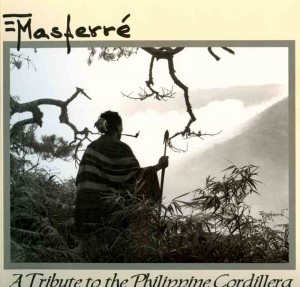
Masferre: a Tribute to the Philippine Cordillera (1999, ISBN 971-91712-0-0) is a wonderful revision of the out-of-print large format book that detailed the photographic world of Eduardo Masferré, who documented ethnic groups in the Cordillera, beginning in the mid-1930s. Masferré’s father was a Catalan immigrant, his mother Northern Kankana-ey. Securing a camera by mail order, Masferré, who was self-taught, produced important and artistically significant photographs all over the Cordillera until his death in 1995. This book contains dozens of photographs, a biography, and ethnographic information on the subject material.
Ethnography of the Major Ethnolinguistic Groups in the Cordillera (2003, ISBN 971-10-1109-3), written by the Cordillera Schools Group, Inc., is a magnificent work describing the history and culture of nine ethnic groups. These include the Bontoks, Ibaloys, Ikalahans, Ifugaos, Isnegs, Kalingas, Northern and Southern Kankana-eys, and Tingguians. In addition to information relating to everything from geographical setting to kinship and religious beliefs, each chapter includes a brief study guide, useful for a review of the more important elements of each group.
Exploring Thai culture at Bangkok’s Siam Society
Bangkok’s best venue for exploring Thai culture and tradition is at the venerated Siam Society, whose exciting complex is on Soi Asok (Sukhumvit Soi 21), just northwest of the (BTS Skytrain Asok, and MRT Subway Sukhumvit stations).
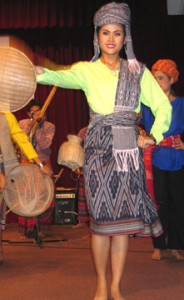
We attended an Isaan music and dance performance there for 200 baht, and were treated to fabulous Thai munchies and an astounding, powerful fruity punch during intermission.
The Siam Society was founded in 1904 during the late period of King Chulalongkorn’s reign, under the Royal Patronage of the future King Rama VI. The Society was founded with the objective of researching and gathering information on the arts and sciences of Thailand and neighboring countries.
Today, The Siam Society continues to operate as a non-profit organization dedicated to its founding cause, through lectures, cultural and artistic performances, library and bookstore, and exhibition space.
On the grounds, you’ll also find the beautiful Kamthieng House, an ethnological museum. One of the best surviving examples of Northern Thai architecture, this 160-year old traditional teakwood house provides a superb example of a traditional Lanna Northern Thai house built on wooden stilts. The house has been stocked with artifacts associated with the rural way of life in traditional agricultural communities. This includes a fascinating collection of beautifully hand-woven materials, ornate wood carvings, traditional musical instruments and sacred items. Under the house at ground level, a rich assortment of fish traps, irrigation devices, ploughs and rice-harvesting equipment made of wood, reeds and bamboo are displayed.
Prior to your visit, we’d suggest visiting their website, for a great calendar of events, at www.siam-society.org
The Siam Society
131 Sukhumvit Soi 21 (Asok), Bangkok (BTS Skytrain Asok, and MRT Subway Sukhumvit stations)
Tel: (02) 661-6470
Open Tuesday through Saturday, 9 am to 5 pm (also open on evenings for performances)
Thailand’s Hill Tribes
Approximately 500,000 semi-nomadic tribespeople live in Thailand, comprising some 15-20 tribes. Each has its own culture, dress, language, customs, and belief system. Tribal culture crosses geo-political boundaries, and therefore each group will be known by several names, depending on the modern country in which they’re found, whether it be Thailand, Burma, China, Laos, or Vietnam.
In Thailand, hill tribes occupy the north and northwestern areas of the country, heavily populating the area known as the Golden Triangle. Different tribal groups are well interspersed and quite used to living in close proximity with villages of other tribes. Most hill groups practice some degree of animism, combined with shamanism and ancestor worship. Four of these groups (Lahu, Lisu, Hmong, Mien) commonly cultivate opium, although programs sponsored by the Thai government increasingly attempt to sway their economies away from that crop.
Among the most visible of Thailand’s tribal groups are:
Akha (aka Kaw): Known for their distinctive silver-coined headdresses, Akha typically are found on mountain ridges and valleys. The Akha are among the most visible of tribal groups, commonly seen selling elements of tribal clothing on the streets of Bangkok, far from their traditional villages in the north.
Collector interest:
- belts, made from silver, shells, coins, and seeds
- bracelets for men, hollow, with engraved designs (dragon designs are particularly desirable)
- bracelets for women, flat and silver, with engraved designs, or solid silver, copper, or brass, with engraved designs
- buckles of beaten silver for fastening tunics
- earrings
- neck rings, flat and silver, hollow, or solid
- necklaces of colorful beaded glass
- pendants, chained and silver
- rings
- textiles, including ornate women’s outfits, appliquéd, silvered, and beaded
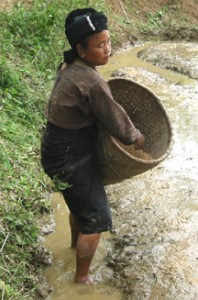
Hmong (aka Meo): Hmong women are famous for their black jackets and trousers with colorful, striped borders. Their talent at embroidering is legendary, and colorful Hmong bedspreads and throws, with elaborately stitched village scenes, are increasingly common.
Collector interest:
- bedspreads and pillowcases, with embroidered village scenes
- belts, made from silver
- bracelets , open, made from solid silver, copper, or brass, with engraved designs
- clothing, embroidered
- earrings
- neck rings, hollow, solid, or twisted
- pendants, lock-shaped
- rings
- textiles, made with batiking
Karen (aka Kariang, Yang): Karen are the heaviest-populate tribal group, numbering approximately 250,000. They are divided into four main groups, the White Karen, Pwo-Karen, Red (Kayah) Karen, and Pa-O (Black) Karen. Karen are increasingly influenced by Christianity. The Pwo-Karen are becoming increasingly well-known for their intricate basketry and superior weaving skills.
Collector interest:
- basketry
- belts, made from silver
- ear ornaments, cylindrical-shaped
- neck rings, flat and silver
- necklaces of colorful beaded glass, or silver or bronze, made from coins, bells, or beads
- smoking pipes, made from silver and wood
- textiles, embroidered with seeds
Lahu (aka Mussur): Lahu women are known for their distinctive red and black jackets, and their finely woven shoulder bags are popular items for collectors. Lahu are subdivided into five different groups (yellow, white, blue, red, sheleh), primarily indicated by the predominant color of clothing.
Collector interest:
- belts, made from silver
- bracelets, open, made of solid silver, copper, or brass, with engraved designs
- bracelets for men, hollow, with engraved designs
- bracelets for women, flat and silver, with engraved designs
- buckles of beaten silver, for fastening tunics
- ear ornaments, cylindrical-shaped
- musical gourded reed-pipe
- neck rings, flat and silver, or hollow, solid, or twisted
- pendants, chained and silver
- rings
- shoulder bags, finely woven
- textiles, including ornate women’s beaded and appliquéd tops and tunics
Lisu (aka Lisaw): Lisu women are known for their multi-colored outerwear, worn over black trousers, often topped by black turbans. Lisu wealth is traditionally based on raising livestock and opium cultivation. Sexual and marital partners tend to be chosen individually.
Collector interest:
- belts, made from silver
- bracelets for women, flat and silver, with engraved designs
- bracelets, open, made of solid silver, copper, or brass, with engraved designs
- collars for women, made from colorful cloth and silver dangles
- earrings
- neck rings flat and silver
- pendants, chained and silver
- rings
Mien (aka Yao): Originating in China, the Mien write with Chinese characters, and observe many traditional Chinese customs. Women wear black turbans, and often wear coats with thick fur-like collars.
Collector interest:
- belts, made from silver
- bracelets, open, made from solid silver, copper, or brass, with engraved designs
- hollow or solid neck rings
- paintings, traditional, preponderance of red and black colors
- pendants, chained and silver
- rings
- textiles, embroidered, including women’s trousers and money bags
Chiang Mai area: Golden Triangle and Points North
Aside from trekking opportunities, many visitors make the northern run to Chiang Rai and the Golden Triangle, to visit the Mekong area and Burma. There is very little to see in the ancient capital of Chiang Rai, as ancient buildings have been plowed-under. A few minutes north, in the Golden Triangle area, where Thailand, Laos, and Burma converge, you can take a boat for 300 baht which will take you on a one-hour tour down the river, allowing you to step inside Laos for twenty minutes. This has value if you’re up here anyway, but in our opinion, is not worth the time and effort unless you want to tell your friends you’ve stepped into Laos and Burma.
Overview
The area between Chiang Mai and the northern border is fine for trekking and village visits, but the towns themselves have little to warrant a stop. In a nutshell:
Chiang Rai: Not worth a stop for itself, as much of the old capital buildings have disappeared or been torn down. If you’re here, the Hilltribe Museum and Education Centre is worth a visit, with clothing, implements, and accessories from six tribes on display. Downstairs, tribal crafts are for sale. Located at 620/1 Thanon Thanalai, in the eastern part of the city (053) 719-167. Open from 9 am – 8 pm.
Chiang Saen: This is a small town a few kilometers distant from Chiang Rai with a few historical temples, but not as impressive as those you’d find in other parts of Thailand.
Mae Sai: This town hosts the border crossing into Burma. Tachileik, on the Burmese side, features little above shops selling the same goods you’d find anywhere in northern Thailand. Most are overtly commercial. You are allowed to travel north into Burma from here, as far north as Kyiangtong (Cheng Tung), which is a city that offers very interesting treks into hillside villages. Occasionally, the Tachileik-Kyaingtong road is closed due to military activity.
If you cannot travel into deep Burma, our advice is to avoid the Mae Sai/Tachileik border town, and instead concentrate of seeing Myawadi, the Burmese town adjacent to Mae Sot, south of Chiang Mai, roughly due west of Phitsanoluk. Myawadi has its own fascinating elements and, in our opinion, is more reflective of Burmese life.
Sop Ruak: This is the “center” of the Golden Triangle. From here, you can hire a fast longtail boat, or 300 baht ferry to visit a small Lao outpost at Don Sao island, pay 20 baht to Lao authorities, and by Lao crafts, and sample Lao drinks. We were fascinated by jars of Lao whiskey, containing (alternately) scorpions, cobras, and tiger penises. One shop allows you a free taste before you buy, and surprisingly, the tiger variety has the smoky flavor one would normally associate with Scot malt whisky from the island of Isla. If you are tempted to by a jar, consult your own country’s customs policies, as the jars contain parts of animals that might be on the endangered species lists.
We found the House of Opium museum in Sop Ruak to be worth a visit, although most of the signs are in Thai. You can buy antique opium pipes there, and see exhibits related to the cultivation of opium.
Malaysia Oasis Top Ten Sites in Malaysia
Peninsular Malaysia
1. Melaka, a charming riverside town, boasts Dutch colonial architecture, great museums, and some of the best antiquities shopping in Malaysia. Tour Melaka (Malacca) now!
2. Breathtaking islands, such as Tioman, with its jungle and scuba adventures, or Langkawi, home of magnificent white sand beaches, draw thousands of return visitors every year. Tour Lankawi now!
3. The old seaside city of George Town, Penang is full of charming old shops and wonderful colonial architecture. Walking tour maps are available at just about every hotel. Tour Penang’s hills and temples, or Tour Georgetown now!
4. The jungle-clad Cameron Highlands have drawn trekking visitors for decades, to explore, relax, appreciate the beauty of the tea plantations, and enjoy some of the spiciest food in Malaysia.
5. The capital of Kuala Lumpur has several good museums, world-class shopping, one of the best transportation systems in Asia, the notable Petronas Towers, and a vibe all its own. Tour Kuala Lumpur now!
Malaysian Borneo
6. Kuching, capital of the state of Sarawak, is considered by many to be one of Southeast Asia’s best-kept secrets, with exceptional museums, great food, and the best tribal and craft shopping in Malaysia.
7. Kinabalu National Park is home to Mt. Kinabalu, with some of the best sunrise views in Asia.
8. Mulu National Park, with its caverns, headhunters’ trail, and trekking options, is one of the most outstanding experiences in Malaysia.
9. Bako National Park is home to Proboscis monkey, the Rafflesia, the world’s largest flower, and carnivorous pitcher plants.
10. If rainforest ecosystems and longhouse tours are an interest of yours, you couldn’t do better than the rugged, but accessible Kelabit Highlands.


![bidayuhladies_132x188[1]](http://www.wowasis.com/travelblog/wp-content/uploads/2010/06/bidayuhladies_132x1881.jpg)